Get in touch with Zhenling Company

PTFE (TEFLON) CNC MACHINING
Drawing-led custom machining
PTFE (Teflon) CNC Machining Services
PTFE CNC machining begins with defining the grade, geometry, measurement state and document scope before production. Zhenling examines drawings for chemical-resistant seals, bushings, valve components and other custom parts, then confirms the manufacturing scope in a written quotation. PTFE Teflon CNC Machining enquiries should include PTFE grade, part function, creep-sensitive dimensions, finish, inspection and any POM comparison requirement. Rely only on the scope that the written quotation confirms for the part, including route, open limits, records, price basis, timing, inspection responsibility and any stated order exclusion.
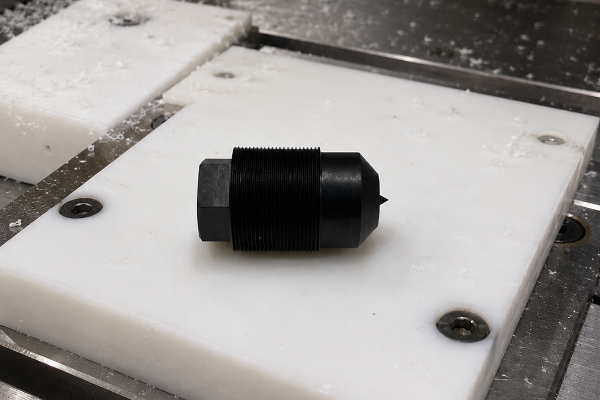
-
SPEC-01
Material specification
Provide the PTFE compound, filler type and percentage, supplier rule, traceability requirement and intended-use restrictions.
-
SPEC-02
Drawing and revision
Identify critical features, datums, free-state or restrained measurements, edge conditions and the controlling revision.
-
SPEC-03
Quantity and schedule window
State prototype and production quantities plus the required delivery window so the quotation can define a realistic plan.
-
SPEC-04
Inspection and records
List the dimensions, material evidence, inspection outputs and release records your quality system requires.
Related Drawing-Led CNC Resources for PTFE Parts
Zhenling was established in 2006 and manufactures non-standard components from customer drawings or samples. The resources below describe the general Jiashan factory platform; the quotation determines which route is suitable for a specific PTFE part.
PTFE supplier fit must be reviewed against the released drawing, grade, geometry, stability risks, inspection plan and written quotation.
PTFE ORDER-REVIEW NOTETurning resources
- Turning equipment category and availability confirmed per order.
- Boring equipment category and availability confirmed per order.
- Drilling equipment category and availability confirmed per order.
Milling resources
- Milling equipment category and availability confirmed per order.
- Proposed 3-axis route confirmed per order.
- Proposed 4-axis route confirmed per order.
Complex-feature resources
- Proposed 5-axis route and equipment confirmed per order.
- Wire-EDM route and equipment availability confirmed per order.
- Grinding route and equipment availability confirmed per order.
Features to identify before machining
Seal faces, grooves and seating radii
Internal or external threads and their start/exit condition
Thin walls, unsupported spans and interrupted features
Press or slip fits, mating material and assembly state
Concentricity, runout, profile and datum relationships
Part families to define by function
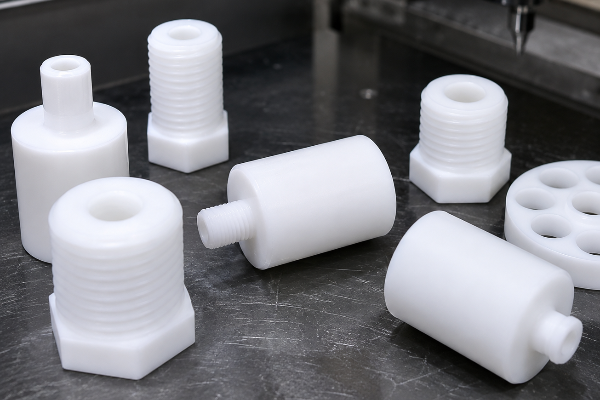
Seals and seats
Define the contact face, pressure direction, media, temperature and mating surface. Keep the functional edge separate from a generic deburring note.
Bushings and bearing pads
State load, motion, lubrication, the mating shaft and housing materials, and the assembled clearance. A low coefficient of friction alone does not define the correct grade.
Rings and spacers
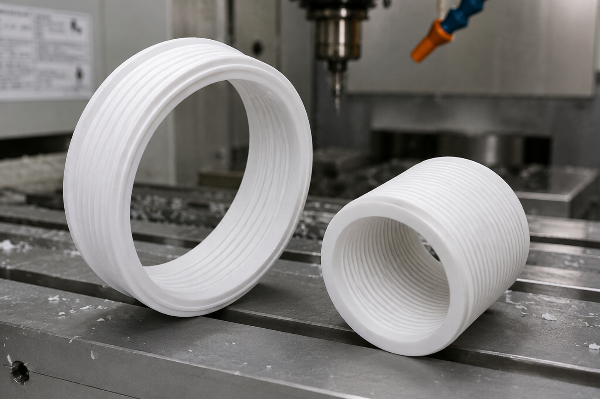
Identify flatness, parallelism, free-state measurement and any compression during assembly. PTFE softness makes a clear handling and packing condition important for thin sections.
Valve and pump features
Mark sealing radii, flow-facing surfaces, threads, grooves and pressure direction. Provide the medium and cleaning requirement with the drawing.
Electrical insulators
State dielectric or conductivity requirements before considering a filled grade. Carbon- or bronze-containing options can conflict with the electrical objective.
Custom profiles
Use the 3D model to communicate shape and the drawing to control precision dimensions, material, datums and acceptance. Name the revision that governs the quotation.
Unfilled and Filled PTFE Grade Selection
PTFE is a fluoropolymer built around carbon and fluorine, but a family name is not a purchasable compound. Consider unfilled, glass-filled, carbon- or graphite-filled, and bronze-filled PTFE as screening directions until the exact material specification is set. Compare machining with injection molding only after volume, tooling, geometry and revision risk are defined.
PTFE Grade and Drawing Review Matrix
| Operating priority | Candidate family | Trade-off to review | RFQ input required |
|---|---|---|---|
| Chemical isolation, a low friction coefficient or electrical insulation | Unfilled PTFE | Load, creep, thermal movement and feature stability still control the design. | Media, temperature, load, mating surface, stock form and intended use |
| Wear resistance or dimensional-property improvement | Glass-filled PTFE | Filler percentage and the counterface can change the fit decision. | Glass %, counterface, wear mode, supplier data sheet and traceability |
| Wear, load or dry-running priorities | Carbon or graphite-filled PTFE | Carbon, graphite and carbon fiber are not interchangeable labels; validate durability against the actual duty. | Filler identity, pressure, speed, lubrication, conductivity and restrictions |
| Compression or creep-control priority | Bronze-filled PTFE | Media compatibility, density and electrical-isolation needs must be checked. | Bronze %, media, counterface, electrical requirement and regulatory limits |
Representative supplier data for specification review
The figures below are examples from named suppliers’ molding-material data. Use them to standardize data-sheet questions; the selected compound’s specification controls the order.
| Named material | Property | Published value | Published method or source |
|---|---|---|---|
| Daikin 15GL | Specific gravity | 2.22 | ASTM D4894 table heading |
| Daikin 15GL | Tensile / elongation | 23 MPa / 300% | Daikin grade list |
| Daikin 25GL | Specific gravity | 2.25 | ASTM D4894 table heading |
| Daikin 25GL | Tensile / elongation | 18 MPa / 270% | Daikin grade list |
| Daikin 25CAR | Specific gravity | 2.10 | ASTM D4894 table heading |
| Daikin 25CAR | Minimum tensile / elongation | 15 MPa / 90% | Daikin grade list |
| Fluorotec 40% bronze-filled PTFE | Specific gravity | 3.0–3.12 g/cm³ | BS EN ISO 13000-2 table |
| Fluorotec 40% bronze-filled PTFE | Tensile / elongation | 22–27 MPa / 230–270% | BS EN ISO 13000-2 table |
| Fluorotec 60% bronze-filled PTFE | Specific gravity | 3.8–3.95 g/cm³ | BS EN ISO 13000-2 table |
| Fluorotec 60% bronze-filled PTFE | Tensile / elongation | 10–18 MPa / 100–200% | BS EN ISO 13000-2 table |
01
Specify the compound, not only the color.
Put the base resin, filler identity and percentage, approved supplier or substitution rule, lot traceability and intended-use restrictions on the drawing or purchase specification. For a Zhenling RFQ, use this matrix because a filler trade-off can make the wrong grade look acceptable until the operating inputs are named.
02
Temperature needs an operating envelope.
For high temperatures, do not use melting point alone as a service limit; define load, exposure time, media, geometry and the selected supplier grade.
03
Regulated-use check
For food-contact or another regulated use, verify every constituent, the actual manufacturer, the authorization path and the specified conditions of use.
04
Substitution check
Do not approve an alternate by filler family alone. Compare the supplier data sheet, property requirements, traceability and intended-use limits.
Machining and Part-Finishing Scope
For a soft thermoplastic, the finish specification belongs on the drawing rather than in an unclear “as machined” note. State the required surface finishes, edge, cleanliness, marking and packing condition that the assembled part needs.
-
Machined surfaces
Call out the functional face, datum and surface-finish requirement only where it affects sealing, sliding or assembly.
-
Deburring and edge breaks
Identify thread starts, cross-holes, grooves and seal edges that require a controlled burr or edge condition.
-
Cleaning scope
State acceptable residue, particle and handling limits instead of relying on an undefined “clean” requirement.
-
Marking limits
Show the permitted marking zone and method when part identification must not touch a seal or bearing surface.
-
Packing condition
Define separation, bagging or protection needs for soft faces, threads and thin sections.
-
Process environment
Flag cleanliness or exposure-control requirements that must be reviewed before the manufacturing route is quoted.
State whether the drawing calls for a solid PTFE part or a PTFE coating on another substrate.
PROCESSDrawing, Tolerance and Inspection Requirements
PTFE dimensions cannot be considered apart from material state and measurement conditions. NIST reported that residual stress can greatly affect PTFE dimensions and thermal expansion, so a feature-level acceptance plan is more useful than a borrowed universal tolerance.
“Residual stresses greatly affected the thermal expansivity and the dimensions of specimens.”NIST, Thermal Expansion of Polytetrafluoroethylene
PTFE Drawing Risk Review
- Mark thin walls and unsupported spans.
- Identify seal faces, flatness datums and protected edges.
- Define thread form, start, exit and allowable burr condition.
- State the press or slip fit, mating material and assembly condition.
View Remaining 6 Specifications
- Define concentricity, runout and profile around a clear datum scheme.
- Define free-state versus restrained measurement.
- State inspection temperature, conditioning time and measurement state.
- Provide the stock-form supplier, lot and molding or sintering history when relevant.
- Define edge break, deburring and cleaning boundaries.
- Identify the exact grade, filler percentage, intended-use limits and traceability needs.

What the drawing controls
- Nominal dimensions and geometric controls
- Critical-to-function features
- Measurement state and datums
- Surface, edge and cleanliness requirements
What the quotation must confirm
- Material and accepted substitution rule
- Features included in the inspection scope
- Required records and release criteria
- Any open manufacturability questions
Close common acceptance gaps before release
| Ambiguous note | Replace it with | Decision protected |
|---|---|---|
| “Tight tolerance” | A value tied to a named feature, datum and measurement state | Machining and inspection use the same target. |
| “Deburr all edges” | Protected seal edges, permitted edge breaks and thread-exit limits | Functional edges are not altered by a blanket instruction. |
| “PTFE” | Exact compound, filler identity and percentage, supplier rule and traceability | Material substitution remains controlled. |
| “Inspection report” | Named dimensions, sample level, units, state and record format | The quoted report matches the quality need. |
PTFE Machining Pricing and Schedule Inputs
Custom PTFE pricing depends on the exact compound, stock form, geometry, quantity, tolerance, inspection and finishing scope. Scheduling also depends on material availability, review closure and the agreed release evidence, so the written quotation remains the controlling commercial record.
Compare written terms, not assumptions. Minimum quantity, quote timing, lead time, payment, delivery basis and included records should be confirmed in the quotation for the exact drawing scope.
Normalize price and schedule before comparing quotes
-
01Input
Exact compound and stock form
Why it changes quoteFiller, supplier, shape and traceability change sourcing and machining assumptions.
Buyer ActionAttach the material specification or approved-equivalent rule.
-
02Input
Critical geometry
Why it changes quoteThin walls, deep features, seal faces and threads change holding and inspection effort.
Buyer ActionFlag critical-to-function features on the drawing.
-
03Input
Quantity and release pattern
Why it changes quotePrototype, repeat batch and scheduled releases use different planning assumptions.
Buyer ActionSeparate sample quantity from production demand.
-
04Input
Inspection scope
Why it changes quoteFeature count, measurement state and report format affect review time.
Buyer ActionList required dimensions and records before quotation.
-
05Input
Finishing and packing
Why it changes quoteEdge, cleaning, marking and protection requirements change the route.
Buyer ActionDefine the delivered condition and protected surfaces.
Buyer-Defined Inspection and Order Documentation
Agree on the acceptance evidence before production begins. The scope may cover only critical dimensions or expand by contract, but the drawing and quotation should specify what is checked, under which conditions and which record is required.
Inspection-scope fields
- Drawing revision and applicable standard
- Critical dimensions and geometric controls
- Free or restrained measurement state
- Inspection temperature or conditioning requirement
- Sampling or full-inspection requirement
Document-scope fields
- Material identity and supplier evidence
- Lot traceability requirement
- Dimensional record format
- First-piece or release approval point
- Nonconformance communication route
HOW WE WORK: FROM DRAWING REVIEW TO SHIPMENT
The RFQ-to-release path separates information supplied by the customer from the points both parties confirm in writing. It does not establish a fixed quotation or shipment date.
Attach the drawing, material specification, quantity, operating medium, temperature, load and intended use.
Review filler identity, stock form, thin walls, seal faces, threads, datums and measurement state.
Confirm the material, revision, quantity, schedule basis, inspection fields, documents and delivered condition.
Use the accepted drawing and quotation as the manufacturing and commercial baseline.
Compare the required features and records with the written release criteria.
Release the order only after open deviations and required documentation are resolved.
-
Engineering handoff
Leaves the supplier with a complete material and feature definition.
-
Procurement handoff
Makes quotations comparable on quantity, schedule basis and delivered scope.
-
Quality handoff
Connects measurement state, critical features and release records.
Parts We Review: Machined Part Feature Requirements
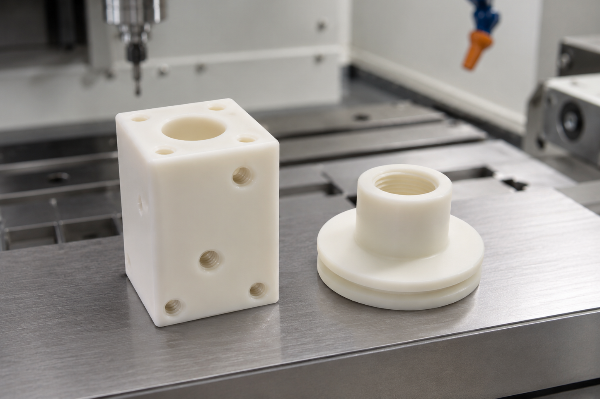
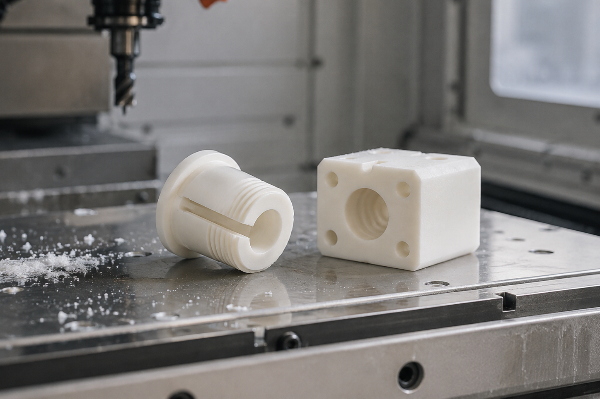
Use a part image to begin a geometry discussion, then let the drawing supply the material and acceptance facts. Color alone cannot distinguish unfilled PTFE, carbon-filled PTFE or another material.
-
01 Thread definition
Specify form, class, engagement, start, exit and burr limits.
-
02 Datum strategy
Relate the hex, thread and tapered feature to functional datums.
-
03 Measurement state
State whether the part is checked free, restrained or assembled.
PTFE Trade-Offs and Alternative Materials
PTFE offers chemical resistance, low friction, insulation and non-stick behavior, but those benefits do not make it the default for every load case or geometry. Examine the likely failure mode before selecting a compound or an alternative thermoplastic.
Design signals that require a second look
Situation
Why the first choice may fail
Next decision
High sustained load or tight dimensional retention
Unfilled PTFE can move under load and with temperature or residual stress.
Review filled PTFE or another engineering plastic against the full load case.
Soft counterface with abrasive filler
A filler that benefits the PTFE part may increase counterface wear.
Evaluate both sides of the tribological pair.
Electrical isolation requirement
Conductive fillers can conflict with the insulation objective.
State the electrical requirement before selecting carbon or bronze content.
Food-contact or regulated application
The polymer family does not establish formulation- and use-specific authorization.
Verify every constituent, actual supplier and condition of use.
Extremely tight feature claim without measurement state
The inspection result can be ambiguous when temperature, conditioning and restraint are undefined.
Resolve the drawing-risk checklist before quoting.
PTFE CNC Machining Engineering Tools
-
PTFE Grade Family Screen
Filter and identify the optimal PTFE grade for your specific application. Assess variations in mechanical, thermal, and chemical properties.
Launch Tool -
Published PTFE Compound Data Comparator
Side-by-side technical comparison of different PTFE compounds. Make data-driven material selections for precision-machined components.
Launch Tool -
PTFE Drawing RFQ Readiness Builder
Evaluate engineering drawings for manufacturability before quoting. Ensure all critical tolerances and specifications are properly defined.
Launch Tool
Request a PTFE Drawing Review
Use the matrix and checklist above, then submit the information that controls material fit, manufacturability and acceptance. Define the listed fields before comparing a quotation or releasing it for review.
Upload Your PTFE Drawing-
[REQ-01]
Part
Drawing, revision and 3D model
-
[REQ-02]
Material
Compound, filler, supplier rule and traceability
-
[REQ-03]
Demand
Prototype, batch and forecast quantity
-
[REQ-04]
Service
Medium, temperature, load and counterface
-
[REQ-05]
Acceptance
Critical features and measurement state
-
[REQ-06]
Records
Material, dimensional and release requirements
FAQs: PTFE CNC Machining
INQUIRYSend the drawing, exact material specification, quantity and application conditions for review. Zhenling will confirm the quoted machining, inspection and delivery scope in writing.
PTFE is the polymer name, while Teflon is a brand name used for fluoropolymer products. A purchase specification should name the exact resin or compound rather than rely on the brand term alone.
Start with the medium, temperature, pressure, movement, counterface and intended-use restrictions. Unfilled PTFE may be a candidate for chemical isolation, but the final compound must be checked against the actual duty and supplier data sheet.
They can shift mechanical, wear, compression, electrical and counterface behavior in different directions. Use the filler family as a screen, then specify the filler identity, percentage, supplier data and application limits.
Tolerance is reviewed by feature, geometry, material state, datum scheme, conditioning and inspection condition. Submit those inputs so the written quotation can identify the accepted scope.
Mark edge conditions, thread exits, thin walls and whether dimensions are checked free or restrained. Those requirements become part of the drawing review and quoted inspection scope.
Yes, include the thread standard, class, engagement length, start and exit condition, mating part and acceptance method. The drawing review determines whether the material and geometry can be quoted together.
Send the controlling drawing and, when available, the 3D model plus material specification and purchase requirements. Confirm accepted file types through the inquiry channel before transmitting sensitive data.
Use the lead time confirmed in the written quotation after material, quantity, geometry, inspection and finishing scope are reviewed. State the required delivery window in the RFQ so timing is evaluated with the full scope.
Quantity acceptance is confirmed with the drawing-based quotation. State prototype, batch and forecast quantities so the commercial scope matches your sourcing plan.
List the exact material, traceability, dimensional and release records you require. The accepted quotation should identify which documents are included and the applicable acceptance criteria.
![Shop-Floor Carbon Steel CNC Machining Guide [2026]](https://zhenlingmetal.com/wp-content/uploads/2026/08/carbon-steel-cnc-machining-handbook-r2-featured-150x150.png)