Get in touch with Zhenling Company

Titanium CNC Machining that starts with the drawing, not an unverified grade list
Zhenling accepts titanium CNC machining inquiries for custom industrial parts. Grade, material condition, geometry, tolerance, inspection, post-processing, quantity, and schedule are reviewed together before a manufacturing route or quotation is confirmed. Titanium CNC Machining enquiries should include alloy, size, geometry, tolerance datum, measurement method, finish and delivery requirement. Resolve material, geometry and measurement risks first. Price and timing should follow the documented route, not an equipment category.
A complete RFQ is the honest starting point. We don’t claim a titanium grade, project history, tolerance, dust-control process, or regulated qualification unless it’s documented for the order.
TOL: PER DRAWING
5-AXIS: AS REVIEWED
Founded in 2006
Company-provided operating history
8,000 m²
Company-provided Jiashan site; 6,000 m² workshop
3-, 4- and 5-axis
Machining-center categories stated by Zhenling
ORDER-SPECIFIC
Destination, export documents and delivery scope confirmed per order
Start with a Titanium Project-Fit Review
“Can you machine titanium?” is only the first question. Commercial risk appears when buyer and supplier assume different material conditions, drawing revisions, critical features, inspection evidence, or secondary-operation responsibilities.
A one-off outsourcing request is difficult to compare when drawing, quantity, material, and inspection expectations are incomplete. Unlike an instant-quote promise, Zhenling’s response begins by identifying what is confirmed, what remains open, and what could change the review route.
Confirmed at inquiry
Zhenling accepts titanium CNC service RFQs and reviews custom-part geometry and constraints. Its Jiashan factory and general CNC equipment categories are company-provided facts.
Confirmed after review
Material acceptance, machining route, inspection plan, outside processing, packaging, price, and delivery are confirmed only after the controlled drawing package and commercial scope have been reviewed.
Not claimed without evidence
No named titanium grade, past titanium case, fixed tolerance, titanium-dedicated capacity, or titanium chip and dust-control system is presented as established capability.
Search vocabulary is not capability evidence
Buyers often search for a titanium part, machined titanium, CNC milling, corrosion resistance, strength-to-weight ratio, tensile strength, surface finish, high temperatures, or whether titanium can harden during cutting. Those terms help frame questions; they don’t prove that a design, alloy, or acceptance plan is approved. Grade 5, excellent corrosion resistance, and biocompatibility also appear on competitor pages, but Zhenling makes no Grade 5 or biocompatibility claim here.
A titanium machine shop should make unresolved assumptions visible before price and delivery become commitments. A useful question is not “Can titanium be cut?” but “Can this material condition, geometry, evidence plan, and supply scope be controlled together?”
Titanium buyer-review note.
Test project fit with the actual files
Send the current two-dimensional drawing, three-dimensional model when available, material requirement, quantity, and critical acceptance points. Zhenling can then respond to the actual part instead of a broad material label.
Request a DFM & Machinability ReviewTitanium RFQ Risk Matrix
Select a factor on the left to visualize part-specific risks over the geometry.
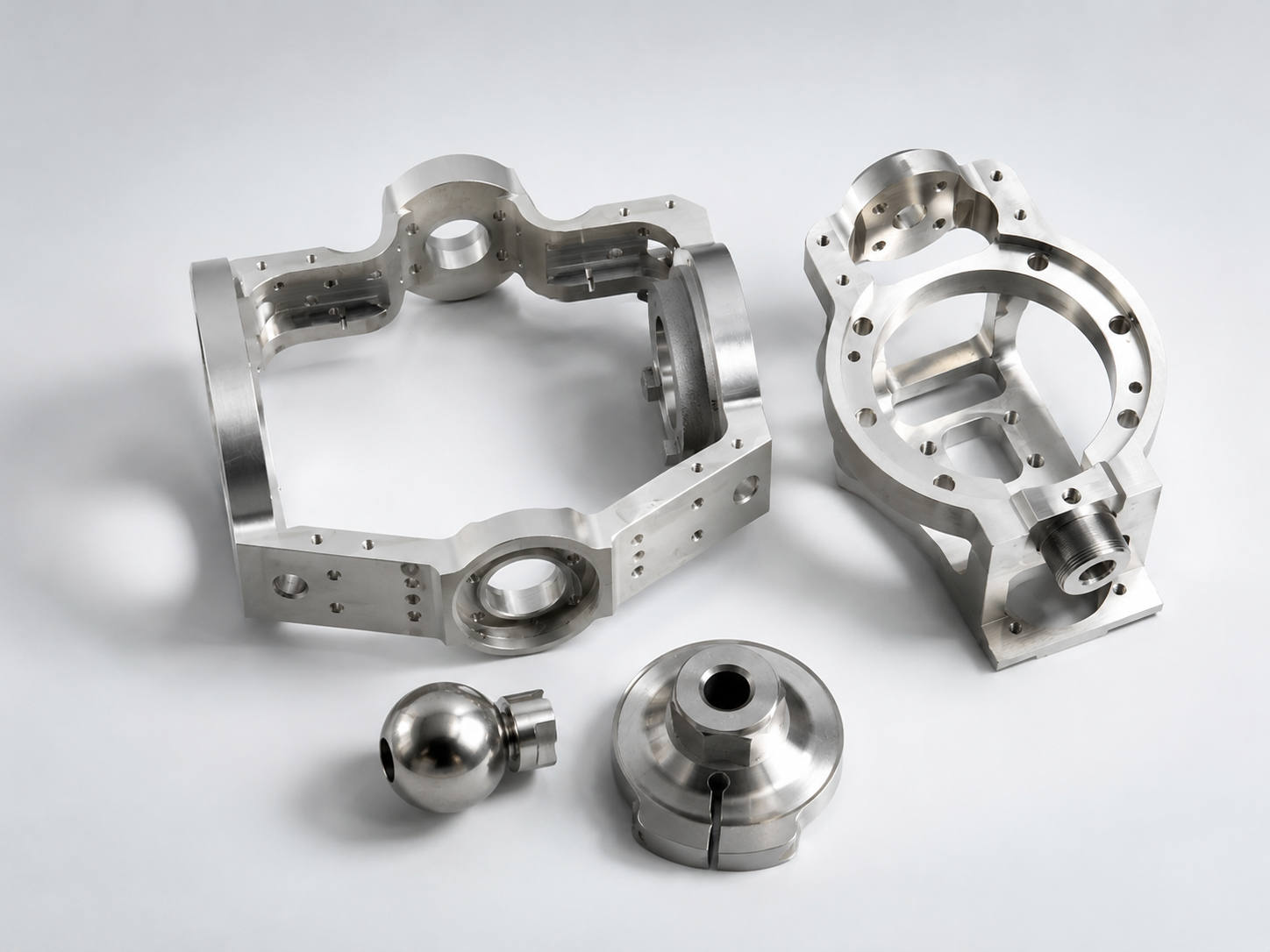
01
Material Requirement
Risk: Generic “Titanium” may hide grade, condition, stock form, specification, or document differences.
Provide: Exact callout, applicable specification, condition, stock preference, and required material documents.
Clarify: Accepted material basis, exclusions, and any sourcing assumption.
02
Geometry & Access
Risk: Deep pockets, thin walls, small features, or long reach can create rigidity, heat, wear, and inspection risk.
Provide: Current model and drawing, critical faces, minimum wall intent, and permitted design changes.
Clarify: Manufacturing review status, access concerns, setup assumptions, and open questions.
03
Workholding & Datums
Risk: A secure setup may conflict with functional surfaces or datum relationships.
Provide: Functional datums, no-clamp areas, assembly relationships, and part orientation if relevant.
Clarify: Datum interpretation and any feature that needs clarification.
04
Tolerance & Finish
Risk: Blanket tight tolerances can raise inspection burden without protecting function.
Provide: Critical dimensions, geometric controls, surface requirement, and acceptance hierarchy.
Clarify: Which requirements are included, reviewed, or require discussion.
05
Inspection & Records
Risk: Buyer and supplier may budget different measurement methods or reporting levels.
Provide: Sampling, report fields, material records, first-piece expectations, and release documents.
Clarify: Inspection scope, report deliverables, and commercial exclusions.
06
Secondary Scope
Risk: Finishing, cleaning, marking, packaging, and outside processing can sit outside the headline price.
Provide: Required final condition and party responsible for each operation.
Clarify: Included operations, subcontracted scope, logistics, and evidence responsibility.
Critical Feature to Evidence Matrix
Drawing and model discrepancies can interrupt scheduling because the shop can’t tell which definition controls. A feature-by-feature link between function, manufacturing review, and acceptance evidence removes that ambiguity in the design-to-inspection information context described by NIST.
Unlike a generic “precision machining” claim, the Critical Feature to Evidence Matrix exposes how the buyer expects each important relationship to be approved. Zhenling uses it as an RFQ discussion framework, not as a guarantee that every feature is feasible.
SEC. 01 // MATRIX PARAMS
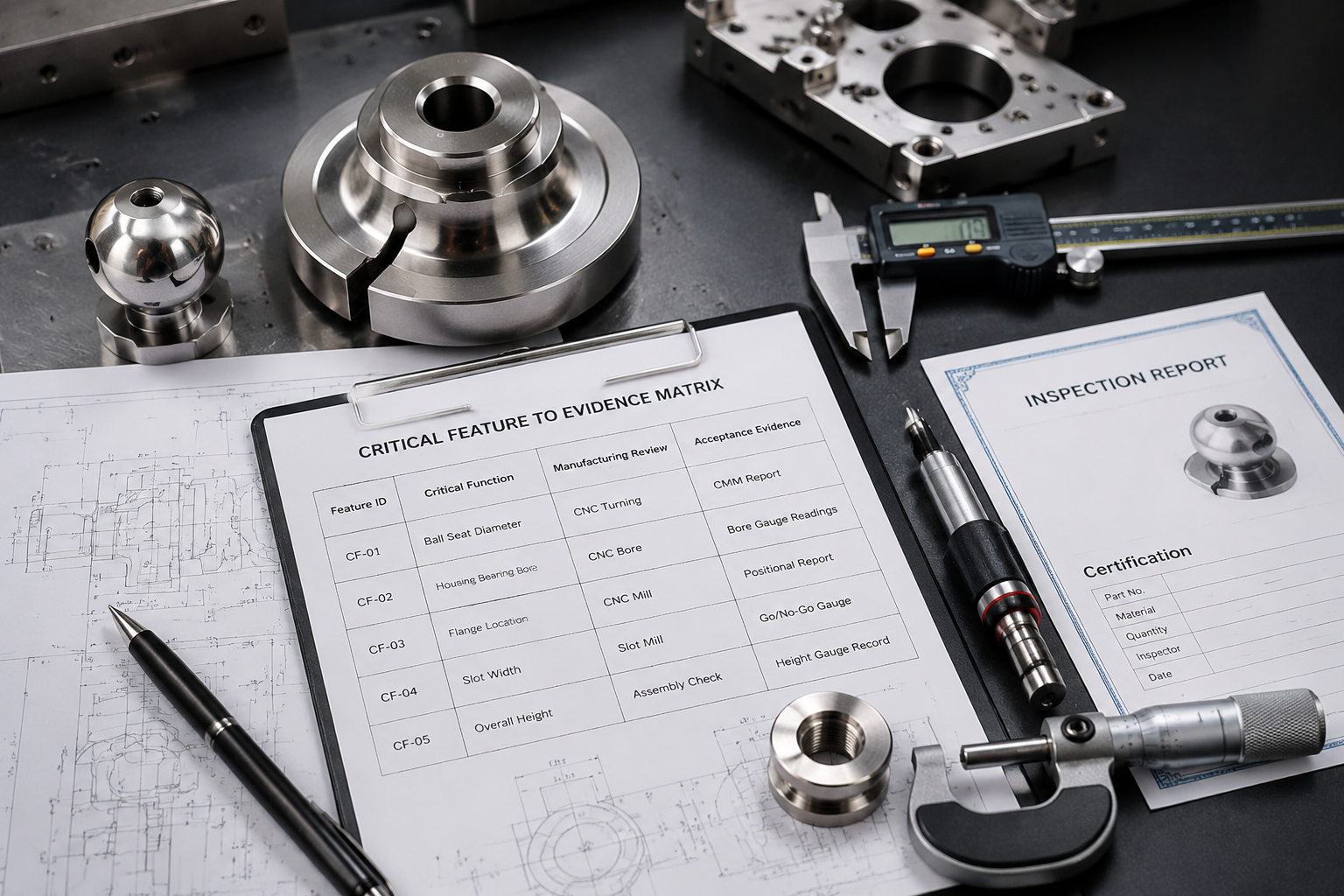
Mating face or seal interface
Thin wall or flexible section
Deep pocket or restricted access
Hole pattern and positional relationship
Edge or burr-sensitive interface
A1
Functional definition
Mark the few features that can affect function instead of applying a blanket requirement everywhere. Explain the assembly, flow, sealing, motion, or alignment consequence.
A2
Acceptance evidence
Define evidence before the part arrives. A report is useful only when datum interpretation, sampling, method, and acceptance language agree.
A3
Commercial alignment
Ask each supplier to quote the same evidence level. Otherwise, a cheaper offer may simply exclude a measurement, document, test, or secondary operation.
Build the matrix before suppliers price different scopes
Highlight the functional features on the current revision and state what evidence the approval process requires. Zhenling can identify open questions before the commercial comparison is frozen.
How to Compare Titanium CNC Machining Quotes
Titanium CNC machining cost can’t be normalized by unit price alone. A quote may separate material, setup, tooling, machine time, inspection, outside processing, packaging, and shipping, while another supplier groups the same inputs differently.
Lowest price is not necessarily the best commercial offer. An honest comparison aligns the material basis, controlled revision, critical features, evidence scope, quantity, and requested schedule before price is ranked against a complete product definition; the source does not provide Zhenling pricing.
Normalize this field
Hidden bottleneck
Question for every supplier
Material and starting stock
Hidden bottleneck:
Availability, source, certification, stock allowance, and substitution rules.
Question:
What exact material basis and documents are included?
Setup and access
Hidden bottleneck:
Fixtures, re-location, tool overhang, multi-face access, and datum transfer.
Question:
Which geometry assumptions could change the route or price?
Removal volume and feature burden
Hidden bottleneck:
Cycle time, heat, wear, thin sections, deep cavities, and small tools.
Question:
Which features are treated as critical cost or feasibility drivers?
Tolerance and inspection
Hidden bottleneck:
Measurement method, programming, sampling, records, and approval time.
Question:
Which report and acceptance activities are included?
Secondary operations
Hidden bottleneck:
Outside processing, transportation, supplier responsibility, and re-inspection.
Question:
Who owns finishing, cleaning, marking, packaging, and final release?
Quantity and schedule
Hidden bottleneck:
Setup allocation, material procurement, capacity review, and reorder assumptions.
Question:
Does the quote use the same lot size, forecast, and requested delivery basis?
SYS.VERIFY.FACTORY
Verify the Factory, Equipment, and Project Controls Behind the Quote
Zhenling states that Shanghai Zhenling Hardware Co., Ltd. was founded in 2006 and operates an 8,000 m² site with a 6,000 m² workshop in Jiashan, Zhejiang. The company lists CNC turning, milling, grinding, boring, drilling, wire EDM, and 3-axis, 4-axis, and imported 5-axis machining centers.
These facts do not prove a titanium project, titanium-dedicated capacity, or suitability for your critical features; the NIST quality survey is framework context only.
Evidence questions for supplier review
Ask who owns the manufacturing work, how revisions are released, and what happens when a requirement can’t be confirmed. Request controlled files, an agreed material basis, inspection scope, and shipment documents.
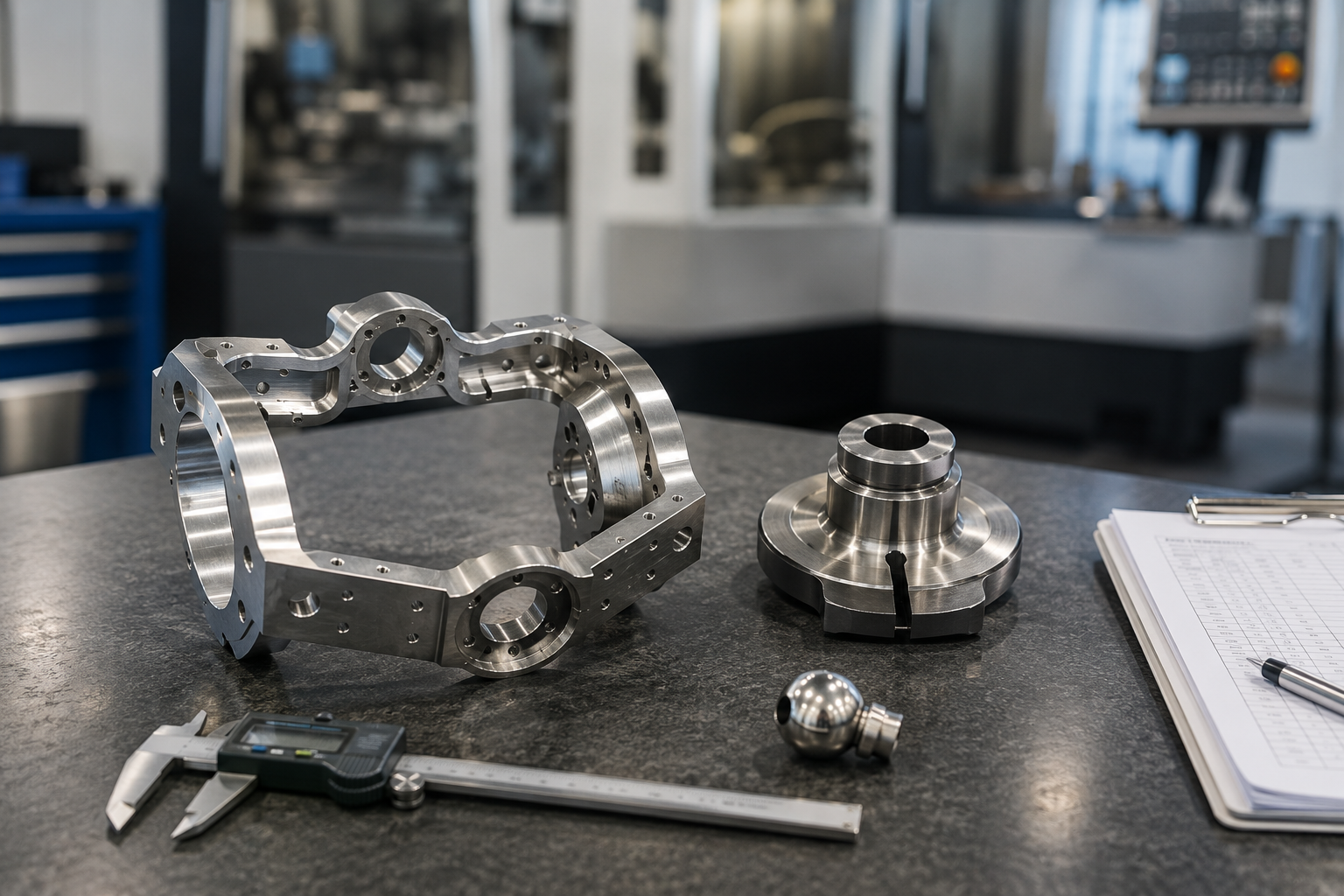
PROJECT CONTROLS SEQUENCE
01
Buyer submits controlled scope
Drawing, model, material, quantity, and specs enter one RFQ package.
02
Engineering identifies open points
Zhenling reviews if material, geometry, access, and datums are defined to quote.
03
Quotation restates the basis
The offer names assumptions and inclusions rather than hiding behind “per drawing.”
04
Order controls follow accepted revision
Manufacturing scope stays aligned with the approved technical definition.
Where Titanium May Fit Non-Regulated Industrial Projects
Government and materials-industry sources identify chemical process, power generation, marine, metallurgy, and other industrial uses of titanium metal. Counter-evidence also shows that aerospace dominates United States titanium-metal consumption, so broad market language would be misleading, as bounded by USGS Titanium in 2024.
Material use in an industry does not prove Zhenling has completed that industry’s titanium project. Honest language is narrower: Zhenling accepts drawing-led industrial inquiries, then confirms the order-specific material, geometry, evidence, and supply requirements.
DESIGN SCREENING PROMPT
If titanium’s weight or corrosion case is not decisive and conductivity or easier machining is the real driver, compare the project against brass CNC machining for conductive or easier-machining parts before fixing the material route. That is a design-screening prompt, not a substitution recommendation.
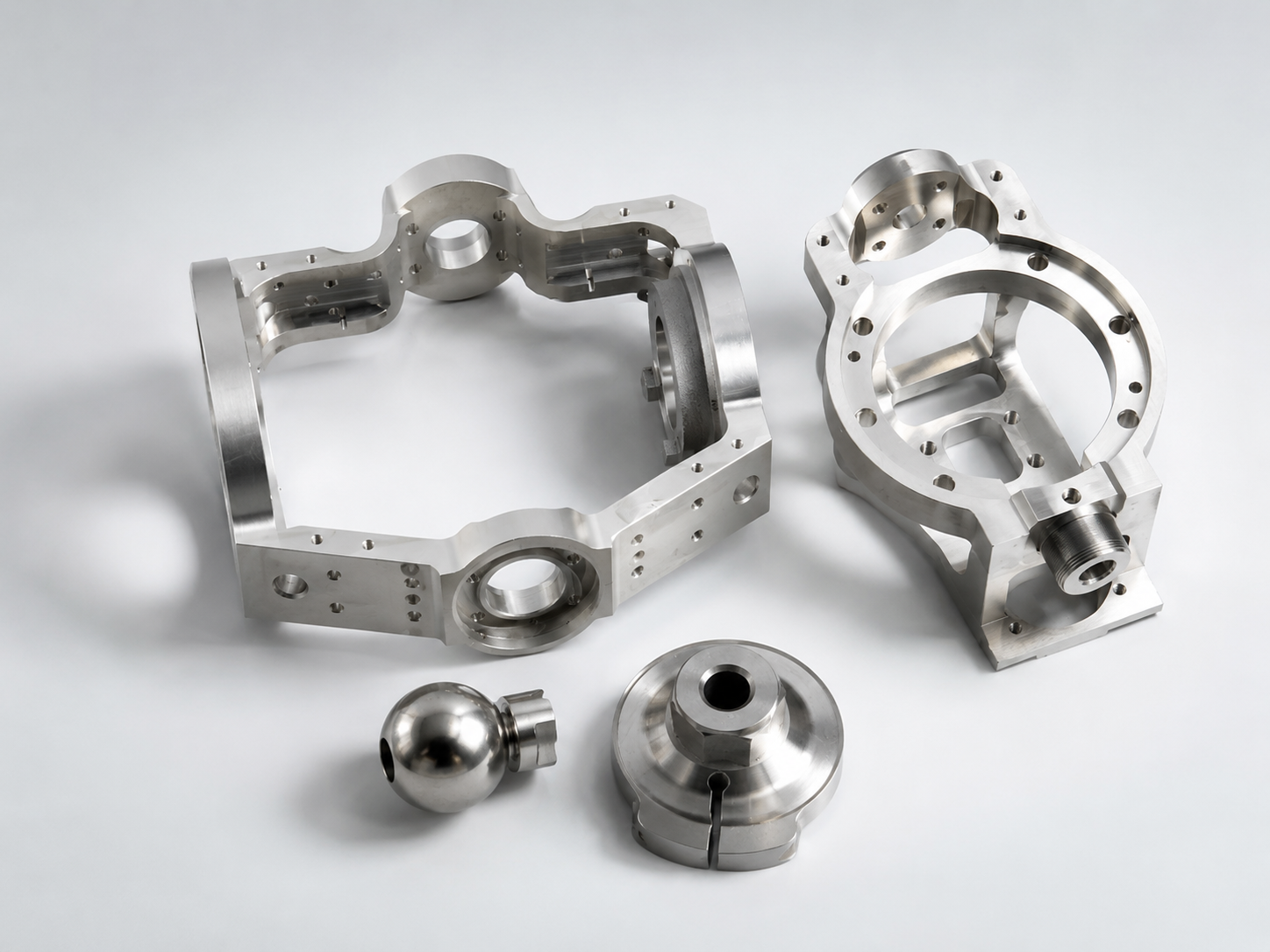
Chemical and fluid equipment
A buyer may specify titanium for corrosion-related service in chemical processing or fluid systems. The quotation still needs the exact environment, material authority, pressure boundary, acceptance requirements, and design ownership.
Marine and water systems
Marine or water-service context can create corrosion, joining, cleanliness, and documentation questions. Zhenling won’t infer suitability from the word “marine”; the controlled specification and project review decide.
Industrial machinery
Custom brackets, housings, valve-related parts, shafts, interfaces, and equipment components may have weight, corrosion, temperature, or service drivers. These are inquiry contexts, not published titanium case studies.
Excluded scope
this page makes no United States defense procurement, medical-device or implant, or regulated aerospace qualification claim. It also makes no claim about in-house titanium grinding, deburring, chip collection, dust extraction, or fire-control systems.
Use the Titanium RFQ Checklist for a Reviewed Quote
Buyers evaluating overseas suppliers worry that an instant quote may hide the actual factory, communication path, or release controls. A Titanium RFQ Checklist makes the technical and commercial handoff visible before suppliers price different scopes.
This checklist does not approve a grade or process. It helps Zhenling and the buyer determine whether the information is complete enough for a responsible titanium machining services review against a complete product definition.
PHASE 01
Send with the inquiry
-
01
1. Controlled files
Two-dimensional drawing, three-dimensional model, revision, units, and controlling-document rule.
-
02
2. Material definition
Specification, grade, condition, product form, substitution rule, and material-document requirement.
-
03
3. Commercial quantity
Prototype or production intent, lot size, forecast or reorder expectation, and requested schedule.
-
04
4. Critical features
Functional datums, mating surfaces, holes, thin walls, deep features, edges, and failure consequence.
-
05
5. Final condition
Surface requirement, secondary processing, cleaning, marking, packaging, and party responsible.
-
06
6. Acceptance evidence
Sampling, inspection method, report fields, first-piece approval, records, and shipment documents.
PHASE 02
Expect from the reviewed response
-
Material basis
What requirement and sourcing assumption the offer uses.
-
Scope confirmation
Included manufacturing, inspection, secondary operations, packaging, and documents.
-
Open questions
Drawing, geometry, datum, tolerance, finish, or evidence items that need buyer input.
-
Exclusions
Anything not included, unconfirmed, or dependent on third-party processing.
-
Commercial basis
Quantity, price basis, schedule assumptions, validity, and change conditions.
Titanium Project Evaluation Tools
01
Titanium RFQ Completeness Checker
02
Quote Scope Normalizer
03
Critical Feature Evidence Builder
FAQ: Titanium CNC Machining
Yes. Zhenling accepts titanium CNC machining inquiries. Exact grade, condition, geometry, tolerance, inspection, post-processing, quantity, price, and schedule require a project review.
No grade list is claimed on this page because no grade-specific Zhenling evidence was provided. Send the required specification, grade, condition, and product form for engineering review.
A model may support geometry review, but a controlled drawing or equivalent product definition is usually needed for tolerances, datums, finish, edge conditions, inspection, and document requirements. State which file controls.
Material basis, stock, feature access, setup count, removal volume, critical tolerances, inspection, secondary operations, quantity, and schedule can all change scope. Zhenling provides a project quote rather than a universal online price.
No universal titanium tolerance is promised. Feasibility depends on the feature, datum structure, part size, wall behavior, access, material condition, inspection method, and order scope.
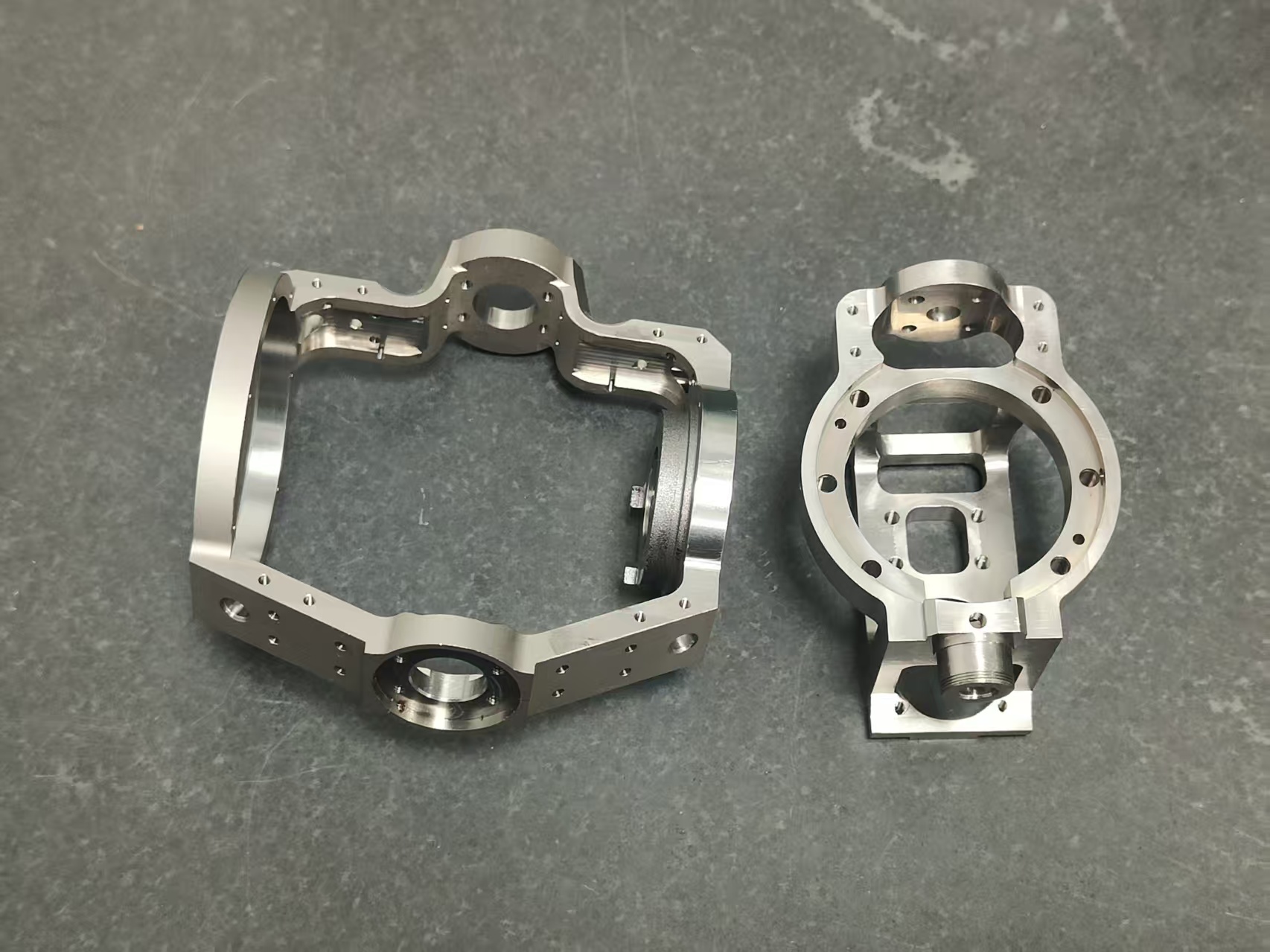
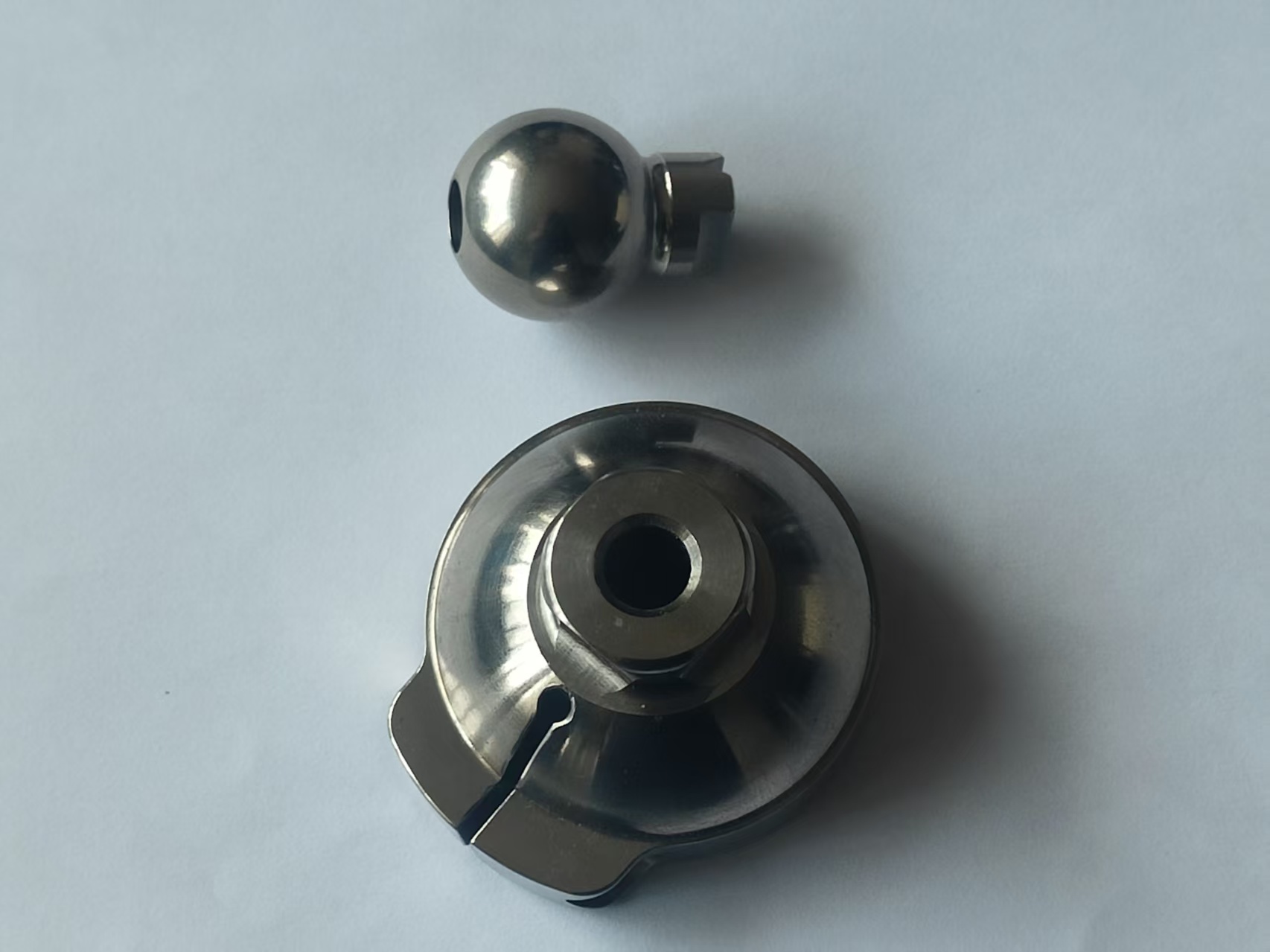
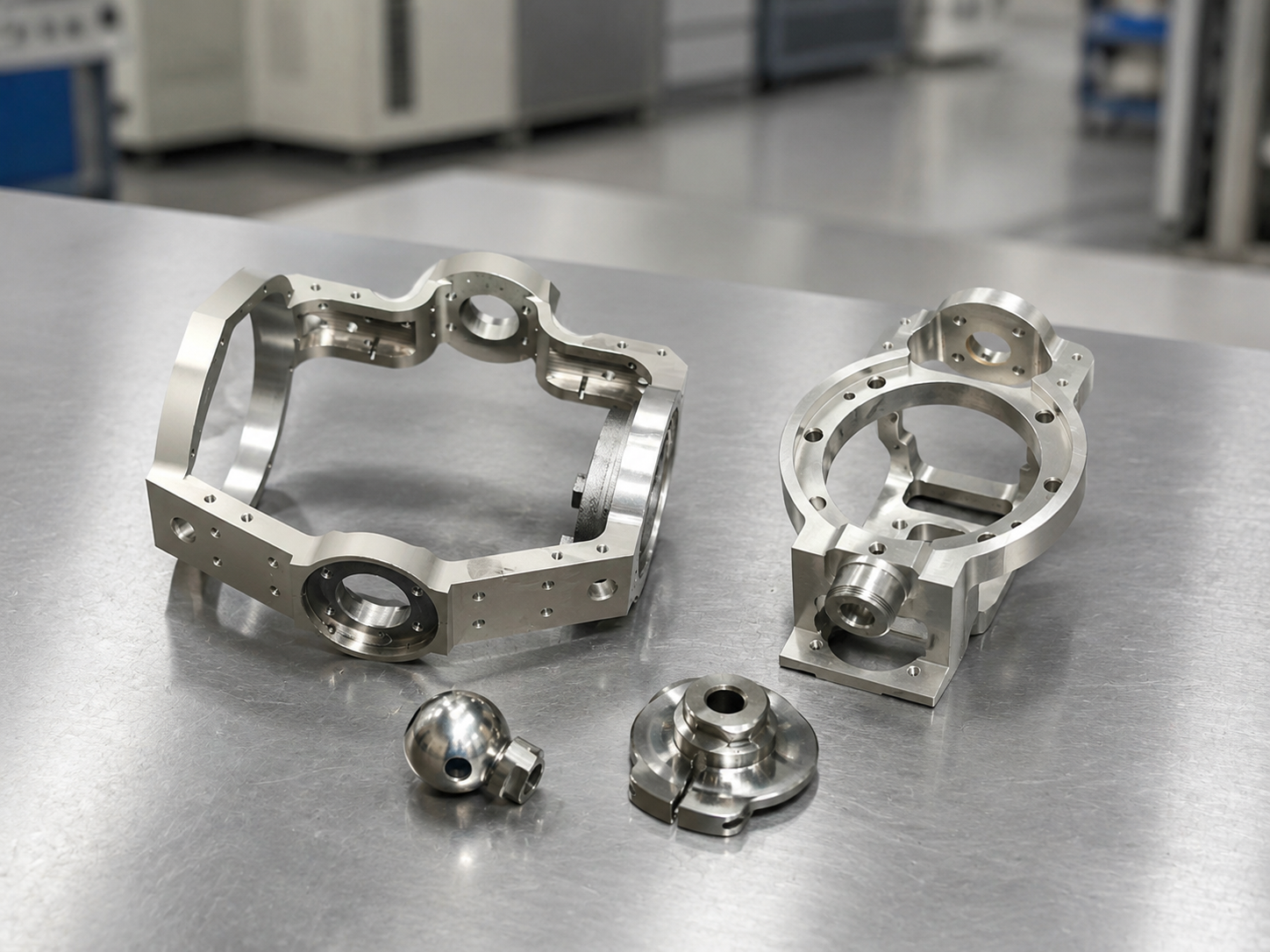
No. User-provided photos show machined metal parts and visible geometry, but appearance can’t verify material, grade, tolerance, finish, inspection, or project history.
No such qualification is claimed on this page. Those regulated scopes are excluded from the offer described here.
This page doesn’t claim in-house titanium grinding, deburring, chip collection, dust control, or fire-control capability. Any requested secondary operation needs explicit review and written scope confirmation.
![Shop-Floor Carbon Steel CNC Machining Guide [2026]](https://zhenlingmetal.com/wp-content/uploads/2026/08/carbon-steel-cnc-machining-handbook-r2-featured-150x150.png)