Get in touch with Zhenling Company

POM (Delrin/Acetal) CNC Machining
POM (Delrin/Acetal)
CNC Machining Services
- Quotation timing confirmed after RFQ review
- Prototype schedule confirmed in the written quotation
- Minimum quantity confirmed in the quotation
- STEP, IGES, PDF, DWG and DXF files
Zhenling reviews POM CNC machining requests from your drawing, material requirement, quantity and acceptance criteria. Our CNC machining services assess each POM material before tolerance, grade, inspection scope and delivery are fixed in the quotation. POM Delrin Acetal CNC Machining enquiries should include resin grade, moisture or dimensional-stability concerns, tolerances, finish and inspection. Schedule depends on the released inputs. Check route, limits, inspection evidence and exclusions before treating any date as firm.
NDA terms and the protected transfer scope must be agreed in writing before covered files are exchanged.
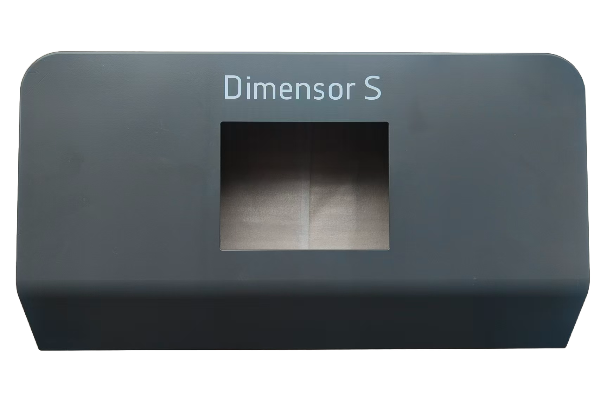
RFQ-Ready POM Machining at a Glance
Quote review
Confirmed after RFQ review
Prototype planning
10 working days after drawing approval
Production planning
20 working days, confirmed with the quotation
Order quantity
Minimum quantity and single-piece availability confirmed per quotation
Drawing package
STEP or IGES with PDF, DWG or DXF
Inspection package
Scope agreed before order and supplied when specified
POM CNC Machining Feasibility Review
The first question is not whether a CNC machine can remove the material. It is whether the drawing, stock condition and acceptance plan define a controllable part, so each request to CNC machine POM is reviewed across geometry, material identity, operating duty and verification requirements.
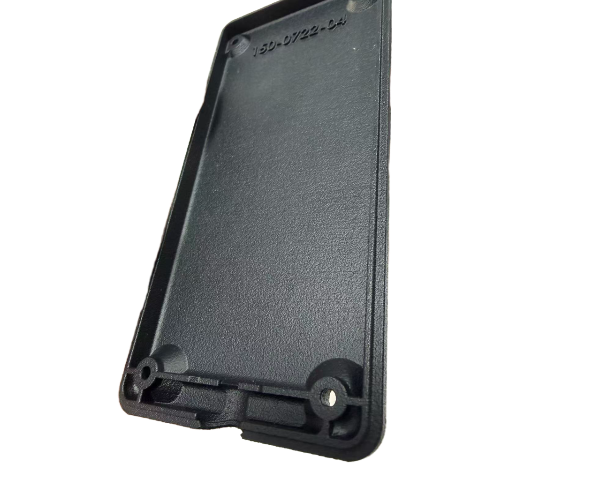
Geometry and setup review
Show thin walls, deep pockets, long bores, slender turned sections, threads, undercuts, tight fits and surfaces that cannot carry clamp marks. Include the free-state or restrained-state requirement where part flexibility can affect inspection.
Material definition
State POM-H, POM-C, Delrin, polyacetal or the complete supplier grade when known. If the grade is open, provide the mechanical properties, chemical exposure, color, regulatory and traceability requirements that control the choice.
Functional duty
For gears, POM bushings, guides and other low-friction parts, add load, speed, temperature, lubrication, mating material, shock, expected life and heat-dissipation path. Low coefficient of friction alone does not establish suitability.
Acceptance definition
Identify critical dimensions, datums, fits, geometric controls, surface texture, edge condition and report needs. State the drawing revision and any purchase-order or regulatory clause that makes a document mandatory.
POM-H and POM-C Questions for Your RFQ
Polyoxymethylene is an engineering thermoplastic also known as acetal or polyacetal. This plastic material includes homopolymer and copolymer families. POM material properties vary by family and grade; ASTM D6100 covers specified POM shapes, while Delrin is a trademark used for acetal homopolymer.
Unlike a generic Acetal vs Delrin comparison, this matrix turns each trade-off into a quotation input. The differentiator is input discipline: POM-H and POM-C are not interchangeable labels for purchasing or approval.
Material Candidate Specifications
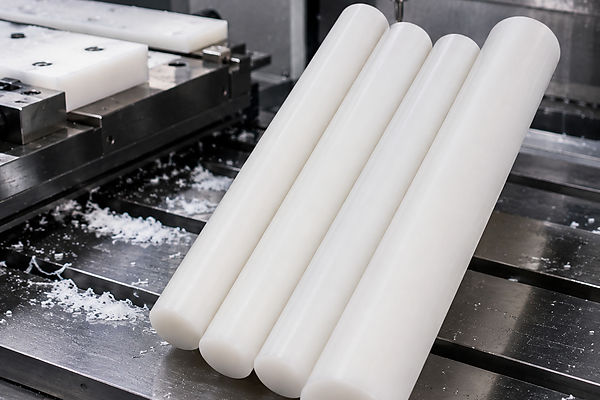
MAT-01 // POM-H
POM-H / acetal homopolymer
Use this as a candidate family when stiffness, mechanical properties, fatigue behavior or tribological performance is central to the design. For Delrin parts, confirm stock-shape quality, section size, porosity risk, chemical exposure and the exact manufacturer grade before release.
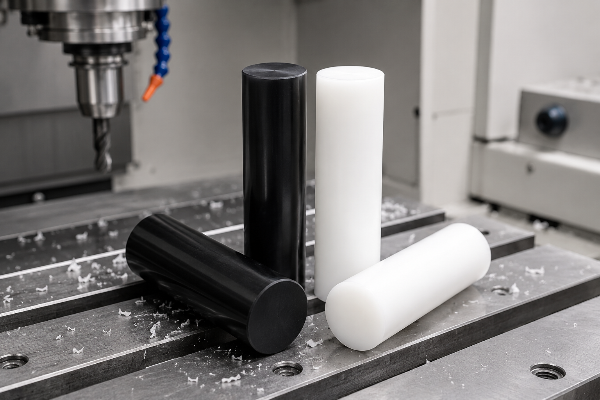
MAT-02 // POM-C
POM-C / acetal copolymer
Use the acetal copolymer family as a candidate when chemical or hydrolysis conditions, stock-form availability or centerline quality influence the design. For acetal parts, food-contact or medical language must be checked against the exact formulation, supplier documentation and intended use.
POM RFQ Decision Matrix
-
Design priorityStiffness, dimensional stability, low friction, wear resistance, chemical resistance or impact behaviorWhich requirement controls the material decision when properties conflict
-
Material identityPOM-H, POM-C, Delrin, supplier grade, color and modificationWhether a complete material specification or approved-equivalent rule is needed
-
Stock formRod, plate, sheet, tube or an open stock-form requirementAvailability, thickness tolerance, bow, camber, porosity and material history
-
GeometryThin walls, deep features, fits, threads, long ratios, datums and clamp-sensitive facesSetup, support, material-removal sequence and inspection-state risks
-
Operating dutyLoad, speed, temperature, cycle, shock, lubricant and mating materialCreep, fatigue, friction, wear and heat-flow limits
-
End-use boundaryFood contact, electrical, medical or other regulated useExact grade documentation and applicable use conditions
-
AcceptanceCritical dimensions, surface texture, edge condition, inspection method and report scopeWhat is measured, under which conditions and against which revision
Surface and Edge Requirements for Machined POM
A useful acetal machining drawing defines functional surfaces and edges instead of relying on broad labels such as smooth or high-precision. B46.1 separates roughness, waviness and lay, while a POM-C turning study found that several tool and cutting variables affected surface quality under its stated test conditions. ASTM D6100 identifies POM shape specifications, but the finished part still needs separate surface and edge acceptance criteria.
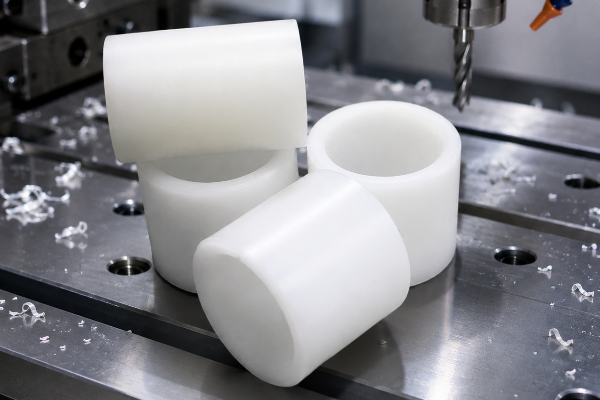
Surface texture
Identify the functional face, parameter, limit, sampling location and whether lay direction matters. Do not apply one roughness callout to cosmetic, sealing, bearing and nonfunctional faces unless the design requires it.
Edges and burrs
Define break-edge, chamfer, radius, burr and sharp-edge acceptance in the drawing. Add special instructions at thread entries, cross-holes, gear teeth and sealing transitions.
Appearance and handling
State color, scratch limits, witness-mark limits, clean handling, marking and packaging needs. Separate appearance criteria from dimensions so each can be inspected consistently.
Secondary operations
List only operations required by the design and identify the governing specification. Adhesive bonding, coating and marking compatibility must be checked against the exact POM grade and service environment.
POM Tolerance Questions Before Quotation
Tight tolerances on POM or Delrin parts need a feature-by-feature decision. Stock condition, wall stiffness, removed volume, datum strategy, temperature, restraint, inspection timing and measurement uncertainty can each affect whether a reading represents the intended part condition.
The risk is measurement disagreement because the same flexible part can read differently under changed restraint or temperature. Zhenling therefore asks for the inspection state and reference condition; ISO 1:2022 provides a standard reference-temperature framework.
Published Project Controls
Quote review
Timing confirmed after engineering review
Prototype schedule
10 working days after drawing approval
Production schedule
20 working days, confirmed with the quotation
Order quantity
Zhenling standard minimum order quantity: 1 piece; material procurement, setup, inspection and quantity effects confirmed per quotation
Payment structure
Payment method, deposit and balance timing confirmed in the written quotation
Company history
Founded in 2006
Jiashan site
8,000 m² site with a 6,000 m² workshop
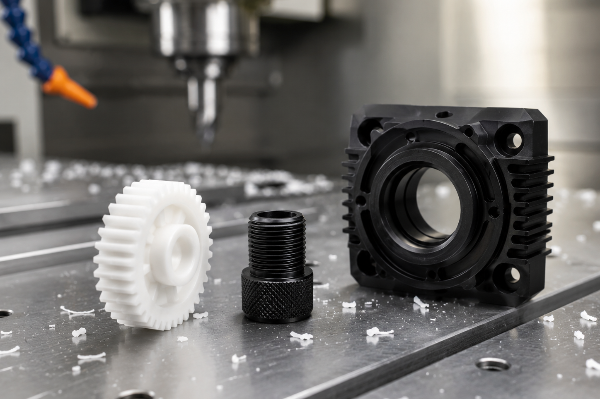
Drawing and Acceptance Inputs
| Feature group | Define before approval | Reason |
|---|---|---|
| Size and location | Nominal, tolerance, datum references and inspection state | Separates functional location from a free-state reading |
| Holes, shafts and fits | Mating-part data, fit class, temperature and assembly method | Connects the drawing limit to real clearance or interference |
| Form and profile | Flatness, cylindricity, runout or profile controls where functional | Prevents size alone from masking shape error |
| Thin or flexible geometry | Wall, unsupported length, restraint and measurement fixture | Reduces disagreement caused by clamping or elastic movement |
| Threads and inserts | Thread standard, engagement, torque, assembly cycle and insert requirement | Links thread design to load and repeated use |
| Material condition | Stock form, grade, batch documentation, conditioning history and stabilization requirement | Connects material history to the acceptance plan |
| Metrology | Reference temperature, humidity if relevant, measurement method and uncertainty rule | Makes the reported result reproducible and interpretable |
Feasibility Review
Send the controlled 2D drawing with the 3D model so critical requirements are not inferred from model geometry alone.
POM CNC Machining Pricing and Lead Time
A quotation reflects the material specification, stock form, geometry, tolerance scope, setup count, quantity, inspection, secondary work, packaging and delivery terms. Custom machined parts are quoted in writing rather than sold at a fixed public price.
Cost Drivers and Practical Levers
| Cost Driver | Cost Effect | Useful RFQ Action |
|---|---|---|
| Exact grade and stock | Availability, certification and oversize stock affect material cost | Provide an approved grade or a clearly bounded equivalent rule |
| Geometry and setups | Deep features, thin walls and multiple orientations add support and handling | Mark functional features and allow accessible radii where possible |
| Tolerance allocation | Broad tight limits increase machining and verification effort | Apply close limits only to functional characteristics |
| Inspection package | More characteristics, methods and records add quality work | Define the report scope and sampling plan before order |
| Quantity and release plan | Setup cost is distributed differently across prototype and repeat quantities | Provide prototype, annual and release quantities |
Quotation and Scheduling
- Engineer-reviewed quote: Response timing is confirmed in the written quotation after RFQ review.
- Prototype orders: Schedule confirmed in the written quotation after drawing review.
- Production orders: Schedule confirmed in the written quotation after quantity and route review.
Order and Trade Terms
- Minimum quantity and single-piece availability are confirmed in the written quotation.
- Payment method, deposit and balance timing are confirmed in the written quotation.
- Incoterm, destination and freight responsibility are confirmed in the written quotation.
- Rush scheduling is reviewed case by case; no expedited date is committed before drawing review.
Define Inspection Deliverables Before Order
Inspection scope comes from the drawing, purchase order and any applicable regulatory requirements. A first-article report, dimensional report, material record or traceability field is included only when the quotation defines it.
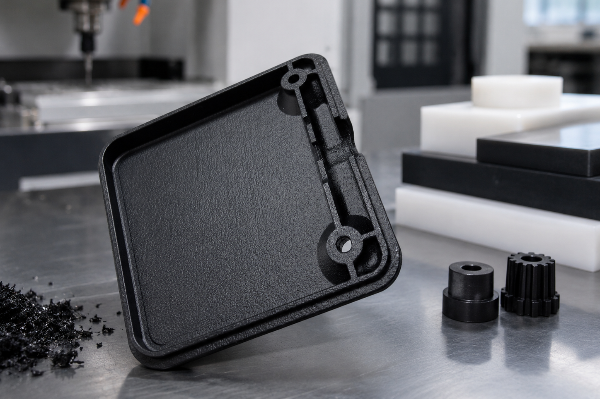
Inspection Scope to Confirm
Controlled revision
identify the approved 2D drawing, 3D model and specification set.
Characteristics
mark critical dimensions, geometric controls, fits, surface texture and edge conditions.
Method and condition
state the measurement method, part restraint, reference environment and uncertainty or decision rule where needed.
Sampling and records
define first-article, in-process, final or lot sampling and the required report fields.
Release authority
identify purchase-order, drawing or regulatory clauses that control approval and retention.
Agreed Deliverables
| Deliverable | Include it when | Define in the quotation |
|---|---|---|
| Dimensional report | Selected characteristics require recorded results | Characteristics, method, units, sampling and revision |
| First-article report | The drawing, purchase order or launch plan requires first-article approval | Form, measured values, ballooning, approval and resubmission triggers |
| Material documentation | Grade, batch, source or regulatory traceability is required | Document type, issuer, lot linkage and acceptance criteria |
| Appearance record | Cosmetic or edge condition needs recorded approval | Reference sample, photographs, zones and defect limits |
We complete first-article or dimensional inspection before shipment, with the report scope agreed at quotation. A dimensional or first-article inspection report, when specified with the order, ships with your order.
From POM Drawing Review to Shipment
- SEC-0101
Send controlled files
We work from STEP or IGES models with PDF, DWG, or DXF drawings.
- SEC-0202
Define material and duty
Provide the grade or required properties, stock-form constraints, operating conditions and regulated-use requirements.
- SEC-0303
Review feasibility
We identify open questions around geometry, material, surface, tolerance, inspection and delivery.
- SEC-0404
Approve the quotation
The written quotation fixes the agreed scope, schedule, payment and shipping terms.
- SEC-0505
Control the order
Production and inspection follow the approved revision and documented acceptance requirements.
- SEC-0606
Release and ship
The specified report package is checked against the order before dispatch.
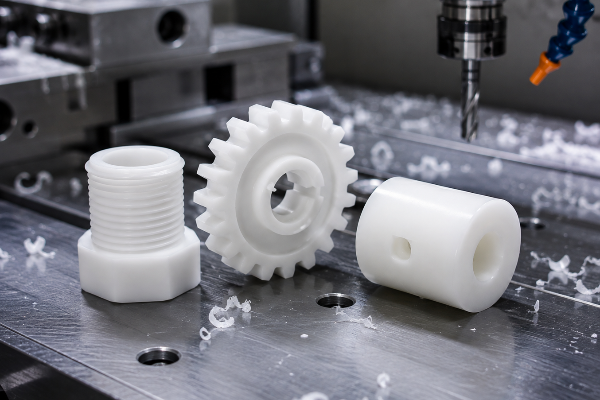
Zhenling Manufacturing Context
Shanghai Zhenling Hardware Co., Ltd. was founded in 2006. Our Jiashan site covers 8,000 square metres, including a 6,000 square metre workshop for custom industrial precision parts.
General factory facts do not by themselves establish that a specific ASTM D6100 stock shape is available or that a POM drawing is feasible; those points stay project-specific.
POM supplier fit must be reviewed against the released drawing, grade, quantity, dimensional-stability risks, inspection plan and written quotation.
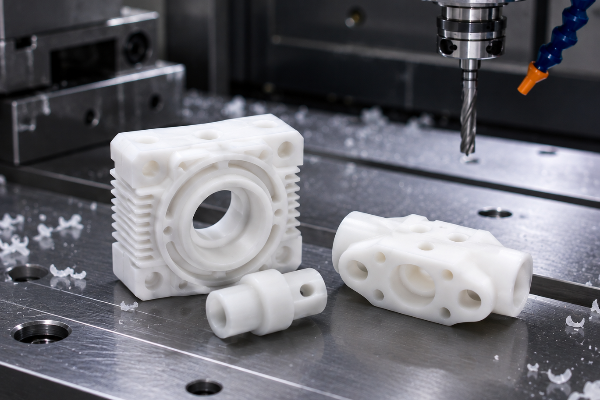
Process
Drawing-based production
We manufacture non-standard components from customer drawings or samples and support both domestic and export business.
Resources
General machining resources
Turning, milling, grinding, boring, drilling, wire EDM or multi-axis machining may be candidate routes. Actual equipment, execution site and availability must be confirmed for the order.
Specifications
Project-specific assignment
The machine, setup, material source and inspection route for a POM request are confirmed only after feasibility review and quotation.
When POM Is Not the Best Fit
POM offers machinability, stiffness and low friction, but those properties do not settle every design. Review the mechanical, thermal, chemical, assembly and regulatory system before approving acetal plastic. Low friction does not automatically approve the material, and a family name can still be the wrong choice for a purchase specification.
ASTM D618 provides conditioning procedures for plastics testing, but conditioned test results alone can still lead to the wrong material choice when service data and acceptance conditions are missing.
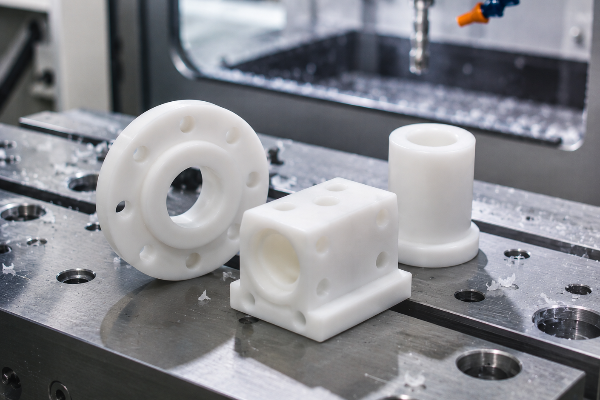
Evaluation Matrix
| Situation | Why it works against the design | Next decision |
|---|---|---|
| Sustained load with tight deflection limits | Thermoplastic creep can change fit or preload over time | Define load, duration, temperature and allowed movement; compare materials on long-term data |
| High temperature or poor heat rejection | Frictional and environmental heat can change mechanical response and dimensions | Model the duty cycle, mating-part heat capacity and cooling path before selecting the polymer |
| Shock-dominated service | A grade selected mainly for stiffness or wear may not deliver the needed impact response | Prioritize impact duty and compare a tougher polymer or a revised geometry |
| Adhesive-bonded assembly | Low surface energy can make bonding difficult without a validated surface and adhesive system | Use mechanical retention or qualify the complete bonding process |
| Regulated food-contact use | 21 CFR 177.2470 is specific to qualifying POM copolymer and its stated conditions | Verify the exact formulation, supplier documentation and intended contact conditions |
| Very high-volume simple geometry | Repeated machining time may dominate unit cost | Compare injection molding after geometry, tooling, volume and change risk are stable |
POM (Delrin/Acetal) Engineering Tools
-
POM RFQ Builder
Capture grade, stock condition, critical dimensions, inspection method and unresolved items. Its output is an RFQ checklist, not machining parameters, process approval or a manufacturability guarantee.
Launch Tool -
Drawing Acceptance Checklist
Record the drawing revision, material, datums, critical dimensions, measurement method and open questions. Its output is a review checklist, not drawing validation or a manufacturability guarantee.
Launch Tool -
POM Duty Fit Questions
Record load, temperature, moisture, wear, chemical exposure and mating-part requirements. Its output is a buyer question list; material suitability remains an application-engineering decision.
Launch Tool
POM CNC Machining FAQ
Technical parameters, material behaviors, and processing specifications for precision manufacturing.
Submit Inquiry
Is POM plastic the same as Delrin?
POM is the polymer family, also known as acetal or polyacetal. Delrin is a trademark commonly used for acetal homopolymer, so the drawing should still name the grade or required properties.
What is the difference between POM-H and POM-C?
POM-H is the homopolymer family and POM-C is the copolymer family. A Delrin grade is not automatically interchangeable with every copolymer because stiffness, chemical response, stock-shape behavior, porosity risk and availability can differ.
Can POM be CNC machined to tight tolerances?
Yes, a POM part can enter tight-tolerance review, but feasibility is determined feature by feature. The drawing must define material condition, geometry, datums, inspection state, temperature and the functional fit instead of relying on a blanket number.
Why can POM warp after machining?
Material history, internal stress, asymmetric material removal, heat, clamping and flexible geometry can all contribute to movement. The machining and inspection plan should consider those mechanisms before the final tolerance is accepted.
How does temperature affect machined acetal parts?
Temperature can change part dimensions and mechanical response, while friction can add local heat during service. Define the operating range, mating system and inspection reference condition rather than assuming excellent dimensional stability covers every situation.
What conditioning and measurement conditions should a POM drawing define?
Identify the material and stock history, any conditioning or stabilization requirement, the reference temperature, relevant humidity, restraint state and measurement method. ASTM D618 and ISO 1 provide useful frameworks for conditioning and dimensional reference conditions.
What operating conditions determine whether POM suits a gear, bushing or low-friction component?
Provide load, speed, cycle, temperature, lubricant, shock, mating material, contact geometry, expected life and heat flow. A peer-reviewed POM study found that load, sliding speed, contact temperature and counter-body heat-sink volume all influenced the tested tribological system.
What files and specifications should I send for a POM machining quote?
Send a controlled 3D STEP or IGES model with a 2D PDF, DWG or DXF drawing. Add quantity, exact material or selection requirements, critical tolerances, surface and edge criteria, inspection deliverables and target date.
Is there a minimum order quantity for POM parts?
Zhenling standard minimum order quantity: 1 piece; material procurement, setup, inspection and quantity effects are confirmed in the written quotation, together with material procurement, setup, inspection and quantity effects.
How long do prototype and production POM parts take?
After drawing, quantity, route and inspection review, the written quotation confirms the prototype or production schedule, including any expedited option.
What inspection report can ship with my POM order?
A dimensional or first-article inspection report ships with the order when specified. Agree the characteristics, drawing revision, method, sampling and report format at quotation; Y14.5 controls on the drawing remain part of the defined product requirements.
![Shop-Floor Carbon Steel CNC Machining Guide [2026]](https://zhenlingmetal.com/wp-content/uploads/2026/08/carbon-steel-cnc-machining-handbook-r2-featured-150x150.png)