Get in touch with Zhenling Company

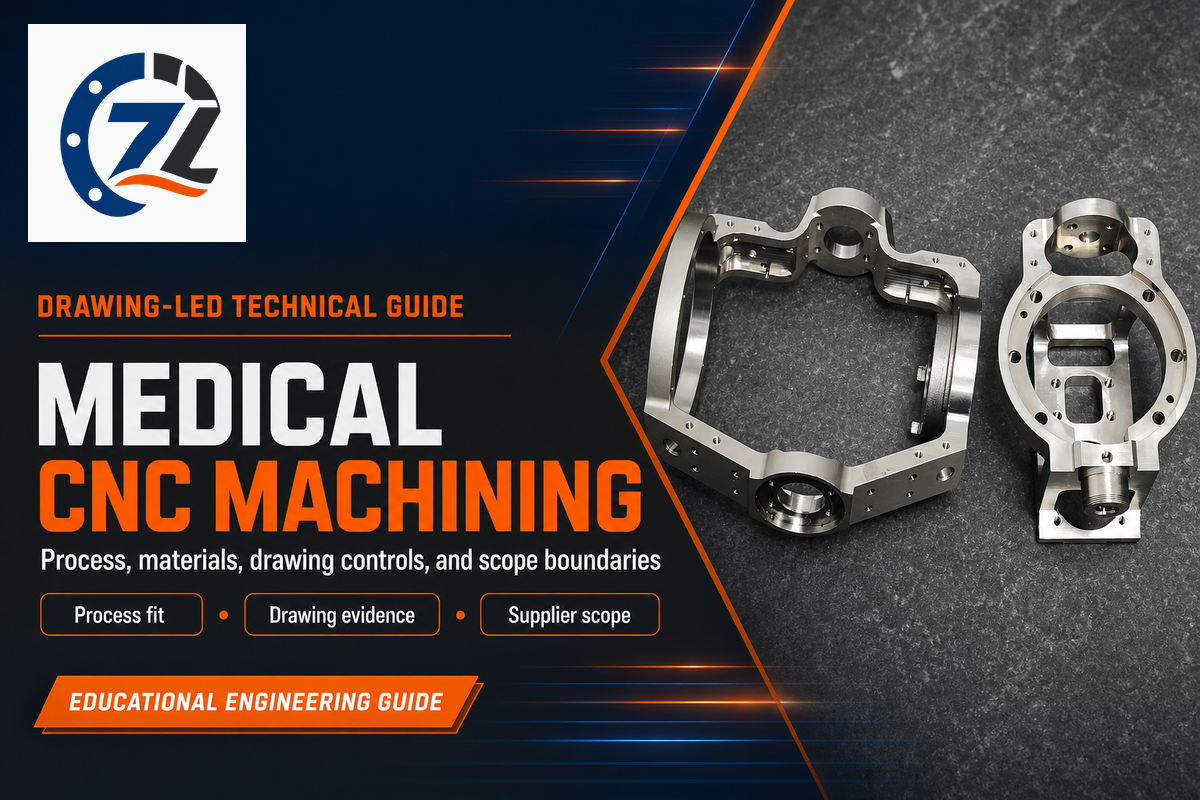
Medical CNC machining is the drawing-led fabrication of non-finished metal or plastic components for medical equipment: brackets, housings, fluid-path fittings, and structural hardware cut to a customer’s print rather than designed, cleared, or assembled as a complete device. That distinction sets a machining supplier’s normal boundary: cut the specified material, hold the drawing tolerances, inspect the part, and provide the agreed records. Regulatory clearance and finished-device design control remain with the legal manufacturer unless the machined item is itself a finished device or accessory.
This guide works through the medical cnc machining process types used on medical parts, the material families that come up most often, how tolerance and GD&T conventions get specified on a medical drawing, where ISO 13485 and the FDA’s Quality Management System Regulation actually apply, the device categories these components end up in, and a short framework for telling whether a drawing-led machining shop or a certified device manufacturer fits a given part. Updated August 2026.
Medical CNC machining is the drawing-led fabrication of non-finished metal or plastic parts for medical equipment. Industry examples in this guide span general-feature tolerances around ±0.127mm down to tight Swiss-turned features around ±0.0025mm, but the released drawing and a supplier’s documented capability govern each part.
Key Takeaways
- ISO 13485 is not an automatic legal requirement for every drawing-led component shop. FDA’s QMSR applies to manufacturers of finished devices and accessories, while the legal manufacturer still controls component suppliers through purchasing controls and quality agreements.
- Medical components often call for tight tolerances – as tight as ±0.0025mm (±0.0001in) – commonly held via Swiss-type turning on small, slender parts.
- Stainless steel, aluminum, carbon or alloy steel, and corrosion-resistant alloys are widely machined. Implant-grade titanium and PEEK require application-specific material, traceability, and biocompatibility evidence.
- ASME Y14.5 (2018 edition) provides the GD&T language when a drawing invokes it; it does not set one universal tolerance for medical parts.
- Global medical device contract manufacturing market is projected to grow from USD 87.43 billion (2025) to USD 153.13 billion by 2034.
Quick Specs
| Typical tolerance range | ±0.127mm (±0.005in) general features down to ±0.0025mm (±0.0001in) tight-tolerance features |
| Drawing convention | ASME Y14.5 GD&T (2018 edition), when specified on the drawing |
| Zhenling’s confirmed material scope | Stainless steel 303/304/304L/316/316L/321; aluminum 6061/7075/5052/2024; carbon and alloy steel; corrosion-resistant alloys C276/904L |
| Covered here for buyer education only | Implant-grade titanium, PEEK, other biocompatible materials |
| Regulatory scope this guide covers | Component-level machining under FDA QMSR / ISO 13485:2016 (not finished-device manufacturing) |
| Zhenling’s current certifications | Company materials supplied for this project list CE and ASME; they do not evidence ISO 13485 or ISO 9001 |
What Is Medical CNC Machining?
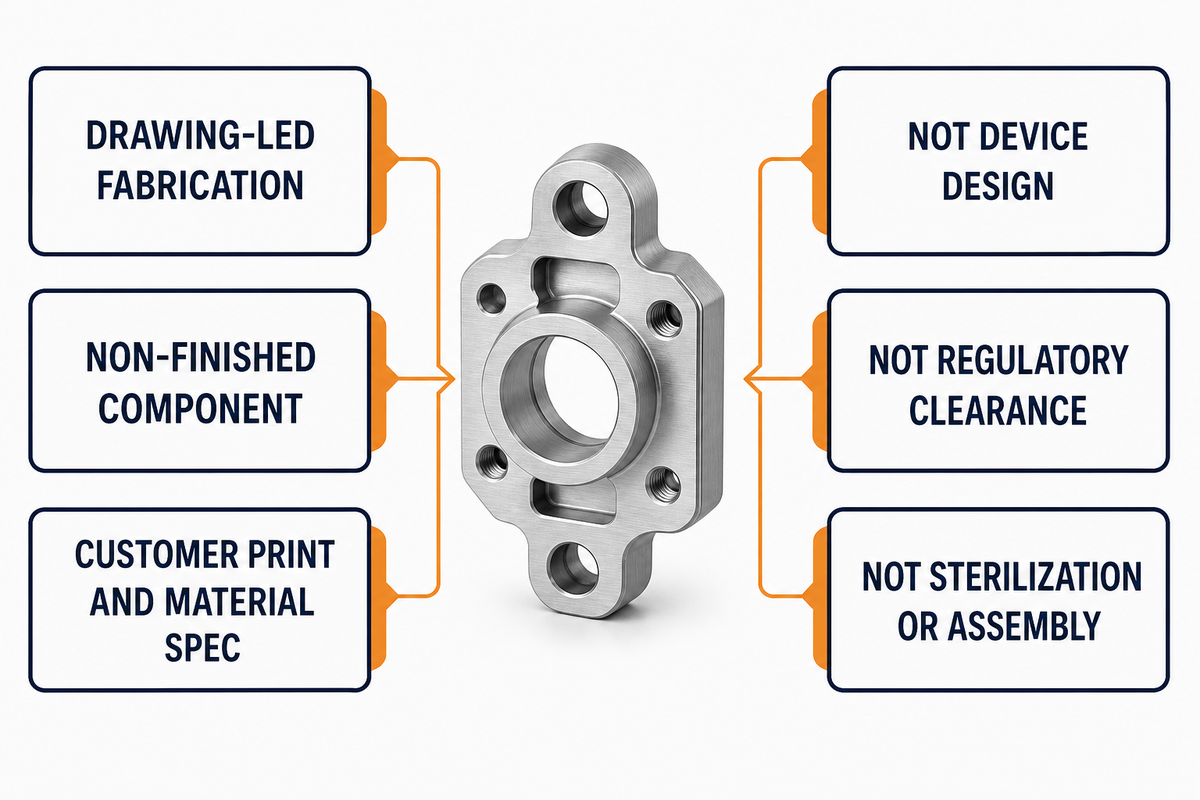
Medical CNC machining is the drawing-led fabrication of non-finished metal or plastic components for medical equipment, distinguished from finished-device design, regulatory clearance, sterilization, and assembly. Machining shops cut parts to a customer’s print and material specification; they do not design, clear, sterilize, or assemble the finished medical device unless separately contracted and qualified for that scope.
Typical examples include equipment housings and brackets, connector bodies, fluid-path fittings, and structural hardware for diagnostic or surgical systems. These are defined by a CAD model, drawing, material specification, tolerances, and an agreed inspection plan. Milling, turning, Swiss turning, and multi-axis machining may all be used, but the work remains component manufacturing until the item itself meets the regulatory definition of a finished device or accessory. That finished-device boundary matters in the QMSR discussion later in this guide.
Search language varies: medical machining, CNC medical machining, CNC machining for medical devices, and CNC machining in the medical field can describe the same broad sourcing category. For procurement, machining for the medical industry still means defining medical parts and components through precision machining and a controlled print, rather than assuming that any machine parts are cleared medical products.
One market-research estimate values the global medical device contract manufacturing market at USD 87.43 billion in 2025 and projects USD 153.13 billion by 2034, a 6.5% CAGR. These third-party estimates describe the broader contract-manufacturing market; they do not measure machining alone or attribute revenue to Zhenling.
How Medical CNC Machining Works: Process Types Compared
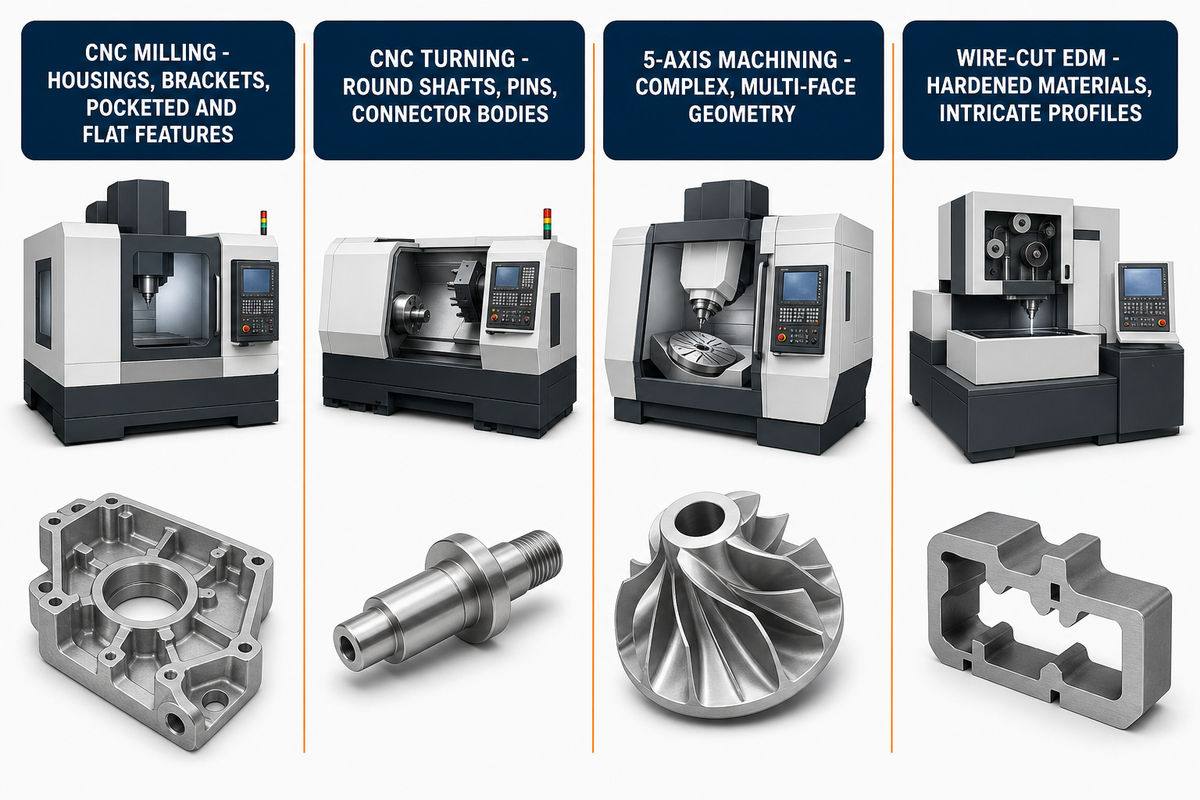
Four types of CNC machining processes cover most medical-component work: CNC milling, CNC turning (including Swiss CNC turning), 5-axis machining for complex multi-face components in a single setup, and wire-cut EDM for hardened or intricate-profile features, each suited to a different combination of geometry, material, and tolerance. Used well, CNC machining can hold the tolerance and finish a medical drawing actually calls for, but these machining technologies are not interchangeable, and no single one is a drop-in substitute.
The medical manufacturing process may combine rapid prototyping with production machining, but process selection remains geometry- and evidence-specific. Buyers comparing CNC machining for medical work, or CNC machining for the medical sector more broadly, should ask how the machine shop controls CNC machining technology, 5-axis CNC machines, and other machining applications instead of assuming that using CNC machining ensures reliability.
For complex medical geometry, the types of CNC selected may include precision CNC machining, Swiss CNC, or 5-axis work. Those CNC machining processes can make precision parts, yet no machine choice by itself establishes fitness for a demanding medical application.
| Process | Typical geometry / use | Tolerance capability | Notes |
|---|---|---|---|
| CNC milling | Housings, brackets, pocketed and flat features | General to tight, feature-dependent | Common first choice for prismatic geometry |
| CNC turning (incl. Swiss-type) | Round shafts, pins, small-diameter connector bodies | Down to ±0.0025mm (±0.0001in) on Swiss-turned features | Swiss CNC turning suited to slender parts prone to deflection |
| 5-axis machining | Complex, multi-face geometry in one setup | Tight, setup-dependent | Reduces repositioning error on complex parts |
| Wire-cut EDM | Hardened materials, intricate internal profiles | Tight on profile; surface-finish-limited | Not always suitable where a fine surface finish is required |
A published supplier case study on a titanium spinal implant housing illustrates why process selection matters, even though implant-grade titanium sits outside Zhenling’s material scope. Reported requirements included a 6.00mm bore at +0.00/−0.01mm and Ra 0.4µm, with Ra 0.31µm reported after machining. According to the source, 5-axis machining and CNC turning were used, while a wire-EDM workaround on comparable geometry could not meet the required surface finish. This is one supplier’s case study, not a universal capability guarantee.
Swiss-type turning is often selected for small, slender turned parts because the guide bushing supports stock close to the cutting zone and limits deflection. It can serve both prototypes and production, but tooling, offsets, inspection frequency, and process validation still change with the drawing and lot requirements.
Materials in Medical CNC Machining: An Industry Overview
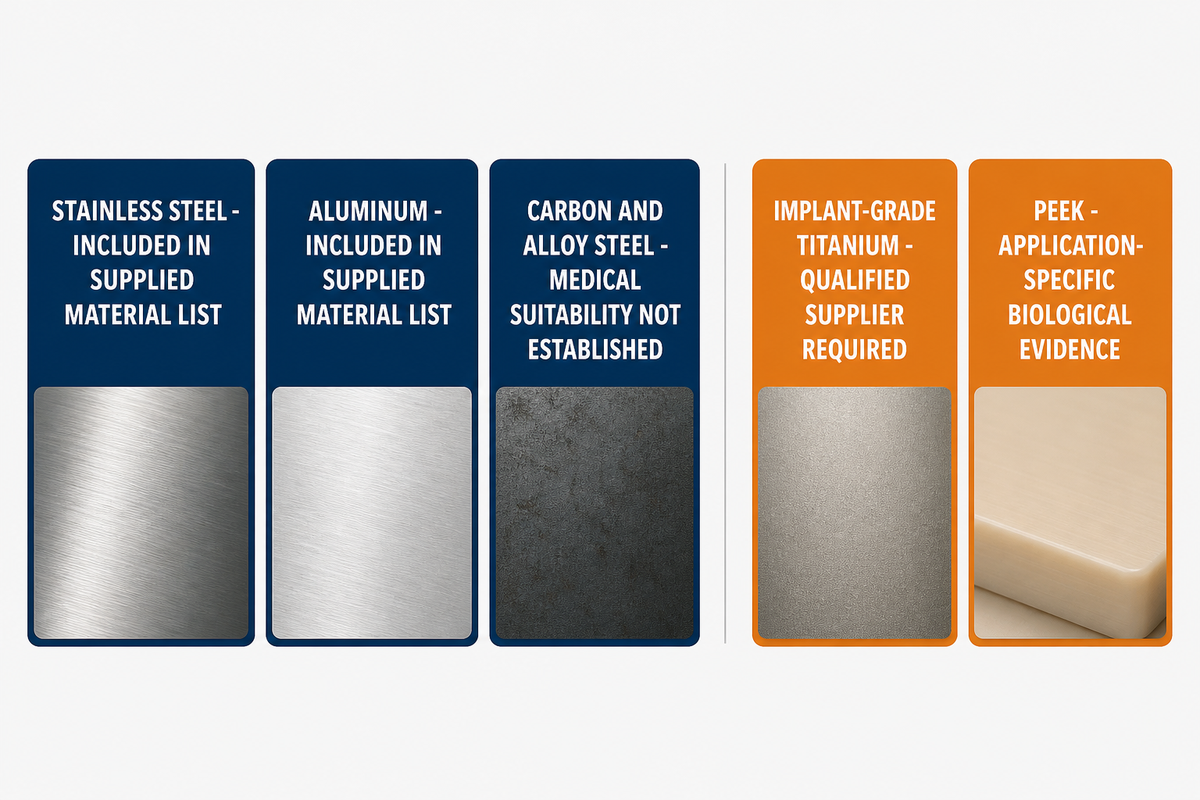
Not all of the metals and plastics conventionally found in CNC machine shops are also commonly selected for medical parts and components. Although a metal may be routinely machined, its use in a medical application can add buyer-specific quality-system, material-traceability, or biocompatibility documentation requirements. Whether the machining supplier itself must hold ISO 13485 depends on the part’s status, the legal manufacturer’s supplier controls, and the quality agreement.
Materials for medical applications are selected by the device team, not by a keyword list. When precision medical components, medical implants, or other complex medical devices are involved, material selection and biological evaluation must follow the finished item’s contact profile and risk analysis.
| Material group | Zhenling scope disclosed for this project | Medical-use evidence boundary |
|---|---|---|
| Stainless steel 303 / 304 / 304L | Included in the supplied material list | Drawing, end use, material traceability, and finish requirements still control |
| Stainless steel 316 / 316L / 321 | Included in the supplied material list | Corrosion resistance and passivation must be specified and verified for the application |
| Aluminum 6061 / 7075 | Included in the supplied material list | No implant or body-contact suitability is inferred from machinability |
| Aluminum 5052 / 2024 | Included in the supplied material list | Buyer must define grade, temper, traceability, finish, and end-use restrictions |
| Carbon steel | Included in the supplied material list | Medical suitability is not established; use is drawing and device specific |
| Alloy steel | Included in the supplied material list | Medical suitability is not established; use is drawing and device specific |
| C276 | Included in the supplied material list | Application-specific chemistry, traceability, and inspection requirements must be confirmed |
| 904L | Included in the supplied material list | Application-specific chemistry, traceability, and inspection requirements must be confirmed |
| Implant-grade titanium | Not established by the supplied evidence | Requires a qualified supplier and the legal manufacturer’s material and biological-evaluation controls |
| PEEK and other body-contact polymers | Not established by the supplied evidence | Grade, processing, traceability, and biological-evaluation evidence are application specific |
ISO 10993-1 frames biological evaluation within a risk-management process, and the FDA guidance on ISO 10993-1 explains its use for devices with body contact. A material certificate alone does not establish finished-device biocompatibility. Buyers should align material identity, lot traceability, processing records, and the legal manufacturer’s biological-evaluation plan. For stainless parts, passivation may also be specified to remove free iron from the surface and support formation of a chromium-rich passive layer; it should be an explicit drawing or purchase-order requirement, not an assumed side effect of machining.
⚠️ Materials Verified vs. Materials Covered for Education
Project materials confirm Zhenling’s scope as stainless steel (303, 304, 304L, 316, 316L, 321), carbon and alloy steels, corrosion-resistant alloys C276 and 904L, and aluminum (6061, 7075, 5052, 2024). Supplied evidence does not establish implant-grade titanium or PEEK capability, cleanroom or sterilization processes, bioburden control, or ISO 13485/9001 certification. Those requirements must be verified with the supplier selected for the specific part.
Tolerances, GD&T, and Surface Finish Conventions for Medical Components
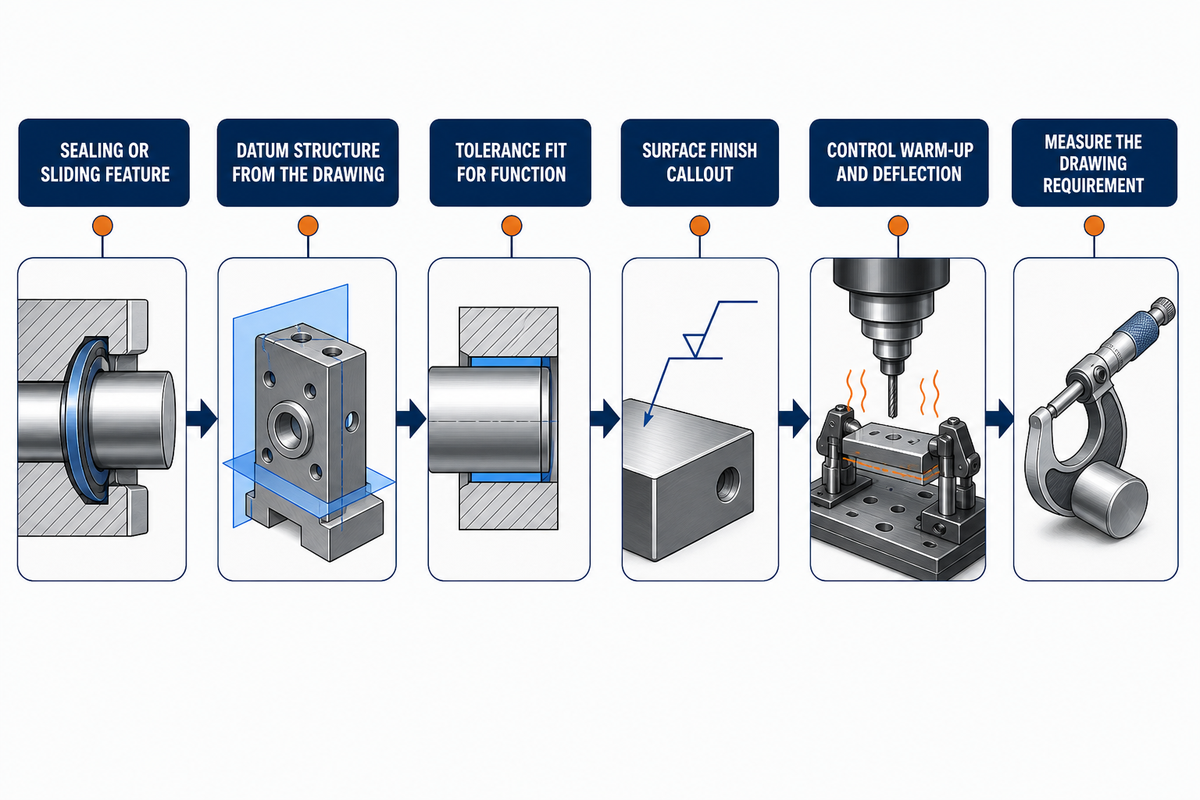
Industry examples used for this guide span ±0.127mm (±0.005in) on general features down to ±0.0025mm (±0.0001in) on selected tight-tolerance features. These are comparison points, not default medical tolerances. Each released drawing defines the requirement, ASME Y14.5 (2018 edition) defines GD&T notation when invoked, and the supplier must confirm capability for every feature and inspection method. An Ra 3.2µm as-machined finish is a common quoting baseline, but sealing, bearing, and implant surfaces can require a different specified finish and process.
That same third-party case study reports a 6.00mm +0.00/−0.01mm bore, an Ra 0.4µm finish requirement with Ra 0.31µm achieved, and an M3×0.5 Class 6H thread. It also reports a 0.8mm wall deflecting 0.06mm during roughing before a fixture and toolpath change reduced deviation to 0.008mm. A separate bore drift from 6.000mm to 5.997mm was addressed with warm-up and boring-bar compensation. These figures document that supplier’s reported job; they are not Zhenling production records.
Precision surgical hardware and every surgical tool drawing need their own feature-level acceptance criteria. Process reliability and reliable medical supply depend on inspection evidence for those precision parts, not on a generic claim that CNC machining ensures accuracy.
Why Are Micrometers Critical in Machining Medical Parts?
Because at the tolerance levels used on medical components, sometimes a few thousandths of a millimeter, a difference invisible to the eye can be the difference between a part that seats, seals, or threads correctly and one that fails at final inspection. That worked example above makes this concrete: a 0.06mm wall deflection was six times the drawing’s allowed tolerance, and a 0.003mm bore drift over one production run was enough to require an active compensation routine.
Common Drawing and Tolerance Mistakes to Watch For
Drawing reviews often surface preventable mistakes. These include assuming the CAD origin automatically acts as a datum, specifying a tighter tolerance than the function needs, and omitting a surface-finish callout on a sealing or sliding feature. A second drawing review before quotation is a low-cost way to align datum structure, manufacturing setup, and inspection method.
The Quality-System Landscape: ISO 13485 and FDA 21 CFR 820 Explained
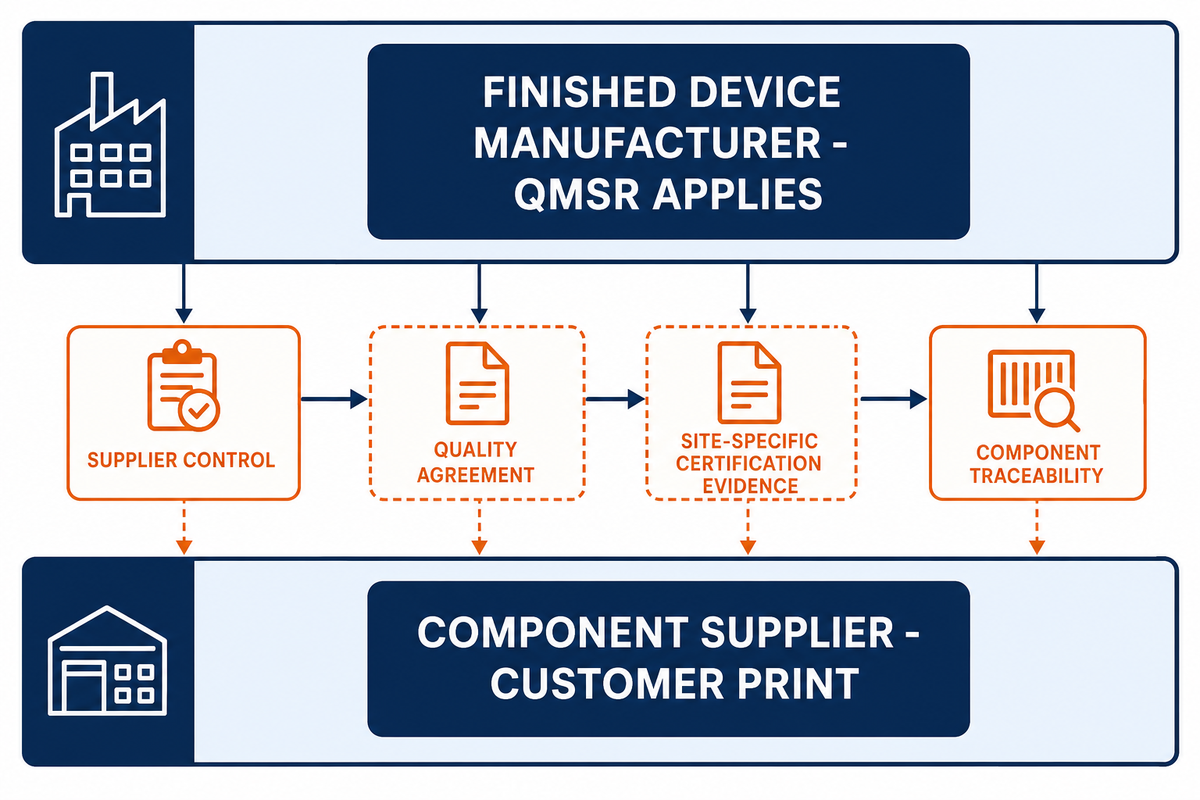
ISO 13485:2016 specifies a quality-management-system framework for organizations involved in the medical-device life cycle. Since February 2, 2026, the FDA’s QMSR has incorporated ISO 13485:2016 by reference into 21 CFR Part 820, with additional FDA-specific provisions. Buyers should verify a certificate’s holder, site, scope, issuer, and validity, then connect that certificate to the actual quality records and quality agreement for the component.
FDA issued the QMSR final rule on January 31, 2024, with an effective date of February 2, 2026. It applies to manufacturers of finished devices. FDA’s definition includes a device or accessory suitable for use or capable of functioning, and the agency notes that some components, including blood tubing and diagnostic X-ray components, are themselves finished devices. A component supplier therefore cannot determine regulatory scope from the word “component” alone; the legal manufacturer must classify the item and define supplier controls.
That does not leave an uncertified subcontractor outside the buyer’s quality system. Requirements-management commentary on the QMSR transition explains that supplier weakness can create inspection exposure for the legal manufacturer. A quality-practitioner discussion describes the corresponding audit practice. These secondary and practitioner sources support a practical recommendation, not a legal opinion: document supplier requirements, records, audit rights, and change control in the quality agreement.
Medical device manufacturers and other legal medical manufacturers set supplier controls for medical device manufacturing and medical device development. The fabrication of medical devices and components therefore carries different obligations at different tiers; a statement that all medical devices must come from an ISO 13485-certified machine shop would be too broad.
Before You Choose a Supplier, Verify:
- Real quality system records, not simply a generic certificate name
- Certificate holder, site, scope, issuer, and current validity
- Quality agreement and controls that apply to the subcontracted process
- Material, lot, inspection, nonconformance, and change-control records for the actual component
⚠️ Important, Zhenling’s Current Certifications
Company materials supplied for this project list CE and ASME documentation but do not establish ISO 13485 or ISO 9001 certification. Ask for the certificate identity, scope, and current validity required by your purchasing controls. For Zhenling’s disclosed machining scope, see the Medical CNC Machining Services page.
Where Medical CNC Machining Is Used: Application Categories
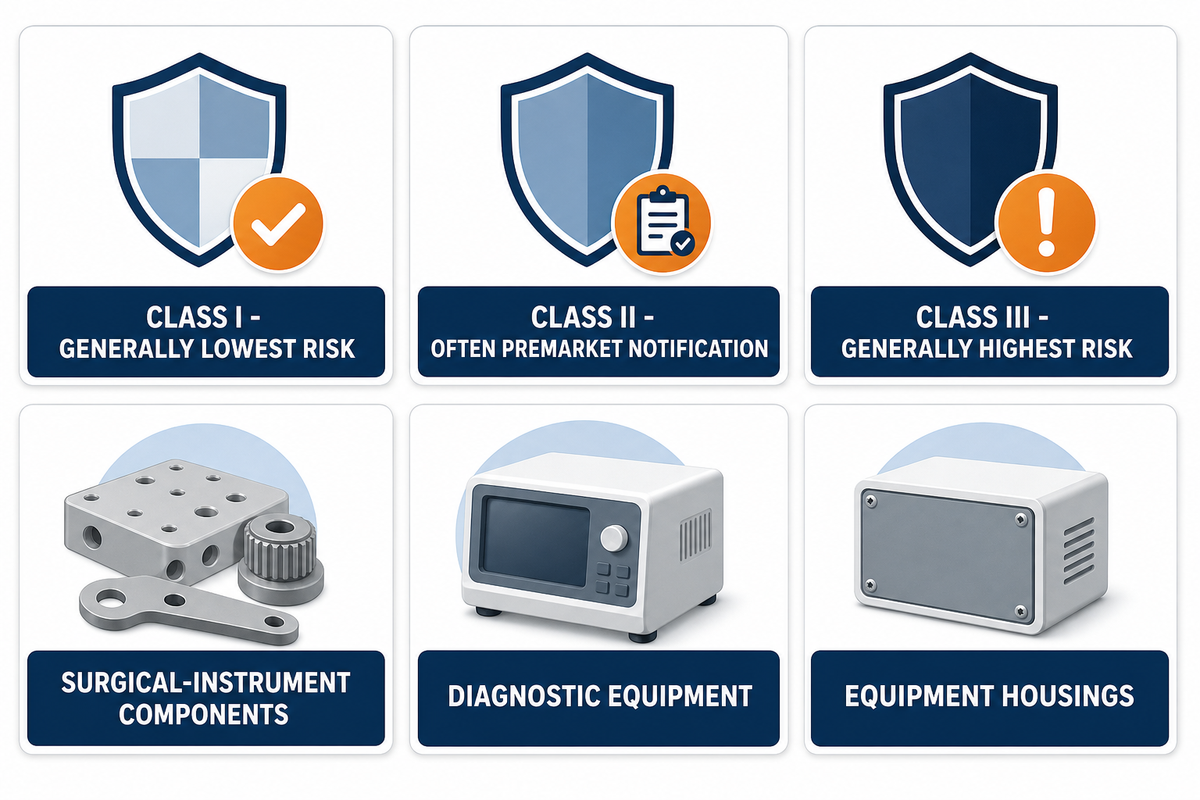
Machined components appear in surgical instruments, diagnostic equipment, orthopedic systems, laboratory equipment, housings, and structural assemblies. A component’s end use does not by itself establish its FDA class. Legal manufacturers classify finished devices and then flow the relevant material, process, inspection, and traceability requirements to suppliers.
What Are Class I, II, and III Medical Devices?
FDA groups devices into Class I, II, and III according to risk and the regulatory controls needed to provide reasonable assurance of safety and effectiveness. Class I generally carries the lowest risk and Class III the highest, but classification is product-specific. Many Class II devices require premarket notification, while many Class III devices require premarket approval; the FDA classification database and applicable regulation provide the authoritative route for a particular device.
Examples of machined work include small surgical-instrument components, connector bodies, equipment housings, fixtures, and implant-adjacent instrument hardware. Supplier qualification depends on the actual device, component function, patient-contact profile, and controls assigned by the legal manufacturer, not on a broad application label.
Search phrases such as “CNC medical,” “CNC machining medical devices,” and “CNC machining of medical devices” collapse component machining and finished-device responsibility into one label. In real medical technology programs, the production of medical parts may involve several suppliers, and each must be qualified only for its assigned scope.
ISO 13485 certification can be an important qualification signal, but it is not the only supplier-selection input for a non-finished component. Buyers should also assess material scope, process capability, inspection resources, traceability, change control, communication, and the specific quality agreement.
The Component-vs-Certified-Device Scope Test
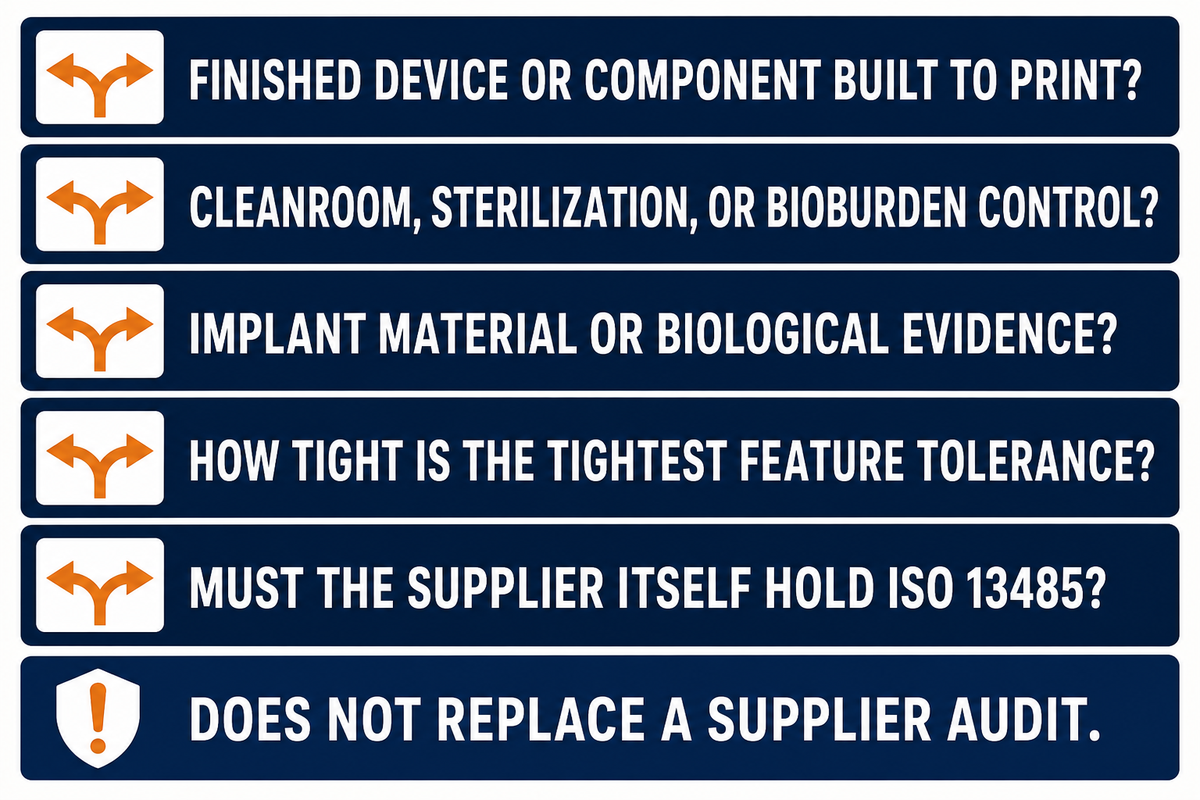
Use this five-question test for initial supplier triage, not regulatory classification. A conventional drawing-led component shop is more likely to fit when the item is not itself a finished device or accessory, the supplier does not perform controlled cleaning or sterilization, the material and tolerances fall within documented shop capability, and the legal manufacturer’s purchasing controls do not require the supplier to hold ISO 13485. Any uncertain answer should go back to the legal manufacturer’s quality and regulatory teams.
| Question | More likely a component-shop fit | Requires legal-manufacturer or specialist review |
|---|---|---|
| 1. Finished device/accessory, or a component built to your print? | Component, built to print | Finished device or accessory (e.g., blood-contact tubing, diagnostic X-ray component) |
| 2. Does the part need cleanroom assembly, sterilization, or bioburden control? | No | Yes |
| 3. Does the application require implant-grade material controls or biological-evaluation evidence? | No; standard material and traceability requirements | Yes, or the patient-contact profile is unclear |
| 4. How tight is the tightest feature tolerance? | Within the shop’s documented process and inspection capability | Requires a capability study, process qualification, or inspection method the shop cannot document |
| 5. Must the supplier itself hold ISO 13485 (vs. meeting expectations through a quality agreement)? | No | Yes |
These five answers narrow the supplier pool, but they do not replace drawing review, device classification, a quality agreement, or a supplier audit. Send candidate shops the same controlled drawing and ask each one to identify exceptions, outsourced processes, inspection methods, traceability records, and change-control terms. That produces a more meaningful comparison than certificate names or price alone.
The right medical CNC machining partner is the supplier whose documented material, process, inspection, and quality-system scope matches the released drawing. That test is more useful than choosing among nominal medical CNC machining services by marketing language alone.
For component-shop inquiries, project materials state Zhenling’s commercial baseline as ISO 2768-m for untoleranced metal dimensions and Ra 3.2µm (126µin) as-machined unless the drawing specifies otherwise. They also state a typical quotation response within 12 business hours, prototype lead time of 3-5 days, production lead time of 7-15 days after drawing approval, no minimum order quantity, and NDA availability. Treat each point as a quotation-stage baseline that must be confirmed for the released drawing, material, inspection plan, and delivery location.
Q: What is CNC in the medical industry?
CNC, computer numerical control, machining in the medical industry means computer-guided cutting equipment removing material from metal or plastic stock to produce components to a drawing’s exact dimensions.
Work may use milling, turning, or multi-axis machining to produce housings, instrument parts, and connector bodies from a controlled drawing. CNC avoids dedicated mold tooling, although fixtures and inspection plans remain part-specific.
Q: Why is Swiss turning preferred for medical components?
Swiss-type turning holds tight diameter tolerances on small, slender parts by supporting the material close to the cutting tool, reducing the deflection that standard turning centers struggle with on thin features.
This makes it a common choice for small connector bodies, pins, and other slender components where a conventional lathe setup may be more sensitive to chatter, deflection, or out-of-round features. Because stock support alone does not establish capability, the buyer should still ask how diameter, length-to-diameter ratio, material, tool access, thermal control, and inspection frequency affect the quoted tolerance. A supplier should answer against the drawing rather than a machine brochure.
Q: Why is the medical industry so reliant on CNC machining?
CNC machining can produce complex components without dedicated mold tooling, while supporting controlled inspection and documented revisions across prototype, validation, and production quantities when the process is properly planned.
Digital programs ease geometry changes, but production transfer still requires controlled tooling, offsets, inspection, and records. Traceability comes from the quality system, not the machine.
Q: Does a machining supplier need ISO 13485 to make medical components?
Not automatically; the answer depends on the item’s regulatory status, the legal manufacturer’s supplier controls, and the quality requirements assigned through the drawing, purchase order, and supplier agreement.
QMSR applies to manufacturers of finished devices and accessories, and some items called components may themselves meet that definition. Even when a subcontractor is not directly subject to QMSR, the legal manufacturer remains responsible for supplier controls. Depending on device risk, process criticality, market, and internal purchasing procedures, the buyer may require ISO 13485 certification, a supplier audit, validated special processes, additional inspection records, or equivalent controls through the quality agreement. Confirm the requirement before quotation; a blog cannot classify the item.
Q: When does material selection require specialist evidence?
Implant-grade titanium, PEEK, and other materials used for direct or indirect body contact may require application-specific material, processing, traceability, cleaning, and biological-evaluation evidence defined by the responsible device manufacturer.
Material family alone does not decide the evidence package. Legal manufacturers evaluate contact type, duration, processing residues, geometry, and intended use before defining supplier controls. ISO 10993-1 supports that risk-based evaluation; it is not a blanket certification for raw material or a machine shop. Buyers should connect mill certificates and lot traceability to the final device evaluation rather than treating either document as proof by itself.
Q: How are these medical parts made?
Most medical CNC parts start as a 3D CAD model and a machinist-reviewed drawing, then get cut from bar or billet stock using CNC milling, turning, or multi-axis machining, followed by inspection against the drawing’s tolerance and finish callouts before shipment.
Round and contoured features may be split across turning and 5-axis milling, or combined where the equipment and process plan support it. Fewer setups can reduce repositioning error.
Our Perspective
This guide stays on the machining side of the medical supply chain, not the regulatory or device-design side. It separates industry examples from Zhenling’s disclosed scope and treats implant-grade titanium, PEEK, cleanroom processing, sterilization, and ISO 13485 certification as requirements that need separate evidence. Reliable component sourcing starts with that boundary being explicit.
Related Articles
- Tool Steel CNC Machining Guide material selection and machining considerations for tool steel components
References & Sources
- Quality Management System Regulation (QMSR) U.S. Food and Drug Administration
- Classify Your Medical Device U.S. Food and Drug Administration
- Overview of Medical Device Classification and Reclassification U.S. Food and Drug Administration
- Use of International Standard ISO 10993-1 U.S. Food and Drug Administration
- ISO 13485:2016, Medical devices quality management systems International Organization for Standardization
- ISO 10993-1:2025, Biological evaluation of medical devices International Organization for Standardization
- Machining Micro Parts for Medical Modern Machine Shop
- CNC Technology Produces Medical Implants with High Precision Medical Design & Outsourcing
- Medical Device Contract Manufacturing Market Fortune Business Insights
- Precision CNC Machining Case Study: Medical Parts GD Prototyping
- Quality Management System Regulation Overview Jama Software
- ISO 13485 Contract Manufacturer Audit Discussion Elsmar Cove Quality Forum