Get in touch with Zhenling Company

Magnesium CNC Machining Services for Drawing-Based Custom Parts
Send the current drawing or model, specified magnesium alloy, critical dimensions, surface requirements, quantity, and destination. Zhenling will review the manufacturing route and identify what can be confirmed, what needs clarification, and what requires project-specific evidence before quotation. Magnesium CNC Machining enquiries should include alloy availability, drawing, tolerance, coolant, chip-control evidence, finishing and documented safety route. Keep open questions visible. Capability, records and timing become order-specific only when the written quotation closes those questions.
Capability boundary: magnesium-specific alloy availability, tolerance, tooling, coolant, chip control, fire response, finishing, documentation, and lead time are confirmed for each project. This page does not turn general CNC equipment into an automatic magnesium qualification.
Since 2006
Company operating history
8,000 m²
Jiashan site; 6,000 m² workshop
3-, 4- and 5-axis
General machining centers stated by Zhenling
Project review
Magnesium scope confirmed before quotation
From Weight Targets to a Qualified Magnesium Machining Route
Weight reduction is only the first input. Route selection also depends on stiffness, vibration, load, temperature, corrosion interfaces, stock form, finishing, inspection, service environment, and the evidence needed to release the finished magnesium parts. A peer-reviewed magnesium application review describes a staged design, analysis, manufacturing, and testing route; that sequence is category context, not proof of Zhenling capability.
Step 01: Reason
Define the reason for magnesium
State the mass target, assembly function, operating environment, and the failure or performance mode that matters. “Make it lighter” doesn’t tell a supplier whether the part must resist distortion, protect electronics, manage vibration damping, or survive a dissimilar-metal interface.
Decision checkpoint
risk and cost mismatch appear because the cited 280 N/mm² versus 640 N/mm² cutting-force comparison does not prove an automotive or aerospace part’s CNC precision route. Lower cutting force is not always a lower total quote. Unlike a generic material pitch, you can request a specific drawing review; Zhenling will not claim that category data certifies its machine, tool, or process.
Step 02: Material
Define the material condition
Name the alloy, temper or condition, product form, governing specification, and allowed substitution route. AZ31B and AZ91D may appear in searches, but a wrought alloy and a die-cast alloy aren’t interchangeable purchasing labels.
Step 03: Qualify
Qualify the complete route
Connect the workpiece, machine, tool, workholding, chip management, surface finish, inspection, packaging, and sub-tier processes. Useful quotations expose every open assumption that can change cost or acceptance.
Lower cutting force is not a universal cost answer
Luxfer MEL Technologies reports a mean specific cutting force of 280 N/mm² for magnesium versus about 640 N/mm² for aluminum, and says machining magnesium may need roughly 55% of the power used for aluminum.1 Treat those figures as representative source data, not a promise for every alloy, cutter, machine, or geometry.
- Lower cutting force may reduce the load at the cutting edge.
- Part stability can still limit how aggressively a component is machined.
- Tool accuracy, sharpness, chip extraction, clearance, and machine limits still shape machining time.
- Inspection, fire safety, finishing, and logistics can outweigh the cutting-power difference in the quote.
55%
Industry-source estimate for magnesium cutting power relative to aluminum under the cited context.1
7 inputs
Drawing revision, material, quantity, geometry, finish, inspection, and delivery package still govern a comparable quotation.
How to use the comparison
Decision: use the power figure to frame a question, not to calculate universal savings. Zhenling must quote the reviewed part.
Weight & stiffness
What mass target and deflection limit must the part meet?
Calling magnesium the lightest structural metal does not replace load and stiffness analysis.
Material identity
Is the requirement pure magnesium, a named magnesium alloy, or a performance selection?
Chemistry, condition, and product form affect sourcing, machining, finishing, and validation.
Environment
Which temperature, moisture, chemical, electrical, and dissimilar-metal interfaces apply?
Corrosion resistance and protection must match the assembly, not a generic material description.
Volume pattern
Is this a prototype, a bridge run, or repeat production with stable revisions?
Setup, inspection, material commitments, and change exposure differ by release pattern.
Test the material decision before requesting a firm quote
Send one critical feature, the weight objective, and the specified alloy or open material question. This low-friction review can reveal whether the RFQ is ready for a full machining proposal.
Review Alloy, Geometry and Process Fit for Custom Magnesium Parts
CNC machining magnesium starts with a controlled material callout and a geometry review. The external application review supports a staged development process, but it does not select an alloy or approve a process for this order.
Suppliers can’t responsibly offer CNC-machined magnesium parts from the keyword alone because the alloy, stock form, clamping surface, feature access, edge condition, and inspection datum all affect the machining process. Any supplier asked to offer magnesium machining needs those inputs before it can evaluate fit.
Material packet
- Alloy and temper or condition
- Plate, bar, extrusion, casting, forging, or buyer-supplied blank
- Material specification and certificate expectation
- Approved substitutions and approval owner
- Lot traceability and marking needs
DECISION CHECKPOINT
Material mismatch creates risk and delay because AZ31B, AZ91D, and different product forms aren’t interchangeable. The external 280 N/mm² versus 640 N/mm² comparison doesn’t prove precision capability for an automotive or aerospace application. Unlike a stock table, a request for a specific drawing review makes the material trade-off visible.
Geometry packet
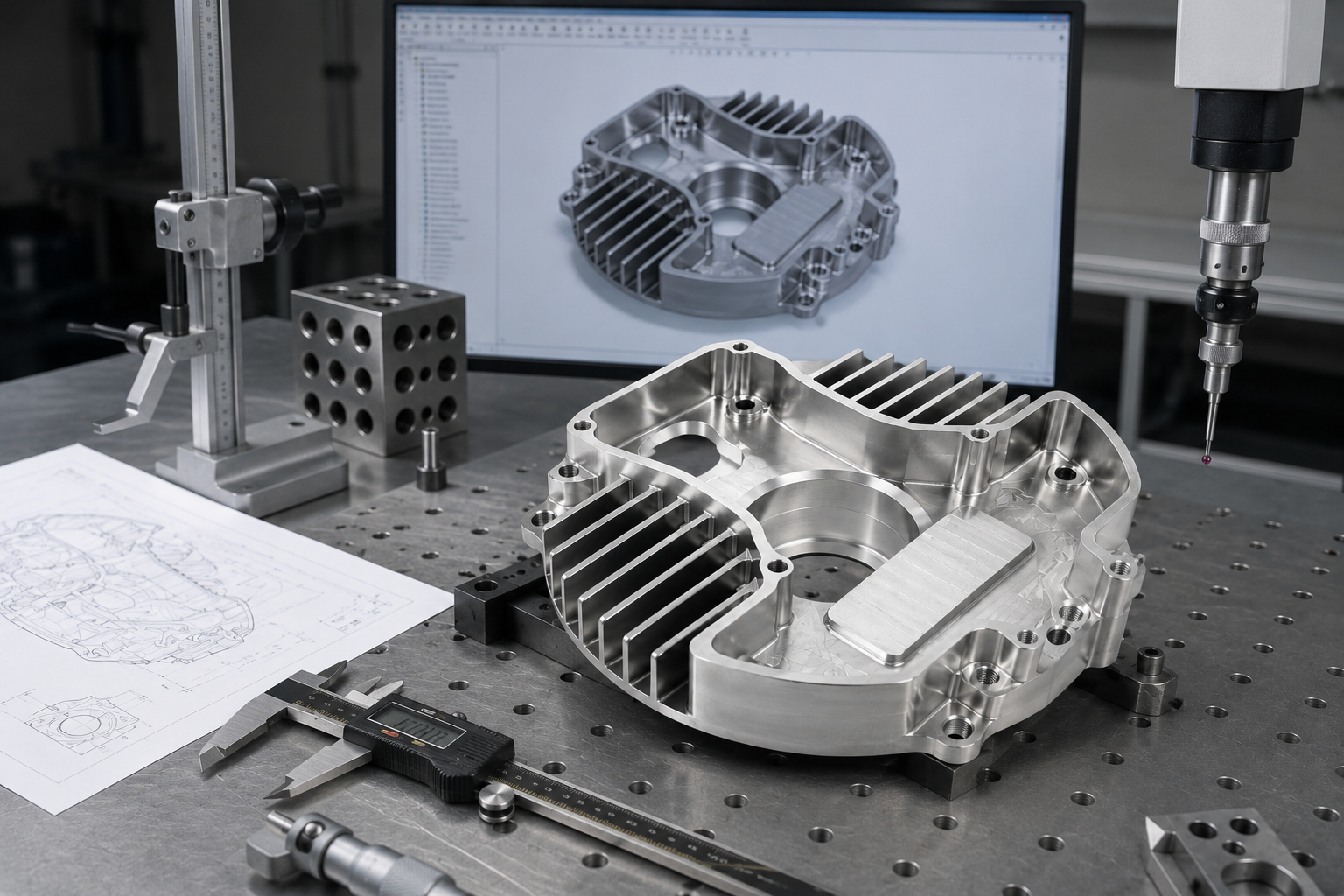
- Controlled drawing and three-dimensional model
- Datums and critical tolerance relationships
- Thin walls, deep pockets, ribs, threads, and small radii
- Clamping faces and distortion-sensitive features
- Burr, edge-break, and cosmetic-face requirements
 GEO DATA SECURED
Production packet
- Prototype and release quantities
- Expected annual demand and revision stability
- Required date and destination
- Inspection and document package
- Finish, packaging, and sub-tier approvals
SEARCH BOUNDARY
AZ31B, AZ91D, magnesium plate, magnesium billet, and cast magnesium are useful prompts for a material discussion. They are not a Zhenling stock list or proof that the named grade has already been qualified on a particular machine.
Match geometry to a route, not to a machine list
| Drawing signal | Route question | Confirmation needed |
|---|---|---|
| Multiple indexed faces | Can 4-axis or 5-axis access reduce refixturing without weakening workholding? | Setup concept, datum transfer, protected faces, and inspection sequence |
| Round features or concentric diameters | Does turning establish the functional datum before milling? | Machine route, transfer logic, runout definition, and measurement method |
| Thin walls or flexible ribs | How will the workpiece be supported without clamp distortion? | Stock allowance, fixture contact, operation sequence, and release measurement |
| Deep cavity or small internal radius | Can the tool reach without excessive overhang or chip recutting? | Tool diameter, reach, corner relief, chip path, and finish expectation |
| EDM callout or inaccessible feature | Is the proposed operation compatible with the specified material and risk-control plan? | Written process qualification and ownership; never infer fit from general EDM capability |
Tool and workpiece review
Industry guidance links exceptional machinability with high cutting speeds and lower cutting force, but it also warns that workholding instability can become the limiting factor.1 A practical review covers cutter geometry, tool life assumptions, edge condition, fixture load, chip formation, and the surface left for inspection or finishing.
Clearance and finish review
Don’t copy a generic instruction such as “avoid tight clearance angles” into a purchase order without context. Ask the supplier to explain the selected tool geometry, expected burr behavior, excellent surface finish target, and how the plan protects the final datum and cosmetic surfaces.

TOLERANCE / RUNOUT LOGIC
Magnesium’s machinability can make the cut look simple. Qualification remains difficult because the material condition, fixture, chips, fire controls, inspection, and finish route must work as one system.
Verify Magnesium-Specific Qualification and Safety Evidence
Fine magnesium chips and dust are a combustible-metal hazard. A responsible buyer asks whether the proposed machining of magnesium has a documented, order-relevant control route that covers chips, ignition sources, fluid selection, housekeeping, fire response, people, and waste handling, not merely whether the supplier owns a CNC mill.
Regulatory Baseline
U.S. OSHA scope to preserve exactly
OSHA 1910.157(d)(6) requires portable fire extinguishers or other containers of Class D extinguishing agent to be distributed so travel distance from a combustible-metal working area is 75 feet (22.9 m) or less. Its coverage includes areas where combustible-metal powders, flakes, shavings, or similarly sized products are generated at least once every two weeks.2
What the regulation does not prove
This regulatory statement doesn’t prove that Zhenling has a Class D fire extinguisher, a Type D fire system, or any specific facility configuration. Ask for the applicable site evidence and jurisdictional review for the proposed order.
Forum pain point: several shops declined magnesium work before one buyer found a willing supplier.6 The trade-off is not simply capacity versus price; a bidder must show that its proposed route and controls are credible.
External requirement verified
Extinguishing-agent access
Confirm the applicable Class D agent, its placement, inspection status, training, and response plan. An ABC extinguisher isn’t a substitute for a Class D fire response when combustible magnesium is involved.
Decision checkpoint: missing fire-response evidence is a safety problem because OSHA defines a 75 ft (22.9 m) travel-distance condition for covered areas.2 Zhenling will not claim that its CNC production site meets this magnesium-specific requirement without records. Unlike a generic extinguisher statement, a request for a specific safety evidence review tests the real trade-off.
Project confirmation needed
Chip and dust control
Ask how magnesium chips are separated, evacuated, collected, stored, and removed from the machine shop. A complete answer addresses routine cleanout, fine material, cross-contamination, hot particles, and responsibility for disposal.
Project confirmation needed
Fluid and hydrogen risk
A 2025 safety review warns that water-based or emulsion fluids can react with magnesium and generate flammable hydrogen.3 Request the qualified coolant or dry-machining route, ventilation basis, monitoring, and exception handling for the actual alloy and operation.
Project confirmation needed
Ignition prevention
Ask how the route manages heat, friction, a spark, tool damage, chip recutting, static sources, and accumulated fines that could ignite. “Magnesium is difficult to ignite as a finished mass” doesn’t make small chips and dust safe.
Project confirmation needed
People and procedure
Request task-specific work instructions, training scope, emergency roles, housekeeping frequency, and incident escalation. A safe production claim needs current records and ownership, not a generic safety sentence.
Zhenling magnesium controls
Available first-party files don’t prove magnesium-specific suppression, extraction, coolant qualification, trained operators, insurer approval, or disposal procedures. These items must be confirmed before the quote is treated as a qualified route.
Supplier Safety Evidence Check
| Ask for | Useful evidence | Weak answer to challenge |
|---|---|---|
| Comparable magnesium work | Redacted route sheet, material and geometry scope, date, result, and lessons learned | “We machine every metal” |
| Chip-control route | Equipment description, segregation map, cleaning frequency, storage method, and responsible role | “The machine has a vacuum” |
| Fire response | Applicable Class D agent, access, inspections, training, drill or response record, and local requirements | “We have fire extinguishers” |
| Fluid decision | Approved process, compatibility basis, ventilation, monitoring, and deviation control | “We use normal coolant” |
| Waste route | Collection, labeling, temporary storage, transporter or recycler responsibility, and prohibited practices | “Chips are recycled” |
Use the evidence check before supplier approval. Open the on-page checklist during a technical call and record whether each answer is verified, pending, not applicable, or unsupported. This checklist exposes gaps; it doesn’t certify a supplier.
Confirm Tolerances, Inspection, Finishing and Documentation from the Drawing
Magnesium precision machining isn’t one tolerance number. Feature size, datum structure, wall flexibility, material form, workholding, tool access, operation order, temperature, finish allowance, and measurement method can all change what’s practical and what evidence can support acceptance. The reviewed development sequence places testing after design, formability and process analysis; it does not define a universal tolerance or inspection method.
Feature-based tolerance confirmation
Mark the dimensions and geometric controls that affect fit, seal, motion, alignment, or approval. Ask Zhenling to confirm the proposed process and inspection method for those features instead of applying a universal machining tolerance to the complete drawing.
- Controlled datum reference frame
- Critical dimension and functional reason
- Measurement method and access
- Sampling or full-inspection expectation
- Report format and acceptance owner
Decision checkpoint: tolerance ambiguity creates inspection risk and rework because a number without datum, free-state, and method context can misstate acceptance. Zhenling will not claim that a generic ISO or ASME reference proves a specific CNC feature. Unlike a tolerance table, a request for a specific drawing review exposes the measurement trade-off; a CMM is not necessarily the correct method for every characteristic.
Performance-first finishing review
Start with corrosion, wear, appearance, electrical contact, masking, coating thickness, color, adhesion, and test requirements. Anodizing, conversion coating, painting, plating, or powder coating may be candidate surface finishes, but this page doesn’t claim an in-house line or a qualified route.
- Governing finish specification and revision
- Qualified processor or approval requirement
- Masking and electrical contact areas
- Pre-treatment and handling limits
- Certificate, test, and appearance criteria
As-machined condition
Define tool-mark acceptance, burr and edge condition, protected faces, cleaning, and corrosion protection during storage. “Excellent surface” or “excellent surface finish” isn’t an inspection criterion.
Outsourced finish
Name who selects and approves the processor, how parts are protected in transit, which dimensions are measured before and after finishing, and who controls a nonconformance. Each quote should show the sub-tier operation instead of hiding it.
Finished-part release
Agree on material records, dimensional results, finish certificates, visual criteria, labeling, preservation, and traceability. Every document package for finished magnesium parts should be order-specific.
TOLERANCE_CHK
DATUM_A
Drawing Review and Acceptance Matrix
| Critical Item | Drawing Requirement | Proposed Evidence | Before-quote Status |
|---|---|---|---|
| Material identity | Alloy, condition, product form, and specification | Material certificate and lot link requested by buyer | Confirm scope and availability |
| Datum relationship | Functional geometric control | Method, setup, sampling, and report field | Confirm measurability |
| Thin or flexible feature | Size, form, and free-state requirement | Fixture approach and release measurement | Review distortion risk |
| Surface roughness | Specified face, value, direction, and evaluation rule | Instrument and record, where required | Confirm machining and finish interaction |
| Protective finish | Specification, masking, thickness, color, and test | Processor responsibility and certificate or report | Confirm sub-tier route |
| Final shipment | Packaging, labels, preservation, and destination | Packing method and document list | Confirm logistics ownership |
Why this matters: machining a dimension and proving a dimension are different tasks. A coordinate measuring machine, hand gauge, optical method, surface instrument, or functional gauge may be appropriate for different characteristics; the buyer and supplier should agree on the method before production.
Request a feature-based acceptance review
Send the drawing callout, datum structure, material form, finish requirement, and desired report. Unlike a generic tolerance table, the response should connect the specific feature to a machining and measurement route; Zhenling won’t claim a universal tolerance.
Zhenling’s Manufacturing Foundation, and What the RFQ Must Still Confirm
A buyer should be able to distinguish a verified company fact from an order-specific magnesium claim.
This matrix makes that boundary explicit so procurement can compare evidence rather than assuming that a general machine shop profile proves every reactive-metal capability. General factory facts do not establish compliance with the cited OSHA combustible-metal requirement or prove any magnesium-specific control.
Evidence Comparison Matrix
1 / 3
Company history
Provided: Founded in 2006
Use as general operating-history context; it is not the start date of magnesium production.
Manufacturing site
Provided: 8,000 m²
Use as general facility context; request the exact proposed production area and controls.
Machining equipment
Provided: 3, 4, 5-axis centers
Use to begin a geometry discussion; request the actual machine, work envelope, setup, and magnesium qualification.
Machining processes
Provided: Milling, turning
Use to route a drawing review; do not infer that each process is approved for magnesium.
Magnesium alloy range
Not proven
Submit the alloy, condition, product form, specification, quantity, and certificate need for sourcing review.
Magnesium project history
Not proven
Request a comparable, redacted project example matched by alloy, geometry, control route, and date.
Fire and chip controls
Not proven
Request site-specific equipment, procedure, training, inspection, insurer, waste, and emergency evidence.
Tolerance and inspection
Drawing review
Mark critical characteristics and agree on method, sampling, reports, and acceptance before order release.
Surface finishing
Project review
Define performance and specification, then confirm processor, masking, testing, certificates, and logistics.
01
Engineering should request
A marked drawing, proposed process route, alloy interpretation, difficult-feature review, workholding concept, and technical questions that remain open.
02
Quality should request
Material traceability, critical-characteristic methods, sampling, report examples, finish records, nonconformance handling, and record-retention scope.
03
Procurement should request
Included and excluded operations, sub-tier ownership, quantity assumptions, delivery terms, packaging, change notification, and the owner for every unresolved item.
Control the Transition from Prototype to Repeat Production
A successful prototype proves one controlled build, not automatic repeatability. Each later release should preserve material identity, machine and fixture logic, tool condition, chip-control route, inspection evidence, finishing, packaging, and approved changes. The reviewed design-to-testing sequence supports staged verification as category context; it does not prove repeat production at Zhenling.
01 // Drawing baseline
Freeze the drawing and model revision, unit system, conflict rule, critical features, and approved clarifications. Record which unanswered items prevented a firm quote.
Revision mismatch creates delay and rejection risk because the correct magnesium part made to an obsolete file is still wrong. The 2003 external case and its two reported fires show why a machining program alone is not a complete baseline. Unlike a repeat-order assumption, you can request a specific production-control review; Zhenling will not claim automatic transfer from prototype to CNC production.
02 // First-part evidence
Agree on material documentation, characteristic results, visual review, finish evidence, deviations, and approval owner. A first article should test the acceptance plan, not merely show that a part exists.
03 // Repeat controls
Define lot identity, setup verification, tool-change triggers, in-process checks, sampling, traceability, chip and housekeeping routines, and nonconformance escalation.
04 // Change triggers
Require approval for alloy, product form, supplier, machine route, fixture, program, critical tool, coolant route, finish processor, inspection method, packaging, or production site changes.
Prototype-to-Production Release Ladder
| Release | Decision | Evidence that should survive |
|---|---|---|
| Feasibility review | Can the specified part and evidence package be quoted responsibly? | Open-question list, assumptions, exclusions, risk items, and proposed route |
| Prototype | Did the controlled route produce an acceptable part? | Material link, route revision, inspection results, finish status, deviation record, and buyer approval |
| Pilot or bridge run | Can the process repeat while the design or demand is still changing? | Setup checks, lot records, defect and rework data, inspection trend, and controlled changes |
| Repeat production | Can the agreed process, evidence, and delivery package remain stable? | Approved baseline, change notification, periodic verification, nonconformance route, and shipment records |
Risk Control Context
A 2003 Modern Machine Shop profile describes a specialist shop that learned through two fires and emphasized cleanliness plus larger-chip production. This is not a Zhenling result; it shows why a repeat-production baseline must preserve the risk controls as well as the CNC program.
What does not justify fast lead times
Exceptional machinability and short cutting time don't eliminate material sourcing, safety qualification, fixture design, tool preparation, inspection programming, finish processing, or logistics. Ask the quotation to separate review time, material time, machining time, sub-tier time, and delivery time.
What protects repeat orders
A named baseline protects both sides: current files, material, route, critical controls, acceptance records, finish, packaging, and authorized changes. If one of those changes, the supplier should explain the impact before the next lot is released.
A prototype may succeed while repeat-production controls remain unclear. The honest trade-off is that adding explicit change triggers takes work before release, whereas leaving them implicit can create delay, mismatch, or requalification later. Request a prototype-to-production control map.
Build a Quote-Ready Magnesium CNC Machining RFQ
Magnesium CNC machining costs are input-driven. Part complexity, alloy and product form, critical tolerance, quantity, setup count, inspection, surface finishes, risk controls, sub-tier processing, packaging, and destination can change the scope; a universal price would hide those variables. The reviewed magnesium hazard evidence explains why chip, fluid, extraction, ventilation, and cleanup assumptions belong in the quote scope rather than outside it.
Files and authority
- Current drawing and model revision
- Units and scale
- Controlling file if documents disagree
- Buyer approval owner
- Confidentiality requirement
Missing files create delay and pricing risk because programming, inspection, and acceptance may follow different revisions. The cheapest bid isn't always the best scope when assumptions remain hidden. Unlike an instant-price form, a request for a specific drawing quotation exposes the trade-off between speed and quote completeness; Zhenling won't claim a firm CNC scope from an uncontrolled model.
Material and geometry
- Alloy, condition, form, and specification
- Allowed substitutions
- Critical datums and features
- Threads, inserts, edge condition, and roughness
- Assembly and service constraints
Commercial and quality scope
- Prototype, release, and annual quantities
- Required date and destination
- Inspection and documentation
- Finish, masking, tests, and certificates
- Packaging, Incoterm, and labeling
Magnesium RFQ Readiness Matrix
| Input | Ready | Needs clarification | Why it affects the quote |
|---|---|---|---|
| Drawing and model | Same revision, units, and authority defined | Conflicting or missing files | Controls geometry, programming, setup, and acceptance |
| Material | Alloy, condition, form, specification, and substitution rule | “Magnesium” only | Controls sourcing, route, evidence, and finish compatibility |
| Critical features | Functional dimensions and datums marked | All dimensions treated as equal | Controls process risk, measurement, and inspection effort |
| Quantity pattern | Prototype, release size, forecast, and revision stability | One quantity with no repeat context | Controls setup, material commitment, and scale-up planning |
| Safety qualification | Required evidence and review owner identified | Assumed from general CNC experience | Controls whether the proposed magnesium route can be accepted |
| Finish | Performance, specification, masking, appearance, test, and processor rule | Color or process name only | Controls sub-tier route, allowance, inspection, and lead time |
| Inspection | Characteristics, method, sampling, report, and records stated | “Full inspection” without definition | Controls acceptance evidence and measurement effort |
| Delivery | Destination, required date, Incoterm, packaging, labels, and documents | Ship date only | Controls preservation, logistics, and landed responsibility |
Low-friction starting point
Identify minimum missing information needed to continue.
Click to expand details
Low-friction starting point
If the full package isn't ready, send one drawing feature with its function, material callout, tolerance, inspection expectation, and quantity. A useful response identifies the minimum missing information needed to continue.
Supplier comparison rule
Compare normalized scope before comparing piece price.
Click to expand details
Supplier comparison rule
Give every bidder the same controlled inputs and ask each one to list assumptions, exclusions, outsourced operations, evidence limits, and open questions. Compare normalized scope before comparing piece price.
Turn the matrix into a project review
Attach the drawing and complete as many fields as possible. Zhenling can then return a clarification list, a project-specific capability decision, and a quotation scope instead of a generic magnesium machining promise.
Magnesium CNC Machining Tools
FAQ: Magnesium CNC Machining
Can you CNC machine magnesium?
Yes. A qualified route still depends on alloy, geometry, workholding, chips, fluid, inspection, finishing, and site controls.
Does Zhenling routinely machine AZ31B or AZ91D?
No such routine capability is claimed here. Submit the exact material callout and drawing for confirmation.
Why use magnesium instead of aluminum?
Magnesium is the lightest structural metal and can provide a useful strength-to-weight ratio, vibration damping, and machining response for some automotive, aerospace, electronics, or robotics designs. Aluminum alloys may remain preferable where sourcing, stiffness, corrosion strategy, surface finishing, design history, cost, or qualification favors aluminum. Compare the complete assembly and validation plan rather than selecting a lightweight material by density alone.
How does machining magnesium compare with aluminum?
When machining magnesium alloys, Luxfer MEL Technologies reports lower cutting force and about 55% of aluminum’s cutting-power requirement in its cited comparison.1 That source doesn't establish a universal cycle time, tool wear rate, or cost reduction. Workholding stability, magnesium chips, tool condition, fire controls, inspection, finish, material sourcing, and logistics can change the result, so use the figure to ask better questions rather than to calculate a promised saving.
Considering its flammability, is magnesium safe for machining?
Yes, under a qualified control plan. Fine chips and dust can ignite, so verify segregation, housekeeping, Class D response, training, and waste ownership.
Can water-based coolant be used when working with magnesium?
Don't assume that a standard water-based coolant is suitable. The reviewed safety literature warns that magnesium in contact with water-containing fluids may generate hydrogen.3 A credible supplier should identify the exact fluid or dry route, alloy and operation scope, ventilation basis, monitoring, maintenance, deviation response, and approval owner; treat “we use normal coolant” as unresolved.
How are magnesium chips normally disposed of?
Practitioners ask this because collection is only one step. Require a written route for segregation, compatible containers, labeling, temporary storage, moisture and ignition control, transport, recycling or disposal, emergency handling, and local regulatory responsibility. Ask who owns each handoff and how mixed or contaminated chips are handled; never improvise wet storage or chemical neutralization from forum advice because a convenient treatment can add heat or hydrogen risk.
What tolerance can Zhenling hold on a magnesium part?
No universal value applies. Send the critical feature and datum scheme for a part-specific answer.
Which surface finishes are available for magnesium parts?
Candidate routes may include as-machined delivery, conversion coating, anodizing, painting, plating, or powder coating. Selection depends on alloy, environment, corrosion requirement, appearance, electrical contact, masking, thickness, adhesion, testing, and processor approval. Zhenling must confirm the actual supply route and documentation for the order; no in-house finish line is claimed.
![Shop-Floor Carbon Steel CNC Machining Guide [2026]](https://zhenlingmetal.com/wp-content/uploads/2026/08/carbon-steel-cnc-machining-handbook-r2-featured-150x150.png)