Get in touch with Zhenling Company

Copper CNC Machining for Custom Industrial Parts
Copper CNC machining becomes quote-ready when the drawing, exact material identity, critical features, delivered surface and inspection evidence describe the same part. As a drawing-led CNC machining service, Zhenling reviews those inputs before confirming a copper machining route or commercial scope. Copper CNC Machining enquiries should include copper grade, conductivity or finish requirement, critical geometry, burr limits and inspection scope. Use the drawing review to test the route and its limits. Confirm records, pricing assumptions and schedule separately for the order.
Since 2006
Company-reported operating history
8,000 m²
Company-reported Jiashan site
6,000 m²
Company-reported workshop
3 / 4 / 5 axis
Listed machining-center categories
Drawing-led
Custom part review
Project check
Material and evidence scope
Why Copper Parts Become Difficult at the Machining Stage
Pure copper grades are often selected for electrical and thermal conductivity, yet softness and ductility can make the machining process less forgiving. The interaction among alloy choice, workholding, tool condition, burr control and delivered-surface requirements is what makes copper machining difficult on a specific part.
[ SEC 01 ] Conductivity vs Machinability
Conductivity data does not predict an easy cut
The honest version is that high functional conductivity and easy machining are separate questions. For example, the Copper Development Association lists C10100 at 101% IACS at 68°F while assigning it a copper machinability rating of 20. This counter-intuitive gap is why function data cannot stand in for a process review.
- A common assumption says a soft metal should cut easily, but burr formation, deformation and clamp damage can still create inspection risk.
- The trade-off matters in an OEM electrical assembly or instrumentation application; unlike a generic “soft metal” claim, Zhenling will not claim a stable route until the material, geometry, sensitive surfaces and drawing evidence are reviewed.
Material risk
Soft does not mean simple
Copper can smear, form a built-up edge and leave a stubborn burr because the material deforms before it separates cleanly. That can affect surface finish, cutting-tool life and the edge condition an inspector actually accepts.
Geometry risk
Workholding can become the hidden variable
Operator voice confirms a practical concern: thin walls, small clamping areas and long copper features can bend or take vise marks. Fixture access and sensitive faces are therefore treated as drawing-review inputs, not assumptions.
Commercial risk
An incomplete RFQ hides the real scope
Buyer RFQs that omit grade, form, temper, contact surfaces, finish, inspection evidence and packaging can produce prices that describe different jobs. Send those fields with the drawing to reduce late clarification.
[ SEC 02 ] Process Parameters
About machining copper speeds and feeds
A universal recipe would be misleading because copper machinability changes with grade, temper, tool geometry, coolant strategy, rigidity and feature access. Process parameters are confirmed after Zhenling reviews the actual material and part; this page does not publish an unsupported copper CNC milling process recipe.
“Copper is not automatically easy because it is soft. The first useful question is which feature or surface cannot be allowed to move, smear, burr or arrive damaged.”
Engineering review principle
Upload a Drawing Check
Have a burr-sensitive edge or thin feature?
Mark it on the controlled drawing and identify the delivered edge and surface condition you expect.
Copper CNC Machining Capabilities for Your Drawing
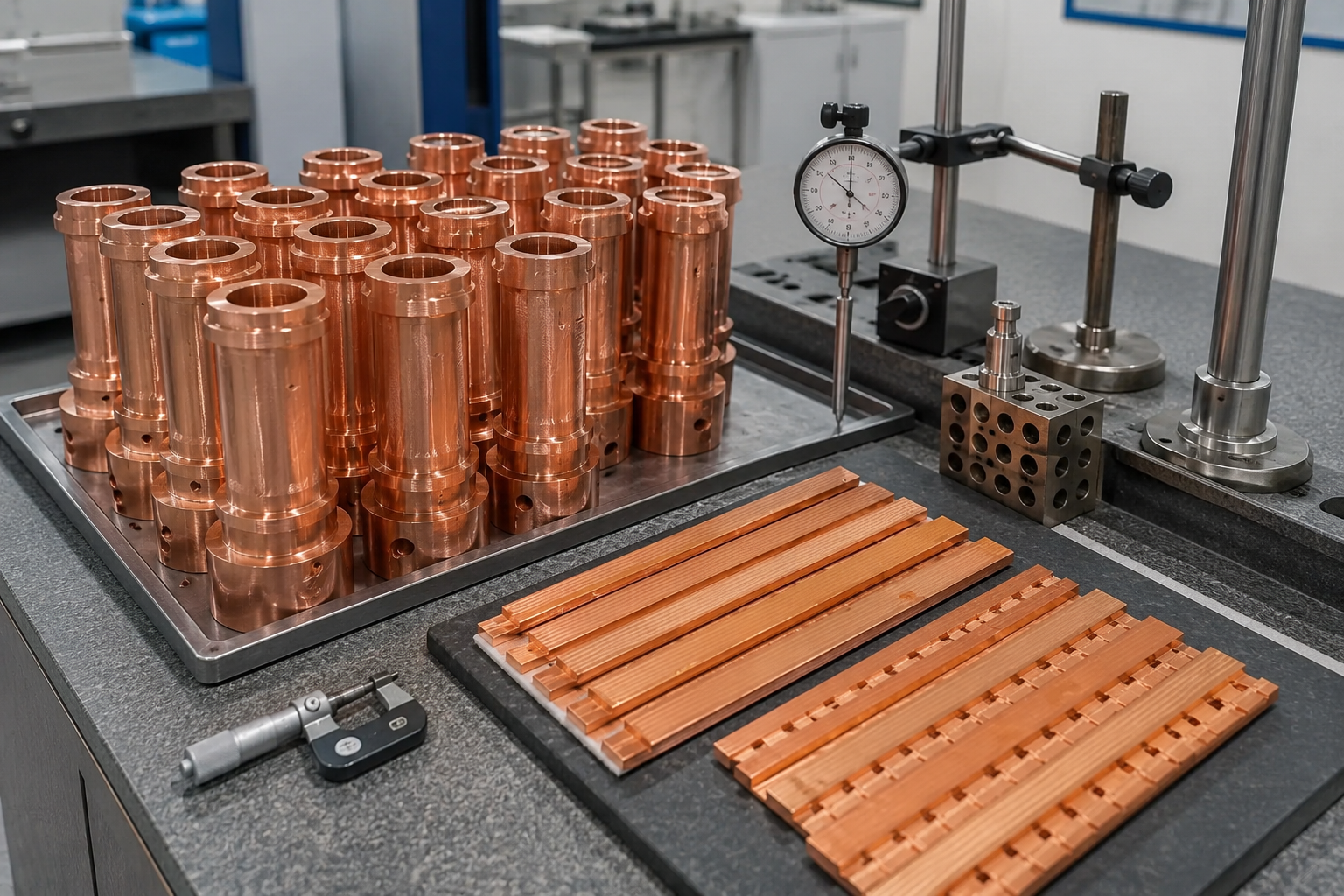
Company information from Zhenling lists CNC turning, milling, grinding, boring, wire EDM and 3-axis, 4-axis and imported 5-axis machining centers. Machined copper parts still require a drawing review; the equipment categories alone do not prove that every grade, tolerance, size or volume is automatically available.
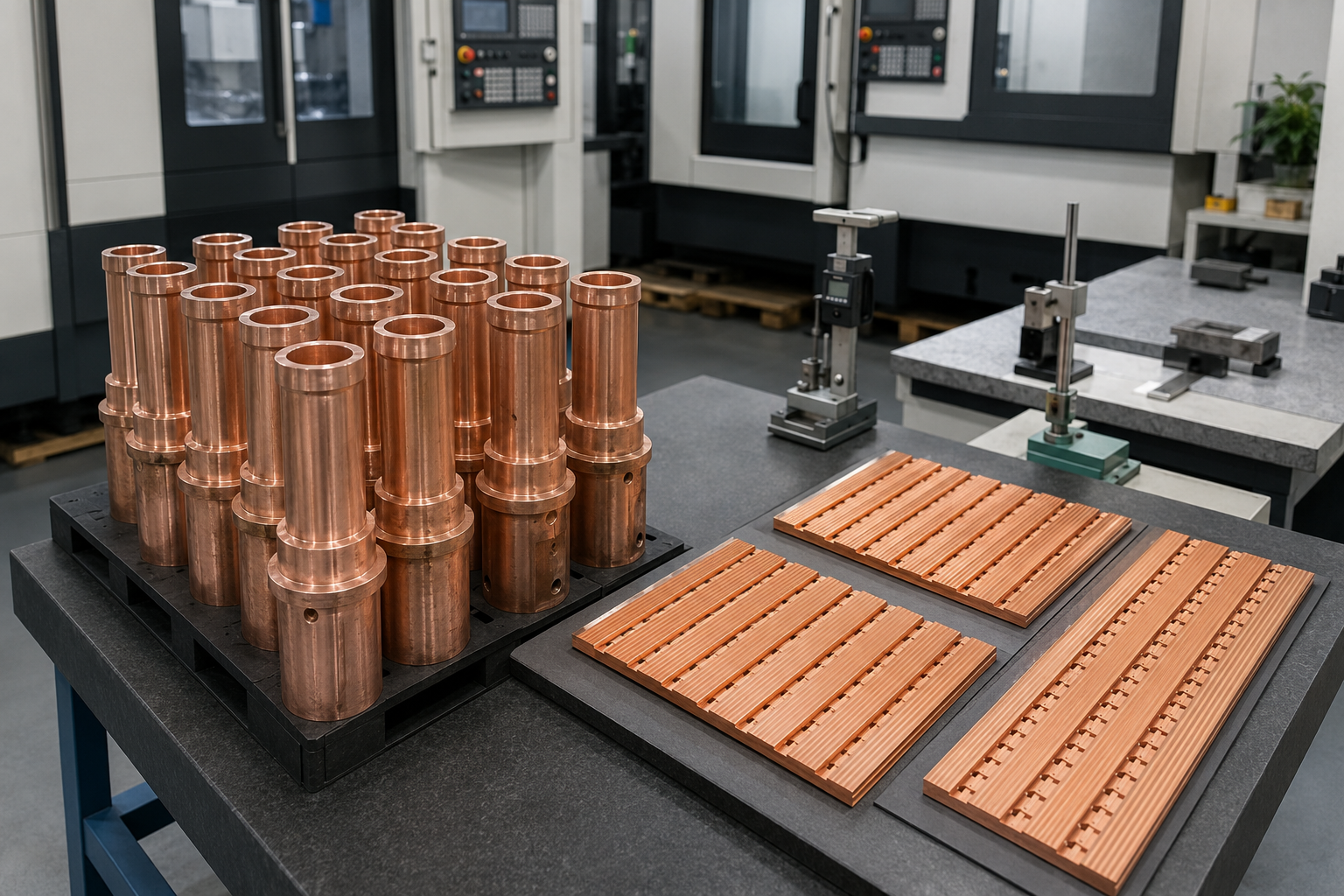
Cylindrical, bored, flanged and slotted geometry is visible; alloy identity and acceptance results remain project-specific.
Verification Required
The visible copper-like components and general machine list do not establish copper-specific tolerance, roughness, lead time, material certificate, report format or production yield. Unlike a generic machine-list pitch, Zhenling’s useful answer comes after the drawing and acceptance package are reviewed.
Slots and pockets
Hole patterns and planar contact facesPossible review route: CNC milling with fixture and burr-control review.
Buyer input that matters
Critical edges, flatness relationship, feature depth and appearance requirements.
Zhenling confirmation
Workholding, tool access, deburring route and measurable acceptance points.
Multi-axis features
Features on several orientationsPossible review route: 3-, 4- or 5-axis process review where the machine and setup fit the part.
Buyer input that matters
Datum continuity, access limits, inspection references and permitted setup marks.
Zhenling confirmation
Whether multi-axis machining reduces risk or only adds unnecessary complexity.
Functional surfaces
Busbar, heat-transfer or connector geometryPossible review route: Function-led material and contact-surface review.
Buyer input that matters
Conductivity or resistivity target, product form, contact areas, finish and governing specification.
Zhenling confirmation
Material availability and route remain subject to project review.
Check process fit before asking for a fixed price
Send the drawing, quantity, exact material callout and critical-feature list for a part-specific response.
Specify Copper by Function, Grade, and Surface Requirement
The phrase “copper” does not define a machining material well enough for a controlled quotation because pure copper and copper alloy families can behave differently. Material selection should begin with the part’s electrical, thermal, mechanical, corrosion resistance, surface and market responsibilities.
| Part function | Buyer defines | Supplier reviews | Quotation Scope |
|---|---|---|---|
| Electrical path or busbar | Exact UNS or grade, product form, temper, contact areas, conductivity or resistivity requirement, and applicable standard | Material availability, source, machining route, contact-surface protection and requested conformance evidence | ASTM B187/B187M covers copper bus bar, rod and shapes; it does not certify Zhenling or an unreviewed part |
| Thermal path or heat-transfer interface | Heat-transfer faces, flatness relationship, finish, assembly load and cleaning limits | Workholding, distortion risk, finishing sequence and inspection references | Performance in the final assembly remains the buyer’s design responsibility unless separately contracted |
| Mechanical assembly | Fits, threads, datum structure, load interfaces, critical dimensions and permitted edge condition | Process order, tool access, deburring and dimensional evidence | A generic tight-tolerances claim cannot replace the controlled drawing |
| Appearance, plating or contact surface | Bare or plated condition, cleaning, mask areas, marking, appearance limits and packaging | External finish source, handling route and surface-protection plan | Color alone cannot verify grade, plating thickness or delivered appearance |
| Restricted substances or destination-market compliance | Target market, product category, buyer specification and full material declaration | Accept, reject or request a separate compliance and process-control review | No universal RoHS, CE or restricted-substance promise is made on this page |
High-purity oxygen-free electronic copper
Cu Content99.99% Min
Conductivity101% IACS
Machinability20 Rating
The Copper Development Association lists minimum copper content of 99.99%, conductivity of 101% IACS at 68°F and a copper machinability rating of 20. Searchers sometimes shorten the designation to C101, but the controlled material callout here is C10100; this is external data, not proof that Zhenling stocks or has qualified it for your part.
Electrolytic tough pitch copper
Cu Content99.90% Min
ConductivityHigh IACS
Machinability20 Rating
The same association lists minimum copper content of 99.90%, high electrical conductivity and a machinability rating of 20. A copper 101 vs 110 decision still depends on the required form, condition, conductivity, surface and governing specification.
Tellurium-bearing copper
Cu ContentAlloyed
Conductivity93% IACS
Machinability85 Rating
C14500/tellurium copper is listed at 93% IACS with a machinability rating of 85, but that does not make it a default substitute for C10100 or C11000. Zhenling will only review it as a buyer-specified option with application and compliance boundaries.
01
Material substitution rule
The exact UNS or grade, form, temper and drawing revision should continue from RFQ to quotation and purchase order. Any proposed substitution needs written buyer approval because conductivity, machinability, assembly behavior and restricted-substance status may change together.
02
Do not ask the supplier to guess the grade
Send the governing material callout and the functional requirement that led you to choose it.
Control Burrs, Distortion, Critical Features, and Surface Condition
A common buyer mistake is treating machining completion as shipment readiness. A copper part can meet its nominal geometry yet fail inspection or assembly because a burr, vise mark, fingerprint, stain or distorted contact face was never assigned an acceptance rule.
PROCESS MANUAL
- 01. Review drawing
- 02. Plan setup
- 03. Control cut & edge
- 04. Protect surface
STEP_01
Review the drawing
Zhenling identifies thin walls, deep cavities, small holes, narrow slots, sensitive edges, threads, fits, datums and appearance or contact surfaces.
STEP_02
Plan the setup
The reason fixture strategy matters is that a soft copper component may move or mark under clamping force. Setup references should support both machining and later inspection.
STEP_03
Control the cut and edge
Sharp copper machining tools, suitable coolant, chip evacuation and a defined deburring route can reduce built-up edge, tool wear and surface drag without pretending that one recipe fits every alloy.
STEP_04
Protect the delivered surface
Cleaning, residue limits, bare-hand contact, VCI or sealed packaging, humidity control and separators should be selected around the delivered condition and destination.
Copper Surface Handoff Checklist
- Identify contact, sealing, heat-transfer and appearance faces.
- State the permitted burr and edge-break condition.
- Define whether discoloration, fingerprints or handling marks are acceptable.
- Name the cleaning process or prohibited residues when the application requires it.
- Specify whether parts must be individually separated, wrapped or capped.
- State VCI, sealed-bag, desiccant or humidity-control requirements where applicable.
- Define marking and traceability without damaging the functional surface.
- Agree how surface condition will be recorded at final inspection.
Inspection, Documentation & Order Control
A dimension only becomes useful when the drawing revision, measurement method and acceptance evidence agree. For an overseas procurement team, the risk grows when the RFQ, quotation, purchase order, inspection record and packing documents describe slightly different material or feature scope.
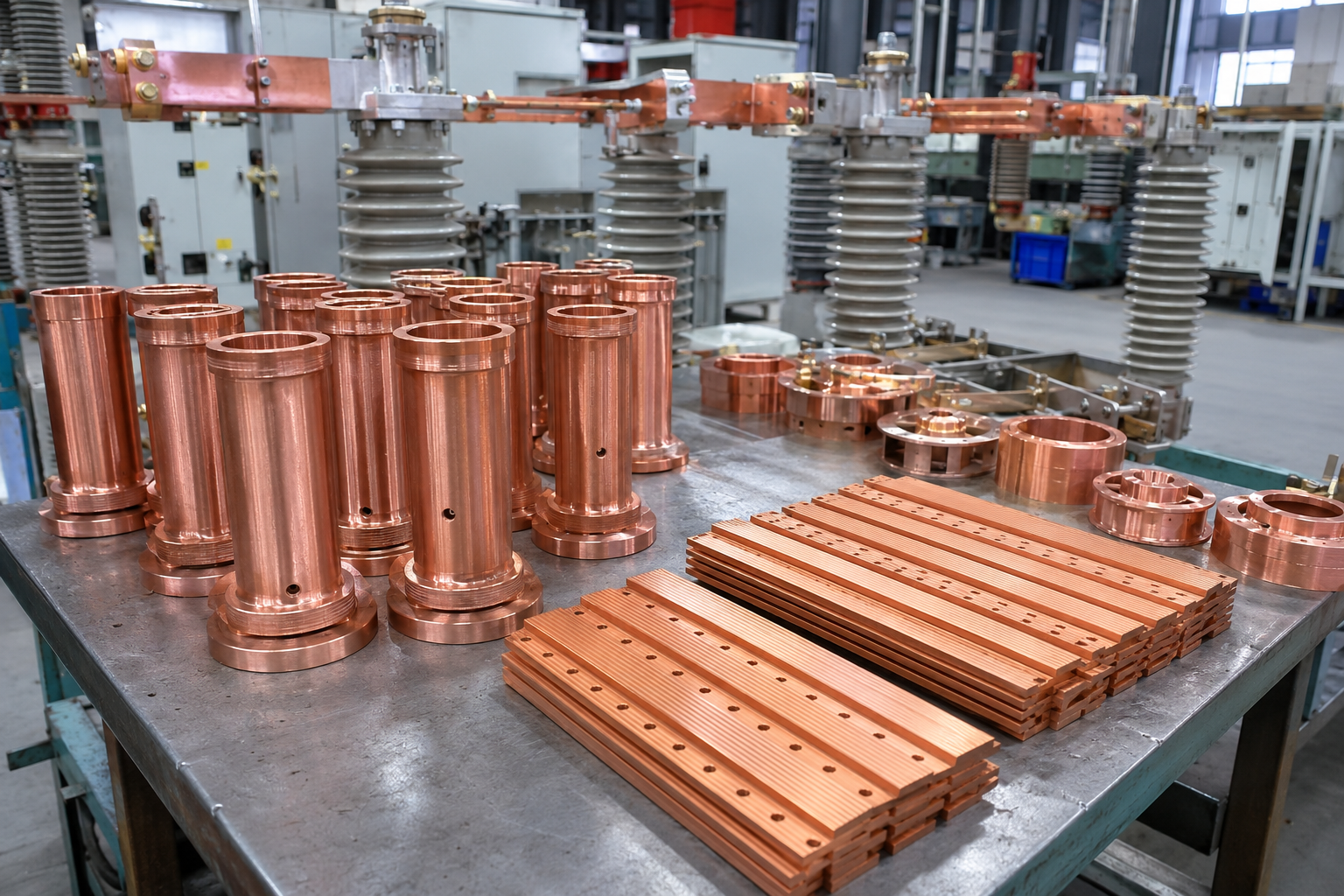
Visual Reference
[ 01 ]
RFQ identity
Record the part number, drawing revision, 2D and 3D files, exact material, quantity, destination and requested date. ASME Y14.5 can frame drawing interpretation when the buyer specifies it, but it is not a supplier certificate.
[ 02 ]
Quotation identity
Zhenling's quotation should reiterate the controlled material and revision while including open assumptions about finish, inspection, documents, packing and delivery. Unlike a broad "precision CNC" claim, it creates a reviewable scope.
[ 03 ]
Purchase-order lock
Procurement confirms the accepted designation, revision, quantity, evidence package and change-approval route. A supplier proposal to change material or a critical process should return to written buyer approval.
[ 04 ]
Inspection & export handoff
The final package may include the buyer-requested evidence of material, dimensional results, first-article or final-inspection records, marking, packing list and other destination-specific documents when mutually agreed.
Evidence Verification Matrix
| Evidence item | Buyer should specify | Zhenling must confirm | What is not implied |
|---|---|---|---|
| Material evidence | Certificate type, heat or lot linkage, required values and language | Availability, source and traceability format before order acceptance | No blanket material-certificate promise for every grade or quantity |
| Dimensional report | Critical characteristics, sampling, units and report format | Measurement route, accessible features and reporting responsibility | No unverified copper-specific tolerance or CMM claim |
| First article / final | Applicable standard, forms, approval point and requalification triggers | Whether the requested method fits the project and commercial scope | No claim that AS9102 applies outside its agreed context |
| Order documents | Destination, importer instructions, origin, invoice and packing needs | Document ownership and the information available from the order | No universal export-document package for every country or transaction |
Copper CNC Machining RFQ Readiness Matrix
The cheapest quote is not necessarily the best commercial comparison because hidden scope can sit in material identity, removed stock, setups, deburring, inspection, finish, packaging or destination. Zhenling uses the following matrix to turn a drawing into a comparable request rather than promising an unsupported copper CNC machining price.
01 / Drawing or sample
Buyer provides
Controlled 2D and 3D files, revision and reference sample role
Zhenling confirms
Readable geometry, conflicts and open questions
Quote effect
Scope clarity and engineering-review time
02 / Application and specification
Buyer provides
Part function and buyer-required ASTM, ASME or other specification
Zhenling confirms
Applicable scope and supplier responsibility
Quote effect
Compliance and evidence work
03 / Material identity
Buyer provides
Exact UNS or grade, product form and temper or hardness
Zhenling confirms
Availability, acceptable source and substitution policy
Quote effect
Raw material, yield and risk
04 / Electrical or thermal requirement
Buyer provides
Conductivity or resistivity target and critical interfaces
Zhenling confirms
Measurable requirement and evidence format
Quote effect
Material and inspection route
05 / Critical features
Buyer provides
Datums, dimensions, tolerances, fits, threads and sensitive edges
Zhenling confirms
Manufacturing and inspection route
Quote effect
Setups, tool access, inspection and rework risk
06 / Surface and secondary work
Buyer provides
Finish, plating, cleaning, masking, contact and appearance areas
Zhenling confirms
Source, sequence and protection plan
Quote effect
External processing, handling and lead-time assumptions
07 / Evidence package
Buyer provides
Material, dimensional, first-article, final-inspection and marking needs
Zhenling confirms
Availability, method, sampling and format
Quote effect
Quality-documentation scope
08 / Quantity and forecast
Buyer provides
Prototype, batch quantity and realistic repeat forecast
Zhenling confirms
Setup and production route
Quote effect
Setup distribution and unit economics
09 / Packaging and destination
Buyer provides
Surface protection, separators, labeling, destination and importer needs
Zhenling confirms
Pack method and logistics assumptions
Quote effect
Handling, freight and documentation
10 / Target date
Buyer provides
Required arrival point and approval milestones
Zhenling confirms
Feasible schedule after all open items close
Quote effect
Capacity, external process and freight choices
Copper Quote Comparability Bottleneck Map
Material
Grade, form, temper, availability and conductivity may control the quote before the machine is selected.
Geometry
Deep cavities, thin sections, several orientations and difficult deburring can add setups and handling risk.
Acceptance
Critical tolerances, sampling, report format and first-article requirements may alter the inspection plan.
Surface
Cleaning, plating, contact protection, appearance limits and packaging can become the controlling handoff.
Delivery
Quantity, approval timing, external processes, destination and document ownership can modify the commercial route.
Copper CNC Machining Tools
CHECKLIST 01
RFQ Readiness Score
MATERIAL REVIEW 02
Copper Grade Fact Comparison
QUOTE REVIEW 03
Quote Bottleneck Estimator
BUYER FAQ
Copper CNC Machining Buyer Questions
Yes. CNC milling and turning can produce copper parts, subject to material and drawing review.
Copper’s softness and ductility can contribute to smearing, built-up edge, burrs, deformation and clamp marks, while its heat-transfer behavior affects the cutting system. Grade, temper, feature access, wall thickness, workholding, tool condition and the delivered-surface requirement all matter, so a generic parameter set is not a reliable acceptance plan.
Provide controlled 2D and 3D files, revision, exact material, quantity, critical features, finish, inspection evidence, packaging, destination and target date. Include any governing material or drawing standard.
They are buyer-specified examples, not a published stock list. Availability and suitability require project review.
These inputs influence raw material, setup count, tool access, fixturing, deburring, inspection, external processing, protection and the way setup cost is distributed. A thin wall or hard-to-reach feature may change the route even when the part envelope looks ordinary. Compare suppliers only after the same material, revision, evidence, finish, packaging and delivery scope appears in every quotation.
Buyers may request agreed material evidence, dimensional results, first-article or final-inspection records, marking and packing documents. Sampling, method, language and format should be agreed before production.
Start by defining cleaning, residue, contact-surface, handling and delivered-appearance requirements. The packing review can then consider part separation, sealed protection, volatile corrosion inhibitor materials, desiccant, humidity control and restrictions on bare-hand contact. No single method fits every surface, storage period or destination, and a clean machined part can still arrive unacceptable if the shipping boundary was never specified.
No general promise applies. These alloys require a separate material, health, process-capability and compliance review.
State the destination market, product category, buyer specification and full material declaration, including restricted constituents where relevant. Also identify which party supplies the governing requirement and which document must accompany the shipment. Compliance cannot be inferred from the word copper, a generic supplier badge or an unrelated certificate.
Need a Project-Specific Review?
Our engineering team can evaluate your exact material, tolerance, and delivery requirements.
![Shop-Floor Carbon Steel CNC Machining Guide [2026]](https://zhenlingmetal.com/wp-content/uploads/2026/08/carbon-steel-cnc-machining-handbook-r2-featured-150x150.png)