Get in touch with Zhenling Company

Aerospace CNC Machining
Aerospace CNC Machining for Drawing-Defined Components
DRAWING-DEFINED SCOPE
ORDER-SPECIFIED REQUIREMENTS
WRITTEN QUOTATION SCOPE
Aerospace CNC machining requests should define the material, part geometry, traceability documents, inspection points and application-specific acceptance requirements. Zhenling can review drawing-defined components; qualification, regulatory approval and release records must be confirmed for the actual order in writing. Aerospace CNC Machining enquiries should include drawing-defined material, traceability documents, critical features, inspection points and programme acceptance requirements. Use the drawing review to test the route and its limits. Confirm records, pricing assumptions and schedule separately for the order.
Request a Quote
ORDER-SPECIFIED
DOCUMENTATION
8,000 m²
Total Site (6,000 m² Workshop)
2006
Precision Manufacturing Since
ORDER-SPECIFIC
PROPOSED EQUIPMENT ROUTE
ORDER-SPECIFIC
DESTINATION & EXPORT DOCUMENTS
Raw Material → Shipment
Order-Specified Traceability
Aerospace RFQ Risks and Evidence to Review
For an aerospace-supply RFQ, compare more than unit price. A missed tolerance, undocumented material lot or missing first-article record can create rework, qualification or schedule risk. Define the controlling drawing, material traceability, inspection scope, release records, communication plan and corrective-action responsibility before supplier approval.
- 01 A missed tolerance found at incoming inspection will lead to rework, requalification, or scrap – not just a delay on that one part.
- 02 An undocumented material lot breaks the traceability chain a defense or space application’s quality system requires.
- 03 A supplier who can’t provide first-article inspection (FAI) documentation on demand shifts verification risk onto your team.
What “Precision” Actually Covers Here
±0.005in
SUITABLE-FEATURE QUOTATION BASELINE
±0.001in
FEATURE-BY-FEATURE REVIEW REQUIRED
Tolerance achievable still hinges on part geometry, fixturing, and material – which is why tolerance capability gets verified against your actual drawing, not a generic spec sheet. Tolerance callouts on an aerospace drawing use the ASME Y14.5 dimensioning and tolerancing standard, the drawing standard specified by the buyer when applicable; it does not establish a Zhenling certification.
Below, compare material and process-selection questions, proposed equipment routes, qualification evidence, inspection records and sourcing terms. These sections do not establish programme history, equipment ownership or supplier approval.
Zhenling’s Structural Answer
Zhenling’s answer starts with the released drawing, material, required traceability documents, inspection points and qualification evidence. The proposed route and deliverables are confirmed for the actual order rather than inferred from a blanket aerospace capability claim.
Evaluate a supplier through order-relevant qualification evidence, the proposed equipment route, first-article requirements and acceptance records rather than country-of-origin assumptions. This page does not rely on forum accounts as evidence.
Aerospace Material & Process Selection Matrix
Material selection drives tooling, process route, inspection and delivery risk. The matrix below is an RFQ review aid for aluminum, stainless steel and carbon or alloy steel; it does not establish qualification or confirmed capability until grade, stock condition, geometry, records and acceptance requirements are reviewed for the order.
Aluminum alloys
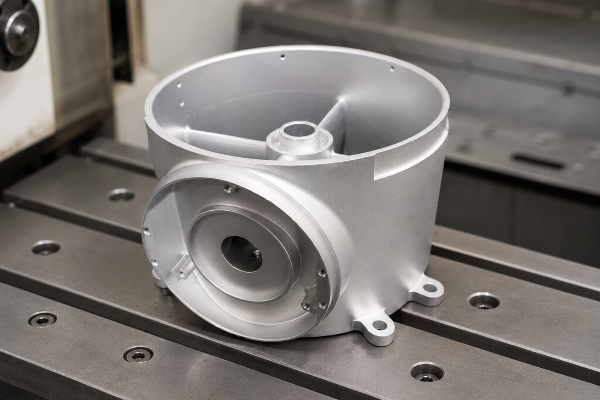
6061/7075-class
- Recommended Process
- 3/4-axis high-speed milling
- Typical Part Types
- Brackets, housings, avionics mounts, structural fittings
- Key Process Note
- 650–2,000 SFM cutting speed — fastest-machining aerospace-grade metal in this range
Stainless steel
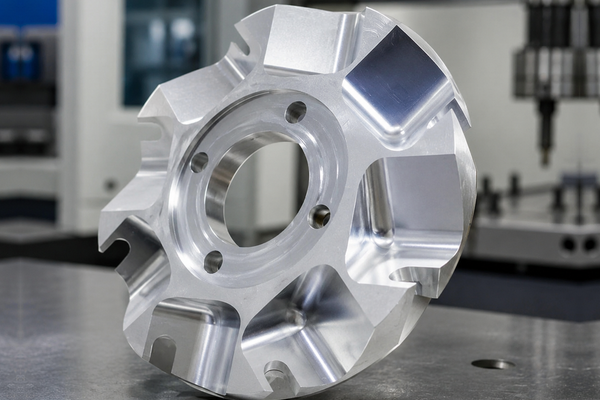
303/304/304L/316/316L/321
- Recommended Process
- CNC turning + milling
- Typical Part Types
- Fluid-system fittings, valve bodies, fasteners, corrosion-exposed structural parts
- Key Process Note
- 100–200 SFM cutting speed — higher tool wear than aluminum, requires speed/feed discipline
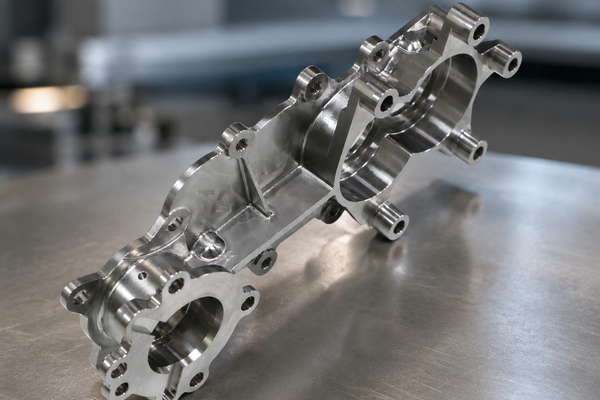
Carbon & alloy steel
Q235A/Q345D/45#/42CrMo-class
- Recommended Process
- CNC turning + milling, wire-EDM on hardened features
- Typical Part Types
- Load-bearing structural brackets, pressure-adjacent hardware
- Key Process Note
- Cutting speeds as low as 100–200 SFM on 4140-class equivalents — closest published analog to this grade family
Aluminum is the default starting point for most bracket and housing RFQs, which is why it’s highlighted above, but the right material for complex aerospace parts is still a function of load path, corrosion exposure, and certification requirement on your specific drawing, not a one-size answer. NIST even highlights 7075 Aluminum in their list of cataloged certified standard reference alloys, a common thread you’d see even on a mill certificate from any mill for equivalent metallurgy.
Aerospace Materials Beyond This Matrix
Hot-section and engine components often require titanium or nickel alloys, specialized tooling, coolant and programme-specific process qualification. This page makes no Zhenling capability or non-capability claim for those parts; supplier fit must be verified for the actual legal entity, site, material and order.
Aluminum, stainless steel and carbon or alloy steel are candidate material families for RFQ review. Exact grade, product form, condition, traceability, proposed process route and qualification evidence must be confirmed; the list is not a qualified material range or aerospace production-history claim.
Use the matrix to identify material, process-route and inspection questions for the RFQ. Supplier qualification and capability remain subject to current, order-specific evidence.
RFQ review note
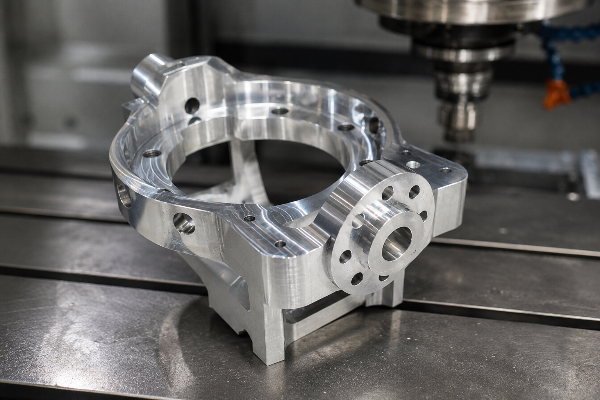
CNC Machining vs. Casting & Additive Manufacturing for Aerospace Parts, When Precision Wins
None of these three processes is universally "better" — each wins under a different combination of volume, geometry, and tolerance requirement. The comparison below focuses on the factors that actually decide the choice on a real RFQ: lead time to first article, tooling investment, and achievable tolerance without secondary operations.
Select CNC machining, casting or additive manufacturing from the required material form, geometry, quantity, tooling investment, surface condition, qualification route and secondary-machining needs. If CNC machining is proposed, the quotation must identify starting material, setup strategy, critical features, inspection records and first-article scope; this page does not claim an established Zhenling aerospace process.
| Factor | CNC Machining (from Billet) | Casting | Additive Manufacturing (Metal) |
|---|---|---|---|
| Lead Time to First Article | 1–3 days (simple part) to 4–6 weeks (complex batch) | Usually weeks to months — pattern or hard tooling required before the first part exists | Days to print, plus post-process time for support removal and finish machining |
| Tooling Investment | None — programmed directly from CAD | Pattern or hard tooling required upfront, amortized over the run | None for the print itself, though finish machining is often still required |
| Achievable Tolerance | ±0.005 in suitable-feature quotation baseline; ±0.001 in only after feature-by-feature review | Generally requires secondary machining to reach aerospace tolerance bands | Generally requires secondary machining to reach aerospace tolerance bands |
| Best Fit For | Low-to-mid volume, tight tolerance, fast iteration, traceable mill-certified material | High volume, complex net-shape geometry, cost amortized over large production runs | Complex internal geometry or weight reduction where milling isn't practical |
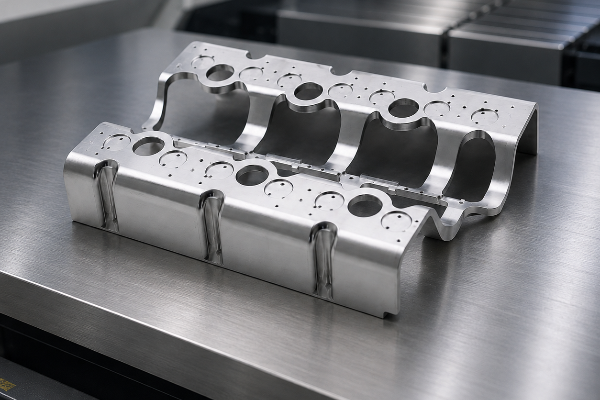
How to Use This Table on Your Own RFQ
If your part count is under roughly a few hundred units, your tolerance calls out below ±0.005 in on any feature, or you need traceable mill-certified material rather than a poured or printed microstructure, start the sourcing conversation with CNC. Above that volume, and once geometry is locked and tolerance-forgiving, casting's tooling cost starts amortizing in its favor.
Additive manufacturing for flight-critical metal parts is also still maturing industry-wide from a certification standpoint, NIST's own additive-manufacturing qualification research program points to the same gap: process validation, powder-lot traceability, and inspection standards are tightening, and manufacturers are increasingly moving validation upstream rather than catching issues at final inspection. That trend reinforces why aerospace precision machining from certified billet stays the default whenever tolerance and material traceability are non-negotiable.
Where CNC wins on tolerance and traceability, the next question buyers ask is whether Zhenling's equipment and process capability actually reaches the programs they're sourcing for.
Drawing Review for Aerospace-Supply Components
For an aerospace-supply RFQ, identify the programme requirements, released drawing, material and traceability records, critical features, inspection method, first-article scope and approval owner. The proposed equipment route and qualification evidence must be verified for the actual legal entity, site and order before supplier approval.
- 01. Proposed wire-EDM route for fine or hardened features, subject to order review
- 02. Proposed grinding route for finish-critical features, subject to order review
- 03. Proposed EDM route for complex profiles, subject to equipment and geometry review
- 04. Setup and axis strategy confirmed for the released geometry
- 05. First-article and in-process inspection method confirmed in the quotation
Use these route categories to frame questions for brackets, housings, fittings, valve bodies and fastener-class hardware. They do not establish equipment ownership, aerospace project history or suitability until the drawing, programme and current evidence are reviewed.
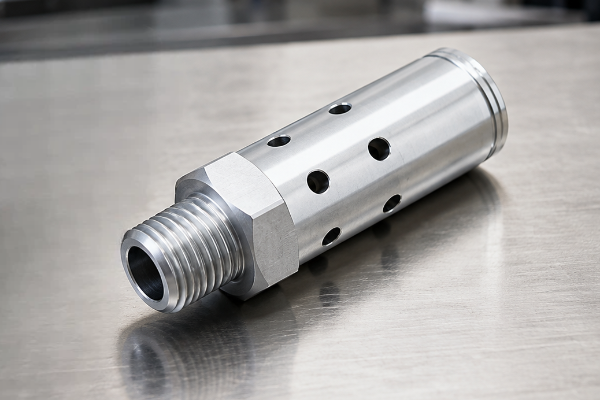
Where This Capability Actually Applies
A single-setup multi-axis route can reduce fixture changes on complex geometry, but the benefit depends on datum strategy, access, verification and the released drawing. If multi-axis machining, coordinate measurement or material traceability is required, the quotation must identify the proposed method, equipment category, record scope and approval owner; this page does not claim an aerospace programme match or a Zhenling-held patent.
How to Verify This Section Yourself
Ask for the required quality-system evidence, legal entity and site, proposed equipment route, traceability sample and relevant inspection report. Review scope, validity and order applicability before treating any supplier as qualified.
Country of origin does not establish traceability. Verify the legal entity, manufacturing site, material source, outside-process route and release records for the order.
// SUPPLIER-VERIFICATION NOTE
Supplier performance varies within every sourcing region. Use order-specific qualification, inspection and traceability evidence rather than a country-level assumption.
// SOURCING-RISK NOTE
Supply-chain variance and traceability gaps must be addressed supplier by supplier. Require current evidence and records for the actual order rather than relying on a marketing-page assurance.
Read Full Note
Check certificate ownership and validity, the proposed equipment route, material traceability and relevant inspection records for every supplier being evaluated.
Qualification & Compliance Requirements
Aerospace qualification is order- and program-specific. Buyers should state the required quality-system evidence, legal entity and site, certificate scope and validity, material traceability, first-article requirements and release records before treating a supplier as qualified.
Buyers evaluating any aerospace machining supplier should ask directly which standard is certified, ISO 9001 alone does not cover the aerospace-specific requirements AS9100 adds.
This is why the required quality-system evidence should be checked before technical and commercial approval.
Aerospace qualification requirements can narrow the supplier list and add review time. Define the required quality-system evidence and submission package before technical and commercial approval.
Aerospace supplier-qualification note
- AS9100 Aerospace QMS
- ASME Mechanical Standards
- CE EU Conformity
AS9100 vs. ISO 9001, What's Actually Different
AS9100 carries every ISO 9001 requirement, then adds aerospace-specific requirements on top: configuration management, counterfeit-parts prevention, risk management, product safety, and full material and process traceability. AS9100-certified suppliers are also eligible for listing in OASIS, the aerospace industry's own supplier-qualification database, a distinction ISO 9001 alone does not carry. The official ISO 9001:2015 standard is the quality-management foundation AS9100 builds on top of, not a separate or competing framework.
State the required material traceability, first-article record, in-process inspection points, final report and release owner in the RFQ. Those deliverables are included only when the written quotation confirms the method, coverage and document package for the order.
Want equipment specs and certification detail in one document?
View Equipment SheetSourcing Guide: Pricing, Lead Time & Support
Unit price is one line on a quote, landed cost is the number that actually matters for high-quality aerospace parts. Inspection requirements, first-article paperwork, logistics, and rework risk from missed tolerances all sit outside the per-part price line, and buyers who compare quotes on unit price alone are comparing the wrong number.
5
Cost Inputs Buyers Should Price Separately From the Per-Part Quote
- Unit Price
- Program Setup
- Inspection & FAI Reporting
- Logistics & Duties
- Rework/Delay Risk
Synthesized from CNC-sourcing cost-framework discussion (rivcut.com, kmwcnc.com, xinqidamachining.com) — a buyer framework, not a Zhenling-specific pricing model or guaranteed savings figure.
What Actually Drives Aerospace CNC Cost
Beyond the quoted unit price, price these inputs separately before comparing two supplier quotes: program setup and first-part qualification, inspection and FAI reporting depth, logistics and duties to your dock, and the rework or delay risk carried by a supplier without a documented tolerance track record.
Lead time varies by part complexity and batch size, not a single fixed number. Simple prototype parts can ship in 1–3 days; complex batch production more commonly runs 4–6 weeks; first-article paperwork for one complex part can add up to 40 work-hours on its own. That work-hour figure traces back to formal FAA guidance on AS9102 first-article inspection requirements, not an arbitrary internal estimate.
Support After Delivery
The quotation should identify the post-delivery response path, incoming-inspection contact, record-retention period and revision-control process for reorders. Do not assume those services or records unless they are confirmed in writing.
For an international order, confirm destination, packaging, export documents, communication window, revision cadence and response-time expectations in writing. This page does not claim an export share, routine destination history or a guaranteed feasibility-response time.
Ready to define the material, process and qualification evidence for your RFQ?
Send Your Drawing — Get a Response This WeekAerospace CNC Machining Engineering Tools
Material Process Fit Finder
Match aerospace-grade alloys with the most efficient CNC machining processes based on your specific part geometries.
Landed Cost Calculator
Calculate the total cost of your aerospace components, including manufacturing, finishing, and international logistics.
AS9100 ISO9001 Qualifier
Instantly verify your project's compliance requirements against strict aerospace quality management systems and standards.
Quote Completeness Score
Evaluate your RFQ documentation to eliminate blind spots, ensuring accurate, fast, and risk-free manufacturing quotes.
Machine Process Match
Determine the optimal machine configuration (3-axis, 4-axis, or 5-axis) to achieve the precision required for your components.
What is aerospace CNC machining?
Aerospace CNC machining is the computer-controlled cutting of metal aerospace components, brackets, housings, fittings, and structural parts, directly from certified mill-stock material, using aerospace tooling built to the tolerance and traceability standards the aerospace industry requires. Unlike casting or additive processes, parts are cut from solid billet, giving each part the full mechanical properties of wrought material rather than a cast or printed microstructure. The term covers everything from single prototype parts to full cnc machining in aerospace production runs.
What materials are used in aerospace CNC machining?
Across the aerospace industry, material selection varies by component and programme. Aluminum, stainless steel and carbon or alloy steel are candidate RFQ families on this page; exact grade, product form, condition, traceability, process route and supplier qualification must be confirmed for the actual order.
What certifications matter for aerospace CNC machining?
AS9100 is the aerospace industry's own quality-management standard, built on ISO 9001 with added requirements for risk management, configuration control, and counterfeit-parts prevention. Zhenling does not claim those certifications here; any required certificate must be verified for the named legal entity, site, scope and validity. Evaluate any supplier by asking directly which standard is certified, don't assume ISO 9001 alone covers aerospace-specific requirements.
What tolerances are typical for aerospace machined parts?
For suitable features, ±0.005 in is a quotation baseline. Any ±0.001 in feature requires feature-by-feature drawing, process and measurement review and written quotation confirmation.
How long does aerospace CNC machining take?
Lead time depends heavily on complexity and batch size. Simple prototype parts can ship in 1–3 days, complex production batches more often run 4–6 weeks, and first-article records for a complex part can add up to 40 work-hours on its own. Send your drawing for a real lead-time response rather than a rule-of-thumb estimate.
Is aerospace CNC machining expensive?
Unit price is only one input, landed cost, inspection and record-keeping requirements, logistics, and rework risk from missed tolerances all affect the real total. Buyers who compare quotes on unit price alone often miss the inputs that actually drive total program cost. See the Sourcing Guide above for the specific cost categories worth pricing separately.
What's the difference between prototype and production aerospace machining?
Prototype work means single parts or small batches with fast, iterative turnaround; production batch machining shifts the focus to repeatability, statistical process control, and consistent cycle time across every part in the run.
Why does 5-axis machining matter for aerospace applications?
5-axis precision cnc machining completes most or all milling operations in a single setup, cutting the fixture changes that otherwise introduce cumulative tolerance stack-up on complex structural and fluid-system geometries.
What are the standard surface finishes for CNC machined aircraft parts?
Aerospace CNC parts commonly specify an as-machined finish, a bead-blasted or anodized finish for aluminum, or a passivated finish for stainless steel to restore corrosion resistance after machining. The right finish depends on the part's environment and, for external airframe surfaces, on aerodynamics, a fluid-system fitting and a structural bracket rarely call for the same finish spec. Confirm surface-finish requirements as part of your drawing package rather than assuming a default.
Is Chinese CNC machining quality reliable for aerospace parts?
Supplier quality is site- and order-specific, not country-specific. That's why this page leads with qualification questions, equipment categories, and traceability requirements rather than asking buyers to take quality on faith. Before committing volume, define the required quality-system evidence, first-article scope, material traceability, inspection records and approval owner, then verify them for the named legal entity and facility.
How long does it take to qualify a new aerospace CNC supplier?
Procurement teams sourcing outside their existing supplier base describe qualification as a real multi-week process even before a first part ships, verifying certifications, requesting first-article samples, and confirming a traceable material chain all take calendar time, not a single phone call. That is exactly why this page leads with required qualification evidence, the proposed equipment route, and the inspection process rather than burying them in a spec sheet, ask for all three upfront and the qualification timeline compresses considerably against starting a supplier search from zero.
How do I choose a CNC machine shop for aerospace components?
Start with certifications, confirm AS9100 or the specific standard your program requires, not just ISO 9001, then check the material and process range against your actual drawing rather than a generic capabilities list. Ask for a first-article inspection report on a comparable part before committing to a production run. Response time and specificity during the RFQ stage are themselves a preview of how a supplier will handle a real production issue later, which makes the qualification conversation part of the evaluation.
![Shop-Floor Carbon Steel CNC Machining Guide [2026]](https://zhenlingmetal.com/wp-content/uploads/2026/08/carbon-steel-cnc-machining-handbook-r2-featured-150x150.png)