
Get in touch with Zhenling Company

A CNC Machining Cost Guide is a framework for explaining a custom-part quote without promising a universal hourly rate. Useful estimates combine material and loss, programming and setup, machine time, labor, tooling, inspection, outside processing, packaging, and logistics, then divide the relevant scope by a clearly defined accepted quantity.
This guide gives engineering, procurement, quality, and finance teams two reusable tools: the 9-Bucket Accepted-Part Cost Build-Up and the 7-Checkpoint Equal-Scope Reconciliation Trail. Every dollar in the worked examples is synthetic and exists only to demonstrate the arithmetic. None is a market rate, a Zhenling quote, a customer result, or a savings claim.
9core quote lines
1named acceptance point
2cost layers: supplier and buyer
What CNC Machining Cost Actually Includes
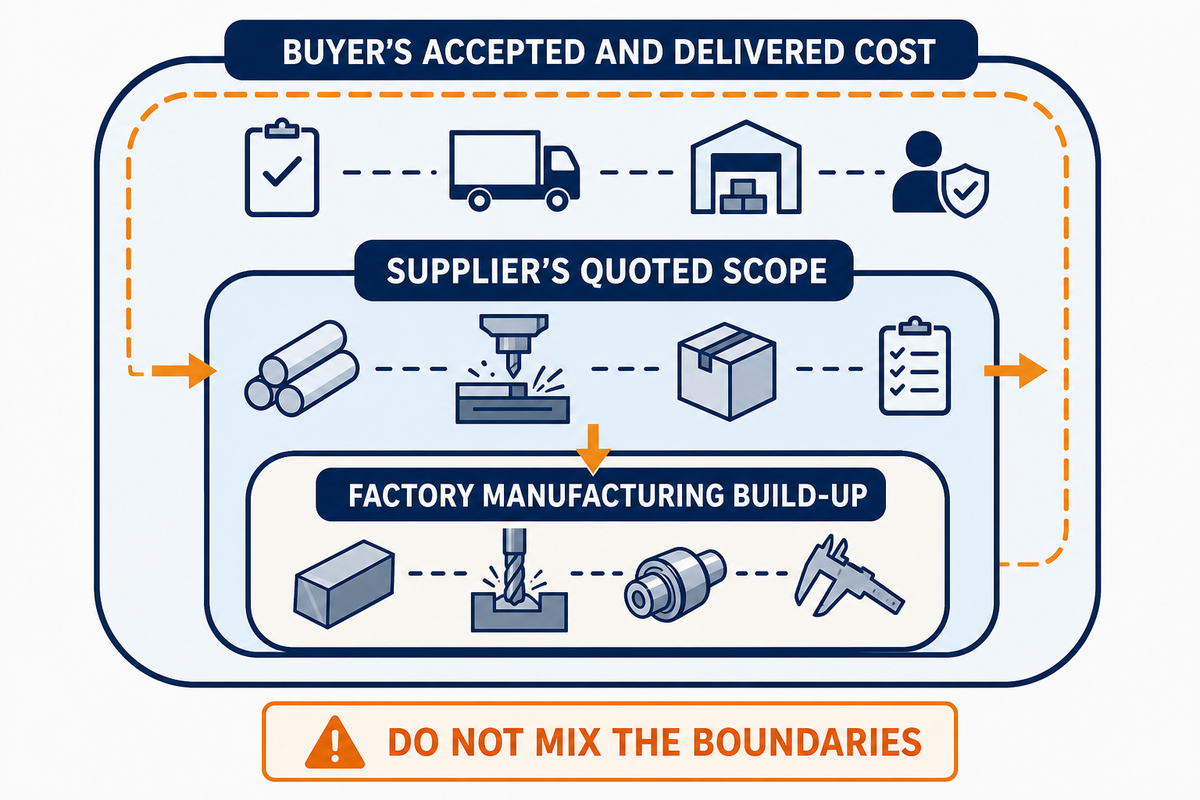
CNC machining cost has three different layers: the factory manufacturing build-up, the supplier’s quoted scope, and the buyer’s accepted and delivered cost. Mixing those layers creates false comparisons because one number may exclude inspection, finishing, freight, rejection handling, or other work carried by the buyer.
Factory build-up starts with net material and unavoidable loss, then adds programming, machine setup, cutting and non-cutting machine time, direct labor, tooling, and inspection. Supplier quotes may add heat treatment, anodizing, passivation, special packaging, documents, and delivery. Buyer-side cost may continue with duty, tax, incoming inspection, inventory capital, administration, and disruption risk.
If your query is about CNC machine cost, CNC machine prices, or used CNC equipment, you’re evaluating a capital purchase. That’s a different decision from the cost of CNC machining an outsourced component. For process selection, drawings, tolerances, and request-for-quote preparation, use Zhenling’s drawing, tolerance, and RFQ planning guide.
CNC pricing becomes useful when the label names its boundary. A pricing review may compare cost per unit at supplier inspection, price per part after buyer acceptance, or total cost of ownership after delivery and risk allowances. Each is valid for a different decision. A pricing comparison should therefore show the cost drivers, time and cost assumptions, and any additional cost carried outside the quote. That discipline helps a team reduce cost without calling the lowest visible number the true cost.
Key point: name the cost layer before comparing the number. “Unit price,” “manufacturing cost per accepted part,” and “buyer landed cost per accepted part” aren’t interchangeable.
9-Bucket Accepted-Part Cost Build-Up
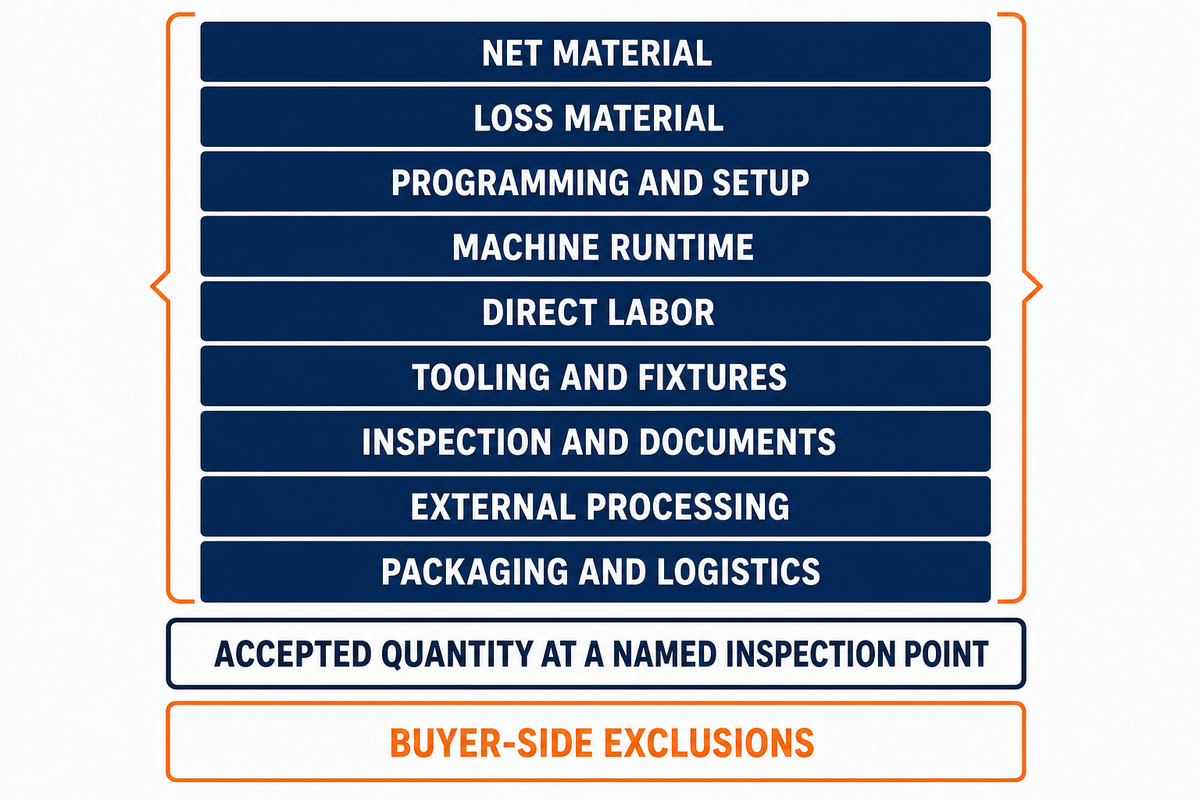
The 9-Bucket Accepted-Part Cost Build-Up rebuilds a total into nine traceable lines, identifies what the supplier includes, and places excluded buyer costs beside the quote. Accepted quantity at a named inspection point is the denominator, so a lower total can’t hide a different rejection assumption or delivery basis.
NIST’s design-for-cost paper separates net and loss material, machine rate multiplied by setup, operation and nonoperation time, labor, and tooling allocation. Its framework supports cost structure, not a universal CNC pricing table.
| Line | Cost bucket | What to request | Typical comparison error |
|---|---|---|---|
| 1 | Net material | Specification, condition, net mass | Comparing different grades or tempers |
| 2 | Loss material | Stock form, allowance, recoverable scrap | Ignoring minimum stock purchase |
| 3 | Programming and setup | One-time hours and setup count | Treating fixed work as per-piece work |
| 4 | Machine runtime | Cycle assumption and machine type | Comparing rates without time |
| 5 | Direct labor | Attended tasks and batch handling | Equating wages with shop rate |
| 6 | Tooling and fixtures | Dedicated items and allocation basis | Missing replacement or qualification |
| 7 | Inspection and documents | Features, frequency, report format | Assuming “inspection” means the same scope |
| 8 | External processing | Finish, masking, certification, recheck | Omitting transport and reject exposure |
| 9 | Packaging and logistics | Incoterm, destination, packaging basis | Comparing ex-works with delivered cost |
How to estimate CNC machining cost
List the nine lines, total only the scope included by the supplier, and divide manufacturing scope by accepted quantity at a stated point. Then add buyer-side exclusions. The compact equation is: (included fixed costs + included variable costs) ÷ accepted quantity. Keep freight, duties, tax, inventory, and buyer inspection visible rather than burying them in an unexplained allowance.
Synthetic HX-120 Housing worked example
A 100-piece batch uses $420 net material, $90 loss material, $360 programming and setup, $900 machine runtime, $240 direct labor, $180 tooling and fixtures, $210 inspection and documents, and $300 external finishing. Supplier manufacturing scope is $2,700.
If buyer incoming inspection accepts 96 parts, manufacturing cost is $2,700 ÷ 96 = $28.13 per accepted part. Add $200 packaging and logistics and the delivered included scope becomes $2,900 ÷ 96 = $30.21. Field reliability is outside this example.
Use Zhenling’s public landed cost per part tool to add buyer-entered freight, duty, brokerage, inspection, transit time, and capital assumptions. The tool exposes inputs; it does not predict a market price.
Why Hourly Rates Do Not Predict Final Part Cost
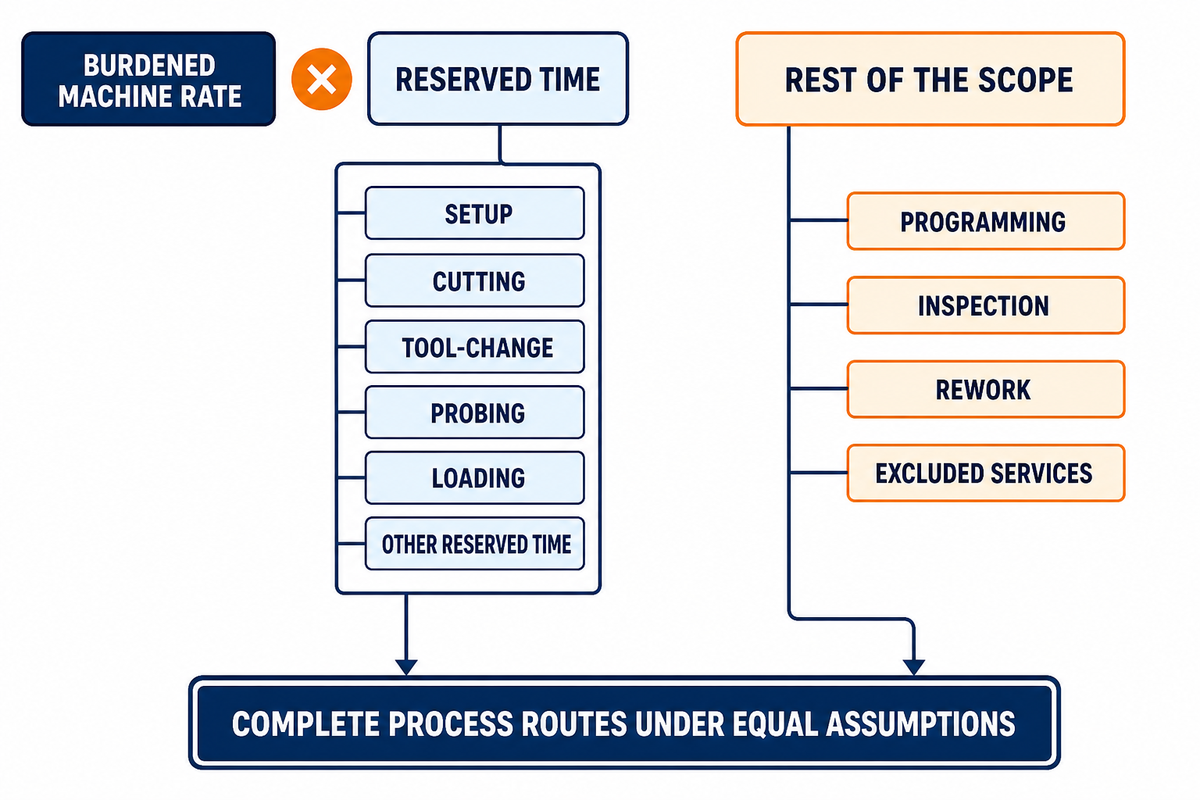
A CNC machine shop hourly rate becomes a project cost only after it is multiplied by a defensible time model and combined with the rest of the scope. A lower cost per hour can lose when setup, programming, runtime, inspection, rework, or excluded services are higher.
NIST’s manufacturing-cost equations place machine rate inside setup, operation, and nonoperation time rather than treating it as the final price.
Employee wage, burdened labor cost, machine rate, and supplier price are four different figures. A milling machine rate may include depreciation, maintenance, power, floor space, software, and overhead. The quote still depends on how long the type of machine is reserved, how much operator attention is required, and which machining operations occur outside the primary cycle.
Searches for “How much does CNC machining cost per hour,” “CNC machining cost calculation,” and “Metal CNC machining cost guide” all need the same warning: a rate or formula is only useful after the part, scope, quantity, and acceptance point are defined.
How to calculate CNC machining cost per hour
For internal estimating, calculate a burdened machine rate from documented annual costs and realistic productive hours, then multiply it by setup, cutting, tool-change, probing, loading, and other reserved time. For supplier comparison, do not reverse-engineer the supplier’s rate. Ask for setup count, assumed cycle time, quantity, inspection scope, and exclusions instead.
Key takeaway
Compare complete process routes under equal assumptions. Hourly rate without setup, time, scope, and accepted quantity is not a part-cost comparison.
Material, Stock Form, and Machinability Change More Than Raw Price
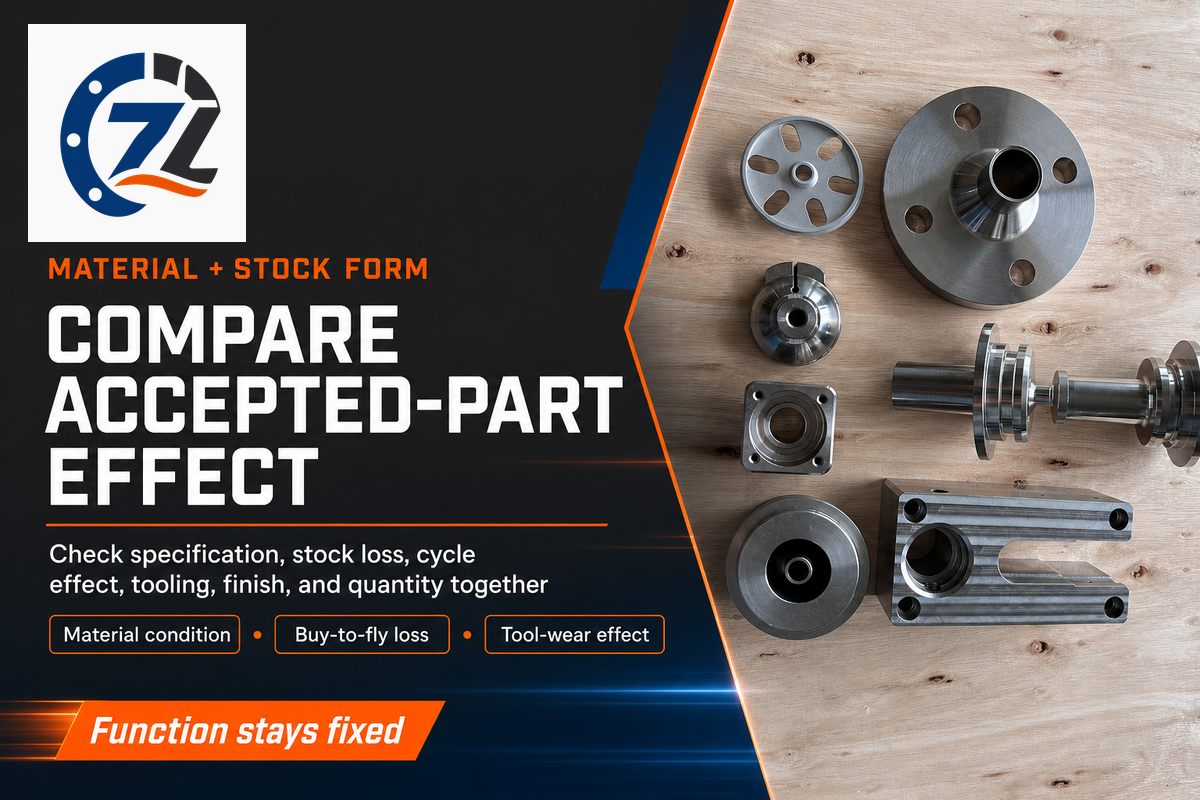
Material cost depends on the specification, condition, stock form, minimum purchase, net mass, and loss, while machinability changes machine time and tooling. Cheapest by kilogram isn’t automatically cheapest by accepted part, and a relative machinability index is never a universal price multiplier.
An aluminum part may be easy to machine, yet a thick special-order plate can create a higher buy-to-fly loss than stocked bar. Stainless steel may require longer machining times, but its strength or corrosion resistance may remove a coating or permit a thinner section. Function must remain fixed before cost reduction begins.
Buyers should separate prototype material decisions from production supply-chain decisions. Programmers may prove geometry on an available alloy, while procurement later discovers a minimum mill quantity, a long lead time, or a different certification requirement. Those changes can affect scrap, cutting-tool wear, speeds and feeds, quality control, and overall cost without changing the computer numerical control program’s visible shape.
Ask suppliers to state the material standard and condition, starting stock, allowance, minimum purchase treatment, scrap ownership, expected tool-wear issue, and any finish allowance. Zhenling’s public machinability and cycle-time comparator separates once-per-batch setup from cutting time and states what the comparison omits.
Decision rule: compare material price, stock loss, cycle effect, tooling, finish, and accepted quantity together. This applies across machining materials, including softer materials like aluminum and harder alloys that increase tool load. Reject any cost calculator that turns one machinability number into a guaranteed price.
Geometry, Axes, and Setups Are Hidden Time Multipliers

Part geometries create cost through programming, workholding, tool access, repositioning, probing, deburring, and inspection. Axis count is only one route variable: a 5-axis machining center may remove transfers for one complex part, while 3-axis CNC or CNC turning remains the lower-cost route for another.
NIST’s cost framework keeps setup time separate from cutting and non-cutting time; the drawing and route review determines which activities enter each bucket.
Complex geometries need a process sketch before price discussion begins. Even a CNC mill may reach five faces in one fixture yet need a second orientation for access or metrology. Long tools can reduce spindle rigidity; hidden burrs can add manual work; and a cosmetic face can demand protected handling. Any of those factors can increase cost significantly even when the cutting path looks short.
| Geometry type | Hidden time multiplier | Evidence to request | Limitations / not suitable for |
|---|---|---|---|
| Multiple machined faces | Reorientation and datum transfer | Setup sketch and datum plan | Axis label alone cannot prove fewer setups |
| Deep pockets | Long-reach tools and chip evacuation | Tool-access review | A shallow visual model may hide depth |
| Small internal radii | Smaller tools and slower removal | Functional radius list | Do not relax a sealing or mating feature blindly |
| Thin walls | Staged cuts, support, and reinspection | Wall function and measurement state | Nominal thickness does not show distortion risk |
| Long slender features | Deflection control and extra handling | Support and sequence proposal | One setup may still be unstable |
| Cross-holes or passages | Orientation, burr access, and verification | Deburr and inspection method | Visual inspection may be inadequate |
| Hard-to-measure features | Fixture and measurement planning | Method, datum, and report requirement | A tight tolerance without a method is incomplete |
| Mixed round and prismatic work | Process transfer or mill-turn planning | Complete route and transfer assumptions | One machine is not always the best route |
| Cosmetic surfaces after finish | Protection, masking, and recheck | Appearance zone and acceptance sample | Unmarked drawings create subjective rejection risk |
Setup reduction may be a cost driver, but it isn’t proof of lower cost. Comparing different CNC types is a comparison of tool accessibility, workpiece orientation, machine kinematics, cutting-tool stiffness, surface quality, inspection transfers, and production volume. Precision CNC work must be proofed in the actual machining plan. Don’t argue five-axis is always cheaper, more accurate or more costly.
Tolerance, Inspection, and Finish: Paying for Confidence

Tolerance and finishing add cost when they alter the route, process control, measurement method, sampling, documentation, or reject exposure. Dimensions aren’t ready for quotation until the datum, feature function, measurement state, acceptance method, and proof needed by the buyer are established.
Sandia National Laboratories’ report connects calibration, machining accuracy, tolerance, and feature-level measurement decisions to the cost of ensuring conformance. Its experiment-specific proportions aren’t generalized here. ASME Y14.5-2018, reaffirmed in 2024, provides a current language for dimensioning and tolerancing; it doesn’t prescribe prices or certify a supplier.
Engineering note
In a synthetic drawing review, changing one feature from ±0.05 mm to ±0.01 mm isn’t priced by applying a percentage. Reviewers first ask why the tighter band is functional, which datum controls it, whether it’s measured before or after finish, and what report the buyer will accept.
Surface finishing can add transport, masking, machining allowance, cosmetic standards, certificates, and dimensional recheck. For a related public tool, see Zhenling’s general tolerance class comparator; keep every critical feature tied to its actual function.
Key point: pay for confidence where failure matters. Remove arbitrary tight tolerances, not functional controls.
Production Volume Changes How Fixed Cost Spreads
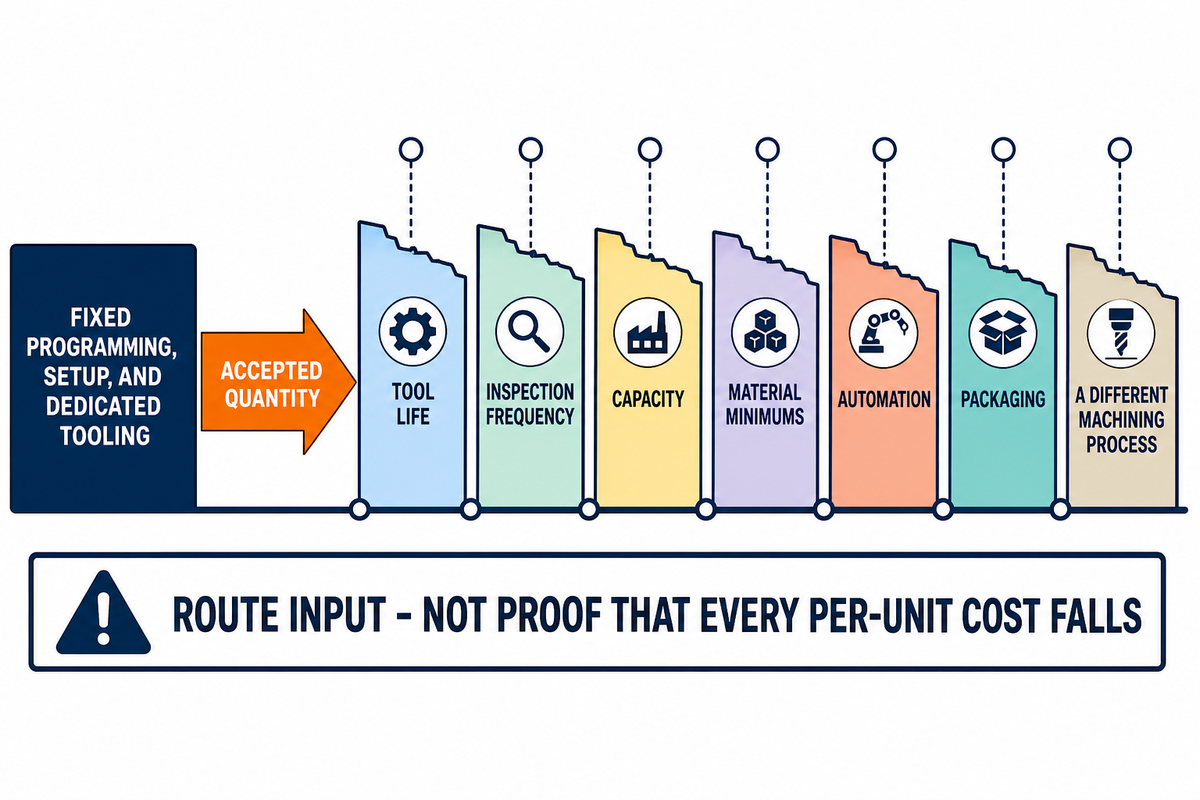
Production volume changes cost per part because programming, setup, and dedicated tooling can be spread across more accepted pieces. That decline isn’t endless: tool life, inspection frequency, capacity, material minimums, automation, packaging, or a different machining process can create a cost cliff.
Separate setup costs from recurring machine time before asking for a quantity discount. If a larger batch needs another fixture, extra tool qualification, a new inspection sample plan, or split delivery, the cost curve changes shape. The number of parts is therefore an input to the route, not proof that every per-unit cost must fall.
Assume the synthetic HX-120 Housing job has fixed programming, fixture, and setup work of $600 and manufacturing scope of $18 per accepted part. At 20 accepted parts, the cost model is $600/20 + $18 = $48 per accepted part. At 100 accepted parts it’s $600/100 + $18 = $24. This arithmetic says nothing about capacity or tool life.
Ask for quantity breaks with the same revision, material condition, finish, inspection, packaging, and acceptance state. If the route changes, request a short explanation. For a related public tool, see Zhenling’s batch cost cliff estimator. If route assumptions change, request a new quote rather than extending the old price linearly.
Key point: quantity spreads fixed work, but accepted quantity and process cliffs determine whether the expected per-unit cost actually appears.
7-Checkpoint Equal-Scope Reconciliation Trail
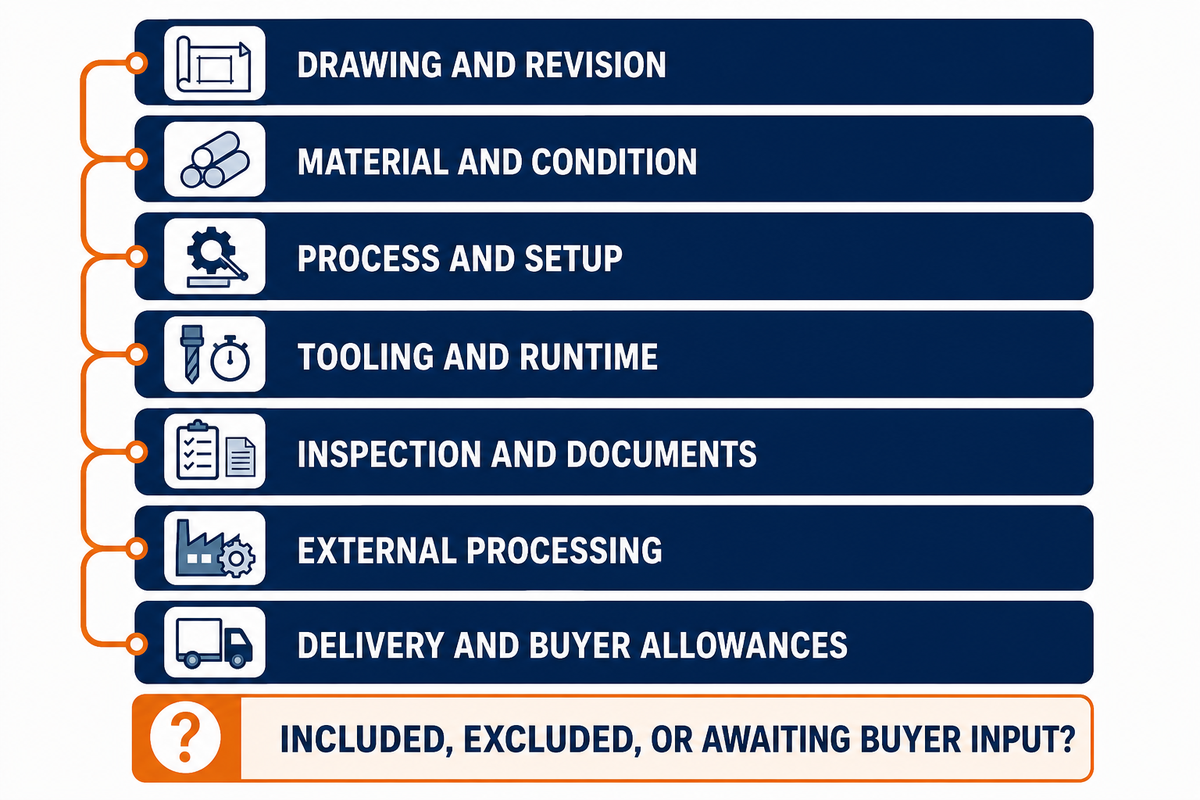
This 7-Checkpoint Equal-Scope Reconciliation Trail identifies why two CNC pricing results diverge after suppliers receive what seems to be the same information. Each checkpoint outlines the underlying decision, cost consequence, evidence required for comparison, and buyer responsible for the answer.
| Checkpoint | Possible drift | Cost consequence | Evidence to request | Decision owner |
|---|---|---|---|---|
| 1. Drawing and revision | Different model, drawing, or interpretation | Programming and contingency change | Controlled file list and clarifications | Engineering |
| 2. Material and condition | Grade, temper, form, or certification differs | Purchase, loss, and machining change | Standard, condition, stock basis | Engineering and procurement |
| 3. Process and setup | Route, machine, or setup count differs | Fixed work and transfer risk change | Route summary and setup sketch | Manufacturing engineering |
| 4. Tooling and runtime | Tool life, fixture, cycle, or attendance differs | Variable and allocated cost shift | Dedicated tooling and cycle assumptions | Operations |
| 5. Inspection and documents | Features, sample rate, or report differs | Measurement and rejection exposure change | Inspection plan and acceptance point | Quality |
| 6. External processing | Finish, masking, certification, or recheck omitted | Outside service and logistics shift | Named process and included evidence | Engineering and quality |
| 7. Delivery and buyer allowances | Incoterm, packaging, duty, tax, inspection, or capital differs | Landed and ownership cost shift | Delivery basis and buyer cost sheet | Procurement and finance |
Zero is ambiguous. It can mean included at no separate charge, omitted, not applicable, or not yet quoted. Ask one discriminating question for every blank: “Is this requirement included, excluded, or awaiting a buyer input?” Use the quote window scorer to check enquiry readiness and the CNC supplier quote comparison calculator to normalize two scopes.
NIST Manufacturing Extension Partnership guidance notes that a higher-priced supplier input can sometimes reduce total ownership cost or risk.
Synthetic buyer total-cost bridge:
| Cost item | Quote A | Quote B |
|---|---|---|
| Supplier manufacturing scope | $2,700 | $2,850 |
| Buyer inspection and rejection handling | $120 | $60 |
| Freight, duty, and packaging | $200 | $160 |
| Inventory and capital allowance | $60 | $40 |
| Delivery-disruption allowance | $180 | $80 |
Quote A: $3,260 ÷ 96 buyer-accepted parts = $33.96. Quote B: $3,190 ÷ 98 buyer-accepted parts = $32.55. The higher supplier price wins only inside this synthetic assumption set.
How to Reduce CNC Machining Cost Without Removing Function
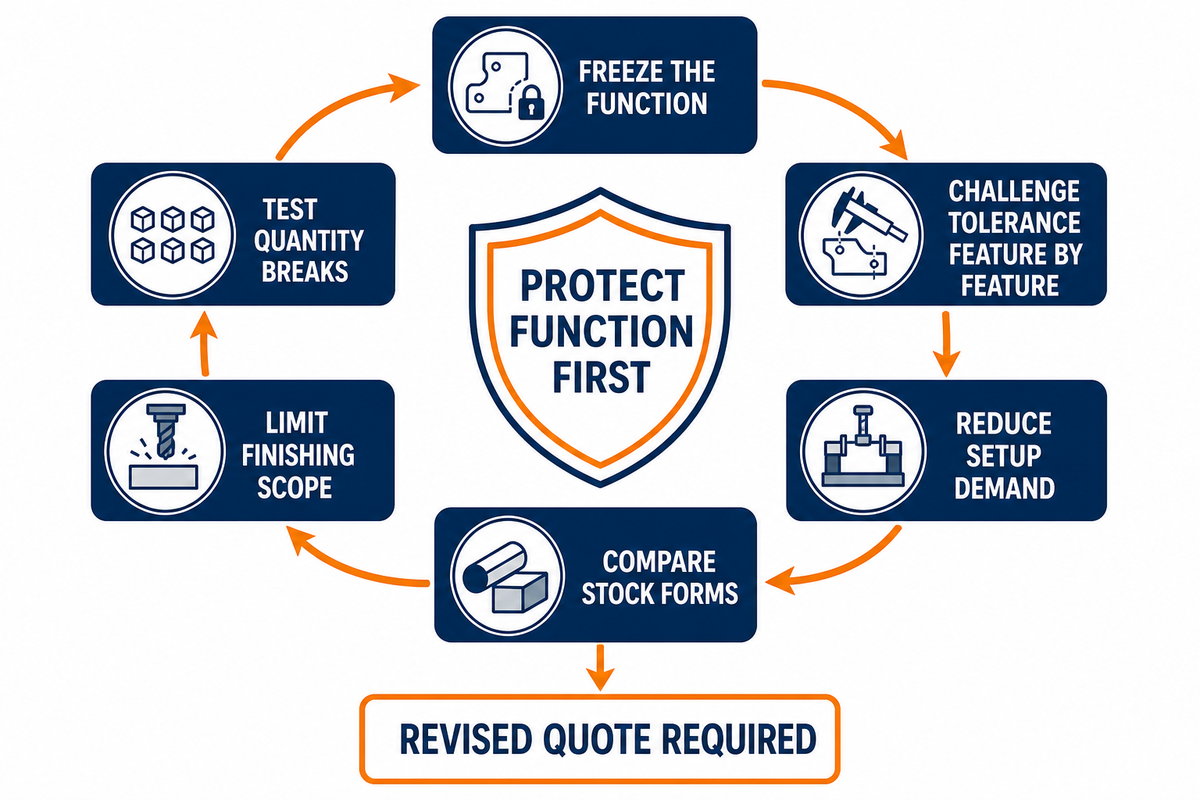
Cost reduction should protect function first, then test the tolerance, setup count, tool access, stock form, finish, inspection, and batch strategy. Reducing the cost of CNC machining by deleting an unreviewed requirement can move expense into assembly failure, rework, or field risk.
- Freeze the function: identify interfaces, loads, sealing, wear, corrosion, and appearance zones.
- Challenge tolerance feature by feature: keep tight tolerances only where function or interchangeability requires them.
- Reduce setup demand: review datum continuity, tool access, and whether a feature can be reached without another fixture.
- Compare stock forms: test bar, plate, tube, extrusion, forging, or near-net stock under the same material condition.
- Limit finishing scope: mark cosmetic zones, masking, coverage, and post-finish inspection explicitly.
- Test quantity breaks: separate fixed and per-piece work, then identify capacity or tooling cliffs.
How can I reduce the cost of CNC machining?
Send a controlled three-dimensional model and drawing, identify functional tolerances, allow practical internal radii, expose tool access, choose a stocked material form where function permits, group compatible features, define finish zones, and request quantity options. Ask the supplier to explain any route change. Cost-effective doesn’t mean selecting the lowest line item; it means removing work that doesn’t protect function or acceptance.
Consider the synthetic HX-120 Housing: a 120 mm × 80 mm × 25 mm stainless body with a Ø30.00 mm sealed bore, ±0.05 mm bore tolerance, six mounting holes on a 50 mm pattern, two Ra 1.6 µm cosmetic faces, a 2.0 mm anodized aluminum cover, and R3 mm nonfunctional corners. Engineering protects the bore fit, sealing face, and hole pattern, then permits a supplier-proposed deburr standard and stocked cover plate. Procurement asks for 25-, 100-, and 250-piece options under the same inspection and delivery basis. Suppliers can now test fewer setups and a different stock plan without weakening the sealed interface. Any saving must appear in a revised quote; the article doesn’t assign a percentage.
Teams use CNC machining when its geometry, tolerance, volume, and material fit the process. Design for manufacturability aims to reduce machining expenses while preserving function, not to announce cost savings before a revised quote exists. Compare CNC machining services with the same precision machining scope and require every per-part cost to name its acceptance point. That keeps CNC manufacturing decisions tied to evidence.
When the scope is normalized, move it into Zhenling’s CNC quotation process and use the same scope sheet for every supplier.
Have a controlled drawing, material condition, quantity, and inspection scope?
2026 Cost Context: Indexes Explain Benchmark Drift, Not Your Quote
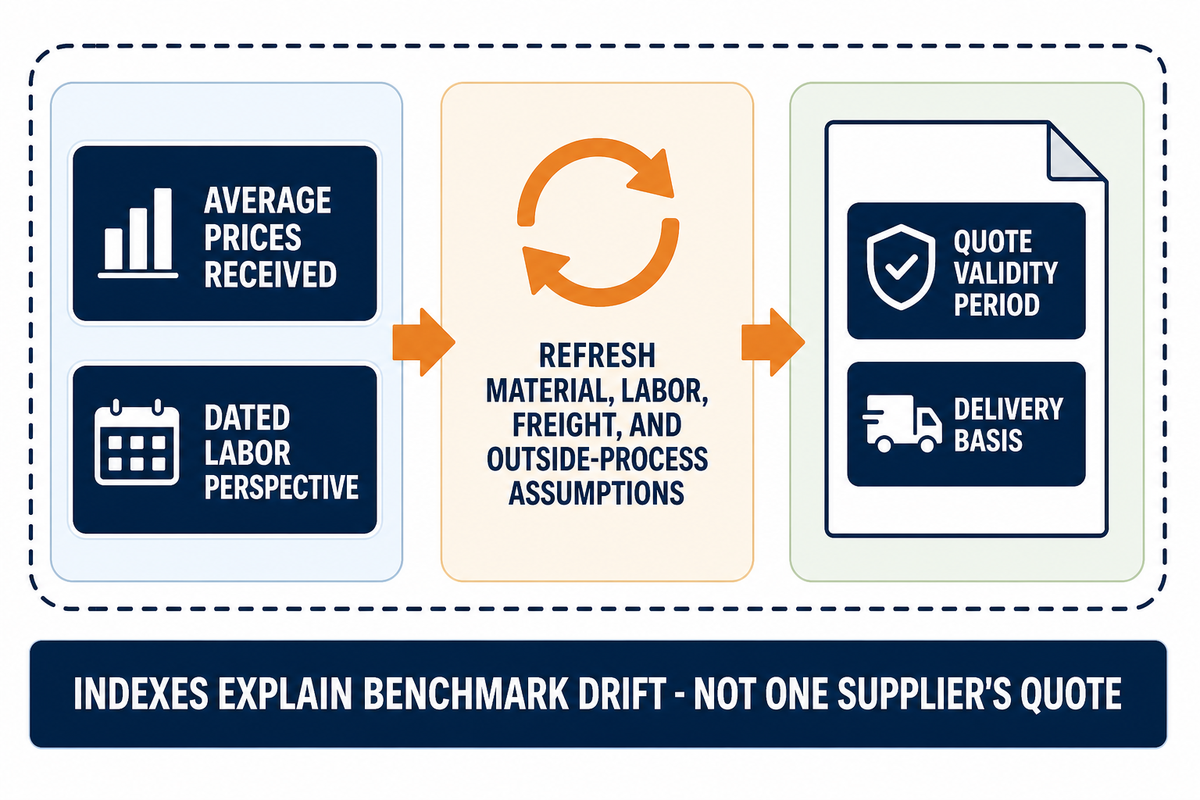
Current economic data explains why old CNC pricing tables age, but it can’t predict one supplier’s quote. Producer-price data describes average prices received by U.S. domestic producers; employee wage tables aren’t burdened labor rates, machine costs, imported-part prices, or buyer landed cost.
Federal Reserve Economic Data sourced from the U.S. Bureau of Labor Statistics moved from 207.453 in January 2025 to 214.839 in July 2026, about 3.6%. In August 2026, the July observation remains preliminary.
Bureau of Labor Statistics producer-price methods note that indexes are updated iteratively before final posting four months after initial release. Its May 2025 occupational employment and wage tables provide dated labor perspective. Use both to date-stamp assumptions, never to convert an index into a CNC machine shop hourly rate.
Action for 2026 budgets: refresh material, labor, freight, and outside-process assumptions at the time of request, and record the quote’s validity period and delivery basis.
FAQs: CNC Machining Cost
These answers apply the same NIST cost-structure boundary to common buyer questions. Keep process, price, and acceptance assumptions in sight because a short universal range conceals the variables that determine quoted CNC machined-part cost.
How much does CNC machining cost?
There’s no defensible universal part price because material, stock size, setup count, runtime, tooling, inspection, finishing, quantity, and delivery scope change together. A useful quote names the drawing revision, material condition, acceptance point, and included evidence, then separates one-time and per-piece costs so buyers can compare equivalent scope without mistaking an excluded cost for efficiency.
Why do CNC machining quotes vary so much?
Two suppliers may interpret the same drawing differently. One may include programming, fixtures, inspection reports, outside finishing, packaging, and freight while another leaves them open. Normalize revision, material condition, quantity, tolerance, inspection, external processes, delivery basis, and buyer allowances before treating a price gap as a supplier-efficiency difference rather than a scope difference.
Is 5-axis machining always more expensive?
No. A 5-axis machine can carry a higher burdened rate, but it may remove fixtures, transfers, and alignment checks. Lower total cost isn’t established until tool access, orientation, kinematics, surface quality, inspection, and quantity are compared in complete process plans. Axis count alone isn’t a price or accuracy ranking in practice.
Does surface finishing increase CNC machined-part cost?
It can. For anodizing, the engineering route may need machine-to and final dimensions, masking, or finish-specific inspection. Other finishes should be quoted against their actual route rather than a universal multiplier. A quote should state whether finishing, masking, certificates, dimensional recheck, and freight between processors are included.
Is aluminum always cheaper to machine than stainless steel?
Not automatically. Aluminum often cuts faster, but the buyer still needs to compare stock form, buy-to-fly loss, part mass, geometry, tolerance, tool reach, inspection, finish, and batch size. Some stainless grades may require lower cutting speeds or more machining power, yet their strength or corrosion performance can, in a suitable design, avoid a thicker section, protective coating, or shorter replacement interval. Availability also matters: a stocked stainless size can beat a special-order aluminum form once minimum purchase and freight are included. Keep function fixed and change one input at a time. Ask every supplier to quote the same drawing revision, material specification and condition, quantity, inspection scope, and delivery basis. Then compare buyer-accepted delivered cost rather than raw material price or cutting speed alone.
What files produce a more accurate CNC quote?
Send a released three-dimensional model, controlled two-dimensional drawing, material specification and condition, quantities, critical tolerances, inspection and documentation requirements, finish, packaging, and delivery basis. Identify acceptable substitutions separately. Clear revision and acceptance scope reduces contingency for clarification, reprogramming, reinspection, and undefined outside processes.
Compare Equal Scope, Then Compare Cost
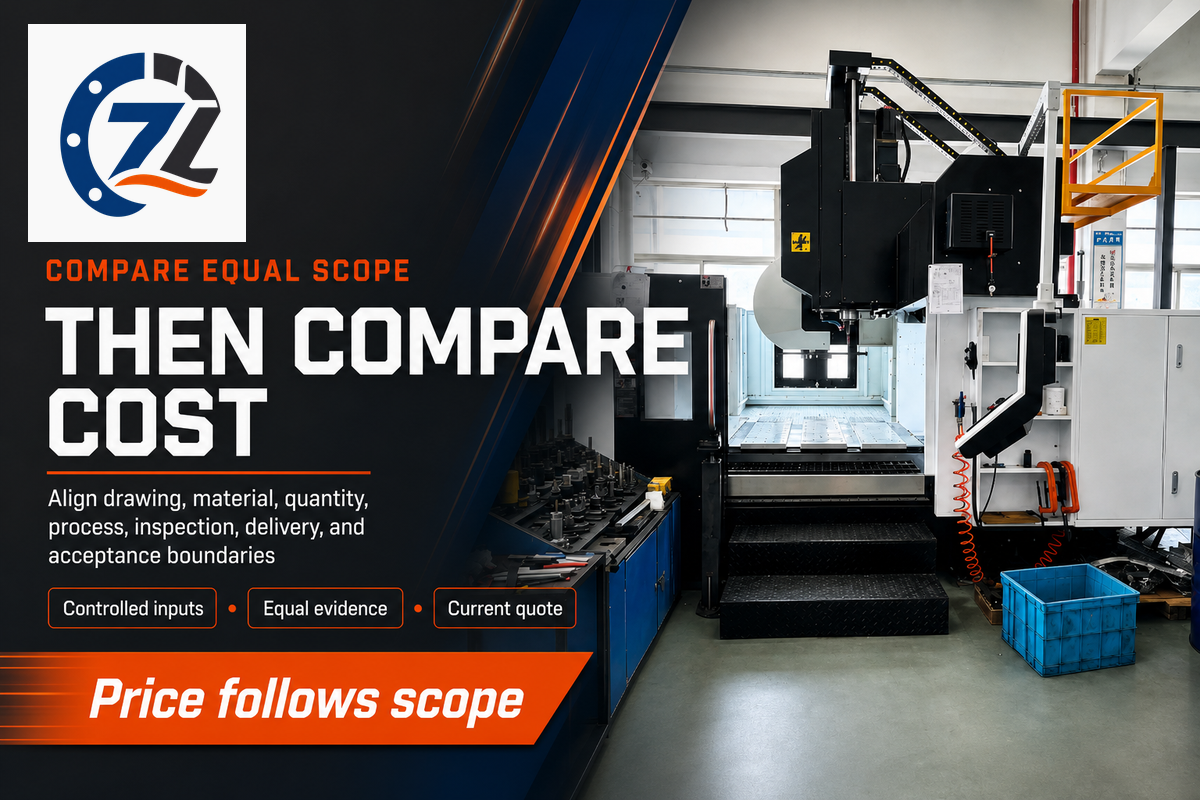
Reliable CNC comparisons start with equal drawings, material conditions, quantities, process boundaries, inspection evidence, delivery conditions, and acceptance points. Rebuild each quote with the nine-bucket cost build-up, then use the seven-checkpoint reconciliation trail to reveal assumption drift. Only after those steps does a price difference become meaningful.
Final cost is meaningful only when it uses the same acceptance and delivery boundary for the cost of CNC machined parts.
For capabilities outside this part-cost scope, review Zhenling’s broader services page.
Public authority sources and Zhenling’s public tools informed this model. No private plant cost, customer case, supplier rate, savings, or performance result was supplied. Treat every synthetic number as arithmetic practice and obtain a current drawing-based quote for the actual CNC machining needs.
References & Sources
- Design for Cost: A Review of Methods, Tools and Research Directions: National Institute of Standards and Technology
- 8 Ways to Improve Your Supplier Selection Process: National Institute of Standards and Technology Manufacturing Extension Partnership
- Quantification of Uncertainty in Machining Operations for On-Machine Acceptance: Sandia National Laboratories
- ASME Y14.5 Dimensioning and Tolerancing: American Society of Mechanical Engineers
- Producer Price Index by Industry: Machine Shops: U.S. Bureau of Labor Statistics via Federal Reserve Economic Data
- Producer Price Indexes: Presentation and Revision: U.S. Bureau of Labor Statistics
- Occupational Employment and Wage Statistics Tables: U.S. Bureau of Labor Statistics


![Shop-Floor Carbon Steel CNC Machining Guide [2026]](https://zhenlingmetal.com/wp-content/uploads/2026/08/carbon-steel-cnc-machining-handbook-r2-featured-150x150.png)


