Get in touch with Zhenling Company
Top 20 Swiss CNC Machining Service Vendors for Custom Parts

Last updated: October 2026
The best Swiss CNC machining service vendors depend on the job: Zhenling Metal for mixed custom components, Cox Manufacturing for scheduled volume supply, GrovTec for pilot-to-production programs, and Swissomation for micro parts. This comparison covers 20 service companies, with capabilities and practical boundaries to help buyers build a drawing-specific shortlist.
Quick Picks
- Best for mixed custom orders: Zhenling Metal
- Best for finishing choices: VMT
- Best for scheduled volume supply: Cox Manufacturing
- Best for pilot batches: GrovTec Machining
- Best for early design collaboration: Swissturn/USA
- Best for micro-part prototypes: Swissomation
Disclosure: This guide is published by Zhenling Metal. We list ourselves first because this is our website, not because we claim to be the market leader. The other 19 manufacturers are grouped by what they’re best for, in no particular order within each group.
How We Selected These Swiss CNC Machining Vendors
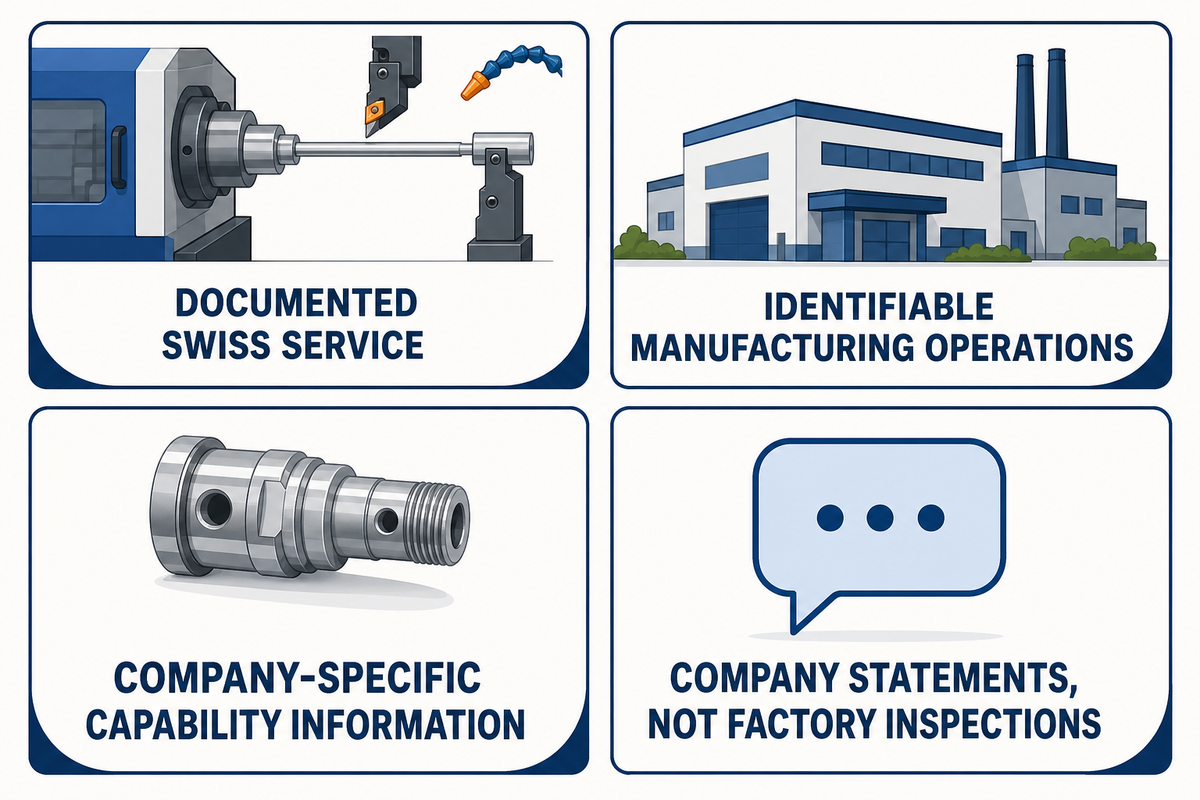
Selection centers on manufacturing businesses with a documented Swiss service, identifiable operations and useful company-specific capability information. Company information was checked against official websites and public sources in October 2026; Zhenling’s own Swiss capacity was also confirmed by its owner. Trading-only companies, distributors, sourcing-only platforms, directories, media websites and used-equipment dealers were excluded. RapidDirect qualifies through its manufacturing operations while retaining a wider partner network. The count represents service companies, not 20 independently inspected factories. The China and United States groups organize purchasing scenarios rather than objective rankings, and inclusion doesn’t imply that every listed process runs at one plant.
20 Swiss CNC Machining Service Vendors at a Glance
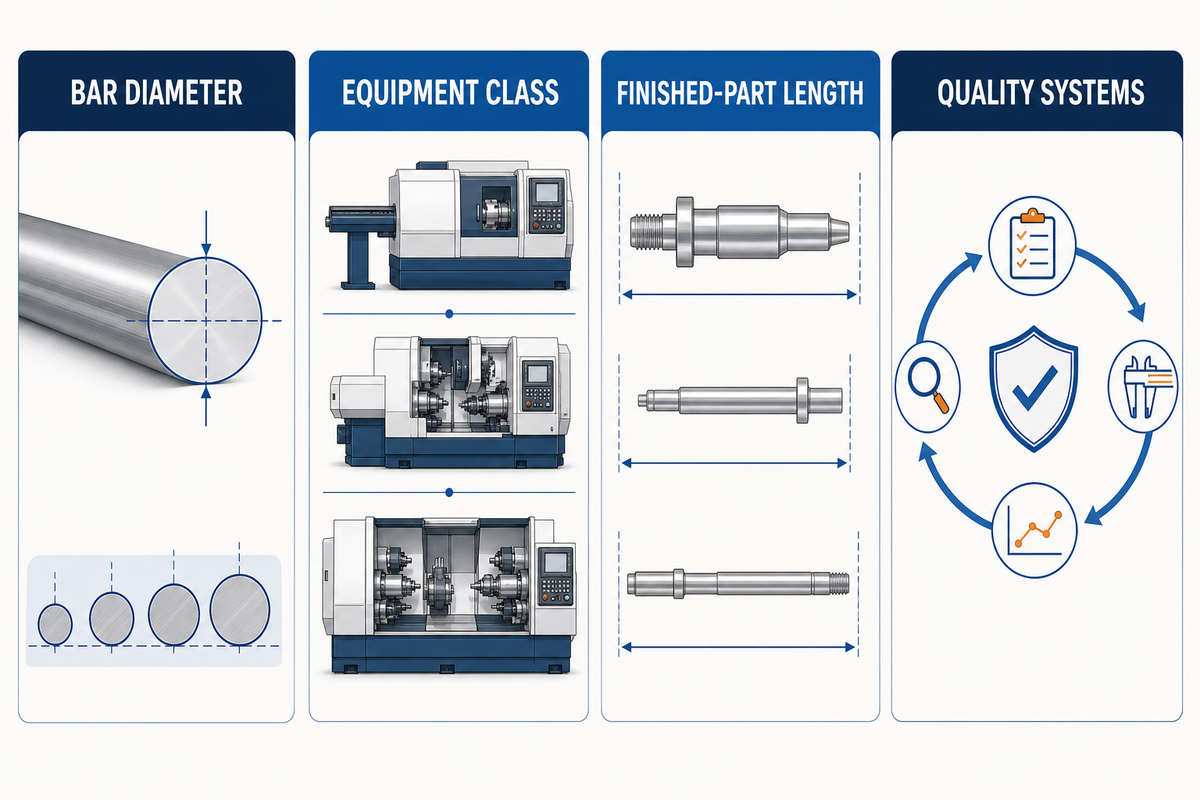
These entries summarize company statements on bar diameter, equipment class and finished-part length. Cards delineate quality-systems and provide additional process details.
| No. | Company | Headquarters or Operating Location | Founded | Best For | Brief Introduction | Swiss Capabilities | Key Advantages | Potential Disadvantages | Official Website |
|---|---|---|---|---|---|---|---|---|---|
| 1 | Zhenling Metal | Shanghai / Jiashan, China | 2006 | Mixed custom orders | Own-plant component manufacturer | Drawing-led Swiss routing | Multiple machining routes | Samples charged separately | https://zhenlingmetal.com/ |
| 2 | Super-Ingenuity (SPI) | Dongguan, China | 2018 | Bar-fed plus milled parts | Mold and machining manufacturer | 1–32 mm bar | Drawing-based inspection | Swiss diameter ceiling | https://super-ingenuity.cn/ |
| 3 | VMT | Shenzhen, China | 2010 | Turned parts with finishes | Factory-based parts manufacturer | Turning, milling, drilling | Broad finishing menu | Cylindrical-part emphasis | https://www.machining-custom.com/ |
| 4 | Falcon CNC Swiss | Dongguan, China | Not stated | Recurring connectors | Custom OEM manufacturer | Live tools; dual spindles | Varied materials | Small-component focus | https://www.falconcncswiss.com/ |
| 5 | RapidDirect | Shenzhen, China | 2009 | Multi-process development | Owned factories plus network | 1–32 mm; 300 mm length | Prototype-to-production breadth | Single-plant conditions additional | https://www.rapiddirect.com/ |
| 6 | Yijin Solution | Shenzhen, China | 2003 | Aviation-oriented fasteners | Custom machining manufacturer | Swiss-type screw machining | Related fitting families | Fastener-focused offer | https://yijinsolution.com/ |
| 7 | Cox Manufacturing | San Antonio, Texas | 1956 | Scheduled volume supply | Screw-machine contract manufacturer | CNC and cam Swiss | Toolmaking; inventory programs | Non-reoccurring costs | https://www.coxmanufacturing.com/ |
| 8 | Gent Machine | Cleveland, Ohio | 1880/1927: accounts differ | Asymmetric long features | Contract machining manufacturer | 20/32 mm Citizen fleet | Long-part devices | 32 mm Swiss class | https://www.gentmachine.com/ |
| 9 | Swissturn/USA | Oxford, Massachusetts | 1987 | Early design collaboration | Employee-owned Swiss manufacturer | 0.010–1.250-inch diameter | Design-to-production support | 12-inch length envelope | https://swissturn.com/ |
| 10 | Swiss-Tech | Delavan, Wisconsin | 1965 | Medical/aerospace components | Precision-component manufacturer | CNC 32 mm; cam 20 mm | Finishing and process control | Separate equipment limits | https://swisstechllc.com/ |
| 11 | GrovTec Machining | Wood Village, Oregon | 2006 | Pilot-to-production programs | American contract manufacturer | 18 Citizen machines | Repeated machine models | Around 50-piece prototype entry | https://grovtecmachining.com/ |
| 12 | Ripley Machine | Ripley, New York | 1994; predecessor 1950s | Recurring round parts | Family-owned production shop | Bar-fed Swiss turning | Reduced secondary handling | Above 1,000-part focus | https://www.ripley-machine.com/ |
| 13 | EMC Precision | Elyria, Ohio; Sheridan, Indiana | 1925 | Finished subassemblies | Components and assemblies manufacturer | Swiss plus other technologies | Finishing; inventory management | Setup costs | https://emcprecision.com/ |
| 14 | U.S. Swiss | San Bernardino, California | 1968 | Angled and threaded details | Swiss CNC manufacturer | 0.005–0.787-inch diameter | Seven-axis feature options | Small diameter envelope | http://www.swissmachining.com/ |
| 15 | Hogge Precision | Hartsville, South Carolina | 1989 | Slender mixed-material parts | Component and assembly manufacturer | Form turning; knurling | Broad materials; automation | Small slender geometry | https://www.hoggeprecision.com/ |
| 16 | Kernell’s Automatic Machining | Berlin Heights, Ohio | 1969 | Long-section cable fittings | Family-owned component manufacturer | Up to 20-inch length | Custom tooling and inspection | 500-piece production emphasis | https://www.kernellsautomatic.com/ |
| 17 | Ardel Engineering | New Hope, Minnesota | 1967 | Mid-volume finished parts | Precision machining job shop | 20/32 mm Citizen machines | Secondary-process support | 500–50,000-part preferred band | https://www.ardelengineering.com/ |
| 18 | McCormick Industries | Appleton, Wisconsin | 1996 | Turned/milled details | Swiss-focused CNC manufacturer | Multi-operation Swiss turning | Lights-out production | Outside heat treating and plating | https://mccormickind.com/ |
| 19 | Kremin Inc. | Frankenmuth, Michigan | 1983 | Medical/aerospace supply chains | Precision CNC manufacturer | 16/20/32 mm Citizen classes | Broaching with Swiss work | Published diameter classes | https://www.kremininc.com/ |
| 20 | Swissomation | Fredericksburg, Texas; Amherst, Virginia | 1983 | Micro-part prototypes | Small-component contract manufacturer | Live milling; automatic feeding | Tooling and metrology | Not large structural work | https://www.swissomation.com/ |
China-Based Swiss Machining Vendors
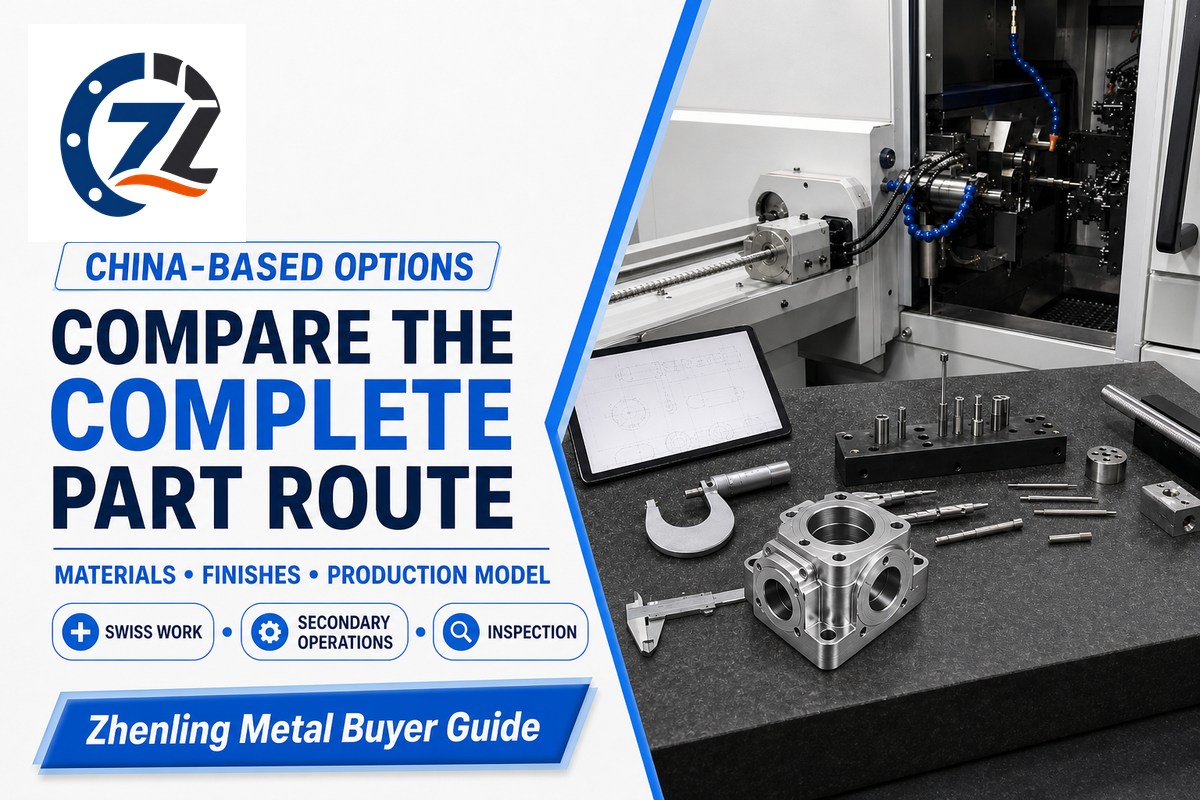
These six firms integrate Swiss work with other custom CNC machined parts. Materials, finishes and production models shape their offers.
1. Zhenling Metal, Best for drawing-led Swiss parts within mixed machining orders
Location: Shanghai, China; manufacturing in Jiashan, Zhejiang · Founded: 2006 · Type: Custom component manufacturer with its own plant
Official website: https://zhenlingmetal.com/
Main products: Valve bodies, plugs, shafts, flanges and fluid control components. Swiss capabilities: Owner-confirmed in-house Swiss machining; drawing review of guide-bushing fit, threads, grooves and cross holes.
Zhenling’s Swiss machining service suits mixed drawing packages containing slender turned details and components better suited to other CNC routes. Engineers review stock condition, feature access, secondary operations and inspection needs when choosing how to manufacture related parts within an assembly.
Material discussions cover carbon, alloy and stainless steels, aluminum and selected corrosion-resistant alloys. The company accepts single-piece machined orders, so a drawing can enter development before a repeat batch is established.
Advantage: Swiss and conventional turning can be considered within one project discussion. Limitation: samples carry a separate charge before first-article approval and batch production; that development cost is distinct from the repeat-order price.
2. Super-Ingenuity (SPI), Best for small bar-fed parts alongside milling work
Location: Dongguan, China · Founded: 2018 · Type: Mold and machining manufacturer
Official website: https://super-ingenuity.cn/
Main products: Pins, connectors, screws, brackets, housings and milled plates. Swiss capabilities: 1–32 mm Swiss bar diameter; separate 3-axis, 4-axis, 5-axis and mill-turn routes.
Quality systems: The service page cites ISO 9001 and IATF 16949.
SPI selects among machining routes according to datum relationships, tool access and workpiece support near the cut. That approach suits related precision parts such as a slender connector and its mating housing, where Swiss machining and multi-face milling address different features.
According to the company, coordinate measuring machines, optical measurement, functional gauges and surface roughness checks support inspection, with report depth defined for the order.
Advantage: the machining discussion can cover both the cylindrical detail and its mating component, including how their features will be measured. Limitation: the stated Swiss range ends at 32 mm; a larger bar-fed component belongs to a different turning or milling route rather than an enlarged version of this Swiss offer.
3. VMT, Best for cylindrical parts with downstream finishing requirements
Location: Shenzhen, Guangdong, China · Founded: 2010 · Type: Custom machining-parts manufacturer with its own factory
Official website: https://www.machining-custom.com/
Main products: Shafts, connectors and small stainless steel, aluminum, brass or PEEK components. Swiss capabilities: Swiss turning, milling and drilling with combined operations in one setup.
Quality systems: The service page states ISO 9001:2015 and IATF 16949:2016.
VMT pairs Swiss work with anodizing, plating, polishing and coatings, making surface finish part of the manufacturing conversation. Its prototype and repeat-production offer suits components that need both functional dimensions and a consistent appearance or protective treatment.
The published quality workflow covers incoming material, in-process checks and final inspection, supported by CMM measurement, material testing and certificates of conformity.
Advantage: buyers can discuss machining and downstream surface requirements together instead of treating the finish as an afterthought. Limitation: this Swiss service centers on cylindrical and slender parts; prismatic geometry needs another machining route, while coating or plating allowances must be included in the finished drawing dimensions.
4. Falcon CNC Swiss, Best for recurring connectors and custom fasteners
Location: Dongguan, Guangdong, China · Founded: Not publicly disclosed · Type: Falcon MFG Co., Ltd.; custom component manufacturer
Official website: https://www.falconcncswiss.com/
Main products: Bolts, nuts, inserts, bushings, pins, connectors, fittings and electrical contacts. Swiss capabilities: Live tooling and dual spindles; stated tolerances to ±0.005 mm on applicable components.
Quality systems: The Swiss page states ISO 9001, ISO 13485 and IATF 16949.
Falcon’s multi-axis Swiss lathes combine turning, milling, drilling and threading for small connection, attachment and fluid-handling components. The company supports development through recurring high-volume manufacture, with material selection and process optimization included in its OEM service.
Stainless steel, titanium, aluminum, brass, copper and engineering plastics give designers options for corrosion resistance, weight or conductivity.
Advantage: the catalog of custom shapes extends beyond standard screws to inserts, valve components and contacts, with final inspection included in the stated workflow. Limitation: the offer is built around small complex parts and recurring volume; a large structural workpiece is outside this Swiss-focused service.
5. RapidDirect, Best for Swiss parts within multi-process product development
Location: Shenzhen, China · Founded: 2009 · Type: Manufacturer with self-owned factories and a partner network
Official website: https://www.rapiddirect.com/
Main products: Shafts, pins, bushings, sleeves, fasteners, contacts, nozzles and valve components. Swiss capabilities: 1–32 mm bar; up to 300 mm length; 5- to 11-axis machines.
Quality systems: Corporate timeline records ISO 9001:2015 and ISO 13485:2016 certification.
RapidDirect combines Swiss CNC machining services with injection molding, sheet metal, general CNC machining and 3D printing. Its Swiss route covers front- and back-side work, cross holes, grooves and flats in one cycle; the stated typical tolerance is ±0.01 mm, with selected features reaching ±0.005 mm after drawing review.
The online quotation and manufacturability-review system provides a common entry point for those different processes.
Advantage: the service spans prototype development and production without limiting the conversation to the Swiss component alone. Limitation: owned factories and network partners both contribute to the manufacturing model, so a requirement that every operation occur at one named plant is an additional production-site condition, not an automatic feature of the offer.
6. Yijin Solution, Best for custom fasteners in aviation-oriented assemblies
Location: Shenzhen, China · Founded: 2003 · Type: Custom machining manufacturer operating a Shenzhen factory
Official website: https://yijinsolution.com/
Main products: Screws, fasteners, bushings, connectors, hydraulic fittings and sensor housings. Swiss capabilities: Swiss-type sliding headstock processing, turning and multi-axis screw machining.
Quality systems: The aviation screw-machining page states ISO 9001 certification.
Yijin’s aviation-focused service names landing-gear bolts, engine valve threads, hydraulic fittings and sensor housings. This range allows buyers to discuss related threaded and non-threaded components together, with the material specification and functional features defining each production route.
The corporate profile describes a factory exceeding 25,000 square meters and more than 100 employees; those figures describe the business as a whole.
Advantage: the combination of screw machining and broader custom CNC work supports conversations about related threaded and non-threaded parts. Limitation: the published Swiss-related offer is concentrated on screws, fasteners, bushings and connectors, rather than a defined envelope for every micro-shaft or long-part program. ISO 9001 describes the quality system, not approval of an aircraft component.
US Shops for Repeat Production
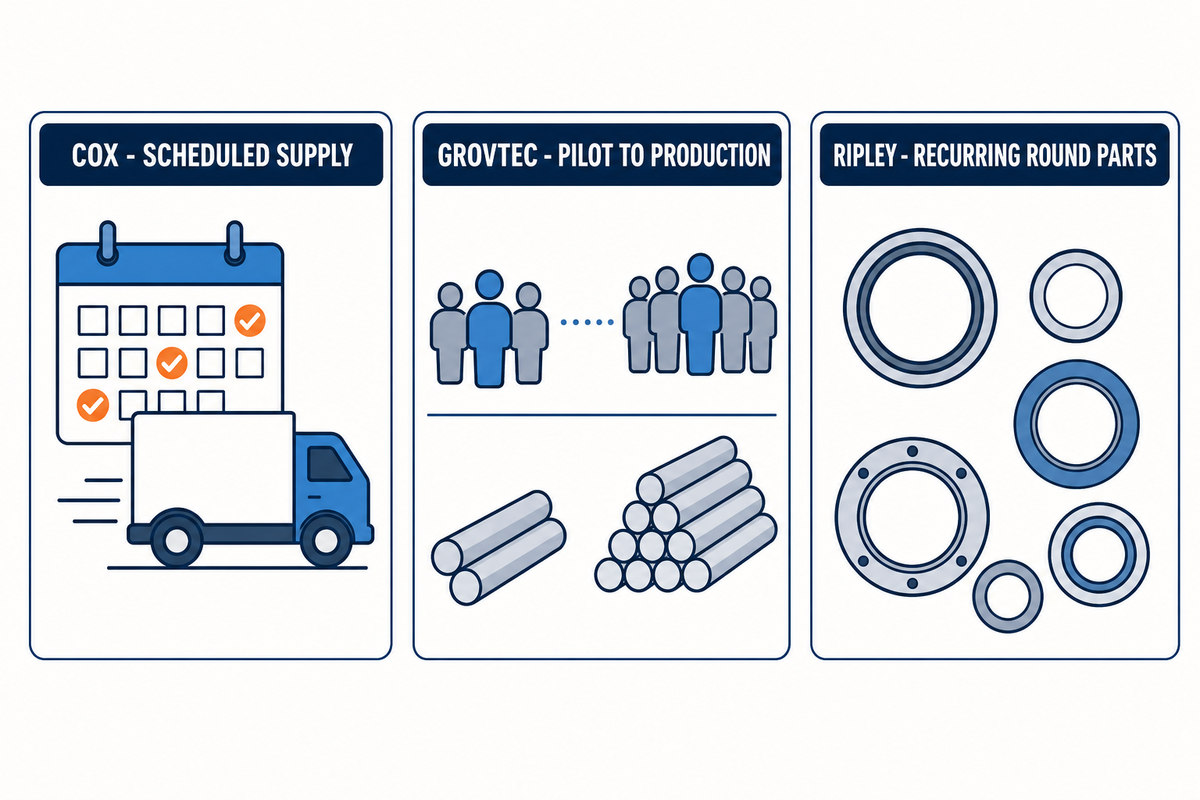
Ongoing purchase decisions rest on release cycles and geometry. These firms address automation and supply or design support services beyond the first sample, which can help purchasers assess Swiss machining services for complex components across programs. Automated machines can run beyond staffed hours, and planned inspections and release schedules set the order.
7. Cox Manufacturing, Best for high-volume parts with scheduled supply support
Location: San Antonio, Texas, USA · Founded: 1956 · Type: Family-operated precision screw-machine contract manufacturer
Official website: https://www.coxmanufacturing.com/
Main products: Miniature parts, slender pins and complex OEM components. Swiss capabilities: Up to 12-axis CNC Swiss turning equipment, plus cam Swiss production.
Quality systems: The Swiss page states ISO 9001:2015 and ITAR registration.
Cox Manufacturing specializes in screw machined products for automotive, electronics, aerospace, medical and industrial applications. Automatic bar loading supports multi-operation CNC work, cam equipment serves miniature or unusually long components, and in-house toolmaking supplies wire EDM forming tools and CNC tool grinding.
For repeat purchasing, the company describes just-in-time logistics, Kanban and inventory programs, together with automotive PPAP and process FMEA support.
Advantage: high-volume screw machined components can be discussed as an ongoing supply program, with tooling and delivery planning alongside part manufacture. Limitation: the up-to-12-axis description applies to the CNC route, not every cam or Swiss machine at Cox; the appropriate equipment configuration follows the job’s geometry and production needs. Its buyer guide separates non-recurring programming, tool-design and fixture charges from repeat part costs, so an initial order carries development expenses beyond the repeat price.
8. Gent Machine, Best for repeat parts with asymmetrical and long features
Location: Cleveland, Ohio, USA · Founded: 1880 roots on its website; a business profile gives 1927 · Type: Contract screw-machine and CNC manufacturer
Official website: https://www.gentmachine.com/
Main products: Intricate turned components, spindles and shafts. Swiss capabilities: Ten Citizen Cincom machines in 20 mm and 32 mm classes with LNS loaders.
Quality systems: The company states IATF 16949:2016 certification and ISO 9001 compliance.
Gent uses high-pressure coolant, mist collection and fire suppression to support unattended production of parts with off-center holes, milled flats and long sections. Selected machines have long-part devices, with completed 13-inch spindles and 20-inch shafts illustrating the work rather than establishing a universal length limit.
Advantage: the Swiss department addresses exotic materials and asymmetric features that its other equipment can’t efficiently combine. Limitation: the listed Swiss fleet is in the 20 mm and 32 mm classes; the separate two-inch conventional turning machine doesn’t expand that Swiss diameter range.
9. Swissturn/USA, Best for production parts benefiting from early design input
Location: Oxford, Massachusetts, USA · Founded: 1987 · Type: employee-owned precision Swiss contract manufacturer
Official website: https://swissturn.com/
Main products: Miniature fasteners and medical, aerospace, defense, photonics and industrial components. Swiss capabilities: Star machines; 0.010–1.250 inches diameter and up to 12 inches long.
Quality systems: The Swiss service states ISO 9001:2015 registration and ITAR registration.
Swissturn brings geometry, material and tolerance discussions into the design stage, supported by machining simulation and failure-mode analysis. The site’s J.I. Morris miniature-fastener offer is also relevant when an assembly combines custom precision components with very small fastening details.
Bar loaders, sub-spindles, front and rear live tooling, and high-pressure coolant support lights-out production across a range of materials including stainless steel, aluminum, brass, copper, nickel alloys, plastics and titanium.
Advantage: early collaboration can connect the part’s functional requirements with a production-ready geometry and inspection plan. Limitation: the published component envelope stops at 1.250 inches in diameter and 12 inches in length; larger parts require another process or supplier.
10. Swiss-Tech, Best for medical and aerospace parts across CNC and cam routes
Location: Delavan, Wisconsin, USA · Founded: 1965 · Type: Custom precision-component manufacturer
Official website: https://swisstechllc.com/
Main products: Swiss-machined components with milling, turning, deburring and polishing support. Swiss capabilities: CNC Swiss bar up to 32 mm; cam Swiss bar up to 20 mm.
Quality systems: The certification page states ISO 9001, AS9100 and ISO 13485; ITAR compliance.
Swiss-Tech’s CNC machines offer sub-spindle pickoff, live cross tools, end-working tools and C-axis control; cam machines provide threading, light milling, slotting and back drilling. The equipment information identifies Citizen L12X and Nexturn SA20B machines for small-part production.
Prototype-to-volume work is supported by statistical process control, measurement automation and in-process inspection.
Advantage: the broader finish-machining, deburring and polishing offer allows the discussion to continue beyond the first turning operation, which matters for components moving into medical devices or aerospace assemblies. Limitation: CNC and cam capacities are different: the 32 mm CNC bar limit can’t be applied to the cam fleet, whose published ceiling is 20 mm.
11. GrovTec Machining, Best for programs growing from pilot batches
Location: Wood Village, Oregon, USA · Founded: 2006 · Type: American contract manufacturer with a dedicated Swiss department
Official website: https://grovtecmachining.com/
Main products: Pins, bushings, valve components and connector parts. Swiss capabilities: 18 Citizen machines: fourteen L16 Type XII and four L32 Type X/XII units.
Quality systems: The service page states AS9100D, ISO 9001:2015 and ITAR registration.
GrovTec’s repeated machine models and scheduling scope support a path from initial validation quantities to scheduled production releases. Its Swiss department serves high-mix, low-volume work and multi-year programs, combining several operations in one setup for related part families.
Common materials include 300- and 400-series stainless steels, alloy steel, aluminum, brass, titanium and engineering plastics.
Advantage: the documented Citizen Swiss fleet and prototype-to-production scheduling offer a concrete basis for planning repeat components, especially where the product mix changes over time. Limitation: GrovTec describes prototype quantities starting around 50 pieces, so a single experimental component is less aligned with its stated entry point than a pilot batch.
12. Ripley Machine, Best for recurring round parts above 1,000 pieces
Location: Ripley, New York, USA · Founded: 1994 incorporation; predecessor shop began in the 1950s · Type: Family-owned production machine shop
Official website: https://www.ripley-machine.com/
Main products: Round parts for aerospace, defense, medical, trucking and valves. Swiss capabilities: Swiss turning with automatic bar feeding and lights-out machining.
Quality systems: The company describes the shop as ISO certified.
Ripley’s Swiss department began by consolidating a CNC-turning job to remove a secondary operation, then expanded around repeat throughput. Its wider turning, milling and grinding services provide alternatives when Swiss lathe machining doesn’t fit a round part’s manufacturing needs.
The company describes a typical quoted Swiss lead time of four weeks, with repeat orders often delivered within two weeks; these are scheduling descriptions, not fixed delivery promises.
Advantage: a recurring part with avoidable secondary handling closely matches the reason Ripley developed its Swiss capability. Limitation: the service explicitly emphasizes orders above 1,000 pieces, making very small prototype lots less suited to its stated commercial focus.
13. EMC Precision, Best for repeat components needing finishing and assembly
Location: Elyria, Ohio, USA; additional operation in Sheridan, Indiana · Founded: 1925 · Type: Precision products and assemblies manufacturer
Official website: https://emcprecision.com/
Main products: Turned and milled components and sub-assembly work. Swiss capabilities: Swiss, multi-axis, multi-spindle and horizontal/vertical machining.
Quality systems: The machining page states ISO 9001:2015 and IATF 16949.
EMC combines machining with heat treating, plating, finishing, packaging and inventory management for purchasing packages that may end with a subassembly. Its wider material offer includes stainless and alloy steels, aluminum, high-performance alloys and engineering plastics.
Manufacturability assessments and a metrology laboratory support the transition from drawing to measured production parts, while the broader business handles prototype through large production quantities.
Advantage: this scope suits components whose machining, finish, sub-assembly and delivery arrangements need coordinated planning. Limitation: EMC’s equipment portfolio includes several distinct technologies; Swiss work, multi-spindle work and milling belong to separate production routes, so a combined quotation doesn’t mean every feature is made on a Swiss machine. EMC also notes that Swiss setup and tooling can be expensive for smaller runs; prototype availability therefore does not imply low initial unit cost.
US Specialists for Small and Complex Components
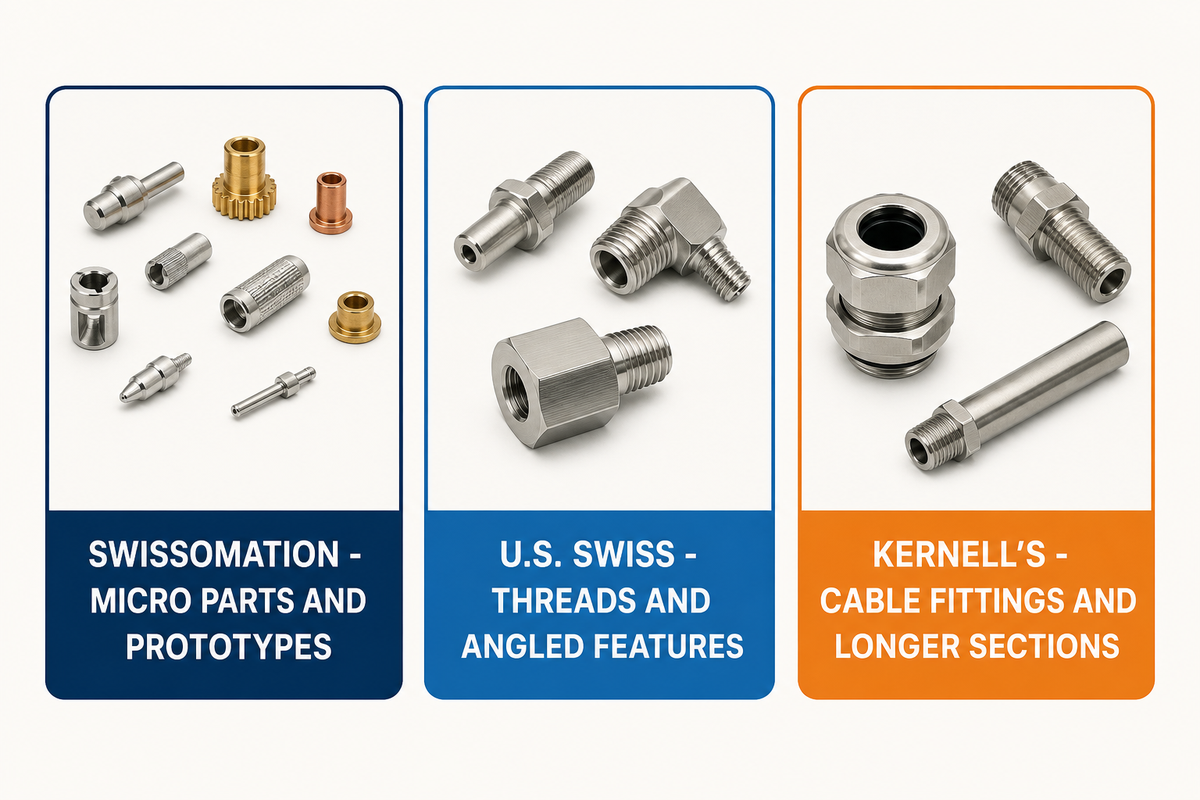
An unusual feature may narrow the candidate list. These shops perform micro-machining, thread work and some secondary processes for precision machined parts. The variety of industries represented here makes part geometry a better starting point than sector labels alone in many cases.
14. U.S. Swiss, Best for intricate parts with threads and angled features
Location: San Bernardino, California, USA · Founded: 1968 · Type: Precision Swiss CNC manufacturer
Official website: http://www.swissmachining.com/
Main products: Small turned components with slots, threads, broaching and angled cross features. Swiss capabilities: Eight Star machines; 3-, 5- and 7-axis configurations; 0.005–0.787 inches diameter.
Quality systems: The company profile states ISO 9001:2015 and ITAR registration.
Thread whirling, thread milling, polygon machining and angled drilling distinguish U.S. Swiss’s seven-axis route for complex secondary details. Simpler components can use three- or five-axis equipment, giving buyers a specific process choice beyond a general promise to machine parts with high precision.
Sub-spindles and automatic bar loaders help complete multi-operation parts within one cycle, and the published production range runs from 10 to 250,000 pieces.
Advantage: the equipment mix can match feature complexity to a suitable machine configuration rather than sending every part through the most elaborate route. Limitation: the published Star-machine diameter range ends at 0.787 inches, which makes this a small-part option rather than a route for larger turned bodies.
15. Hogge Precision, Best for slender parts across varied materials
Location: Hartsville, South Carolina, USA · Founded: 1989 · Type: Precision component and assembly contract manufacturer
Official website: https://www.hoggeprecision.com/
Main products: Turned parts with threads, formed surfaces and knurling. Swiss capabilities: Swiss cutting, form turning and threading with lights-out production.
Quality systems: The Swiss page states an ISO 9001:2015 registered quality management system.
Hogge grew from a screw machine shop into a broader component manufacturing operation serving smaller Swiss parts with high length-to-diameter ratios. Its material range includes aluminum, titanium, stainless steel, nickel alloys, carbon steel, bronze, brass, copper and selected plastics.
The wider 42,000-square-foot facility includes seven- and eight-axis turning centers, machining centers and multi-spindle screw machines, and the company describes expanding automated night production with additional Swiss equipment.
Advantage: repeated turned details can be considered alongside the shop’s broader component and assembly work, with unattended cycles supporting ongoing demand. Limitation: its Swiss offer focuses on smaller slender components; larger prismatic work belongs to the other machining departments rather than this process route.
16. Kernell’s Automatic Machining, Best for cable fittings and longer turned sections
Location: Berlin Heights, Ohio, USA · Founded: 1969 · Type: Family-owned screw-machine and Swiss CNC manufacturer
Official website: https://www.kernellsautomatic.com/
Main products: Cable fittings, wire-rope fittings, fan-shaft hubs, surgical tools and screws. Swiss capabilities: 0.050–1.250 inches diameter; lengths up to 20 inches.
Quality systems: The Swiss page states ISO 9001:2015 certification.
Kernell’s combines automated bar feeding and part handling with in-house tooling construction for continuous custom production. Its order sequence moves from blueprint review and supplier quotations through manufacturing prints, tooling, production and final inspection, giving repeat-job preparation a defined place in the service.
Custom-built inspection equipment complements its tooling capability, and the company describes failure-mode and effects analysis support.
Advantage: both the cutting arrangement and the measurement setup can be developed around the features of a repeat component, rather than treating inspection as a generic final check. Limitation: the company positions production orders from 500 pieces upward, within its published diameter and length envelope; this is a production-oriented option for custom CNC Swiss work.
17. Ardel Engineering, Best for mid-volume runs with secondary-process support
Location: New Hope, Minnesota, USA · Founded: 1967 · Type: Precision CNC machining job shop
Official website: https://www.ardelengineering.com/
Main products: Fittings, screws, shafts, connectors and other cylindrical parts. Swiss capabilities: Four 20 mm and three 32 mm Citizen machines with twin spindles.
Quality systems: The site states ISO 9001:2015, ISO 13485 compliance and ITAR registration.
Ardel pairs Swiss production with milling, turning, wire EDM and finishing for metals, plastics and engineering-grade materials. Magazine bar feeders support continuous operation, while twin spindles allow secondary features to be completed during the same cycle.
Published scheduling guidance gives two to three weeks for prototypes and four to six weeks for production, with rush and emergency options.
Advantage: machining and secondary services can be planned together for parts that need more than a turned profile before delivery. Limitation: Ardel identifies 500–50,000 parts as an effective Swiss production band, although it accepts other quantities, and the stated workpiece diameter reaches 32 mm. Its ISO 13485 wording describes compliance, not certification.
18. McCormick Industries, Best for small parts combining turned and milled details
Location: Appleton, Wisconsin, USA · Founded: 1996 · Type: Precision CNC manufacturer focused on Swiss-type machining
Official website: https://mccormickind.com/
Main products: Pins, ferrules, surgical-tool components and other small complex parts. Swiss capabilities: Swiss turning with multiple operations, plus separate milling and conventional turning.
Quality systems: The machining and contact pages state ISO 9001:2015.
McCormick’s wider portfolio includes ferrules, dowel pins, gas lenses and a surgical mallet shaft. Its Swiss offer combines detailed geometry and multiple operations, with automated lathes supporting production beyond staffed hours.
The company also provides CNC turning and milling outside the Swiss department, allowing the process discussion to follow the part’s size and feature access.
Advantage: the combination of small-part specialization and lights-out production suits intricate repeated components without reducing the selection to one advertised tolerance. Limitation: larger conventional-turning dimensions belong to a separate machining envelope; they don’t describe the size of components that can run through McCormick’s Swiss equipment. Heat treating, plating, grinding, passivation and anodizing are coordinated outside processes, which adds an external production stage for parts requiring these finishes.
19. Kremin Inc., Best for intricate aerospace and medical supply-chain parts
Location: Frankenmuth, Michigan, USA · Founded: 1983 · Type: Precision CNC manufacturer; part of Threadlock Precision
Official website: https://www.kremininc.com/
Main products: Custom aerospace, defense, medical, energy and industrial components. Swiss capabilities: Citizen L32XII, L20E, A32VII, A20VII and K16EVII; 16, 20 and 32 mm classes.
Quality systems: The About page states AS9100D, ISO 9001:2015 and ISO 13485:2016.
Kremin’s named machine models, automatic bar feeders and diameter classes make its Swiss production options concrete. Swiss screw machining combines milling, drilling, threading and broaching, reducing transfers between machines for suitable parts.
The wider business also offers milling and turning, so related machined products can be discussed within the same supplier relationship.
Advantage: the published equipment and quality-system scope provide specific starting points for aerospace and medical supply-chain enquiries. Limitation: the listed Swiss fleet is in 16 mm, 20 mm and 32 mm classes; larger-diameter components need a different route rather than an assumption that all precision CNC services share one capacity.
20. Swissomation, Best for micro and delicate parts from prototype quantities
Location: Fredericksburg, Texas, USA; second location in Amherst, Virginia · Founded: 1983 · Type: Contract manufacturer focused on micro-machining and Swiss production
Official website: https://www.swissomation.com/
Main products: Small detailed components, prototypes and complex Swiss-turned parts. Swiss capabilities: Mainly Citizen lathes, plus Tsugami, Meier and Hanhwah; live milling on all CNC Swiss machines.
Quality systems: The company states ITAR registration and an ISO 9001-compliant system.
Swissomation provides precision Swiss machining for delicate components, with early manufacturability discussions and explicit support for prototype quantities. Automatic bar feeders support continuous operation, while milling and mill-turn services address additional feature types on miniature parts.
In-house tooling, raw-material inspection, material certificates, CMM measurement and profilometers support the stated quality workflow.
Advantage: development-stage quantities and specialist small-part work sit within the same service, helping a product team address manufacturability before settling the production geometry. Limitation: this micro and intricate-component focus does not extend to large structural workpieces. The published ISO 9001 wording is compliance, which is distinct from a claim of third-party certification.
How to Choose a Swiss Turning Machine Shop
In many cases, documentation, landed delivery, drawing complexity and communication across repeat orders can be more influential than the country of origin in establishing quality and price. For CNC Swiss machined components, assess the complete manufacturing and inspection process before comparing piece prices.
When should I choose Swiss machining over a standard CNC lathe?
When proximity to the cut provides the best support for controlling a slender workpiece, and the machine can access the required features efficiently, Swiss machining is a good option. A bar supported by a guide bushing resists deflection near the cutting tool. Conventional CNC lathes offer options for relatively larger and/or shorter pieces with less stringent setup demands; no universal length-to-diameter cutoff selects the process for every drawing.
Swiss machining offers particular value when turning and milling, cross holes, threads or back-side details can share a cycle. The machines can perform several operations, but tool access, workholding and material behavior still govern complex geometries. Compare that route with CNC turning when fewer features are involved. Producing parts on more axes doesn’t automatically shorten cycle times or improve the economics of a simple component.
What information is required for a Swiss machining quote?
Send the drawing revision and CAD model, the exact material grade and bar condition, trial and repeat quantities, critical feature limits, burr and finish requirements, inspection-report depth, and the delivery destination. Separate the first-article order from expected releases. This provides a clearer definition of the job for quoting CNC Swiss machining services and highlights the differences in routing between competing bids.
Check carefully to see if functional datums are marked. Indicate the dimensions that control assembly. Don’t specify unnecessarily tight tolerances everywhere. For long parts, provide completed geometry and handling requirements, not the unfinished bar length. A quote for custom Swiss machined parts should break down setup, tooling, samples, and production including secondary operations, to identify development charges and to support comparison of repeat prices.
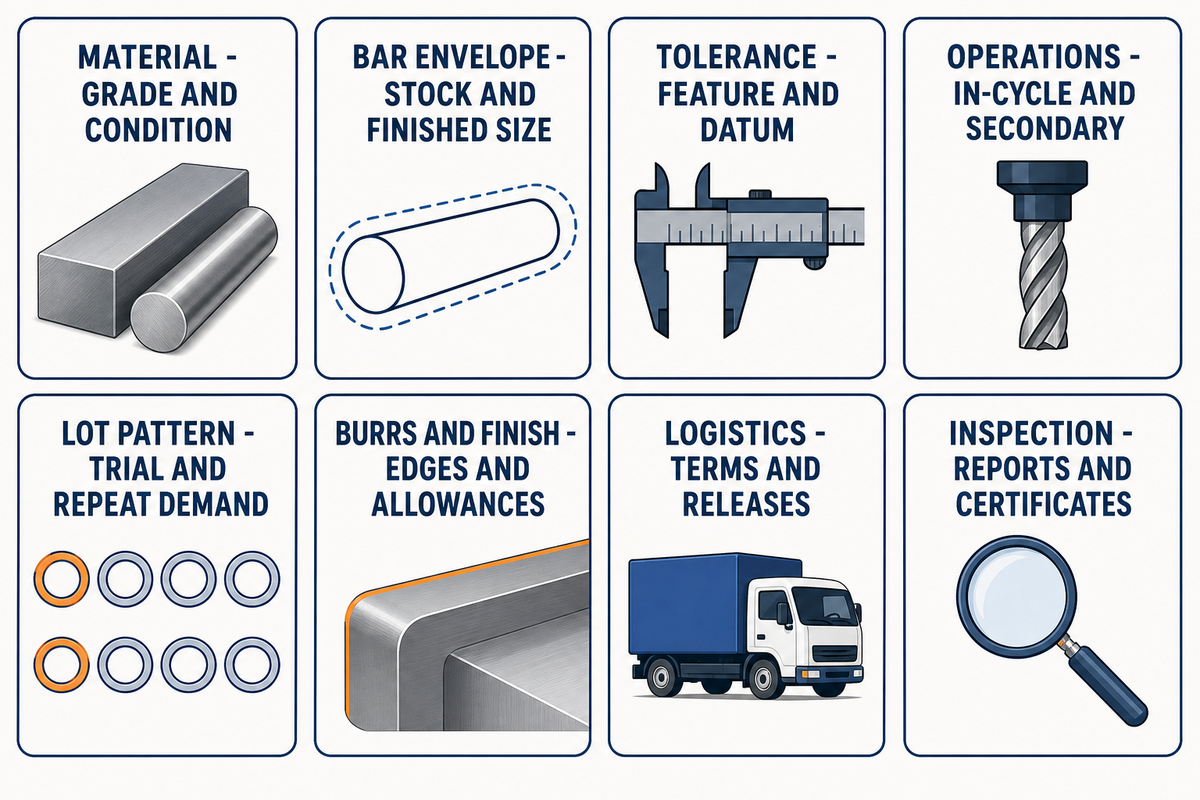
Use this checklist to prepare a common enquiry to each shortlisted supplier. It’s applicable to a specialist screw machine shop as well as a more general CNC machine shop offering a number of process routes.
Drawing-to-quote checklist
- Material: specify the grade, condition and traceability needs. For machining stainless steel components, alloy and stock condition influence tool selection and production behavior.
- Bar envelope: separate stock diameter, finished diameter and finished length. A bar feeder’s capacity doesn’t establish the length of the delivered component.
- Feature tolerance: tie each demanding limit to its feature, datum and measurement method. General high precision language can’t define acceptance for a particular bore or thread.
- Operations: list cross drilling, milling, broaching and secondary work. Establish which steps occur on the Swiss machine and which require another setup or an outside provider.
- Lot pattern: state development quantities, expected releases and annual demand. Long production runs and frequent small batches create different scheduling and inventory needs.
- Burrs and finish: identify sensitive edges and treatment allowances. Specify stainless steel passivation or another required finish as part of the delivered condition.
- Logistics: compare packaging, delivery terms, destination and release schedules. Include the time needed for sample approval and document review in the purchasing plan.
- Inspection: agree first-article reports, ongoing checks and material certificates. Review the relevant certificate scope and any external special processes against your own quality standards.
Swiss machining technology helps make parts only when the production route under consideration matches the work. For CNC Swiss screw machining, a supplier’s machine list is relevant evidence, but a drawing and agreed inspection plan define the order. Keeping the two levels separated supports a meaningful assessment of a claimed capability without converting every stated capacity figure to a guarantee.
Frequently Asked Questions
What types of parts are best suited for Swiss turning?
Small bar-fed components benefit when support and feature access suit the drawing.
Swiss turning suits small pins, shafts, sleeves, bushings and connectors whose features can be cut from bar stock. Support near the cutting tool helps slender sections resist deflection. The practical fit also depends on cross holes, threads, flats and finishing needs. Compare the drawing with each shop’s actual Swiss capacity before choosing a supplier.
What materials can be Swiss machined?
Material choice follows the required function, specified grade and available stock condition.
Common options include stainless steel, carbon and alloy steels, aluminum, brass, copper and certain engineering plastics. Some shops also machine titanium and nickel alloys. Availability depends on the factory, grade, bar condition and required features. Name the exact material specification in your inquiry, because a broad material category doesn’t establish an acceptable substitute.
What are the main advantages of using a Swiss machine shop?
Close workpiece support and combined operations can improve a suitable manufacturing route.
A Swiss machine shop can combine turning, drilling, threading and milling on suitable bar-fed parts, reducing transfers between separate machines. Close support near the cut helps control slender workpieces. These benefits matter most when the machine configuration fits the drawing and repeat demand; they don’t make every small component cheaper or more accurate automatically.
Which Swiss machining vendor is best for my project?
The right match depends on the part and its complete production requirements.
Choose by the drawing, material, critical features, release quantities and inspection requirements. Use the company profiles to build a relevant shortlist.
Are the best Swiss machining suppliers located in Switzerland?
The process name does not limit suitable suppliers to a single country.
No. Swiss describes a machining approach. The companies in this comparison operate in China and the United States, with different capabilities.
Is the best supplier always the one with the tightest advertised tolerance?
An isolated tolerance number cannot describe a supplier’s fit for the whole drawing.
No. A tolerance claim needs a feature, material and measurement context. The stronger fit is the shop that can meet your complete drawing.
Discuss Your Swiss Machining Project
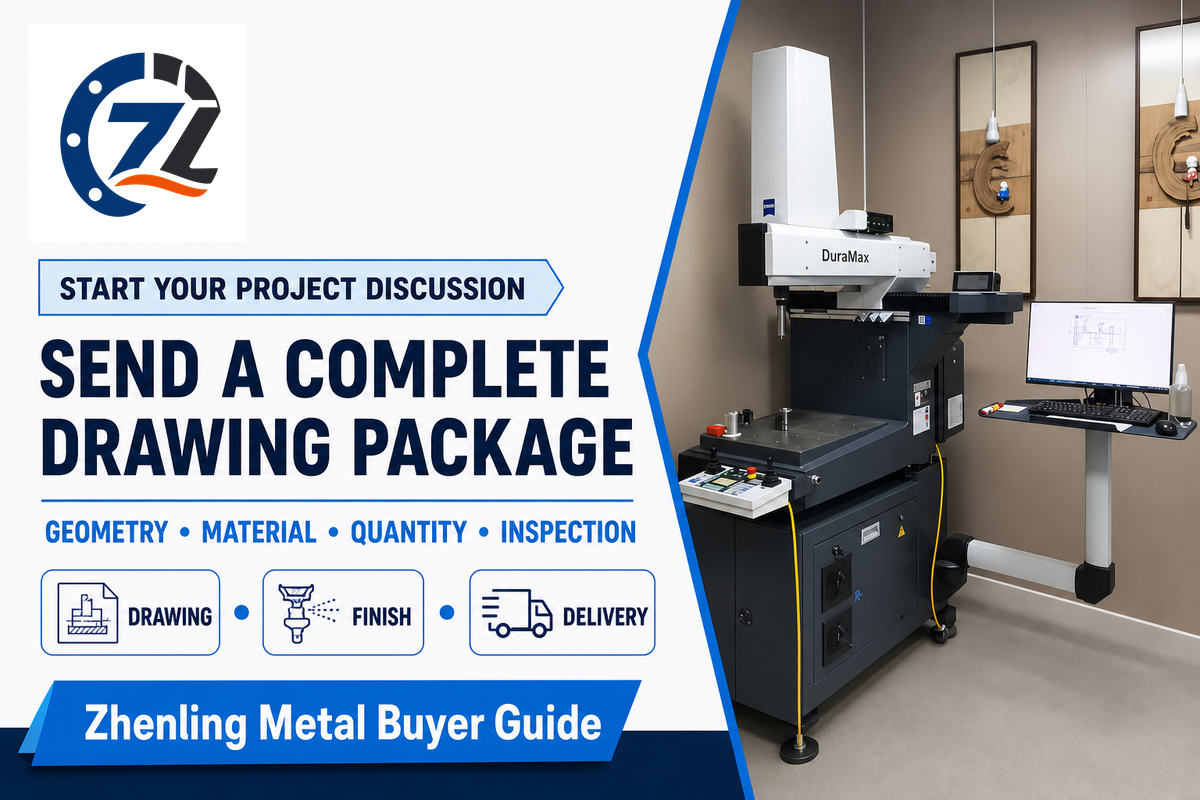
Bring the drawing, material grade, initial quantity and expected repeat demand to Zhenling’s technical team. We can review whether Swiss machining, conventional turning or another route fits the component, including secondary operations and inspection needs. The best starting point is a complete job definition that shows how the part functions and which features matter to assembly. To begin that discussion, send your part drawings with the required finish, documentation and delivery destination. These details define your machining needs; sample pricing is handled separately from repeat production.
ZHENLING / MADE-TO-PRINT MANUFACTURING
From Engineering Question to RFQ-Ready Drawing
Zhenling supports custom flanges, valve bodies, rolls, bent pipe, and profiled machined parts for industrial buyers. Our engineers review the drawing, material condition, tolerance stack, quantity, and inspection requirements before the machining route is quoted.
START WITHDrawing · Sample · Critical dimensions
DEFINEMaterial · Quantity · Tolerance · Certification
DRAWING / MATERIAL / TOLERANCE
Prepare Your Part Brief
- PART INPUT
- 2D/3D drawing or sample
- PROCESS REVIEW
- Machining · forming · welding · inspection
- RESPONSE ROUTE
- Submit the website inquiry form
We use your details to review and respond to the enquiry. See our Privacy Policy.


