Get in touch with Zhenling Company

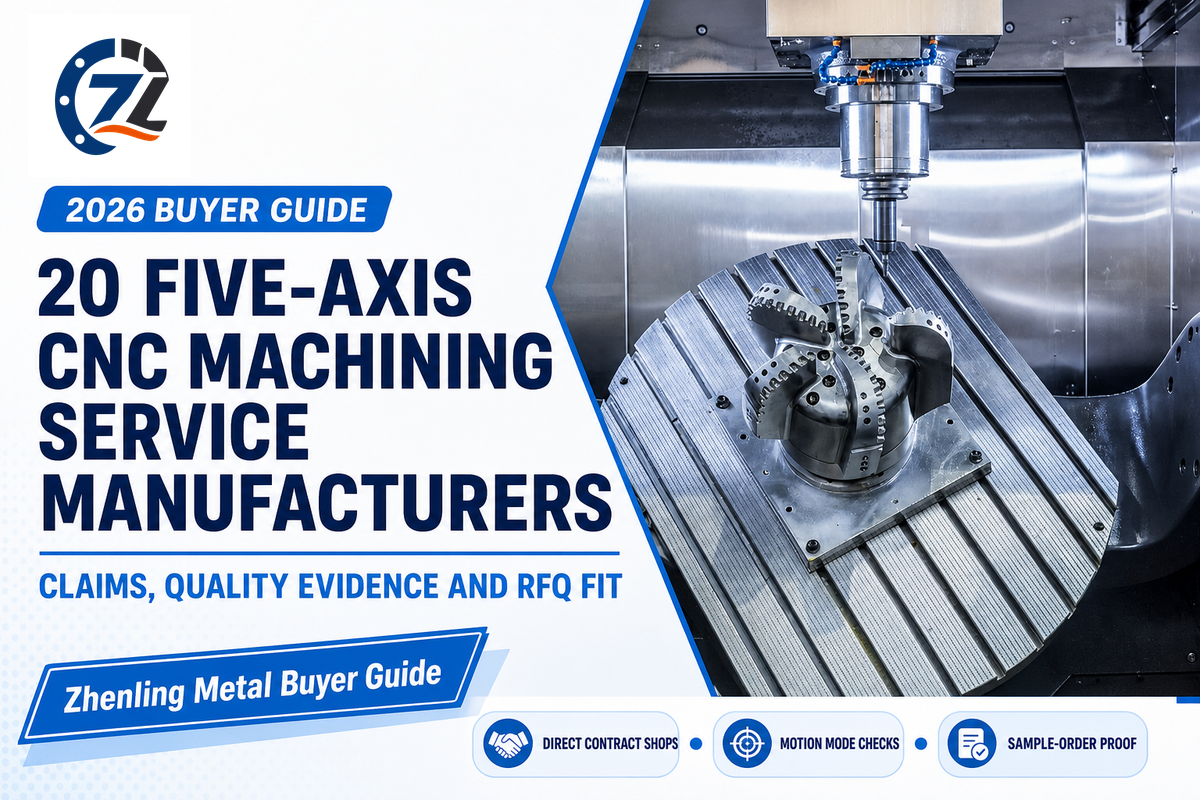
5 axis CNC machining service manufacturers are contract suppliers that accept customer drawings and deliver machined parts using indexed, simultaneous, or mixed five-axis process routes.
Page role: this directory supports supplier due diligence. Zhenling’s five-axis production capability and quotation route remains the site’s commercial service page; the article below compares public supplier evidence and does not replace that page.
The best 5 axis CNC machining service manufacturers are not simply the shops with the longest machine lists. A defensible shortlist separates contract part producers from machine-tool sellers, distinguishes simultaneous cutting from indexed 3+2 positioning, and checks whether material, inspection, capacity, and delivery evidence applies to the quoted site. This guide compares 20 providers whose official pages showed both custom or contract manufacturing and a five-axis claim when reviewed on September 2, 2026.
NIST research on geometric-error modeling and evaluation shows why five-axis performance should be tested with defined methods. This article therefore treats a supplier public claim as a starting point for order-specific verification, not proof of part capability.
Zhenling Metal appears first because that order was specified in the commissioning brief. That position is not an independently measured first-place ranking. Companies 2 through 20 are unranked. Public pages cannot tell us which shop will make your part best; they can tell us what to verify before a sample order. Missing founding dates, motion modes, certificate scopes, or machine envelopes are reported as “not stated on the reviewed official pages,” not filled from directories.
Fast shortlist rule: Send the same drawing revision, material condition, critical-characteristic list, inspection plan, quantity, finishing scope, and delivery term to three to five candidates. Then compare the returned evidence—not the adjectives on their websites.
How This 20-Company List Was Built
Search results for this keyword mix three different markets: businesses that sell five-axis machines, platforms that distribute jobs across a network, and shops that accept a drawing and deliver machined parts. Only the third group qualified. The screening method was deliberately conservative.
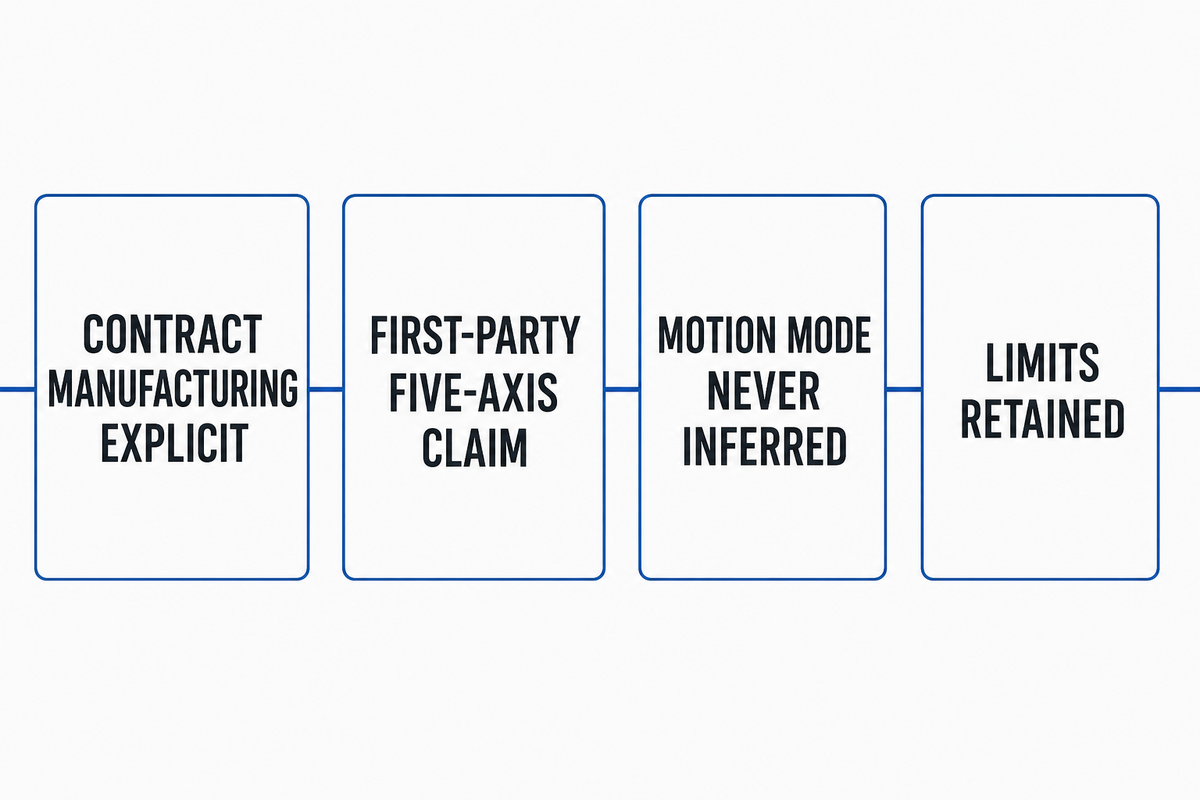
- Contract manufacturing had to be explicit. An official page needed to describe custom parts, subcontract machining, prototypes, tooling, or production components. A machining-center catalogue alone did not qualify.
- Five-axis capability had to appear on a first-party page. Directory badges and copied supplier profiles were not sufficient. A first-party page is still a supplier declaration, not independent proof of performance.
- Motion mode was never inferred. “Five-axis,” “multi-axis,” a machine model, or a picture of a trunnion did not automatically become “simultaneous five-axis.” Indexed 3+2, continuous motion, turn-mill movement, and unclear wording remain separate.
- Limits were retained. If a page did not identify the founding year, plant, exact machine, certificate scope, or inspection output, the profile says so and gives a question for the request for quotation.
This evidence rule follows a useful distinction from the National Institute of Standards and Technology: a supplier declaration is first-party conformity assessment, whereas an independent entity performs third-party assessment. In this article, an official company page verifies what the company publicly states. The page does not prove that the statement applies to every site, machine, shift, or order.
The review excluded obvious machine-tool sellers and distributors. Broad marketplaces were also excluded where the reviewed page did not establish the production site or whether the five-axis work would remain inside one controlled facility. That does not mean those routes are poor choices. They cannot be compared under the same “direct contract manufacturer” evidence rule.
That boundary matters because searches for 5-axis CNC machine manufacturers often return builders of machine tools, while buyers looking for online CNC machining usually need machining companies that accept customer files. This directory focuses on the second need. It includes both a conventional 5-axis machine shop and distributed providers only when a first-party page tied the offer to produced parts. The word “advanced” was not treated as proof: advanced CNC equipment, advanced 5-axis programming, or advanced 5-axis CNC controls still need an order-specific route and inspection plan.
Search labels such as 5 axis CNC machining factory, CNC machining manufacturer, Custom CNC machining service, and 5 axis CNC machining service manufacturers USA were treated as discovery phrases, not proof that a result was a direct parts supplier.
20 Manufacturers at a Glance
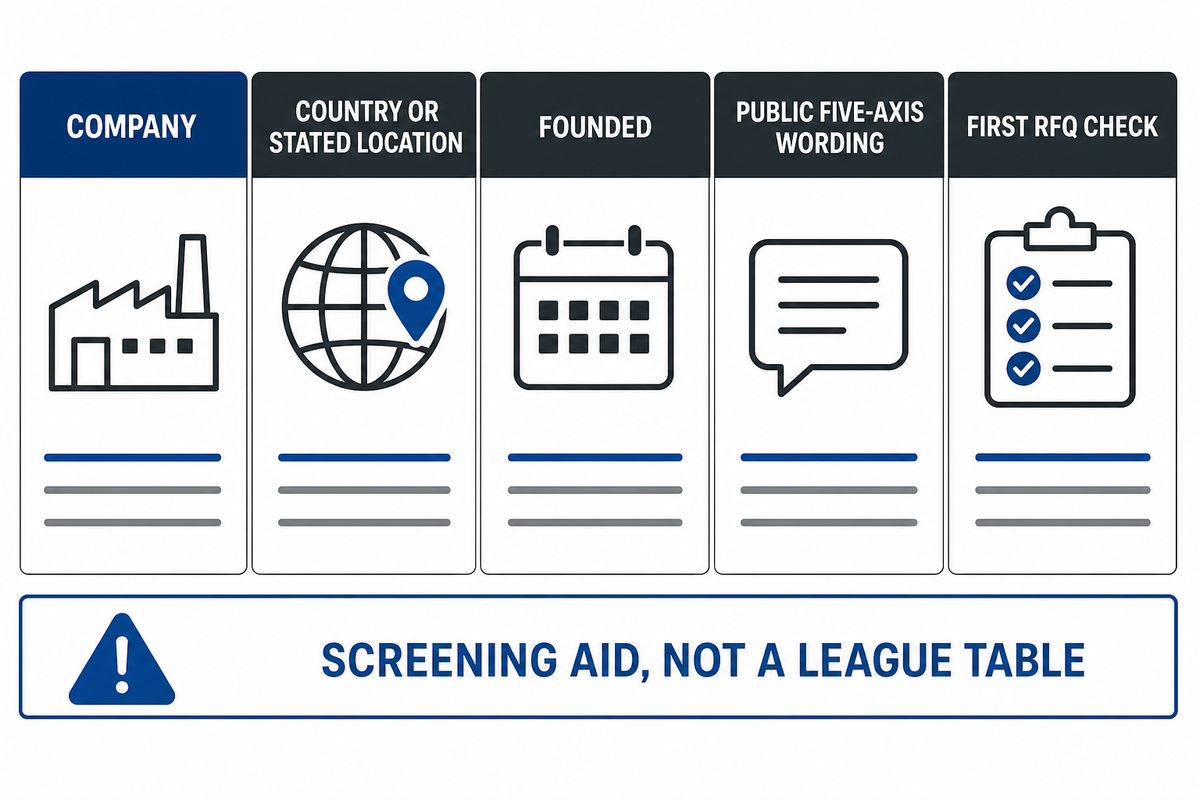
The comparison table below is a screening aid, not a league table. “Unclear” means the reviewed official page did not establish the motion mode. Certification entries are supplier-published and still require a current certificate showing the correct holder, site, scope, and validity. This evidence handling follows the NIST conformity-assessment distinction between first-party declarations and independent third-party assessment.
| Company | Country / stated location | Founded | Public five-axis wording | First RFQ check |
|---|---|---|---|---|
| Zhenling Metal | China / Jiashan | 2006 | Mode unclear | Machine, kinematics, inspection output |
| Robocon CNC | India / Pune | Not stated | Simultaneous stated | Quoted machine and export documents |
| Disk Precision | Singapore | Not stated | 5-axis vertical milling; mode unclear | Certificate and CMM scope |
| Genesis Manufacturing | UAE / Sharjah | Not stated | 3- and 5-axis; mode unclear | Entity, site, machine, inspection |
| Aldus Engineering | Australia / Melbourne | Not stated | 5-axis milling; mode unclear | Materials and current certificate |
| Best Manufacturing | United States / not stated | Not stated | 5-axis service; mode unclear | Machine envelope and certificate scope |
| Fathom Manufacturing | United States / site must be tied to quote | Not stated | Single continuous setup wording; kinematics unclear | Operating facility and workcell |
| 5th Axis Inc. | United States / San Diego | Not stated | 3-, 4-, and 5-axis; mode unclear | Contract work versus product business |
| JACO Machine Works | United States / California context | Not stated | 5-axis service; mode unclear | Machine, size, report format |
| PCM Innovation | Canada / Ste-Claire, Quebec | 2000 | Large 5-axis equipment; mode unclear | Production fit and qualifications |
| Brown & Holmes | UK / Tamworth | 1938 on reviewed homepage | Simultaneous described | Material, volume, export terms |
| Redline CNC | UK / Redhill context | Not stated | Five-axis and 3+2 wording; clarify quote | Exact machine configuration |
| Fletcher Moorland | UK / Stoke-on-Trent | 1946 | Simultaneous stated | Low-volume fit and capacity |
| Penta Precision | United Kingdom | 1998 | 3-, 4-, and 5-axis; mode unclear | Production pathway and motion strategy |
| EC International Group | France / global locations | Exact year not stated | 3-to-5-axis; mode unclear | Facility, scale, tooling, inspection |
| Super Ingenuity (SPI) | China / exact HQ not stated | Not stated | Five-axis service; job mode unclear | Strategy and FAI package |
| CTT Precision Manufacturing | Taiwan / exact HQ not stated | Not stated | Five-axis service; mode unclear | Certificate holder and kinematics |
| Kanou Precision | China / Dongguan | 2005 | Five-axis turn-mill; motion scope unclear | Machine list, material, site |
| Sino Industries | China / Jiashan | Not stated | Indexed five-axis stated | Do not assume simultaneous cutting |
| Taiwan Yi Long CNC | Taiwan / exact HQ not stated | Not stated | Five-axis service; mode unclear | Ownership, capacity, inspection |
Manufacturers 1–5
1. Zhenling Metal — China
Founded and location: Zhenling’s reviewed service page states 2006 and a workshop in Jiashan, China, within a Shanghai business context. The homepage and About page use different English legal-name variants, so this profile uses the brand “Zhenling Metal.” A buyer should confirm the exact contracting entity on the quotation, certificate, invoice, and bank details.
Type and five-axis scope: It presents itself as an own-workshop, drawing-led contract manufacturer of non-standard parts. The five-axis page discusses reducing re-fixturing for multi-face features, angled geometry, and related datums. It does not clearly state whether a quoted job runs simultaneous five-axis motion, indexed 3+2, or a mixed route.
Materials, process, and industries: Official material pages cover carbon and alloy steels, bearing steel, stainless grades, aluminum alloys, nickel-based alloys, C276, 904L, and engineering plastics. The public evidence is strongest for made-to-print metal work and fluid-control, pressure-boundary, oil-and-gas, and industrial applications. For plastics or unfamiliar sectors, request order-specific proof rather than transferring metal experience automatically.
Advantages: direct access to a China-based workshop, broad alloy coverage, engineering review around datums and setup reduction, and an export-oriented quotation path. Limitations: the reviewed page does not identify the exact five-axis machine, working envelope, kinematics, public baseline tolerance, inspection-report format, or which finishing steps remain in-house. Those are RFQ questions, not assumed strengths.
Official website: https://zhenlingmetal.com/
2. Robocon CNC Pvt Ltd — India
Founded and location: The reviewed official page identifies Pune, India, but does not state a founding year. It operates as a precision contract manufacturer and exporter rather than a machine reseller.
Five-axis scope: the reviewed service page explicitly advertises simultaneous five-axis machining on Mazak Variaxis centers. That is stronger motion-mode evidence than a generic “5-axis capable” statement, but the RFQ should still name the quoted machine, envelope, postprocessor, collision-checking route, and whether all critical surfaces stay in one setup.
Materials, quality, and markets: the page lists aluminum 6061-T6 and 7075-T6, 316L stainless, Grade 5 titanium, Inconel 625 and 718, D2 and H13 tool steels, 4140 steel, PEEK, Delrin, brass, and copper. It publishes ISO 9001:2015 and CMM-report language and targets aerospace and defense, motorsport and automotive, medical devices, semiconductor equipment, robotics, and energy.
Advantages: explicit simultaneous wording, named machine family, wide material list, and export-facing documentation. Limitations: promotional savings, delivery, and tolerance language is not a substitute for a drawing-specific process plan. Overseas buyers should pin down Incoterm, packing, material traceability, report language, deviation approval, and responsibility for special processes.
Official website: https://roboconcnc.com/
3. Disk Precision — Singapore
Founded and location: the reviewed official page places Disk Precision in Singapore but did not state an exact founding year. It describes CNC machining and related fabrication for custom components.
Five-axis scope: Disk Precision names 4-axis horizontal and 5-axis vertical milling for parts with multiple milling features. The page does not establish whether the five-axis machine uses simultaneous contouring, indexed positioning, or both. Ask for the machine model and the operation sequence for the quoted part.
Materials, quality, and industries: published materials include PEEK, PTFE, 6061 and 7075 aluminum, copper, carbon steel, 304 and 316L stainless, and titanium. The page references internationally recognized certifications and serves automotive, aerospace, electronics, and oil-and-gas work, but a generic certification statement is not enough to establish holder, standard, site, or scope.
Advantages: Singapore location, a broad metal-and-engineering-plastic menu, and both horizontal and vertical multi-axis options. Limitations: exact founding year, five-axis kinematics, current certificate copies, CMM capacity, machine envelope, and production-volume fit were not all established on the reviewed page. Include those fields in the qualification call.
Official website: https://diskprecision.com/
4. Genesis Manufacturing — United Arab Emirates
Founded and location: Genesis Manufacturing’s reviewed page identifies Sharjah, UAE, but did not publish a founding year. It offers custom precision machining and fabrication for regional and international programs.
Five-axis scope: the company states that 3-axis and 5-axis CNC milling are available and describes a large CNC equipment base. The reviewed wording does not separate simultaneous cutting from indexed work. A machine count also says little about which machines, shifts, and operators are available for one order.
Materials, quality, and sectors: the page lists aluminum, steel, titanium, ABS, POM, HDPE, PET, carbon-fiber composites, and fiberglass. It publishes API Spec Q1 language and names oil and gas, automotive, regulated-device manufacturing, robotics, new energy, and tool-and-die work. Verify whether the cited quality scope covers the legal entity and processes in the quote.
Advantages: Middle East location, multiple manufacturing processes, and a wide material range may suit programs that need machining plus fabrication. Limitations: the founding year, exact production entity, simultaneous capability, dimensional-report format, and order-specific tolerance are not established by the reviewed page. Composite machining also requires separate dust, tooling, and inspection planning.
Official website: https://genesis-mfg.ae/
5. Aldus Engineering — Australia
Founded and location: Aldus Engineering operates in Melbourne, Australia. Its official service page says the underlying precision-machining operation has more than 30 years of experience, but it does not give an exact founding year suitable for this comparison.
Five-axis scope: Aldus explains that five-axis milling adds a second rotary axis to reach complex angles and reduce setups. The reviewed page does not unambiguously promise simultaneous five-axis motion for every job, so the table retains “mode unclear.”
Process, quality, and industries: the page covers precision CNC machining, 3-, 4-, and 5-axis milling, and CMM-related quality language. It publishes ISO 9001 and names automotive, defense, aerospace, electronics, and food-processing work. A complete material list was not visible in the reviewed evidence, so buyers should specify grade, form, condition, approved substitutions, and mill-document requirements rather than asking whether the shop “machines metal.”
Advantages: an Australian production option, multi-axis breadth, and sector diversity. Limitations: exact incorporation date, material matrix, machine model and envelope, simultaneous-versus-indexed strategy, certificate scope, and inspection deliverable all need confirmation. For defense work, add controlled-data and export-handling requirements only if the program calls for them.
Official website: https://www.aldusengineering.com.au/
Manufacturers 6–10
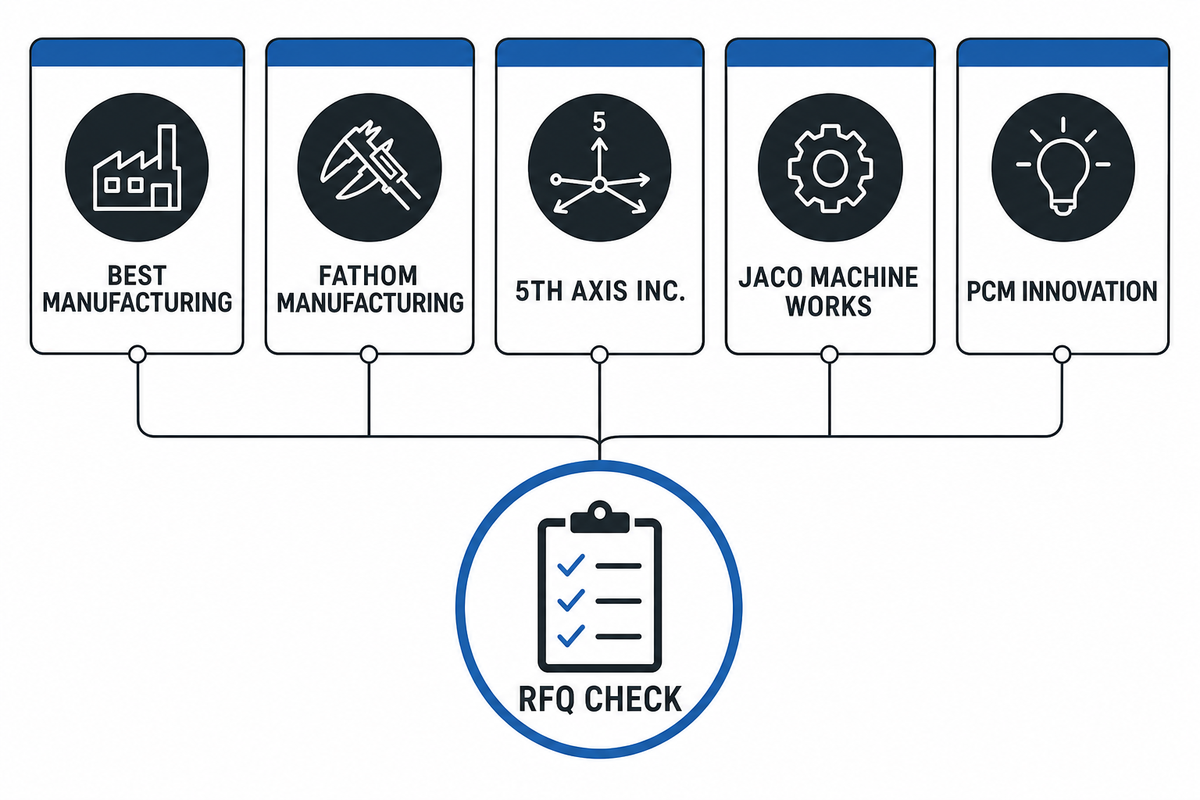
6. Best Manufacturing — United States
Founded and location: Best Manufacturing is a United States precision machine shop. The reviewed five-axis page did not state a founding year or headquarters address, so neither is supplied here from a directory.
Five-axis scope: its official page offers five-axis CNC machining for complex parts and prototype-through-production work. Although the page emphasizes precision and efficiency, the reviewed wording does not identify the exact kinematics or explicitly bind simultaneous motion to a named machine. Buyers should ask for the machine model, work envelope, rotary limits, and machining strategy used in the quotation.
Materials, quality, and industries: the page lists aluminum, stainless steel, titanium, and plastics. It publishes AS9100 and ISO 9001 claims and addresses aerospace and defense, medical devices and specialized instruments, automotive, energy, and industrial equipment. Treat the certificate names as a prompt to obtain current copies and scope pages.
Advantages: clear contract-machining positioning, regulated-industry orientation, and support for both prototypes and production. Limitations: founding date, exact facility, machine configuration, envelope, and report package were not all established in the reviewed evidence. If a quote relies on outside finishing or testing, identify the approved source and who controls the result.
Official website: https://www.bestmmi.com/
7. Fathom Manufacturing — United States
Founded and location: Fathom is a United States contract-manufacturing organization with multiple capabilities and operating locations. The reviewed five-axis article did not provide a founding year or a single headquarters statement appropriate to this profile. More importantly, a multi-site company must tie each quotation to the actual producing facility.
Five-axis scope: the official article says five-axis machining can complete complex parts in a single, continuous setup. That describes a process benefit, but “continuous setup” is not the same sentence as a machine-specific promise that all five axes move simultaneously on the quoted part. Request the workcell, site, motion strategy, and transfer plan.
Materials and markets: the page discusses stainless steel, titanium, and plastics and frames the service for aerospace, medical devices, automotive, semiconductor, and general CNC applications. Certification and inspection details were not established in the reviewed page, so buyers should obtain site-specific quality credentials and the proposed first-article package.
Advantages: broad manufacturing resources and the possibility of routing a program through a larger organization. Limitations: network breadth can obscure site ownership, machine assignment, capacity, and accountability. Put the legal entity, plant, machine, special-process source, and escalation contact on the quote before comparing it with a single-site shop.
Official website: https://fathommfg.com/
8. 5th Axis Inc. — United States
Founded and location: 5th Axis Inc. lists an address on Engineer Road in San Diego, California. The reviewed contract-manufacturing page did not state the founding year.
Type and five-axis scope: the company is known publicly for workholding products, but its own site also has a contract-manufacturing offer covering 3-, 4-, and 5-axis production. That distinction matters: the supplier qualifies here because it says it makes parts, not because it sells fixtures. The exact simultaneous or indexed mode was not established on the reviewed page.
Materials, quality, and industries: the page uses broad “various materials” wording rather than a controlled grade list. It publishes ISO 13485:2016, AS9100 Rev. D, ISO 9001:2015, and International Traffic in Arms Regulations registration claims and names aerospace, defense, commercial, and regulated-device work. Buyers should retrieve current certificates and verify site and scope instead of relying on a webpage badge.
Advantages: workholding knowledge can be relevant to difficult access and repeatable setup design, and the company publishes multiple regulated-sector credentials. Limitations: the contract shop and product business must be separated in the quotation; founding year, material grades, motion strategy, capacity, and the source of finishing need explicit answers.
Official website: https://5thaxis.com/
9. JACO Machine Works — United States
Founded and location: JACO Machine Works presents a United States precision-part operation with California context. Its reviewed five-axis page did not state an exact founding year or headquarters address, so those fields remain unverified here.
Five-axis scope: JACO explicitly offers five-axis machining and milling services for complex-geometry parts. The public wording reviewed for this comparison does not say whether a particular job uses simultaneous motion or indexed positioning. Machine model, travel, rotary limits, postprocessor validation, and in-process probing belong in the RFQ response.
Materials, quality, and sectors: the page lists aluminum, stainless steel, copper, brass, nickel alloy, titanium, Delrin, acetal/POM, PEEK, and Ultem. It publishes ISO 9001:2015 and AS9100D claims and names medical devices, aerospace, sensors, specialized instruments, electrical connectors, and semiconductor tooling and equipment.
Advantages: unusually broad metal-and-polymer coverage and clear precision-industry positioning. Limitations: public material names do not settle grade, condition, lot traceability, or plastic stress-relief requirements. Confirm the current certificate holder and scope, machine assignment, part envelope, sample size, dimensional-report format, and whether special processes are approved or buyer-nominated.
Official website: https://www.jacoworks.com/
10. PCM Innovation — Canada
Founded and location: PCM Innovation’s company history states 2000 and Ste-Claire, Quebec, Canada. It focuses heavily on aerospace tooling, assemblies, and large precision projects rather than presenting itself only as a commodity parts job shop.
Five-axis scope: the official page describes the installation of multiple large five-axis machining centers, including equipment intended for titanium and carbon composites. Size and installed-machine commitment are meaningful capability signals, but the page reviewed does not establish the simultaneous-versus-indexed strategy for a buyer’s toolpath.
Materials, process, and industries: the clearest material claims are titanium and composite materials, with aerospace and transportation applications. Company awards appear on the page, but awards are not quality-system certification. Obtain the current certificate set, inspection resources, environmental controls for composites, and the exact plant responsible for the order.
Advantages: large-part equipment, aerospace-tooling experience, and a Canadian production base may fit molds, jigs, fixtures, and complex low-volume structures. Limitations: a buyer needing recurring small precision components should test production-model fit, minimum economic lot, schedule flexibility, and change-control speed. Clarify tooling ownership, acceptance milestones, and whether the quote is for prototype, pre-production, or repeat production.
Official website: https://pcminnovation.com/
Manufacturers 11–15
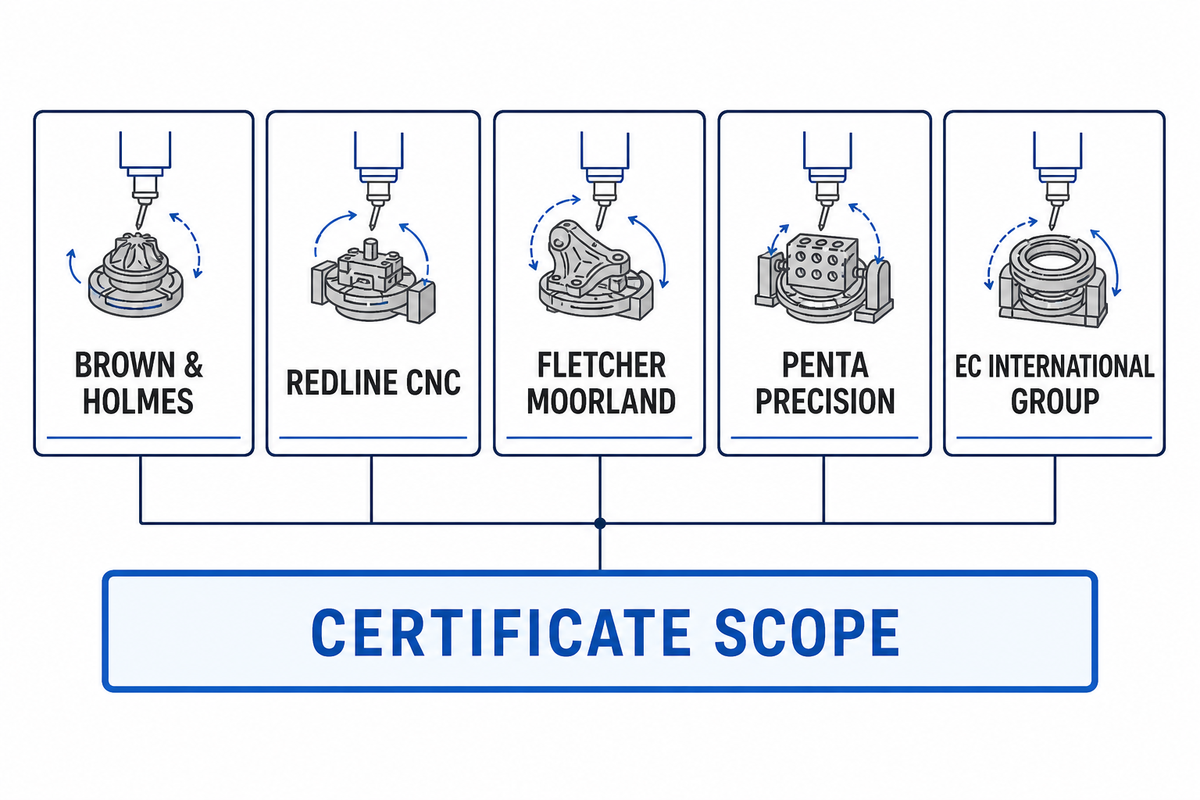
11. Brown & Holmes — United Kingdom
Founded and location: Brown & Holmes’ reviewed homepage gives 1938 and Tamworth, Staffordshire. Because historical dates sometimes reflect incorporation, trading, or predecessor businesses differently, use the date for orientation and confirm the current legal entity on commercial documents.
Five-axis scope: its CNC machining page describes orienting and cutting along five axes simultaneously for complex 3D contours. The company combines contract machining with broader engineering, tooling, and workholding services, which can be valuable when the fixture and part process need to be developed together.
Materials, quality, and industries: the service page names alloys, stainless steels, aluminum, titanium, and hafnium. Public credentials include ISO 9001, AS9100D, ISO 14001, ISO 45001, and Cyber Essentials Plus across company pages, while stated sectors include automotive, aerospace, defense, nuclear, regulated-device manufacturing, machine tool, and power generation. Verify which certificates cover the quoted facility and process.
Advantages: long operating history, explicit simultaneous wording, difficult-material coverage, and fixture/engineering integration. Limitations: the reviewed page did not establish a universal tolerance, exact machine for the order, or included inspection package. Export terms, material availability, lot size, special processes, controlled-data handling, and shipping responsibility can materially change fit.
Official website: https://www.brownandholmes.co.uk/
12. Redline CNC — United Kingdom
Founded and location: Redline CNC is a United Kingdom subcontract precision-machining provider with Redhill context in the reviewed company information. An exact founding year was not stated on the pages used here.
Five-axis scope: the dedicated page offers complete five-axis CNC machining, while other company wording includes 3+2 capability. That mixed public terminology is precisely why the quote must identify the actual route. Do not convert “complete service” into simultaneous cutting without a machine- and program-specific confirmation.
Materials, quality, and industries: the five-axis page names titanium, stainless steel, high-purity aluminum, and Inconel and addresses defense, automotive, energy, regulated-device, and aerospace work. It publishes BSI ISO 9001:2015 language. Request the certificate, scope, first-article format, measurement method for critical characteristics, and any sector-specific approvals.
Advantages: difficult-alloy positioning, UK subcontract access, and a dedicated five-axis offer for regulated industries. Limitations: founding date, exact machine configuration, whether simultaneous contouring is available, and the report package remain unclear in the reviewed public evidence. A low-volume buyer should also confirm programming charges and minimum batch economics.
Official website: https://www.redline-cnc.co.uk/
13. Fletcher Moorland — United Kingdom
Founded and location: Fletcher Moorland states that it was founded in 1946 and operates in the Stoke-on-Trent area of the United Kingdom. Its wider business combines precision engineering with repair, remanufacture, and engineering support.
Five-axis scope: the precision-engineering page explicitly names “5-Axis Simultaneous Machining.” It also presents CNC machining, reverse engineering, and bespoke component work. That makes it a potentially useful route when a buyer has a worn sample or legacy component as well as a drawing, although reverse engineering needs its own acceptance baseline.
Materials, quality, and industries: the published list includes aluminum, D2 steel, stainless, titanium, cast iron, Inconel, nylon, steel, acetal, brass, PTFE, copper, plastics, and bronze. The page describes dimensional and general-tolerance checks and CMM checks where appropriate. Stated sectors include aerospace, automotive, renewables, food production, regulated-device manufacturing, and electronics.
Advantages: explicit simultaneous capability, wide material experience, metrology language, and repair-to-remanufacture context. Limitations: “where appropriate” leaves the inspection output negotiable; put the required CMM report and sampling plan in the order. Confirm available capacity, machine envelope, special-process sources, and whether the shop’s batch model suits your annual volume.
Official website: https://fletchermoorland.co.uk/
14. Penta Precision — United Kingdom
Founded and location: Penta Precision states 1998 and operates in the United Kingdom. The company presents itself as a custom precision-parts manufacturer serving prototypes, research work, and repeat requirements.
Five-axis scope: the official page lists 3-, 4-, and 5-axis CNC milling for complex geometries. It does not establish simultaneous motion or a named machine in the evidence reviewed for this article. Ask how the quoted features are divided between positional work, continuous motion, and any secondary operations.
Materials, quality, and industries: Penta lists aluminum, plastics, stainless steel, titanium, copper, brass, and bronze. The site publishes ISO 9001 and Joint Supply Chain Accreditation Register claims and names aerospace, defense, electronics, food processing, marine, original equipment manufacturing, pharmaceutical and regulated-device manufacturing, research, and scientific work.
Advantages: a broad UK material and sector range and a clear custom-part offer. Limitations: public five-axis detail is light. Penta’s own guidance around one-off prototype economics should prompt buyers to define the production pathway: who owns fixtures and programs, how repeatability is demonstrated, when pricing changes at new volumes, and what happens if a prototype moves to serial production.
Official website: https://www.pentaprecision.co.uk/
15. EC International Group — France
Founded and location: EC International Group describes about 30 years of experience and a network of locations, with French company context. The reviewed pages did not provide one exact founding year and headquarters statement suitable for a single-field comparison, so this article does not convert “30 years” into a guessed incorporation date.
Five-axis scope: its CNC page offers 3-to-5-axis machining for functional prototypes in metal and plastic. The reviewed wording does not specify simultaneous motion. The business model is oriented toward prototypes, pre-series, and low-volume manufacturing, which should be matched to the buyer’s intended scale.
Materials and sectors: the page publishes a long list spanning ABS, PMMA, PC, POM, PP, nylon, PEEK, Ultem, PEI, PPSU, PTFE, several steels, 6060/6061 aluminum, 303/304 stainless, brass, copper, and titanium. It names aerospace, space, telecom, defense, automotive, robotics, energy, regulated-device, and consumer applications. ISO 2768-mK wording appears, but a general-tolerance class does not replace drawing-specific acceptance.
Advantages: prototype and pre-series orientation, broad polymers and metals, and multi-location support. Limitations: exact production facility, motion mode, tooling path, volume ceiling, certificate scope, and inspection output need confirmation. Buyers should also identify who owns the process when a project moves between development and production locations.
Official website: https://www.ec-international-group.com/
Manufacturers 16–20
16. Super Ingenuity (SPI) — China
Founded and location: Super Ingenuity, also presented as SPI, is a China-based contract precision-parts supplier. The reviewed five-axis page did not state a founding year or exact headquarters, so those fields remain unverified.
Five-axis scope: SPI frames five-axis machining around complex geometry, datum relationships, tool access, and avoiding risky re-clamping. The page discusses machining strategy but does not bind every order to either simultaneous motion or indexed 3+2. A buyer should specify the required result and let the supplier disclose the proposed route.
Materials, quality, and industries: the page names Ti-6Al-4V titanium, 7075 aluminum, stainless steel, and PEEK. It advertises CMM inspection, first-article inspection packages, and material certification, with aerospace, automotive, regulated-device, and robotics applications. These are useful deliverable categories, but the purchase order still needs the report content, sampling plan, certificate type, and acceptance rule.
Advantages: drawing-led engineering language, material specificity, and an explicit inspection-document menu. Limitations: founding year, headquarters, exact machine and kinematics, public certificate scope, and process ownership are not fully established. Confirm whether finishing, thermal processing, testing, and any clean processing are performed in-house or by controlled partners.
Official website: https://super-ingenuity.cn/
17. CTT Precision Manufacturing — Taiwan
Founded and location: CTT presents itself as a Taiwan precision manufacturer, while the reviewed homepage did not state an exact founding year or headquarters address. The site also names Chon Teng Precision Co., Ltd., so buyers should match that entity to the quote and certificates.
Five-axis scope: CTT publishes milling, turning, and five-axis machining for custom parts and describes extended equipment operation. The five-axis wording does not state whether the motion is simultaneous or indexed. “24-hour” equipment language should be treated as an operating claim, not proof that the quoted workcell has immediate capacity.
Materials, quality, and markets: listed examples include 7075 and 6061 aluminum and Ti-6Al-4V. Public credentials include AS9100, ISO 9001, and ISO 13485 claims, and sectors include aerospace, drones, low-Earth-orbit satellites, and medical devices. The company also describes assembly and access to forging, casting, and stamping.
Advantages: machining plus integration options, named aerospace and ISO 13485-related credentials, and Taiwan supply-chain access. Limitations: the breadth of secondary processes makes source control important. Confirm which steps are internal, which entity holds each certificate, actual five-axis kinematics, available capacity, material traceability, and the dimensional and functional reports included in the quote.
Official website: https://ctt-metal.com/
18. Kanou Precision — China
Founded and location: Kanou Precision states 2005 and an address in Chang’an Town, Dongguan, China. It positions itself as a precision machining and assembly supplier for international customers.
Five-axis scope: the official page says the business specializes in five-axis turning and milling. That wording may describe turn-mill equipment, five-axis milling, or both; it does not disclose the exact coordinated-axis behavior for a quoted operation. Request machine model, spindle/rotary arrangement, part envelope, and the planned sequence.
Quality and industries: the reviewed page publishes ISO 9001, ISO 13485, and IATF 16949 claims and names regulated-device manufacturing, robotics, and smart-equipment work. A complete material list was not present in the evidence reviewed here. The RFQ should therefore state material specification, grade, condition, source restrictions, certificates, substitution rules, and cleanliness or packaging needs.
Advantages: an established Dongguan location, machining-and-assembly positioning, and credentials aimed at ISO 13485 and automotive-type quality systems. Limitations: the exact five-axis process, material matrix, workcell list, clean-room scope, capacity, and measurement package need verification. Never infer that a company-level ISO 13485 certificate covers every machine or assembly activity.
Official website: https://www.kanouprecision.com/
19. Sino Industries — China
Founded and location: Sino Industries’ reviewed service page lists an address in Jiashan County, Jiaxing, Zhejiang, China. It did not state the founding year used for this comparison.
Five-axis scope: this is one of the most important wording distinctions in the list: the official page explicitly describes “5-axis indexed milling” alongside 3-axis work. Indexed five-axis, often called 3+2, can be an excellent route for multi-face access, but it is not continuous simultaneous contouring. Buyers needing continuously changing tool orientation must say so.
Materials, process, and industries: Sino lists aluminum, stainless, brass, carbon and alloy steels, titanium, and engineering plastics. The page addresses prototypes, jigs and fixtures, and lower-volume production components for aerospace, automotive, medical device, electronics, industrial machinery, energy, rail, construction, marine, and consumer sectors.
Advantages: unusually clear indexed-mode disclosure, a broad material list, and multiple sourcing applications. Limitations: founding year, certificate set, measurement resources, exact machine envelope, and capacity were not established in the reviewed page. The buyer should confirm whether indexed machining can meet the datum and surface requirements or whether a different supplier/workcell is needed for simultaneous motion.
Official website: https://sinoindustry.com/
20. Taiwan Yi Long CNC — Taiwan
Founded and location: Taiwan Yi Long CNC presents a Taiwan-based custom machining service. The reviewed page did not state an exact founding year or headquarters city.
Five-axis scope: its official page offers five-axis machining for precision multi-axis parts and promotes setup reduction. The public wording reviewed does not establish whether all five axes move simultaneously on the quoted part. Ask for the machine, program strategy, simulation method, setup count, and any operations transferred to other equipment.
Materials and markets: the page refers broadly to high-strength alloys and composites and names aerospace, medical devices, automotive, tooling, and custom components. A broad family name such as “high-strength alloy” is not a purchasable material specification; the quote should carry the exact grade, condition, stock form, source, and required certificate.
Advantages: a direct five-axis service offer and Taiwan-based sourcing for several precision sectors. Limitations: founding year, headquarters, exact material grades, simultaneous capability, certification, inspection output, machine envelope, and live capacity require direct confirmation. Composite work also needs process-specific dust control, tool selection, edge-acceptance criteria, and contamination rules.
Official website: https://www.twyilongcnc.com/
How to Verify a Supplier’s Five-Axis Claim
A five-axis label does not establish the route assigned to a quoted part. Ask the supplier to identify the production site, machine, working envelope, setup count, and whether each critical operation uses indexed 3+2, simultaneous motion, turn-mill movement, or another transfer. For deeper process education, use the machine, postprocessor, and prove-out evidence guide and the separate 3-, 4-, and 5-axis route comparison.
Vocabulary normalization: supplier pages may label the same sourcing lane as precision 5-axis machining, 5-axis machining services, specializing in CNC machining, specializing in 5-axis, or general machine shop services. They may promise reliable service, productivity, tight CNC machining tolerances, or use application phrases such as used in aerospace, industries such as aerospace, industries like aerospace, rapid prototyping, and parts with complex geometries. These are screening labels, not order evidence.
Equipment wording varies too: a 5-axis machining center, vertical machining centers, horizontal machining centers, CNC lathes, CNC turning, multi-axis CNC machines, and 3-axis machines may all appear in one capability statement. Map those words to the proposed machining process and machining method, including machine setups, cutting tool access, computer numerical control program ownership, horizontal machining transfers, and the exact 5-axis capabilities assigned to the part. Record whether the route combines CNC machining processes such as 3-axis CNC machining, traditional 3-axis machining, 5-axis and 3-axis work, 4- and 5-axis capacity, 5-axis horizontal machining, contour machining, simultaneous 5-axis machining, or heavy-duty 5-axis machining. Only then do broad machining technology, CNC technology, and machining capabilities claims become quote-specific.
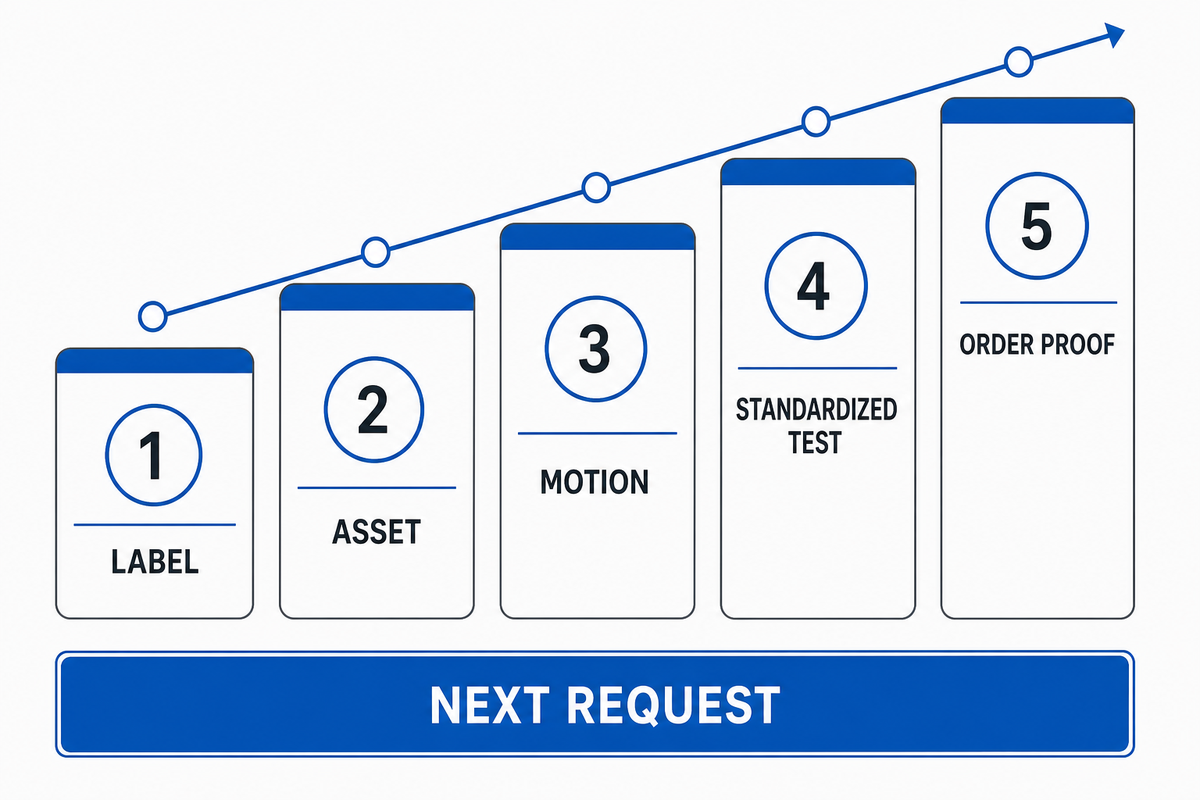
The Motion-Claim Proof Scale helps procurement ask for the next level of supplier evidence instead of arguing over terminology.
| Level | What you have | What it proves | Next request |
|---|---|---|---|
| 1. Label | “Five-axis capable” on a webpage | A supplier declaration exists | Machine, site, kinematics, envelope |
| 2. Asset | Named machine and plant | Relevant equipment may be available | Quoted operation and setup plan |
| 3. Motion | Indexed 3+2 or simultaneous route identified | The proposed kinematic strategy is explicit | Postprocessor, simulation, datum plan |
| 4. Standardized test | Applicable finished-test-piece or machine-performance result | A defined machine test was performed | Method, date, machine identity, result |
| 5. Order proof | Approved first article and critical-characteristic results | The process produced evidence against your drawing | Lot controls, reaction plan, change control |
ISO 10791-7:2020 is useful at Level 4 because it describes finishing-condition test pieces and minimum requirements for assessing cutting accuracy on machining centers with three to five simultaneous axes. It does not certify any company in this list, and it does not replace acceptance of your part. Ask whether the supplier has an applicable result, which machine it covers, and whether that machine will run your order.
Toolpath portability is another supplier-level gap. A successful program on one machine does not guarantee an equivalent process on another configuration. The quotation should therefore name the actual machine family and the simulation or prove-out route without requiring proprietary code.
How to Compare Supplier Quality and Material Evidence
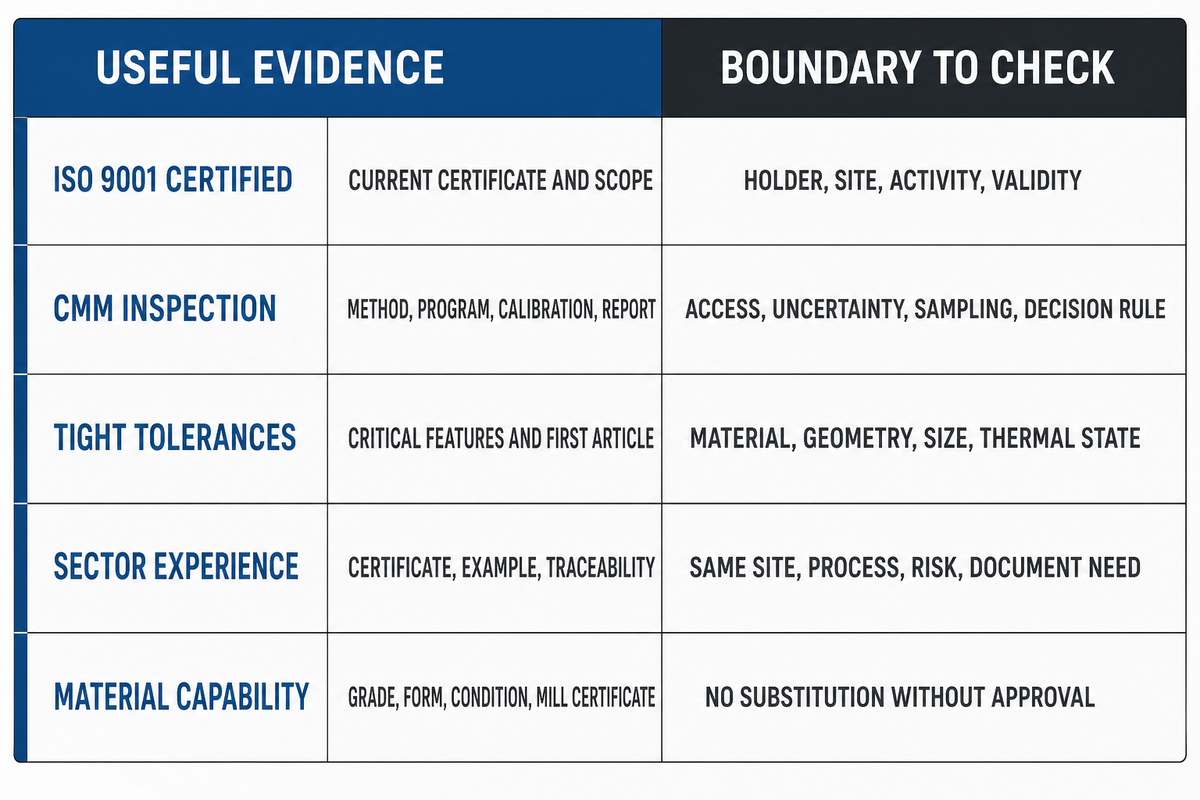
Compare the evidence returned for the quoted part, not the asset name alone. Each supplier should identify the material specification, process route, datum transfers, critical-feature method, inspection output, and acceptance rule. A five-axis machine does not automatically make a more accurate part, and an industry name on a website does not prove that the quoted site, process, or documentation package fits the order.
Quality evidence also has levels. A quality-management certificate concerns a system. A laboratory accreditation scope identifies particular test or calibration capabilities. A calibration certificate concerns an instrument under stated conditions. A dimensional report records results for specified features. None of those documents silently substitutes for the others. NIST’s accreditation guidance notes that an accredited laboratory’s scope lists the test methods or calibration parameters it is competent to perform—and that the accreditation program does not certify individual test data or products.
| Supplier claim | Useful evidence | Boundary to check |
|---|---|---|
| ISO 9001 certified | Current certificate and scope | Holder, site, covered activity, validity |
| CMM inspection | Method, program, calibration status, sample report | Feature access, uncertainty, sampling and decision rule |
| Tight tolerances | Critical-feature list and accepted first article | Material, geometry, size, thermal reference, surface state |
| Aerospace or medical-device experience | Relevant certificate, anonymized deliverable example, traceability flow | Same site, process, risk class and documentation need |
| Material capability | Grade, form, condition, mill certificate and approved source | No substitution without written approval |
For material selection, “aluminum,” “stainless,” “titanium,” or “plastic” is too broad. Release the specification, grade, temper or condition, stock form, grain or directional requirements where relevant, traceability level, and approved substitutions. If finishing changes a critical dimension, state whether inspection occurs before finishing, after finishing, or at both stages. Zhenling’s CNC machining material options can help frame the grade discussion, while its post-machining surface finishing guide can be used to identify the operation that must be included in the quote.
Compare Quotes on the Same Drawing Revision
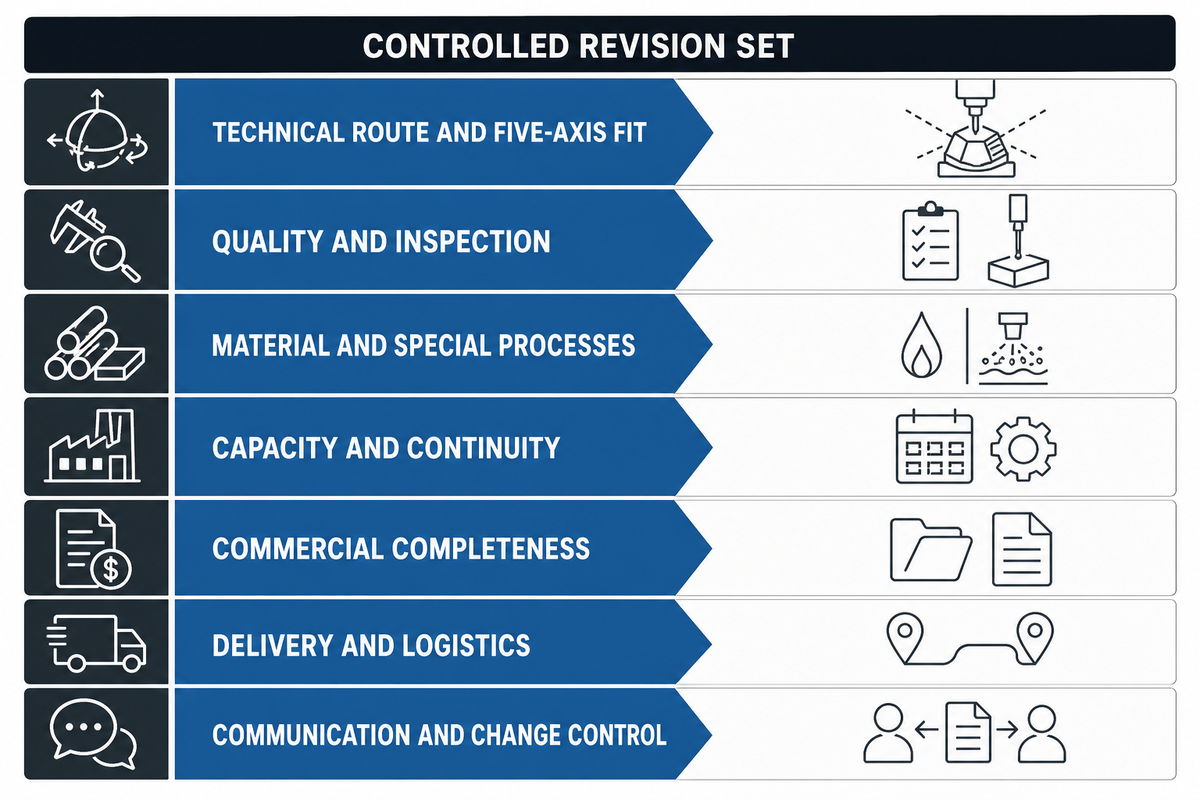
The comparison table prevents a cheap but incomplete quote from looking better than a complete one. First normalize the request; then score evidence. The weights below are a starting worksheet, not an industry standard. A medical-device, aerospace, defense, energy, or prototype program should change the weights to reflect its actual failure cost.
When a score depends on a certificate or laboratory capability, apply the same scope boundary described in NIST accreditation guidance: verify the relevant site, method or calibration parameter instead of treating the document title as universal proof.
| Dimension | Example weight | Full-score evidence |
|---|---|---|
| Technical route and five-axis fit | 20 | Machine, envelope, setup, motion mode, datum and simulation plan |
| Quality and inspection | 20 | Current scope, first article, critical-feature method, report and reaction plan |
| Material and special processes | 15 | Exact specification, traceability, sources, finishing and subcontract controls |
| Capacity and continuity | 15 | Available hours, bottleneck, backup machine/operator, maintenance and recovery plan |
| Commercial completeness | 15 | Tooling, programming, inspection, packaging, duties and exclusions itemized |
| Delivery and logistics | 10 | Milestones, Incoterm, shipment mode, pack standard and delay escalation |
| Communication and change control | 5 | Named owner, response cadence, deviation and revision-acknowledgment process |
Score only what is returned. “Available on request” receives a provisional score until the document arrives. A supplier can recover a low initial score by answering clearly; the point is not to punish missing website content. It is to prevent an unverified assumption from becoming a purchase-order obligation.
RFQ checklist — copy these into your quote request:
| Parameter | Recommended range | Why it matters | How to verify |
|---|---|---|---|
| Drawing and model | 1 controlled revision set | Prevents quoting different geometry | Supplier returns signed revision acknowledgment |
| Quantity | Prototype units, pilot lot, production units per lot and annual units | Changes fixtures, cycle strategy and price | Quote separates each quantity tier |
| Material | Specification, grade, form and condition | Names alone are ambiguous | Mill certificate or agreed supplier declaration |
| Critical characteristics | Every buyer-designated critical feature identified | Focuses process and measurement planning | Ballooned drawing and method list |
| Five-axis route | Indexed, simultaneous or mixed route stated | Stops label-based assumptions | Named machine, setup and operation summary |
| Inspection | First article plus agreed lot sampling | Defines acceptance evidence | Sample report, gauge method and decision rule |
| Special processes | Every thermal-processing, coating and finishing step | Controls dimensions and traceability | Approved source and certificate requirement |
| Delivery | Milestones, Incoterm and pack standard | Makes landed schedule and cost comparable | Quote lists exclusions and shipment responsibility |
The Five-Axis Workcell Recovery Check asks what machine and operator are the bottleneck, whether preventive maintenance is current, what qualified backup exists, and how a program recovers from a spindle, probe, or staffing interruption. If the part carries controlled technical data, add the applicable information-security and export requirements; do not impose a United States defense clause on an unrelated commercial order.
Supplier Qualification Red Flags
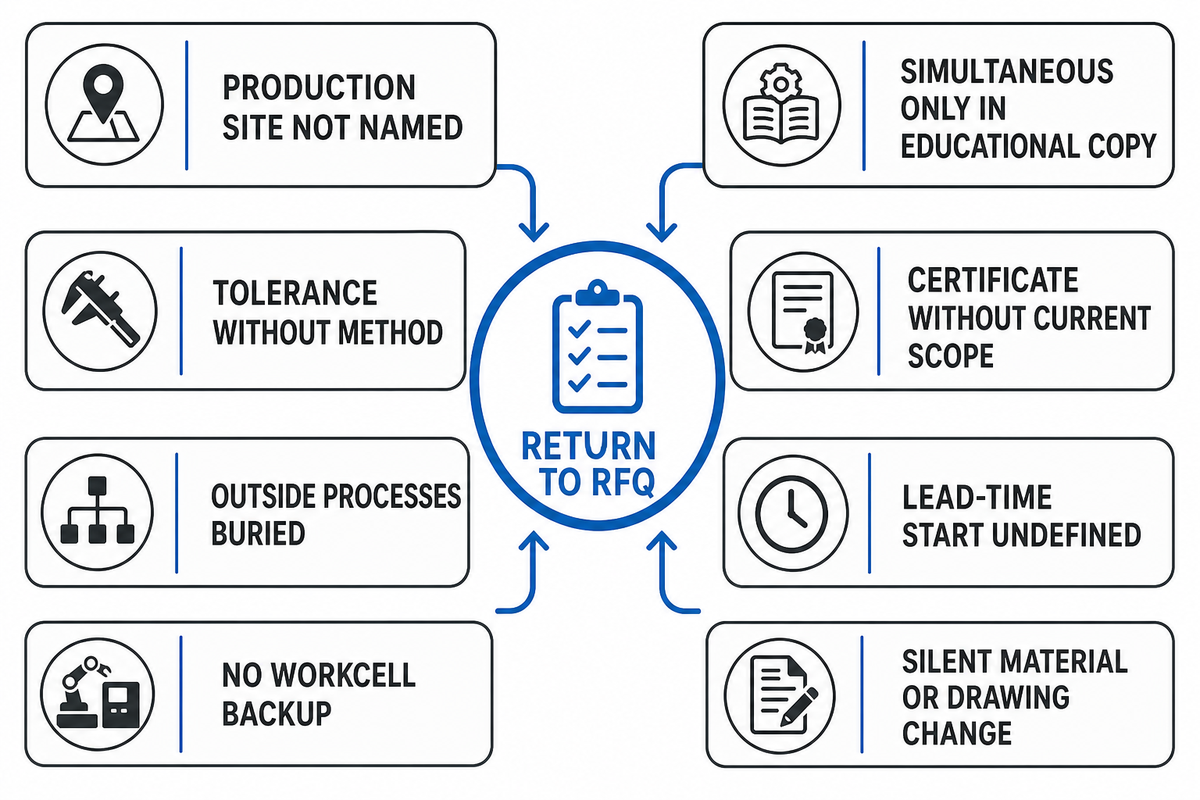
Use the separate axis-route comparison to decide whether the part belongs on three, four, indexed five, or simultaneous five axes. This directory asks a narrower sourcing question: does the supplier’s quote identify the site, machine route, material, inspection evidence, capacity constraint, and delivery ownership needed to support its claim?
Supplier statements can begin the check, but they should not be relabeled as independent evidence. The NIST conformity-assessment overview is the evidence-role boundary used for the red flags below.
- Red flag: the supplier will not name the production site. Ask which legal entity, plant, and machine own the critical operations.
- Red flag: “simultaneous” appears only in educational copy. Ask whether the quoted toolpath actually requires coordinated rotary motion.
- Red flag: the tolerance has no feature, material, or inspection method. Return a marked drawing and request a characteristic-by-characteristic feasibility response.
- Red flag: a certificate logo has no current scope. Obtain the certificate directly and match the holder, address, activity, and validity.
- Red flag: finishing and testing are buried in “included.” Name each outside source, approval responsibility, transport step, and certificate.
- Red flag: lead time starts after an undefined event. Define whether the clock starts at purchase order, deposit, material receipt, drawing approval, or first-article approval.
- Red flag: there is no backup for a single workcell or programmer. Ask for continuity and recovery without demanding confidential staffing data.
- Red flag: the quote changes the material or drawing note silently. Require a deviation list and written approval before manufacture.
A simpler route is not a downgrade when it meets the drawing with better control. Compare total supplier risk: fixture count, datum transfers, tool reach, deburring, inspection access, queue time, and the cost of recovering from a nonconforming first article.
Frequently Asked Questions
What is a 5-axis CNC machining service manufacturer?
It’s a business that accepts customer drawings or models and delivers machined parts using equipment with three linear and two rotary axes. The term shouldn’t be confused with a company that manufactures or distributes CNC machine tools. A service manufacturer may use indexed 3+2 positioning, simultaneous five-axis cutting, turn-mill motion, or a combination; the quotation should state which route applies. Qualification also needs the legal entity, production site, material scope, inspection plan, capacity, and special-process ownership. A machine inventory proves only that assets may exist. An accepted first article and a controlled production plan show whether the proposed route can meet the buyer’s drawing.
How do I verify simultaneous 5-axis capability?
Ask for the production site, machine model, kinematic layout, working envelope, and a written statement that the quoted operation uses coordinated rotary and linear motion. Then request the setup and inspection plan for the critical geometry. A video or sample part can support the discussion, but an accepted first article against your drawing is more relevant than a generic demonstration.
What should I include in a five-axis machining RFQ?
Include the controlled drawing and model, material specification and condition, quantities, critical characteristics, datum scheme, surface-finish requirements, first-article and lot-inspection requirements, special processes, packaging, delivery address, Incoterm, revision control, and allowed deviations. Ask the supplier to return its machine, setup count, motion strategy, exclusions, lead-time start point, and report package.
How much does five-axis machining service cost?
There’s no transferable price without a part. Hold the drawing, material, quantity, inspection, finishing, and delivery assumptions constant before comparing quotes.
What are the disadvantages of five-axis machining?
Five-axis work can require more capable programming, postprocessing, simulation, collision control, machine calibration, and operator knowledge. Equipment and proving costs may be higher, rotary travel can limit access, and singularities can affect tool motion or finish. For simple geometry, that complexity may add no value. The correct comparison is the complete process, not the number of axes.
Should I choose a local or overseas five-axis manufacturer?
Choose the supply route that controls your dominant risk. Local shops may simplify visits, communication, freight, and urgent recovery. Overseas suppliers may offer material, capacity, or cost advantages. Compare landed cost, time-zone response, Incoterm, packaging, duties, export controls, intellectual-property handling, sample approval, and recovery options. Location is one scorecard field, not a proxy for capability or quality.
From Shortlist to a Defensible Sample Order
Reduce the matrix to three to five suppliers, issue one normalized RFQ, and close evidence gaps before awarding a sample. The most useful response is not the longest capability statement. It is the one that identifies the actual site, machine, process route, material source, critical-feature method, inspection output, exclusions, capacity constraint, and delivery responsibility.
The biggest procurement risk is awarding a sample while the production site, machine route, inspection output, or delivery responsibility is still unclear. A buyer should resolve those gaps in the RFQ and require the supplier to return a controlled drawing revision, a proposed process route, and a first-article evidence package.
Zhenling Metal is included first under the commissioned editorial order and can review a drawing for five-axis production. For a direct feasibility response, submit a five-axis machining RFQ with the same evidence fields you send to the other finalists. That produces a comparison you can defend to engineering, quality, procurement, and cost-control teams.
References & Sources
- NIST: geometric-error modeling and evaluation for five-axis machine tools
- NIST: standardized five-axis performance tests
- NIST: conformity assessment basics
- NIST: accreditation versus certification
- ISO 10791-7:2020: accuracy of finished test pieces
- ISO 9001:2015 official standard page
- ISO/TC 176/SC 2 update on the ISO 9001 revision
Verification note: company facts were checked against official pages on September 2, 2026. Supplier pages change, certificates expire, capacity moves, and corporate identities can differ from trading brands. Reconfirm every material fact during qualification. Corrections can be submitted to the Zhenling Metal editorial team with the official source that supports the change.