Get in touch with Zhenling Company
How Buyers Can Specify and Accept Industrial Metal Painting

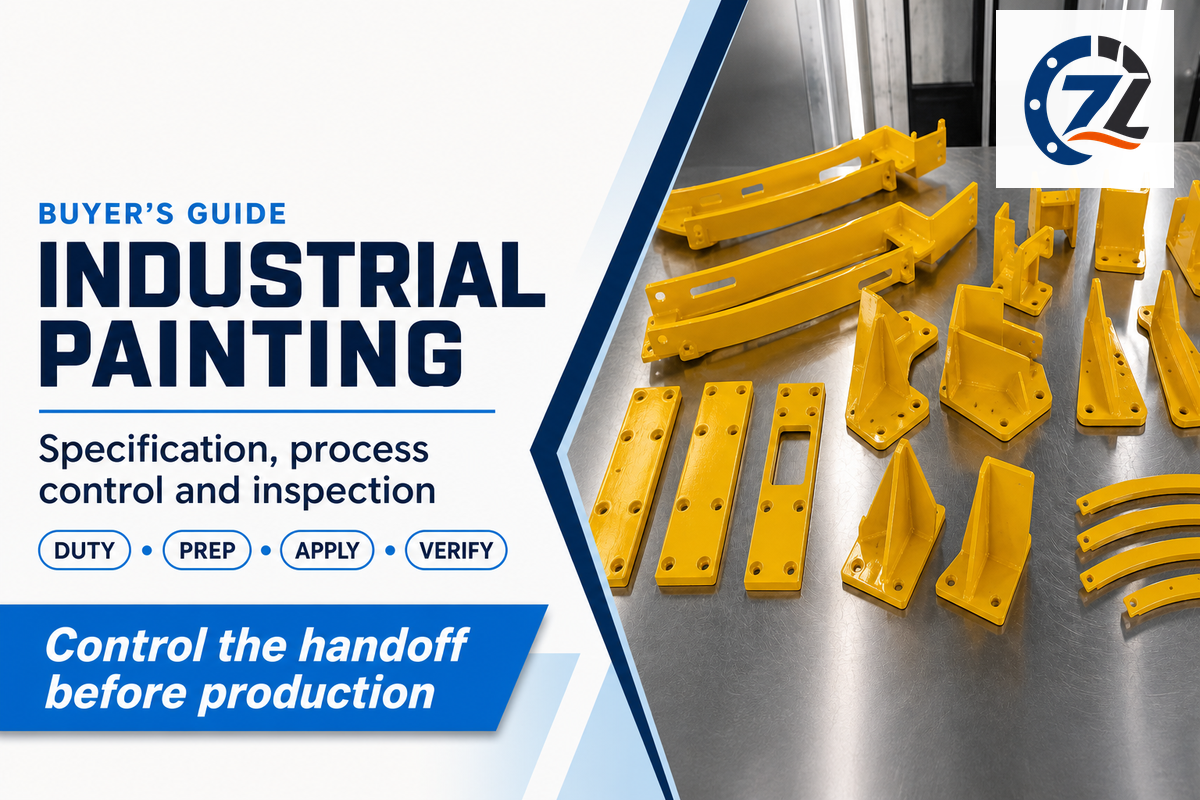
Industrial painting services are easier to compare when the buyer defines the duty, preparation, coating system, inspection evidence, and release criteria before the supplier prices the work. This article is written for engineering, quality, and procurement teams that need a controlled handoff to the finish shop, not a generic paint catalogue or a duplicate service page.
Define What the Coating Must Survive
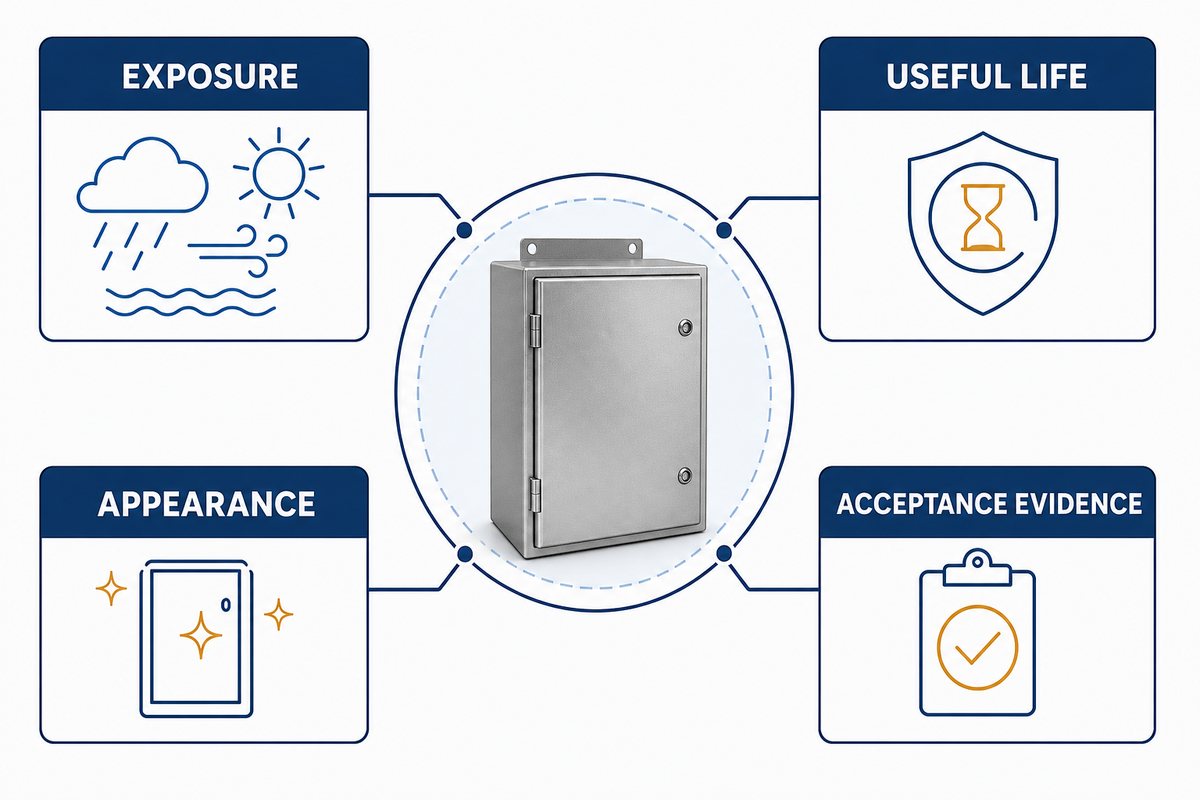
Selecting a protective paint involves a system decision: substrate, severity, preparation, application, cure and maintenance are the package. Black topcoat on a protected indoor bracket isn’t automatically the same scope of supply or risk profile as black topcoat on a welded frame assembly exposed to weather, washdown or periodic chemical exposure, especially when the protection of steel structures is part of the duty.
Distinguish known requirements from information yet to be resolved. Identify the base metal and whether it arrives with mill scale, rust, galvanizing, machining fluid, old paint, weld spatter, or sharp edges. Start with identifying what the finished product will actually touch, and whether the coating is to support corrosion control, corrosion protection, appearance, identification, cleanability, or a mix of these service roles; only the first two concern the development of corrosion.
| Buyer input | Question to answer | Why it changes the specification |
|---|---|---|
| Substrate and condition | What metal, existing finish, rust, welds, or contaminants are present? | Preparation and primer compatibility begin with the actual surface. |
| Exposure | Is the part indoors, outdoors, wet, chemically exposed, abraded, or ultraviolet-exposed? | These conditions set the performance duty for the paint system. |
| Temperature and use | What service temperature, handling, or contact conditions apply? | A defined use condition prevents an appearance-only choice from becoming a functional mismatch. |
| Appearance | Which color, gloss, texture, and visible-area standard matters? | It distinguishes cosmetic expectations from other acceptance evidence. |
Capture uncertainty; don’t let it become an unpriced assumption by the supplier. A paint manufacturer’s product data sheet and project specification requirements can then be measured against a defined service.
A protective coating can be used to protect steel against corrosion, but that purpose doesn’t define the whole system. Structural steel, fabricated brackets, and other metal parts can present different access, exposure, and appearance constraints; an anti-corrosive claim should therefore be tied to the approved system and service brief. This also applies to protective steel finishes used in industry.
Therefore a promise of anti-corrosive paint should be tied to a defined coating system and service condition, not a paint colour.
Translate Exposure into an Industrial Paint Coating System
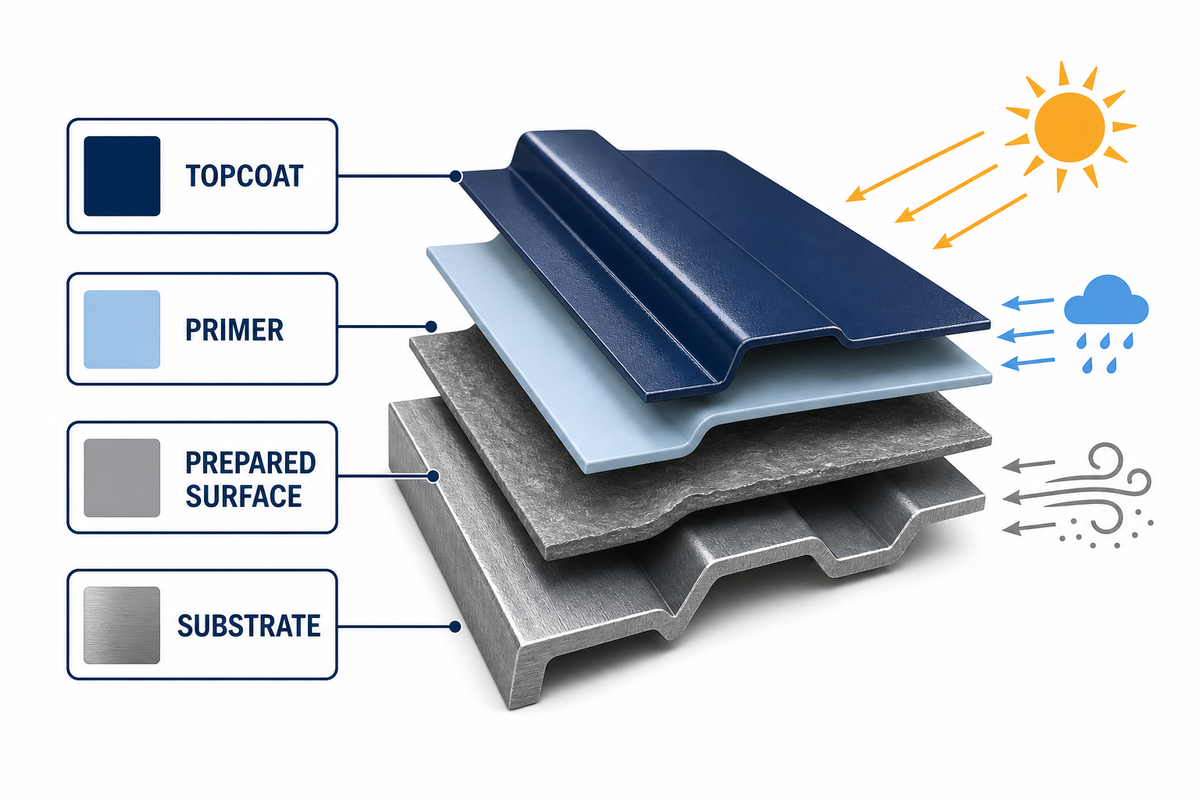
A coating system is the engineered sequence of material types and method limitations appropriate to the specified service duty. This might entail a primer coat followed by an intermediate coat and then a final top coat, but the quantity of paint layers and chemical types used should be matched against the approved paint manufacturer’s technical data for a particular application, rather than a universal shop recipe.
What are industrial paint coatings?
An industrial painting service provides the controlled creation of a film layer by application to a surface for corrosion resistance, finish appearance, identification, or ease of cleaning, with the right paint selected for its specific industrial applications.
Use a buyer-side checklist to ask the supplier to define protective paint systems through approved product documentation, including the proposed coating sequence, the preparatory surface requirement, mix/induction details where relevant, application limits, overcoating window, temperature/moisture requirements for cure and service limitations, so the buyer can select the right system. That’s how you manage a coating system review where the buyer doesn’t mandate a specific brand or specific resin category.
Pigments, solvents, and film-building requirements determine which documentation needs review, while the approved protective coating system remains the controlling unit.
Some primers contain anti-corrosive pigments; epoxy paint and polyurethane names themselves don’t guarantee performance in the specific component use case. Use the Approved Coating System documentation to match the right sequence for the specified duty.
| Decision point | Controlled question | Evidence to retain |
|---|---|---|
| Primer role | Is it compatible with the prepared substrate and the next coat? | Approved system data and preparation requirement. |
| Build sequence | Which coats form the complete paint system? | Coat-by-coat material identification and thickness requirement. |
| Topcoat role | What appearance and exposure duty must it meet? | Color, gloss, service condition, and acceptance criteria. |
| Repair route | How will damage, masked areas, or missed coverage be corrected? | Approved repair method and reinspection rule. |
Specify Surface Preparation Before It Disappears Under Paint
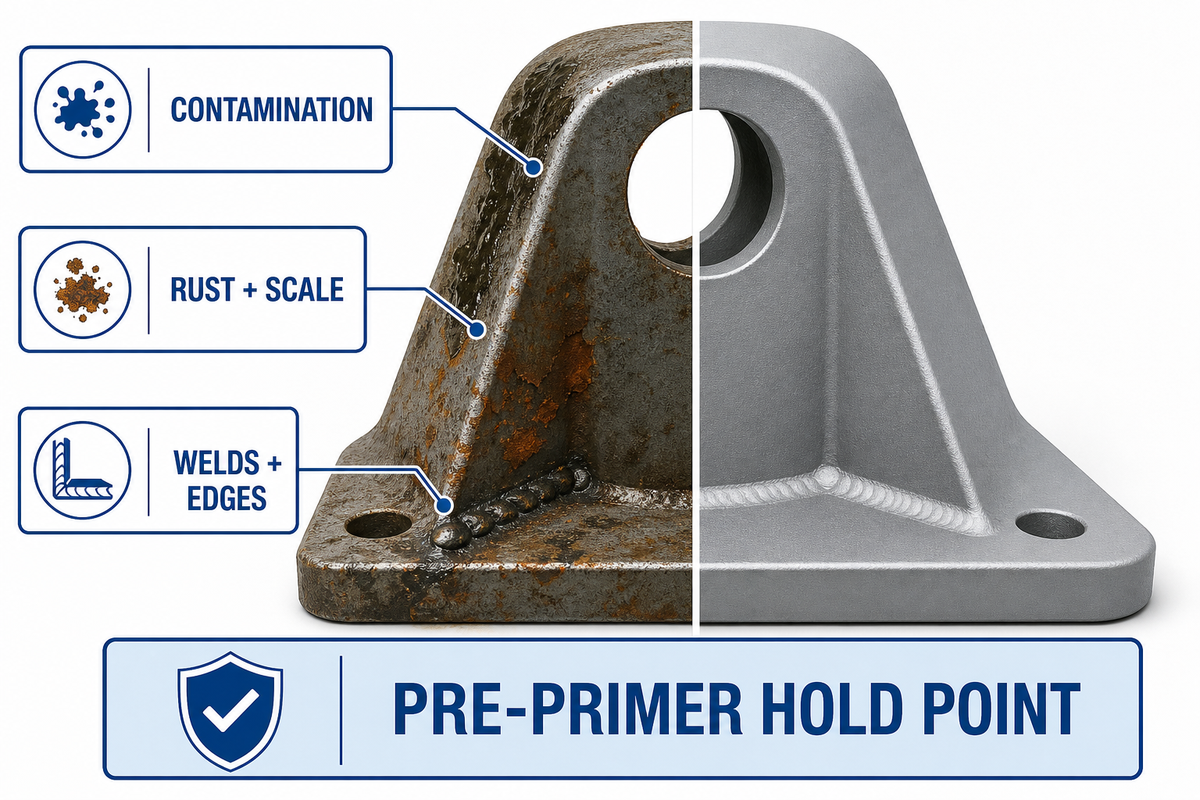
Preparation is evidence, a hold point that can’t be verified once the primer is sprayed. Define the preparation required, define who signs it off, and verify the evidence.
There are several processes commonly mashed into the vague bucket of “clean the metal part”: remove oil / soluble contamination, remove rust / scale / paint / spatter and ease sharp edges and then obtain the cleanliness / profile standard appropriate to your system. This requirement differs based on the substrate and the chosen coating system document. There’s no universal blast requirement: some steel needs abrasive blasting, while galvanized, machined, or previously painted parts may require a different preparation route.
| Incoming condition | Question for the specification | Pre-primer evidence |
|---|---|---|
| Oil or machining residue | How will contamination be removed and checked? | Cleaning method and inspection result. |
| Rust, scale, or old paint | Which removal method and final condition are required? | Applicable standard or measurable outcome. |
| Welds and edges | Can they be prepared, coated, and inspected as drawn? | Edge and weld treatment record where specified. |
| Functional interfaces | Which faying surfaces, grounding contacts, weld zones, threads, or sealing faces need no-coat, precoat, or later treatment? | Drawing callout, masking plan, and disposition. |
How soon after blasting can new paint be applied?
There is no universal preparation-to-primer interval; the permitted time follows the preparation standard, coating data sheet, environmental condition, and project specification.
Design access matters too. Make sure that pockets, gaps, edges, and welds can be accessed for surface prep, paint application, and inspection. If the part geometry makes that impossible, fix the design or process plan prior to production instead of inventing a universal shape restriction afterwards.
Proper surface preparation of a steel surface before a new coating may include cleaning, a designated blast process, and any other use of mechanical treatment appropriate to the item and coating documentation. If the authorized preparation step removes rust, note the final condition prior to primer. Use of a brush or roller may be applicable to an authorized local repair; however, this doesn’t imply that a brush or roller may supersede the designated preparation or coating application process.
Control Spray Paint Application, Recoat, and Cure
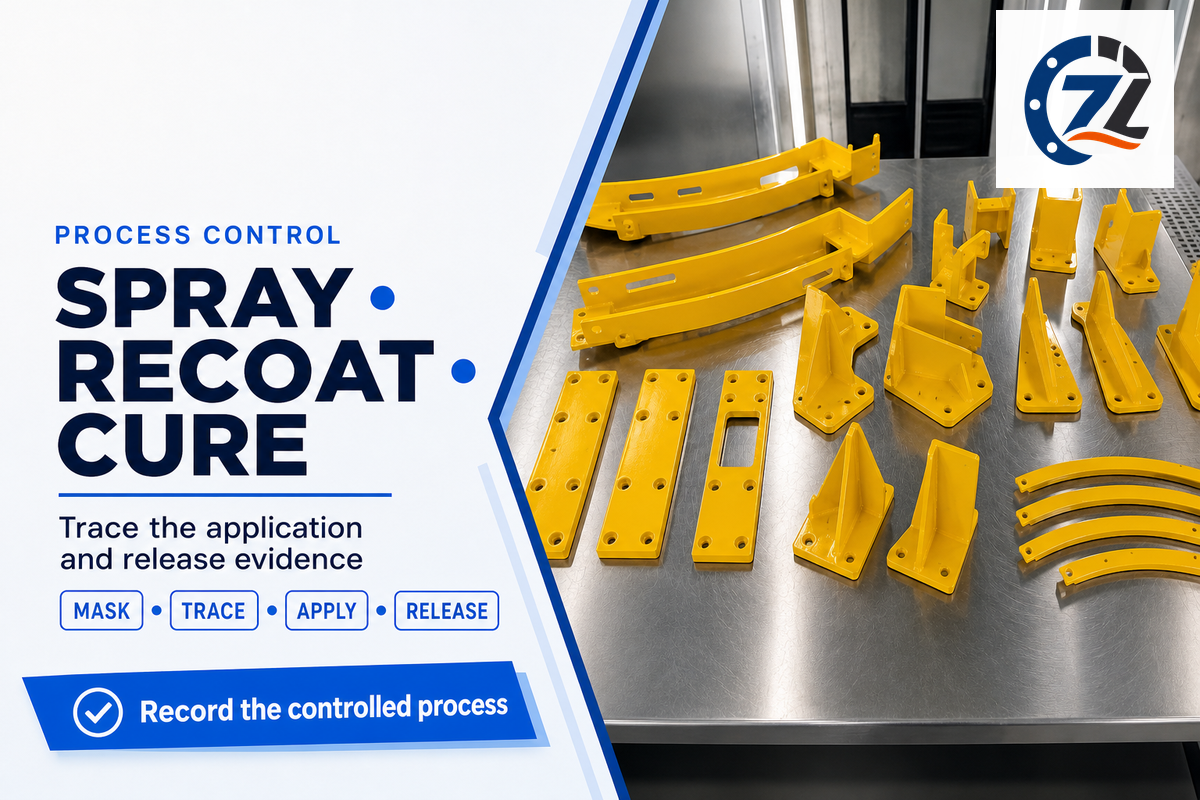
The process record can capture masked interfaces, material and batch ID, mixing and induction (if applicable), viscosity (in controlled conditions), spray technique such as a spray gun, airless spray, or electrostatic application, ambient and part conditions, dry-off to primer, recoat time, and cure/release data.
The application method must also protect designated no-coat areas from overspray, preserve the drawing’s functional interfaces, and require the spray painter to record any paint spray deviation observed while applying the paint. “Spray paint” is a process description; it’s not an independent acceptance requirement.
For industrial spray painting, record the actual method of application: for example, whether the approved painting process calls for an industrial spray setup, an airless paint method, or air assisted airless equipment. If the product data specifies the use of high pressure, spray pattern or solvent control when using a sprayer, the application log should record that controlled parameter rather than suggest it through the final appearance.
For covered United States spray-finishing operations, OSHA 29 CFR 1910.107 addresses fire and explosion controls; it is not the complete safety boundary for toxic-material exposure or other occupational requirements.
Environmental compliance requires a facility-and-process applicability screen. Federal requirements such as major-source Subpart MMMM and area-source Subpart XXXXXX, as well as other federal, state, or local requirements, may also apply. We haven’t made a legal determination in this guide.
The facility is responsible for making the final determination.
- Freeze masking and no-coat callouts before the first coat.
- Maintain preparation-to-primer, recoat, cure, and applicable paint sprayer setting data with the task record.
- Only approve after the specified cure and inspection requirement has been met.
State Paint Coating Thickness and Measurement Rules Clearly
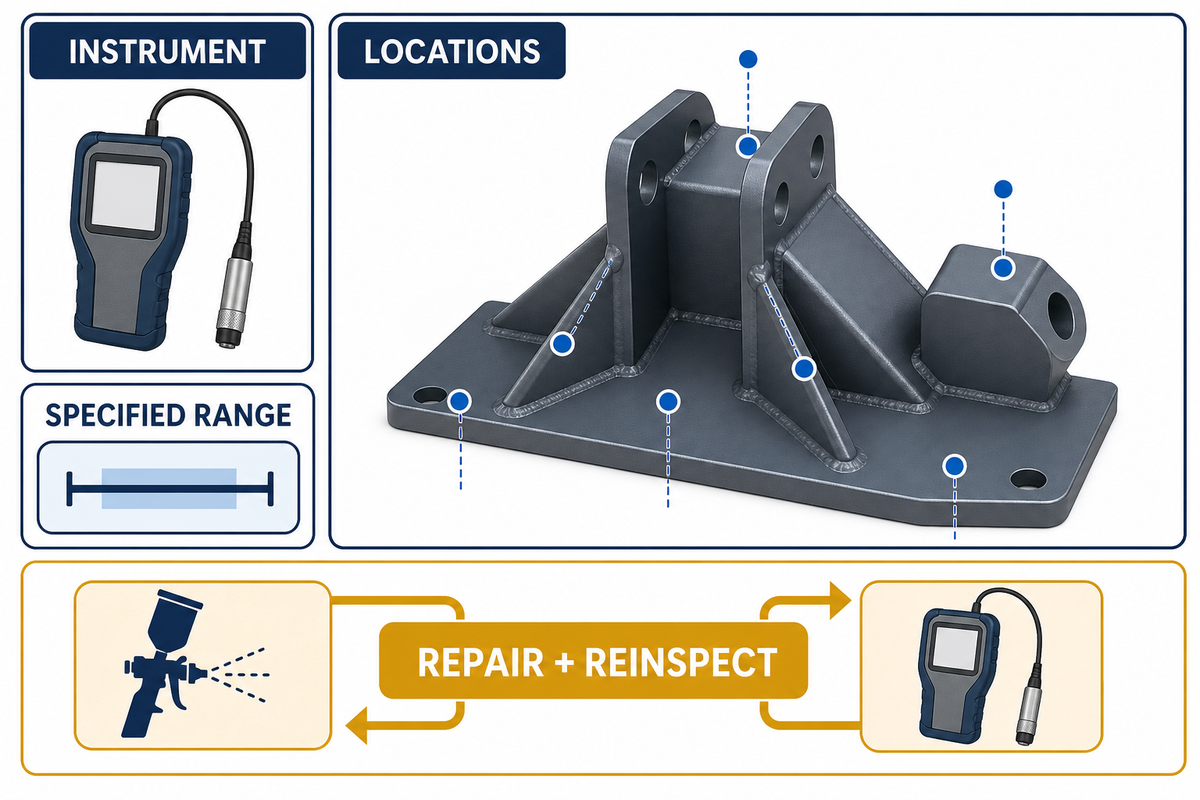
Dry film thickness is significant, but an average isn’t in itself a determination of coating acceptance. The purchase package should indicate if the target applies by coat or to the finished system, what areas are included, how edges, welds, recesses, and hard-to-reach locations are coated, and how repair areas are re-inspected.
ASTM D7091 describes nondestructive dry-film-thickness gauge practice, including verification and adjustment considerations.
SSPC-PA 2 provides a method for determining conformance to specified dry-film-thickness requirements. If called for by the project specification or written agreement, it can control sampling and configuration specific requirements. The limits and options called for are still set by the applicable drawing, contract or coating specification.
Thickness alone can’t establish adhesion, cure, appearance, contaminant control, or full compliance of a coat of paint. Employ it as an additional controlled channel of evidence within the agreed programme of inspection.
More importantly, the thickness of a coating isn’t a replacement for good paint adhesion or proof of the adhesion of the coating to the steel. The inspection plan must separate requirements for thickness, visual quality, cure, and any specified adhesion test into separate checks.
Build Inspection and Acceptance Evidence Before Production
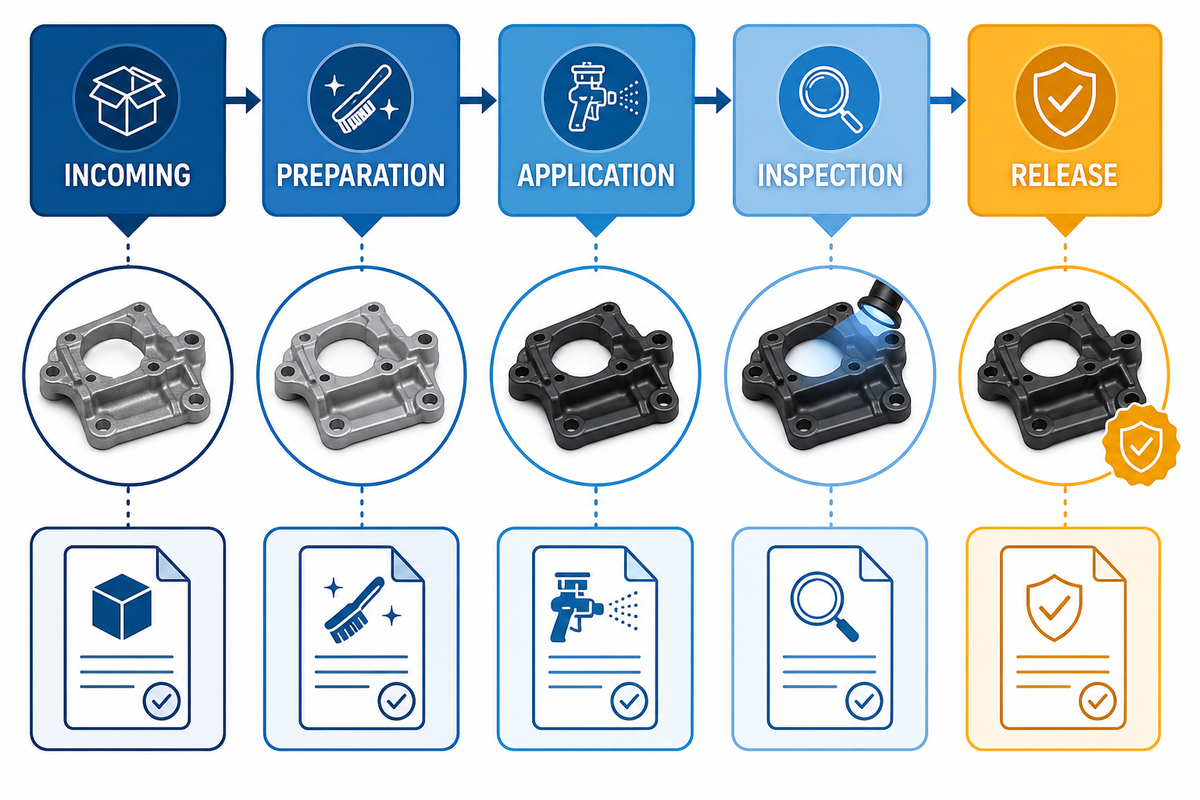
Acceptance evidence is most effective when prepared in advance of the coating process. After a part has shipped, it’s hard to document a prep history or missing material record. Agree the record package, hold points, release authority, and evidence used to judge the quality of the paint while the buyer can still resolve conflicts between the drawing, order, and product documentation.
The WBDG coating inspection guidance identifies materials, surface preparation, coating application, and the final product as inspection hold points whose results must be documented.
| Stage | Hold point or check | Record or disposition |
|---|---|---|
| Incoming | Confirm substrate, condition, drawing revision, and functional interfaces. | Incoming check and job identification. |
| Preparation | Verify cleanliness, rust or old-paint disposition, profile method where required, and edge or weld treatment. | Pre-primer hold-point record. |
| Application | Trace material, batch, mixing, masking, environmental conditions where applicable, and recoat control. | Application log. |
| Inspection | Review appearance, dry film thickness, and adhesion only when it is specified. | Inspection results and nonconformance record. |
| Release | Confirm cure evidence, approved repairs, and required customer records. | Final release package. |
Identify the visible area, allowable appearance variation, any applicable visual or sample approval, and how repaired areas will be handled. Adhesion testing has a place only in the plan when it’s specified as necessary.
| Issue category | Buyer or inspector question | Required disposition |
|---|---|---|
| Incoming damage | Was damage present before preparation began? | Record the condition and obtain an agreed release or repair instruction. |
| Surface contamination | Was oil, residue, or other contamination found? | Repeat the approved cleaning step and document the follow-up check. |
| Rust, scale, or old coating | Does the surface condition meet the specified preparation outcome? | Continue preparation or obtain a written deviation before primer. |
| Weld or edge condition | Can the specified coating reach and cover the feature? | Resolve the feature or preparation method before coating proceeds. |
| Masking deviation | Was a no-coat or functional interface missed? | Use the approved correction method and return the area to inspection. |
| Application deviation | Did material, mixing, spray, or environmental control depart from the approved process? | Hold the affected work for documented technical disposition. |
| Recoat or cure deviation | Was the required sequence or release condition missed? | Follow the coating-system disposition and retain the supporting record. |
| Thickness out of range | Does the measurement plan identify a nonconforming area? | Apply the agreed acceptance or repair rule and repeat the required checks. |
| Appearance or repair variance | Does the visible result or repaired area meet the agreed criteria? | Record acceptance, further repair, or rejection against the defined standard. |
Make the record package traceable at the part, lot, or job level as the purchase order mandates. When multiple drawings, revisions, or coating-system documents are relevant, specify the controlling revision and note the escalation path for a conflict.
With complex assemblies, find the inspection access points in advance. A gauge may be unable to reach each recess; a visual surface may not be the functional surface; and a grounding contact or sealing face may be purposely left uncoated. The acceptance plan should specify how those situations are checked and documented rather than mark unavailable or functional surfaces as unexplained anomalies.
Trace the application of the paint through the approved coating application controls, then retain the related inspection and repair disposition with the release decision. A clear disposition for an out-of-range reading, a missed mask, or a delayed recoat is more useful than a generic instruction to repair as needed. The agreed repair method should return the part to the same inspection path, including any required cure evidence and remeasurement. It gives the supplier a defined inspection route and gives the buyer a basis for accepting, repairing, or rejecting a condition without relying on memory after delivery.
Know When Wet Paint or Powder Coating Fits Better
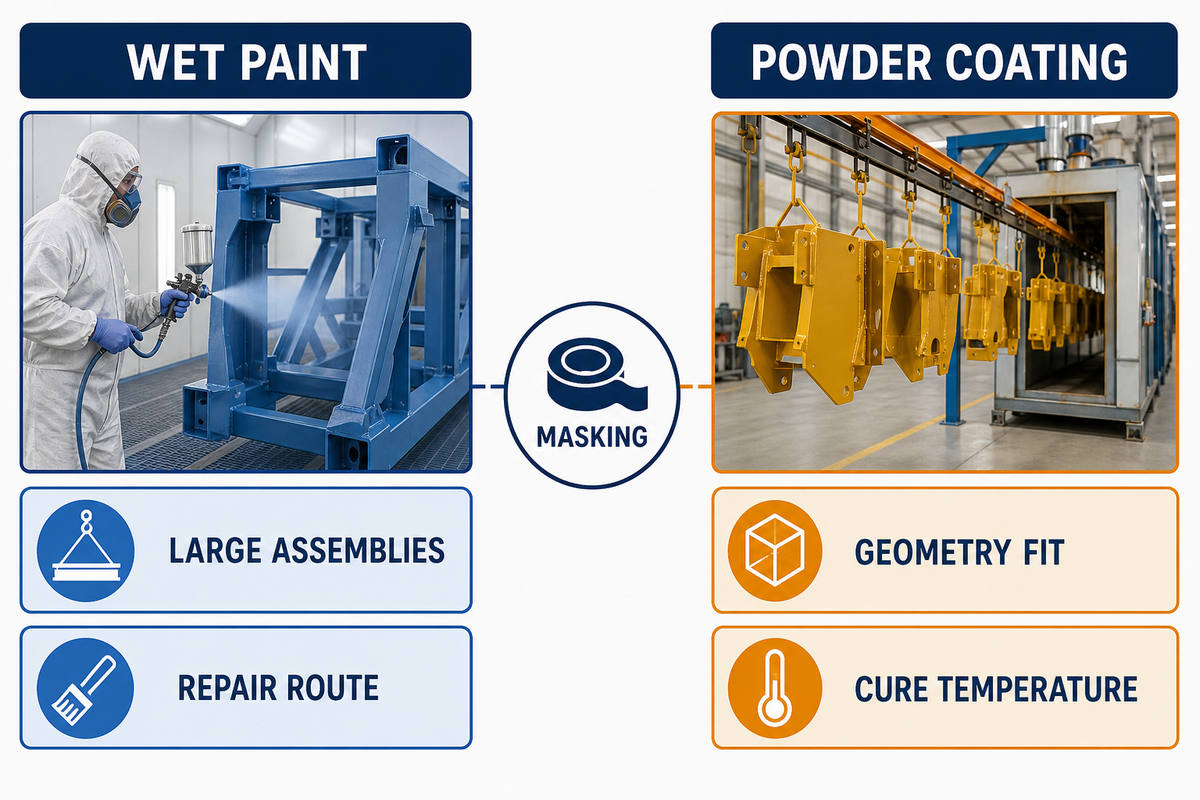
Color or unit price alone cannot choose between the two options. Wet paint and powder coating are separate process choices. Review part size and geometry, cure-temperature tolerance, masking, film-performance requirements, repair route, production volume, and line fit.
For major industrial facilities, there are field-access and maintenance considerations outside the part-level flow presented here.
Wet paint
- Review fit for large industrial assemblies and part-specific access.
- Confirm the approved repair route and masking plan.
- Control the selected application and cure conditions.
Powder coating
- Confirm that size and geometry fit the available process.
- Check cure-temperature tolerance of the complete assembly.
- Review masking and coverage of recesses or threads.
In the case of no definitive process selection, compare the part specific constraints with the overall surface finishing options, or route a powder specific question to the powder coating service page. The selected route should preserve the required interfaces and acceptance evidence, not merely the preferred finish appearance.
Use the 7-Field Coating Handoff for a Quote-Ready Package
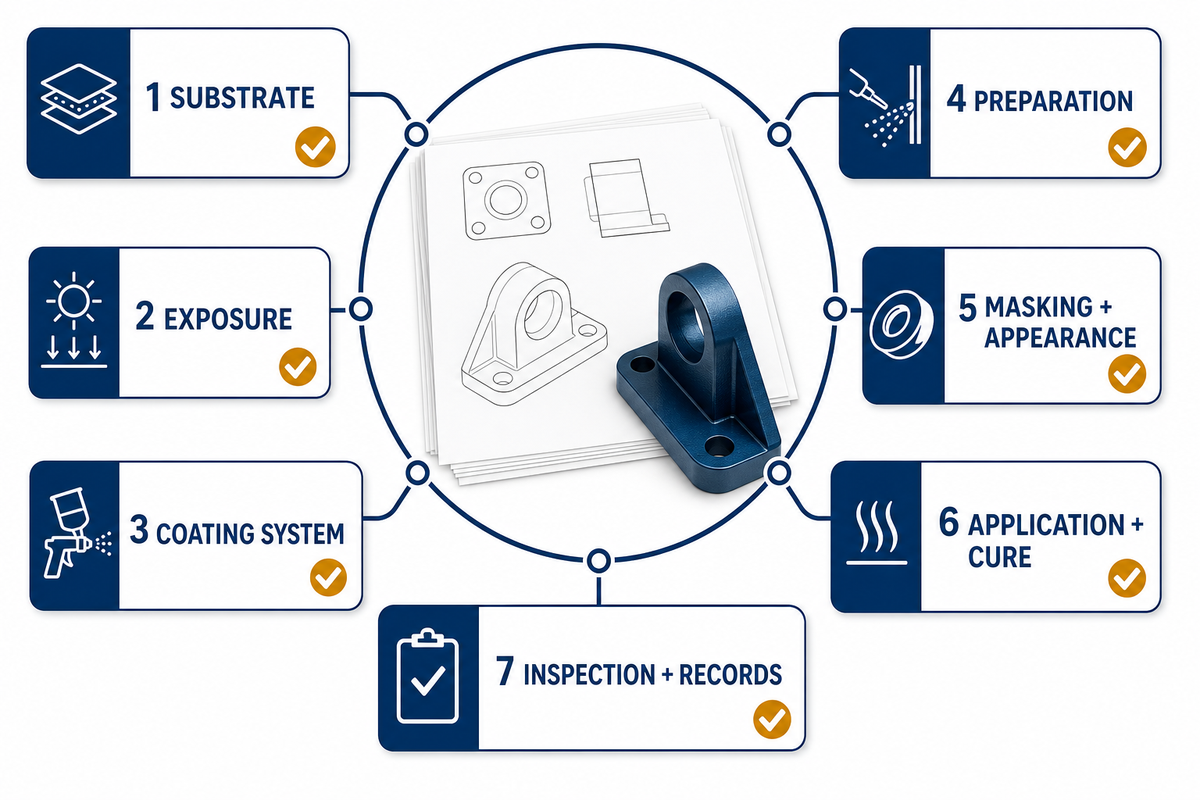
The 7-Field Coating Handoff transforms a casual paint request into a quote package. It gives a supplier the information needed to identify assumptions, select an appropriate system review path, plan inspection, and return questions before a price becomes a production commitment.
Copy the fields below into the request for quotation and attach the required drawings. Complete a field with a controlled requirement or put “to be confirmed”; don’t replace an unknown with a paint name.
7-Field Coating Handoff — include these in the quote request:
| Field | Buyer-defined requirement | Why it matters | How to verify |
|---|---|---|---|
| 1. Substrate and condition | Metal, incoming finish, rust, welds, and contaminants. | Sets the preparation and compatibility review. | Drawing, photos, and incoming check. |
| 2. Exposure | Indoor/outdoor duty, moisture, chemicals, ultraviolet exposure, abrasion, and temperature. | Defines the performance boundary. | Service-environment brief. |
| 3. Coating system | Approved system or supplier review requirement. | Controls material compatibility and sequence. | Manufacturer data and approval record. |
| 4. Preparation | Standard or measurable cleanliness/profile outcome and hold point. | Preserves evidence before primer. | Pre-primer record. |
| 5. Masking and appearance | No-coat interfaces, visible areas, color, gloss, and repair treatment. | Protects function and cosmetic requirements. | Drawing callout and visual criteria. |
| 6. Application and cure | Required process data, recoat limits, and release condition. | Links the paint job to the approved system. | Application and cure record. |
| 7. Inspection and records | Thickness plan, specified tests, repairs, and final package. | Defines acceptance before shipment. | Inspection report and release record. |
Prior to requesting a final price, compare the supplier’s assumptions to all seven fields. Resolve differences in surface condition, owner-furnished material, masking responsibility, the controlling coating data, inspection access, and required records in writing. This safeguards each party from turning an incomplete handoff into an unannounced change after part preparation or coating has begun.
When the seven fields are complete, use the painting services for custom metal parts page to begin a controlled service discussion.
What Changes (and What Does Not) in Industrial Coating Decisions
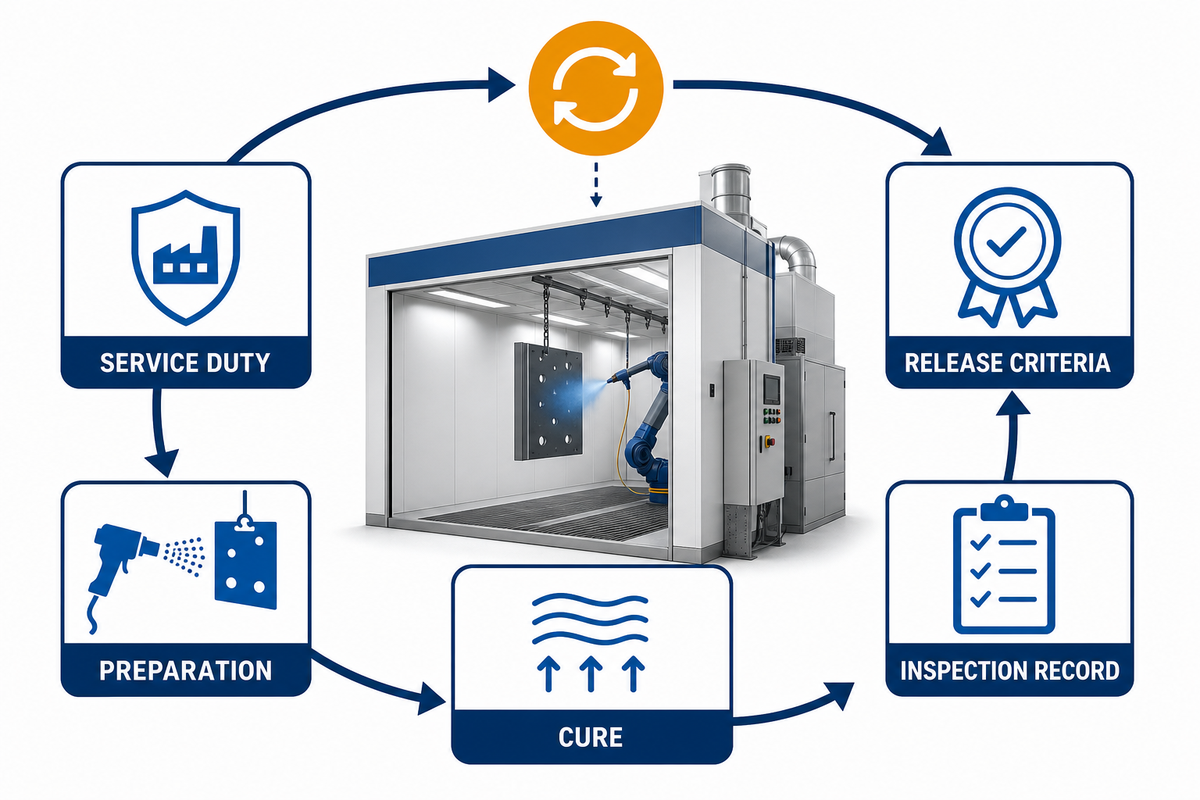
Lower emission products, new spray equipment, and automation can alter a process option but can’t eliminate the requirement to specify exposure, preparation, compatibility, cure and acceptance. WBDG’s lifecycle framing cautions that the lowest volatile-organic-compound number is not automatically the most environmentally favorable choice when durability and repaint cycles are considered.
The same principle applies across industrial units and plants: even a new technology should be evaluated for service duty, the preparation route, the cure condition, and the evidence needed for release.
Sector labels don’t provide the missing specification either. Parts used in food and beverage equipment, for example, still need their actual contact, cleaning, regulatory, and service conditions defined before a coating decision is made.
On a newly introduced coating, assess the paint technology for industrial systems based on approved performance documentation, suitability for the part and duty, relevant plant specifications, and available test evidence. A trend label is background information and not an indication that a specific coating is appropriate.
Maintain the same order of reviews when a process is changed: verify service brief, verify prep and system, determine cure and inspection record, authorize release criteria. That order travels with the process even when the materials or the application technique change.
Frequently Asked Questions
What information should a painting specification include?
Answer
A complete specification identifies substrate and incoming condition, exposure and service environment, approved coating system, preparation standard or measurable outcome, masking, color and appearance, coat-by-coat dry film thickness, cure or recoat controls, inspection method, sampling, and required records. It should also define who resolves conflicts between the drawing, purchase order, and coating supplier’s data sheet.
How should metal be prepared before painting?
Answer
Preparation starts with oil and soluble-contamination removal, then addresses rust, mill scale, old paint, weld spatter, and sharp edges using a method suited to the substrate and specified coating. The purchase package should name an applicable preparation standard or a measurable cleanliness and profile outcome, plus the inspection evidence required before primer hides the surface.
What records should a painting supplier provide?
Answer
Useful records connect delivered parts to the approved materials and process: coating product and batch, preparation and environmental checks where applicable, mixing and induction data, application dates, recoat or cure conditions, thickness readings by coat or completed system, inspection results, repairs, and final release. Agree the exact package before production rather than requesting it after shipment.
Is wet paint better than powder coating?
Answer
Neither process wins in every case. Wet paint and powder coating suit different constraints: large assemblies, field repair, part size, geometry, cure temperature, process fit, and release evidence. The substrate, masking complexity, performance duty, repair plan, and ability to document the specified result should decide.
How do buyers reduce painting rework?
Answer
Freeze the specification hierarchy, review masking and rack points, approve a representative sample when appearance is critical, and place hold points before coating hides preparation defects. Define repair acceptance and require traceable records. That moves the discussion from subjective appearance after delivery to controlled evidence at the stage where it can still be acted upon.








ZHENLING / MADE-TO-PRINT MANUFACTURING
From Engineering Question to RFQ-Ready Drawing
Zhenling supports custom flanges, valve bodies, rolls, bent pipe, and profiled machined parts for industrial buyers. Our engineers review the drawing, material condition, tolerance stack, quantity, and inspection requirements before the machining route is quoted.
START WITHDrawing · Sample · Critical dimensions
DEFINEMaterial · Quantity · Tolerance · Certification
DRAWING / MATERIAL / TOLERANCE
Prepare Your Part Brief
- PART INPUT
- 2D/3D drawing or sample
- PROCESS REVIEW
- Machining · forming · welding · inspection
- RESPONSE ROUTE
- Submit the website inquiry form
We use your details to review and respond to the enquiry. See our Privacy Policy.


