Get in touch with Zhenling Company

Copper CNC machining service suppliers manufacture custom, drawing-based parts by milling, turning and related processes. For a first shortlist, compare 3ERP for C101/C110 prototypes, Cox Manufacturing for repeated turned parts, and Checon or Storm for electrical components. Zhenling Metal offers drawing-led industrial machining. The right choice depends on your grade, geometry, quantity and required manufacturing route.
Updated: October 2026. This report profiles 20 manufacturers. The numbers don’t reflect rankings.
Disclosure: This guide is published by Zhenling Metal. We list ourselves first because this is our website, not because we claim to be the market leader. The other 19 manufacturers are grouped by what they’re best for, in no particular order within each group.
How We Selected These Copper CNC Machining Suppliers
In October 2026, we investigated manufacturers with their own manufacturing operations and verifiable evidence of copper component machining, and verified company information on their official websites. We took a global perspective and covered prototype, repeat-production and electrical component suppliers. Machine-tool sellers, raw-metal distributors, directories, sourcing only platforms and companies with only brass evidence were excluded. Businesses that use factories and partners remain included, with that distinction stated.
The comparison uses company-published capabilities, locations and quality statements. It doesn’t rank independently measured delivery performance, defect rates, and customer satisfaction. A founding year of ‘Not publicly confirmed’ means that the available company history didn’t provide a clear and unambiguous date. Certifications retain the scope and edition described. They shouldn’t be interpreted to mean that all copper parts bear the certifications.
Quick Picks: Copper Supplier Order-Fit Map
This order-fit map should help procurement narrow their first enquiry list. Engineering should be able to identify a process option, and quality teams should have a better-defined document boundary. Finance should be able to compare quotations for the same scope rather than pick the lowest unit price to determine the order cost.
- Mixed industrial drawings: Zhenling Metal combines custom machining with welding, inspection and export support.
- C101/C110 development parts: 3ERP explicitly accepts one-off prototypes; Venco adds EDM and grinding for bridge-production work.
- Repeated turned copper components: Cox Manufacturing, E.J. Basler and D&W Products offer Swiss or multi-spindle routes.
- European contracted series: RADMOT publishes batch and annual quantity thresholds; Luvata Welshpool adds cold forming before machining.
- Contacts and busbars: Checon integrates contact manufacturing and assembly; Storm concentrates on power-distribution components.
- Mixed-material assemblies: Dynamic Design & Manufacturing combines copper with fabrication, while American Micro Industries also makes electrical insulators.
Copper Machining Supplier Comparison
Read the table by order type first and then read the company profiles to identify a potential supplier for CNC machined copper components. All can machine copper, but they serve different purchasing needs.
| No. | Company Name | Headquarters | Founded Year | Best For | Brief Introduction | Copper Machining Capabilities | Key Advantages | Potential Disadvantages | Official Website |
|---|---|---|---|---|---|---|---|---|---|
| 1 | Zhenling Metal | Shanghai, China; machining plant in Jiashan, Zhejiang | 2006 | Mixed industrial drawings | Manufacturer and exporter with its own machining plant | Turning, milling, drilling | Own Jiashan plant; export support | Custom-order focus; no catalogue model | zhenlingmetal.com |
| 2 | 3ERP | Zhongshan, Guangdong, China | 2010 | C101/C110 prototypes | Rapid prototyping manufacturer with partner-network capacity | C101/C110 milling and turning | No strict minimum; CMM | Factory and partner routes | www.3erp.com |
| 3 | Mahuta Tool | Germantown, Wisconsin, USA | 1988 | Industrial short runs | Machine shop and tooling manufacturer | Copper multi-axis CNC and EDM | Wire EDM; tool-and-die capability | Excludes hobby/consumer requests | www.mahutatool.com |
| 4 | Protolabs | Maple Plain, Minnesota, USA | 1999 | Digital C101 factory orders | Digital manufacturer with factory and partner-network routes | Factory C101; Network C110 | Factory/Network routes distinguished | C110 uses Network route | www.protolabs.com |
| 5 | WayKen | Shenzhen, China | Not publicly confirmed | Product-development assemblies | Rapid manufacturing company with in-house production and resource integration | Copper CNC; 3/5-axis processes | Factory plus development processes | Prototype/small-run focus | waykenrm.com |
| 6 | RapidDirect | Shenzhen, China (self-owned factory) | 2009 | Mixed-process purchasing | Manufacturer with its own factory and partner network | C101/C103/C110; beryllium copper | Own factory plus process breadth | Partner routing possible | www.rapiddirect.com |
| 7 | CNCTAL | Dongguan, Guangdong, China | Not publicly confirmed | Drawing-based custom orders | Custom CNC machining manufacturer | C101/C110; drilling and tapping | 50+ machines/support equipment | Not catalogue hardware | www.cnctal.com |
| 8 | Venco MFG | Huizhou, Guangdong, China | 2014; CNC business began in 2015 | EDM and grinding additions | Custom CNC manufacturer | C11000; CNC plus EDM | Wire/sinker EDM; grinding | Bridge program: 20–500 pieces | vencomfg.com |
| 9 | Cox Manufacturing | San Antonio, Texas, USA | 1956 | Repeated small turned parts | Precision screw-machining manufacturer | C110/C145/C172/C173/C175 | Swiss and multi-spindle capacity | Turning emphasis; not large plates | www.coxmanufacturing.com |
| 10 | RADMOT | Wola Gutowska near Radom, Poland | 1984 | European series contracts | Contract CNC machining manufacturer | Copper/alloy turning and milling | 80+ machines; 22 measuring devices | Published batch/annual minimums | radmot.com |
| 11 | E.J. Basler | Schiller Park, Illinois, USA | Not publicly confirmed | Automated turned-part programs | Precision machining manufacturer with global sourcing support | C10200/C14500; production machining | Rotary transfer; automated inspection | Manufacturing and sourcing model | www.ejbasler.com |
| 12 | D&W Products | Cedar Rapids, Iowa, USA | 1951 | Swiss and multi-spindle parts | Precision screw-machined parts manufacturer | Copper; Swiss and multi-spindle | INDEX eight-spindle CNC | Some turning/milling via partners | www.dwproducts.com |
| 13 | Hirsh Precision | Frederick, Colorado, USA | 1979 | Automated multi-axis work | Precision manufacturer with finishing partners | Copper; multi-axis and mill-turn | Fastems-linked five-axis cells | Finishing involves partners | hppi.com |
| 14 | C&H Machine | Escondido, California, USA | 1964 (C&H Machine in Escondido) | Machining plus joining | Precision machining and fabrication shop | Copper CNC, EDM and joining | EDM, brazing and welding | Custom fabrication, not catalogue | www.c-hmachine.com |
| 15 | Ephrata Precision Parts | Denver, Pennsylvania, USA (operating address) | 1972 | Copper with toolmaking | Precision machining and toolmaking manufacturer | C101/C110; CNC and EDM | 56,000-square-foot facility | Tolerance depends on geometry | www.ephrataprecision.com |
| 16 | Checon | North Attleboro, Massachusetts, USA | Not publicly confirmed | Electrical contact assemblies | Electrical-component manufacturer with integrated material production | Copper/alloy milling and turning | Material, forming and assembly | Electrical-component focus | www.checon.com |
| 17 | Storm Power Components | Decatur, Tennessee, USA | 1990 | Power-distribution busbars | Electrical power-component manufacturer | Copper busbar CNC fabrication | Four-axis CNC; dynamic nesting | Power-component specialization | stormpowercomponents.com |
| 18 | Luvata Welshpool | Welshpool, Powys, United Kingdom | 1943 as Dawson Shanahan; joined Luvata in 2024 | Formed and machined components | Cold-forming and precision-machining manufacturer within Luvata | Copper forming and machining | Cold forming plus CNC | Engineered programs, not instant quotes | www.luvata.com |
| 19 | Dynamic Design & Manufacturing | Niwot, Colorado, USA | 1983 | Copper plus sheet metal | Precision machining and sheet-metal manufacturer | C101/C110 CNC and fabrication | Mill-turn center; wire EDM | Published focus: C101/C110 | www.dycoinc.com |
| 20 | American Micro Industries | Chambersburg, Pennsylvania, USA | 1995 | Conductors plus insulators | Custom component manufacturer | Custom copper CNC components | Custom Components Division | Not a high-volume turning specialist | www.americanmicroinc.com |
Prototype and Drawing-Led Copper CNC Machining Services
CNC machining services for copper are good starting points for drawing reviews of development parts and small production runs. Some support larger requirements. The shared feature is a service model that can begin with a custom drawing rather than a catalogue product or a committed annual production program.
Which copper machining suppliers suit prototypes versus repeat orders?
3ERP and Venco explicitly describe prototype or bridge-production work, while Cox and D&W emphasize Swiss or multi-spindle production. RADMOT publishes minimum batch and annual quantities. Use these differences to choose the first enquiry route: a single development part and a recurring turned component can require different fixtures, inspection plans and production equipment.
1. Zhenling Metal
Best for: Drawing-led copper parts within a mixed industrial machining order.
Headquarters: Shanghai, China; machining plant in Jiashan, Zhejiang
Founded: 2006
Company type: Manufacturer and exporter with its own machining plant
Website: zhenlingmetal.com
Zhenling Metal is the publisher of this guide and a drawing-led manufacturer for buyers coordinating several industrial machining needs. The Jiashan plant brings machining, welding and inspection together, while the Shanghai business supports exports; that combination is useful when a copper part belongs to a larger assembly and the purchase order also includes other machined parts. The copper service starts with drawings, grade, finish and delivery requirements; it doesn’t assign every project the same process or tolerance.
Quality statement: Website states CE and ASME approvals for pressure equipment work; these aren’t copper-part certifications.
Buying limitation: Its published operating model favors custom one-offs and small batches rather than catalogue production.
2. 3ERP
Best for: C101/C110 prototypes and bridge production.
Headquarters: Zhongshan, Guangdong, China
Founded: 2010
Company type: Rapid prototyping manufacturer with partner-network capacity
Website: www.3erp.com
3ERP offers a useful starting point for an engineering team that needs a C101 or C110 prototype before deciding on repeat production. The copper page accepts one-off work without a strict minimum quantity, and the equipment includes 3-, 4- and 5-axis machines, material testing and CMM inspection. The practical advantage is access to both machining and dimensional feedback during development. A buyer planning a later production run can compare the prototype route with the proposed series-production route before committing to fixtures.
Quality statement: ISO 9001:2015, according to 3ERP’s company website.
Buying limitation: Combines its own facilities with qualified manufacturing partners, so a factory-only purchase needs an agreed production route.
3. Mahuta Tool
Best for: Industrial short runs combining copper CNC and EDM.
Headquarters: Germantown, Wisconsin, USA
Founded: 1988
Company type: Machine shop and tooling manufacturer
Website: www.mahutatool.com
Mahuta Tool combines copper machining with the tool-and-die background of an industrial machine shop. Its wire EDM capability is relevant to complex profiles that a rotating cutting tool can’t reach conveniently; the site states a maximum component envelope of 27.75 × 15.75 inches. The broader tooling business handles single-hit, progressive and transfer dies, including dies up to 20,000 lb. Its stated 1–100-part project pattern makes the shop worth considering for industrial short runs that may return.
Quality statement: ISO 9001:2015, according to company website.
Buying limitation: Typical projects are industrial short-run and repeat work; the shop explicitly excludes hobby or consumer requests.
4. Protolabs
Best for: C101 prototypes through a digital factory workflow.
Headquarters: Maple Plain, Minnesota, USA
Founded: 1999
Company type: Digital manufacturer with factory and partner-network routes
Website: www.protolabs.com
Protolabs separates a semi-automated factory service from Protolabs Network, and that distinction matters for copper. The factory offering lists C101; the copper page routes C110 through the Network. Its general factory machining service advertises turnaround as fast as one day, but that isn’t a promised lead time for every copper geometry. For a buyer, the attraction is a digital manufacturing workflow with a clearly identified factory option. A C110 requirement therefore moves the enquiry from the factory route to the Network route.
Quality statement: Factory CNC: ISO 9001:2015 and AS9100D, according to its quality page.
Buying limitation: C110 is listed through Protolabs Network, while the factory copper offering is C101.
5. WayKen
Best for: Product-development prototypes with multiple manufacturing processes.
Headquarters: Shenzhen, China
Founded: Not publicly confirmed
Company type: Rapid manufacturing company with in-house production and resource integration
Website: waykenrm.com
WayKen is oriented toward product development, where a copper component may sit beside plastic models, cast samples or tooling. Its About page describes a 35,000-square-foot factory and more than 70 employees, while its service mix combines CNC machining with vacuum casting and tooling. Copper appears in its metal machining materials, and dimensional reporting and CMM support are part of the offer. This breadth can help a development team coordinate a prototype assembly.
Quality statement: Website states ISO 9001:2015, IATF 16949 and ISO 14001.
Buying limitation: Its published CNC focus is prototypes and small production runs, rather than a dedicated high-volume copper turning line.
6. RapidDirect
Best for: Copper parts coordinated with a wider mixed-process order.
Headquarters: Shenzhen, China (self-owned factory)
Founded: 2009
Company type: Manufacturer with its own factory and partner network
Website: www.rapiddirect.com
RapidDirect combines its own Shenzhen factory with a manufacturing partner network. Its copper service names C101, C103, C110 and beryllium copper, while the broader business handles injection molding, sheet-metal fabrication and 3D printing. That mix makes it relevant when custom copper components are one item in a mixed-process purchase. The distinction to preserve is manufacturing responsibility: a coordinated order can include work outside the company’s own factory.
Quality statement: Website lists ISO 9001:2015, ISO 13485, ISO 14001 and IATF 16949.
Buying limitation: Jobs can be routed to manufacturing partners when requirements or capacity don’t suit its own factory.
7. CNCTAL
Best for: Drawing-based copper prototypes and repeat custom parts.
Headquarters: Dongguan, Guangdong, China
Founded: Not publicly confirmed
Company type: Custom CNC machining manufacturer
Website: www.cnctal.com
CNCTAL describes a drawing-based machining business rather than a catalogue-parts store. Its copper offer covers C101 and C110 with milling, turning, drilling and tapping, supported by more than 50 CNC machines and associated equipment. Across the machining service, the company describes custom projects from 1 to 10,000 pieces. It’s a plausible shortlist option for an OEM moving from a first sample into repeated custom orders while keeping the drawing as the controlling purchase document.
Quality statement: ISO 9001 certified, according to its website.
Buying limitation: Its stated fit excludes catalogue hardware and simple parts better made by stamping, forging or extrusion.
8. Venco MFG
Best for: Copper prototypes needing EDM or grinding alongside CNC.
Headquarters: Huizhou, Guangdong, China
Founded: 2014; CNC business began in 2015
Company type: Custom CNC manufacturer
Website: vencomfg.com
Venco MFG combines CNC work with wire and sinker EDM plus surface and cylindrical grinding. These secondary processes distinguish its offer for a copper component that needs more than straightforward milling; the copper page names C11000, and its low-volume program describes one-piece prototypes and bridge production of 20–500 pieces. The company says it was established in 2014 and began its CNC business in 2015. A development buyer can therefore frame the enquiry around the complete machining sequence, including the operations needed after the main CNC setup.
Quality statement: ISO 9001:2015 quality management system, according to its industrial equipment page.
Buying limitation: Its published low-volume program centers on 20–500 pieces; large series are outside that stated bridge-production range.
Precision Copper Parts for Repeat Production
For recurring copper orders, the process route matters for both the first sample and subsequent orders. Swiss turning and multi spindle machining have differing set-up requirements from rotary transfer and automated milling. The following profiles identify manufacturers with production-oriented capabilities; they do not imply that every part or quantity belongs on the same equipment.
9. Cox Manufacturing
Best for: Repeat orders of small turned copper parts.
Headquarters: San Antonio, Texas, USA
Founded: 1956
Company type: Precision screw-machining manufacturer
Website: www.coxmanufacturing.com
Cox Manufacturing is a stronger process match for repeated small turned components than for a large copper plate. The copper machining page names C110, C145, C172, C173 and C175, with Swiss and multi-spindle capability supporting the service; the company reports roughly 100 primary machines and 350 spindles across three shifts. The business reports total weekly output of more than 2.7 million precision components across its material range. An on-site material warehouse is another practical feature of its offer for recurring production and material availability.
Quality statement: ISO 9001:2015, according to company website.
Buying limitation: Its multi-spindle and Swiss emphasis is a closer fit to repeated turned components than large milled plates.
10. RADMOT
Best for: Contracted repeat production in Europe.
Headquarters: Wola Gutowska near Radom, Poland
Founded: 1984
Company type: Contract CNC machining manufacturer
Website: radmot.com
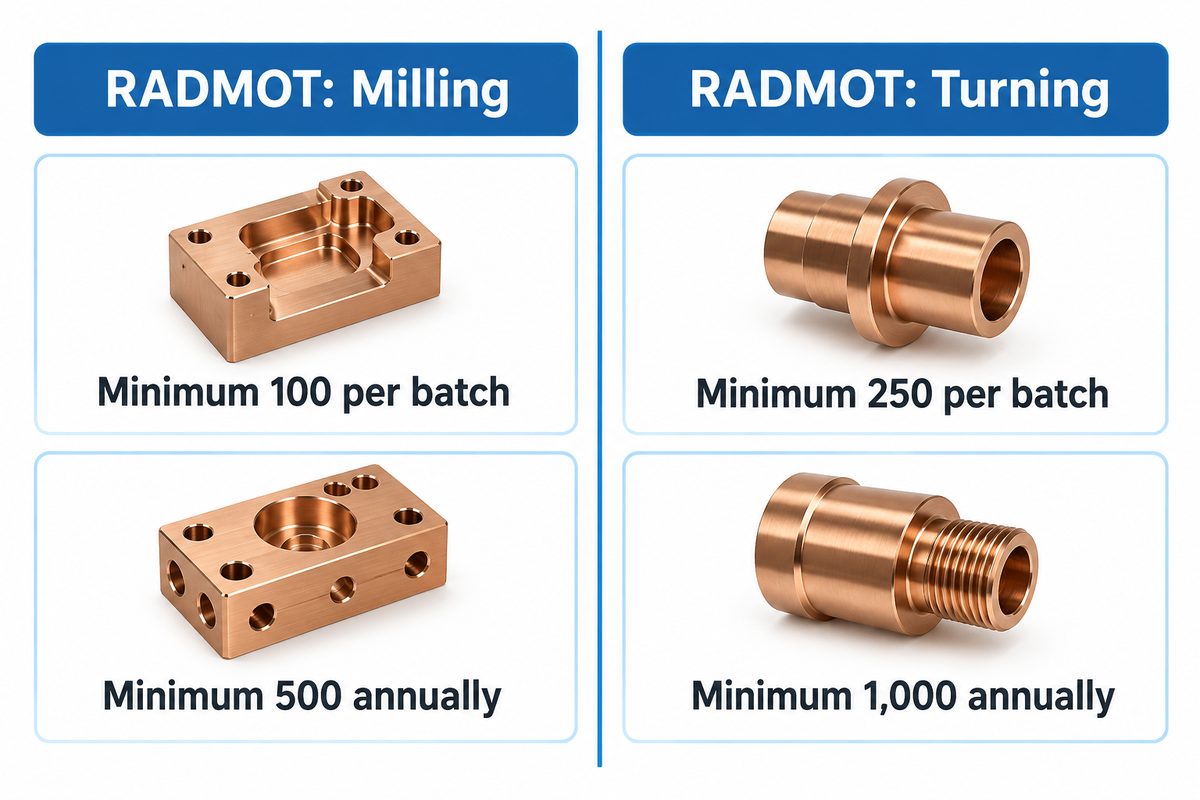
RADMOT gives buyers unusually clear quantity boundaries for contracted production: at least 100 milled parts per batch and 500 annually, or 250 turned parts per batch and 1,000 annually. That helps an OEM rule the company in or out before preparing a detailed enquiry. The copper and copper-alloy service sits within a broader turning and multi-axis milling operation; the company describes more than 80 CNC machines and 22 measuring devices. For repeat orders in Europe, the useful comparison is the annual program and inspection scope, not just the first batch price.
Quality statement: ISO 9001:2015, IATF 16949 and ISO 14001:2015, per website.
Buying limitation: Published minimums are 100 milled parts per batch/500 annually, or 250 turned parts per batch/1,000 annually.
11. E.J. Basler
Best for: High-volume tellurium-copper turned components.
Headquarters: Schiller Park, Illinois, USA
Founded: Not publicly confirmed
Company type: Precision machining manufacturer with global sourcing support
Website: www.ejbasler.com
E.J. Basler combines Swiss machining, multi-spindle CNC and rotary-transfer processes with automated machine loading and visual part checking. The copper material pages identify C10200 and C14500; these capabilities suit a discussion about repeatable turned features and production quantities rather than a generic request for a single milled block. The company also offers global sourcing support, so its own manufacturing capability and the delivery route for a particular order should be distinguished.
Quality statement: IATF 16949 and ISO 9001:2015, per company website.
Buying limitation: Its service emphasis is high-volume turned and screw-machined parts rather than large-format fabrication.
12. D&W Products
Best for: Repeat copper components suited to Swiss or multi-spindle CNC.
Headquarters: Cedar Rapids, Iowa, USA
Founded: 1951
Company type: Precision screw-machined parts manufacturer
Website: www.dwproducts.com
D&W Products describes a 100% CNC operation focused on Swiss and multi-spindle parts, including INDEX eight-spindle equipment. Copper is among its listed machining materials, making it a relevant candidate when the geometry and quantity justify a production-oriented turning process. The website separately describes trusted partners for turning and milling outside its in-house focus. Buyers comparing precision copper pins or similar repeated components can use this distinction to identify the actual machining route without assuming that every process advertised by the business occurs on the same shop floor.
Quality statement: ISO 9001:2015; ITAR registered, per website.
Buying limitation: Its website routes conventional CNC turning and milling through trusted partners.
13. Hirsh Precision
Best for: Complex copper components within automated precision production.
Headquarters: Frederick, Colorado, USA
Founded: 1979
Company type: Precision manufacturer with finishing partners
Website: hppi.com
Hirsh Precision brings five-axis automation, Swiss turning, mill-turn and assembly into one manufacturing offer. Seven 5-axis mills are linked to Fastems flexible manufacturing technology, and its Frederick headquarters occupies 65,000 square feet. The company’s copper guidance discusses C101, C110, C145 and other alloys. The stated ISO 13485:2016 and AS9100D quality system makes the company relevant to buyers evaluating manufacturing controls for medical devices or aerospace parts, subject to the scope of the actual order.
Quality statement: ISO 13485:2016 and AS9100D quality system, per website.
Buying limitation: Surface finishing includes supplier-network operations as well as in-house methods.
14. C&H Machine
Best for: Copper parts combining CNC, EDM and joining operations.
Headquarters: Escondido, California, USA
Founded: 1964 (C&H Machine in Escondido)
Company type: Precision machining and fabrication shop
Website: www.c-hmachine.com
C&H Machine combines copper milling and turning with wire and sinker EDM, brazing and welding. That’s a practical fit when an electrical or thermal component needs machining followed by a joining operation. The copper applications include busbars, RF components and heat sinks, with work spanning prototypes through production. The current Escondido business dates to 1964, distinct from the earlier experience of its founders; its process mix is the main reason to shortlist it for custom precision components with several manufacturing stages.
Quality statement: AS9100:2016 Rev D certified and ITAR registered; ISO compliant, per copper service page.
Buying limitation: Its copper service is custom machining and fabrication; it isn’t a catalogue busbar or connector source.
15. Ephrata Precision Parts
Best for: C101/C110 parts with toolmaking and EDM requirements.
Headquarters: Denver, Pennsylvania, USA (operating address)
Founded: 1972
Company type: Precision machining and toolmaking manufacturer
Website: www.ephrataprecision.com
Ephrata Precision Parts names C101 and C110 in its copper machining service and combines multi-axis CNC work with toolmaking, wire EDM and sinker EDM. It operates from a 56,000-square-foot facility at its Denver, Pennsylvania address. This is useful for a project in which the component and the tooling or electrode work need to be considered together. The copper page describes tolerances as tight as ±0.001 inch under suitable conditions. That value belongs to a conditional capability statement; it isn’t a default tolerance for every feature on an order.
Quality statement: Company website describes it as ISO 9001 certified.
Buying limitation: The published ±0.001-inch copper tolerance is conditional on geometry and material behavior.
Copper Components for Electrical and Thermal Applications
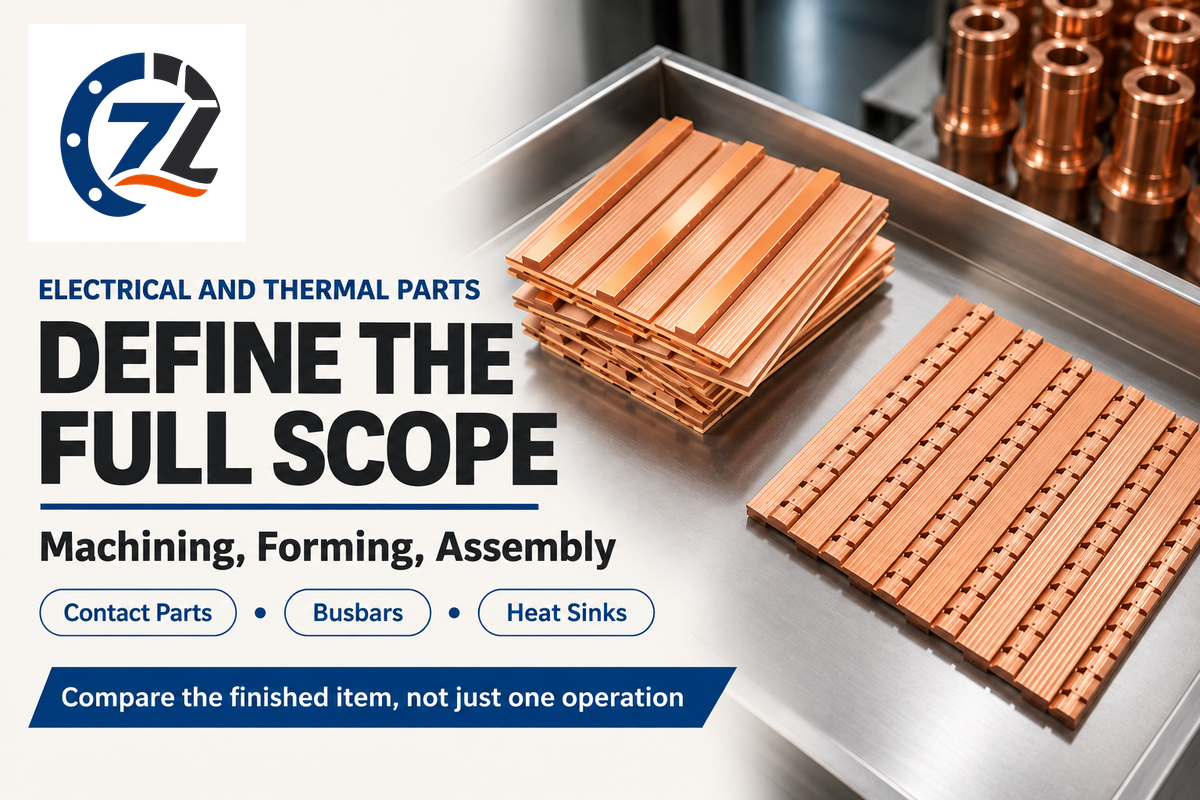
Electrical and thermal components sometimes require more than an exact shape. A busbar assembly may require forming and bending as well as welding. A heat sink part may require machining as well as other processes. These suppliers are able to combine processes to reduce the number of separate manufacturing scopes.
16. Checon
Best for: Copper contact components integrated with electrical assemblies.
Headquarters: North Attleboro, Massachusetts, USA
Founded: Not publicly confirmed
Company type: Electrical-component manufacturer with integrated material production
Website: www.checon.com
Checon approaches copper machining from electrical contacts and power distribution. The service combines material engineering, forming, multi-axis milling and turning with assembly, supported by engineered fixturing for repeatable high-volume components. This combination is valuable when the purchasing decision concerns the finished contact or busbar assembly and its manufacturing sequence. A contact-component buyer can compare Checon’s integrated route with a machine shop supplying only the machined portion, keeping the scope of joining and final assembly visible in the quotation.
Quality statement: ISO 9001-certified operations, according to website.
Buying limitation: Its service focus is electrical contacts and power distribution, rather than general-purpose prototype machining.
17. Storm Power Components
Best for: Machined copper busbars and power-distribution components.
Headquarters: Decatur, Tennessee, USA
Founded: 1990
Company type: Electrical power-component manufacturer
Website: stormpowercomponents.com
Storm Power Components is focused on copper and aluminum power components, including busbars. The Decatur plant combines electrical-component production with four-axis CNC machining and CAD/CAM nesting, providing a basis for comparing a fabricated power component with a purely machined one. Both copper and aluminum are included in the company’s stated material inventory. Its application focus makes it a useful starting point for a power-distribution buyer.
Quality statement: Website states ISO 9001:2015 and AS9100D quality requirements.
Buying limitation: Its integrated plant is focused on copper/aluminum power components rather than the full range of precision machine-shop work.
18. Luvata Welshpool
Best for: Copper components combining cold forming and precision machining.
Headquarters: Welshpool, Powys, United Kingdom
Founded: 1943 as Dawson Shanahan; joined Luvata in 2024
Company type: Cold-forming and precision-machining manufacturer within Luvata
Website: www.luvata.com
Luvata Welshpool combines cold forming, CNC machining, tooling and end-of-line services. The operation traces its history to Dawson Shanahan in 1943, joined Luvata in 2024 and publishes an export reach of more than 40 countries. For a copper component with a repeat production program, the distinctive question is whether a formed starting shape followed by machining suits the drawing better than machining entirely from stock.
Quality statement: Welshpool site: ISO 9001:2015 and IATF 16949:2016.
Buying limitation: The plant’s combined forming-and-machining route best suits engineered component programs rather than a simple instant-quote service.
19. Dynamic Design & Manufacturing
Best for: C101/C110 parts combined with sheet-metal fabrication.
Headquarters: Niwot, Colorado, USA
Founded: 1983
Company type: Precision machining and sheet-metal manufacturer
Website: www.dycoinc.com
Dynamic Design & Manufacturing, at dycoinc.com, combines copper machining with sheet-metal fabrication, welding and assembly. The copper page identifies C101 and C110, a DMG Mori NTX 1000 combination turning and machining center, and in-house wire EDM for profiles that benefit from avoiding conventional mechanical cutting forces. A buyer developing a conductive part within an enclosure or fabricated assembly can compare the combined service scope here.
Quality statement: AS9100D and ISO 9001:2015 registered, per website.
Buying limitation: Its published copper offer centers on C101 and C110 rather than a broad copper-alloy catalogue.
20. American Micro Industries
Best for: Custom copper components purchased alongside electrical insulators.
Headquarters: Chambersburg, Pennsylvania, USA
Founded: 1995
Company type: Custom component manufacturer
Website: www.americanmicroinc.com
American Micro Industries offers copper CNC components through a broader custom-manufacturing business that also produces nonmetallic parts and electrical insulators. The Custom Components Division is relevant when procurement needs conductive and insulating items for the same equipment, with copper complementing the existing component mix. For a buyer, the useful distinction is the combination of materials and made-to-order parts.
Quality statement: Not publicly confirmed.
Buying limitation: Its broader service mix emphasizes custom components and insulation; it isn’t a dedicated high-volume copper turning specialist.
How to Choose a Copper Machining Supplier
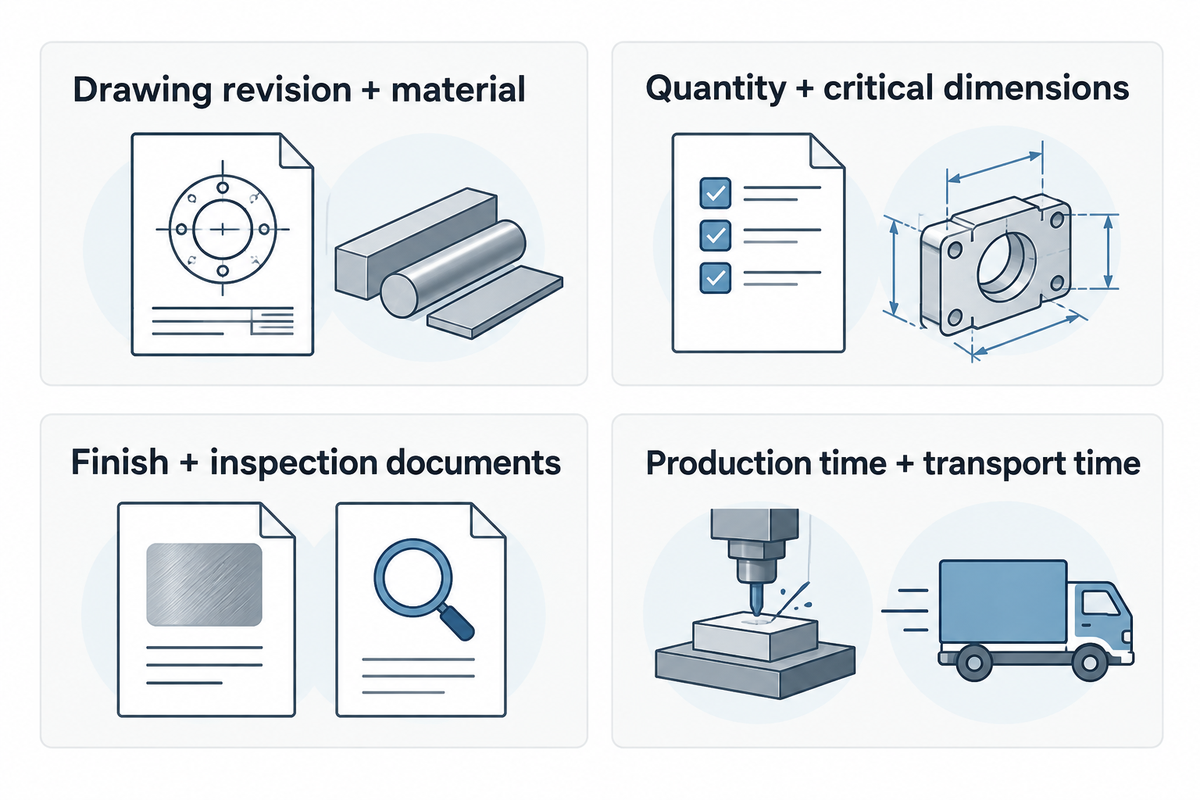
Choose the supplier whose process route is the closest match to the drawing, and compare prices of the same material and level of acceptance. Start with the function of the copper component: an electrical connector, thermal part or formed busbar may require different operations. The eight checks below would help engineering and purchasing agree on the inspection requirements before releasing the order.
Why is pure copper harder to machine than brass?
Pure copper is ductile and can create difficult chips, burrs, and adhesion to the material being cut. Free-machining brass is easier to cut and generally produces a better finish. This affects cutting tools, workholding and edge finishing. Copper’s high conductivity is useful in the finished part, but it does not by itself make the machining operation easy or authorize changing to another alloy.
A shop describing precision CNC machining should be able to correlate the proposed process to the difficult features in your drawing. Our five-axis machining guide addresses related equipment and part validation questions. For a thin wall, consider where the clamp loads act. For a deep pocket, consider tool access and chip removal. A mill that can reach the feature still needs a workable setup. These are valid questions about machining in copper, not reasons to generalize tolerance.
Should you choose C10100, C11000 or C14500?
When specifying copper for CNC machining, use the grade defined in the part design: C10100 for an oxygen-free requirement, C11000 when the design calls for it, or C14500 for tellurium copper. Oxygen content and alloying distinguish copper materials. A supplier offering all three still needs the specific material designation and condition to propose stock and machining route.
For context, alloy producer Concast lists C14500 with a machinability rating of 85 and electrical conductivity of 93% IACS at 68°F. These are different measures: The machinability index of an alloy isn’t the percentage increase in cutting speed. This data describes the alloy and not the performance of the finished component. There may be situations where the electrical conductivity or the thermal conductivity requirement is a functional specification. There would be a design decision to make a substitution.
In a supplier enquiry, “copper C101” or “C110 copper” should be accompanied by the full material designation, temper and applicable material specification. The grade spoken about in the supplier article isn’t necessarily available for CNC machining on hand that week. For thermal components, separate the thermal performance requirement from cosmetic appearance or an assumed finish.
What should a copper machining quote include?
Quotes should provide the drawing revision, material grade and condition, quantity, critical dimensions, finish, inspection documents, packaging and delivery point. Quotes should also separate production and transport times. These details enable procurement to compare custom parts on the same basis, and engineers to identify any deviations from the design intent before a purchase order becomes a manufacturing document.
- Specify the copper alloy and condition. Don’t ask suppliers to “use standard copper.” For conductive applications, the accepted material document is sent with the order. A C101 requirement can’t become a C110 requirement just because a supplier stocks the material. Keep copper alloys separate in the enquiry.
- Geometry should be matched to the process. CNC milling suits different features from Swiss turning or forming followed by machining. Compare the actual sequence for complex copper geometry. For a supplier offering advanced CNC equipment, a valid process route for the part should be provided; a machine description alone shouldn’t be accepted.
- The real order quantity should be compared. State sample, release and expected annual quantities. A fixture justified for mass production may not be justified for a one-off order. For low-volume production, separate setup charges from unit prices. Assess tooling for a forming or extrusion/die-casting route and design implications before comparing with machining from stock.
- Define tolerance by feature. Identify critical dimensions and the inspection method. A tight tolerance on a mating diameter differs from a general surface dimension. To achieve tight tolerances consistently, the supplier needs an agreed-upon datum structure and measurement approach. Request the first-article report that matches the drawing, rather than depending on a generalized “high-precision” claim.
- Determine edges and surface finishing. Identify required deburring, polishing or plating and contact/masking areas. State inspection acceptance for a burr-free edge. Do not carry an instruction to anodize over from an aluminum CNC machining drawing without selecting a copper-compatible finish. Finishing and coating requirements are part of the manufacturing scope.
- Identify the factory and quality scope. For a factory-and-network business, record who will machine, inspect and finish the parts. Obtain current certificates for the relevant site and activity. Aerospace and medical industries have different documentation needs; a logo on a group website doesn’t define the order’s requirements. ITAR registration is a separate status, not a quality-management certification.
- Price the delivered scope. Compare the costs of production, inspection and finishing, packaging and freight and import costs, at the same delivery point. Count scrap or loss in material yield only once and as part of the cost element which already includes it. The cheapest machining work can produce a higher total order cost if the other quotation charges for services which the cheaper one leaves out.
- Establish release procedures and repetitive orders. Reach an understanding about how samples are approved, how changes to drawings are controlled, and how release of the next batch is effected. OEMs buying copper CNC machined parts for industrial equipment need that continuity as much as an attractive first quotation. Identify the owner of any deviation prior to the movement of parts to the next assembly or to the customer’s inventory.
These checks apply to industrial purchasing, but the required documents should follow the actual application. A copper component widely used in electrical equipment or a component of robotics, automotive, or high pressure equipment would still require a drawing and acceptance criteria. “Professional CNC machining” is a service description and not a substitute for these decisions.
For a more detailed comparison of the procedure, refer to the CNC machine shop selection guide. For parts made by both machining and fabrication, compare the sheet metal fabricators with the same assembly scope. If the part is primarily turned, the turning design and inspection guide provides related context. For this order, focus the copper supplier short list on process and document the requirements of the order.
Copper CNC Machining FAQs
Which copper CNC machining suppliers are best for electrical contacts?
Checon is a relevant starting point for integrated contact assemblies; Cox and E.J. Basler are candidates for repeated turned copper components.
The distinction is the supplied item. Checon combines material engineering, forming, machining and assembly, while the production-oriented shops emphasize machining routes for repeated components. A finished contact assembly and a standalone turned pin involve different purchasing scopes. Start with the drawing and joining requirements, then compare the relevant profiles instead of treating every electrical component as the same type of order.
Do copper machine shops support prototype and low-volume parts?
Yes. 3ERP accepts one-off copper prototypes, while Venco describes prototypes and bridge production of 20–500 pieces.
These published ranges make both companies good candidates for development, but quantity is just one factor to consider. The inspection scope for a prototype that establishes fit, for example, may not be the same for a production release sample. Describe the purpose for the order, and specify if the supplier should also perform production runs. The quotation should also separate tooling costs from first batch costs.
What tolerance can you expect for copper CNC parts?
Ephrata publishes copper capability as tight as ±0.001 inch, with the applicable tolerance depending on the feature and setup.
The conditional value serves as a useful enquiry reference rather than a drawing-wide promise. Thin sections, clamping, tool access and the selected copper grade can change the process needed for acceptance. Indicate the dimensions that control fit or function and give their datums. The vendor’s offer must define the dimensions it accepts and how they’re to be measured prior to release of the order.
What surface finishes are available for copper parts?
Common choices include an as-machined surface, polishing and suitable plating such as tin or nickel.
Select the finish based on the contact, soldering, appearance or environment. Corrosion resistance may be relevant, but the coating must also suit the component’s electrical or thermal duty. Indicate masking and finished dimensions to control plating so as not to affect an accepted fit.
How much do custom copper parts cost and how long do they take?
RivCut publishes C110 examples from $95–$150 for simple parts to $250–$400 or more for complex parts, with standard production of five to seven business days.
Its table places medium-complexity heat sinks and electrodes at $150–$300 per piece and lists a three-business-day rush option for simpler parts. These are illustrative prices for one source. They aren’t market averages or delivered quotes for your drawing. The page connects examples with geometry categories, and these examples aren’t reference prices for all sizes and quantities. Cost and lead time will depend on inspection, surface finishing, freight and the agreed-on start point.
Is C14500 easier to machine than C11000?
C14500 is a tellurium-bearing copper selected for improved machinability, but it is not an automatic replacement for C11000.
The Concast C14500 data sheet shows the alloy has a machinability of 85 and a 93% IACS electrical conductivity at 68°F. The machining index and conductivity measure different properties. Use the alloy only where the material specification and component function permit the substitution; do not translate the index into a cutting-speed multiplier.
Send a Copper Part Drawing for Review
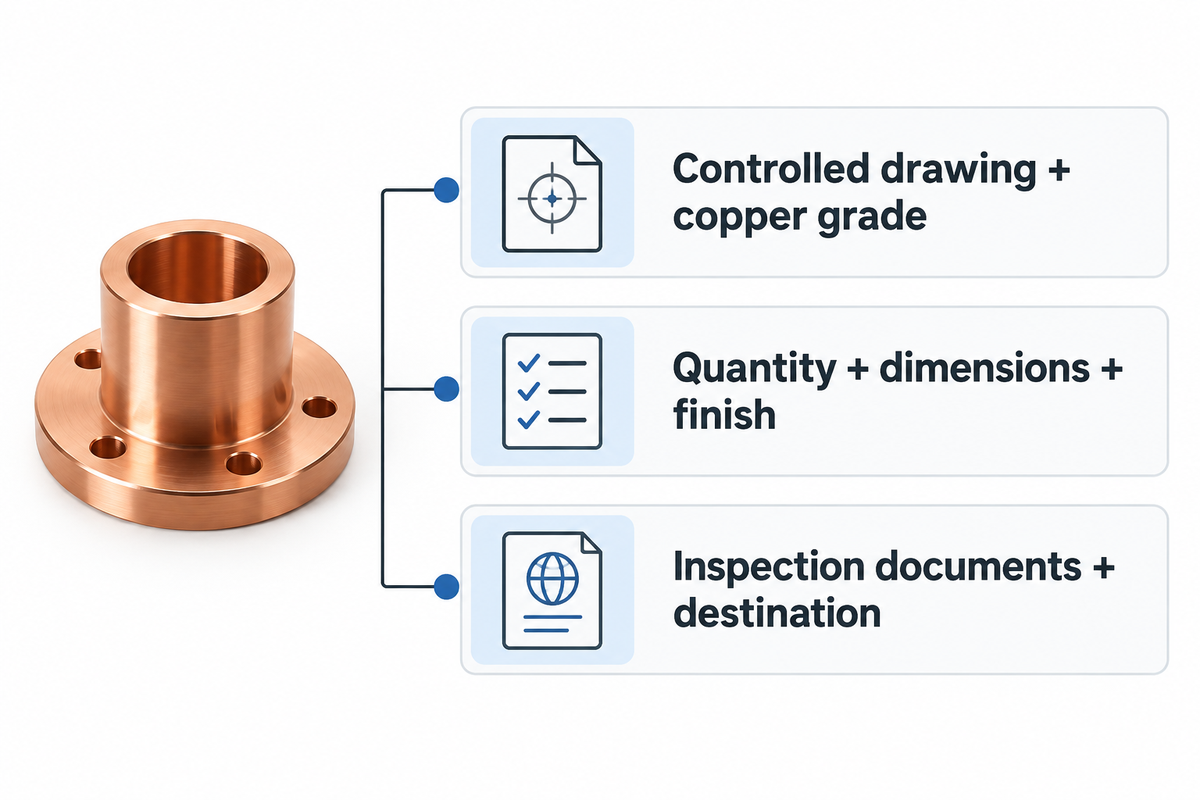
Send Zhenling Metal your controlled drawing, specified copper grade, order quantity, critical dimensions and required finish. Add the inspection documents and delivery destination so the proposed scope can be reviewed together. Our copper CNC machining service is a starting point for discussing the manufacturing route and quotation for your custom copper machined parts.
References & Sources
The company comparison draws on the manufacturers’ official company, service and quality pages reviewed in October 2026; their websites are identified in the table and profiles. Concast’s C14500 alloy data supplies the attributed material figures, and RivCut’s C110 pricing page supplies the explicitly labelled price examples. These are company-published statements, not independent rankings or industry averages.