Get in touch with Zhenling Company

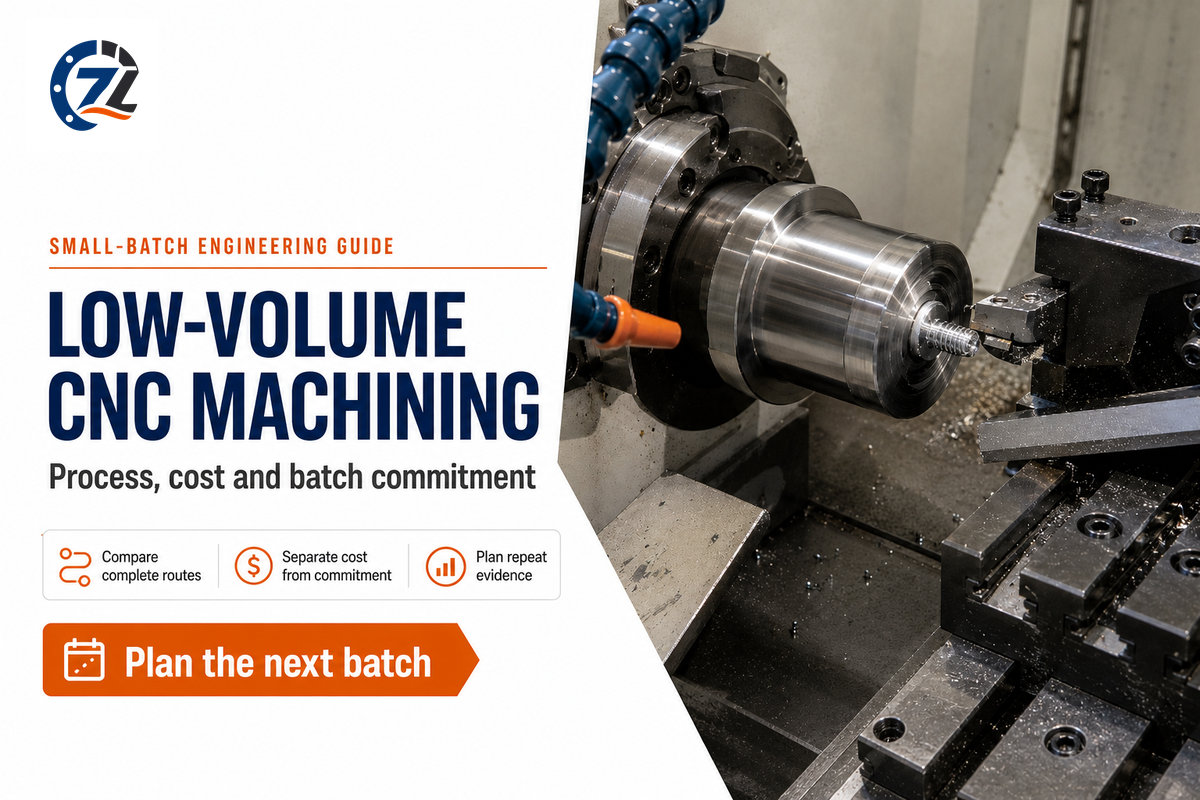
Low-Volume CNC Machining makes limited quantities of parts by cutting material from stock with computer-controlled tools. It suits functional prototypes, pilot batches and small repeating orders. When engineering is still testing a feature and purchasing needs an installation date, the useful question is not just how many parts you need, but how much design and purchasing commitment the next batch should carry.
Quick answer: Choose small-batch machining when material, geometry and demand favor a flexible cutting route. Compare the complete finished-part cost, then separate first-part approval, lot acceptance and repeat-process evidence before increasing your order.
- Batch size describes one run; annual demand describes a different decision.
- A lower unit price can require a larger cash commitment.
- Printing, molding and casting should be compared as complete manufacturing routes.
- Keep the approved revision, setup and inspection records together for repeat orders.
What Low-Volume CNC Machining Means
Small-batch CNC production uses programmed cutting operations to make a limited number of parts, often with setup work across the batch. A CNC machine may mill a housing, turn a shaft or perform both operations. Distinguishing a development prototype from a batch intended for installation isn’t always a matter of quantity.
Generally, the CNC machining process moves from CAD to drawing to programming and then to preparing the stock, creating the workholding, cutting, deburring and inspection. CNC milling uses rotating tools to remove material, and CNC turning rotates a workpiece for features to be cut. A CNC part with both types of geometry may need multiple operations or a combined machining center.
What is considered low volume in manufacturing?
An order for a small volume of parts may have a small production commitment relative to the part or process and the market. There’s no single quantity that defines every job. A batch of 20 complex housings requires a different setup, machine-time and inspection commitment than a batch of 200 simple spacers. Be clear about the order quantity, expected repeat demand and purpose.
A prototype answers a product development question. Low-volume production can instead supply finished equipment or replacement parts year after year. NIST’s research on high-speed machining for prototypes supports functional metal prototyping, but doesn’t establish a universal production-volume boundary.
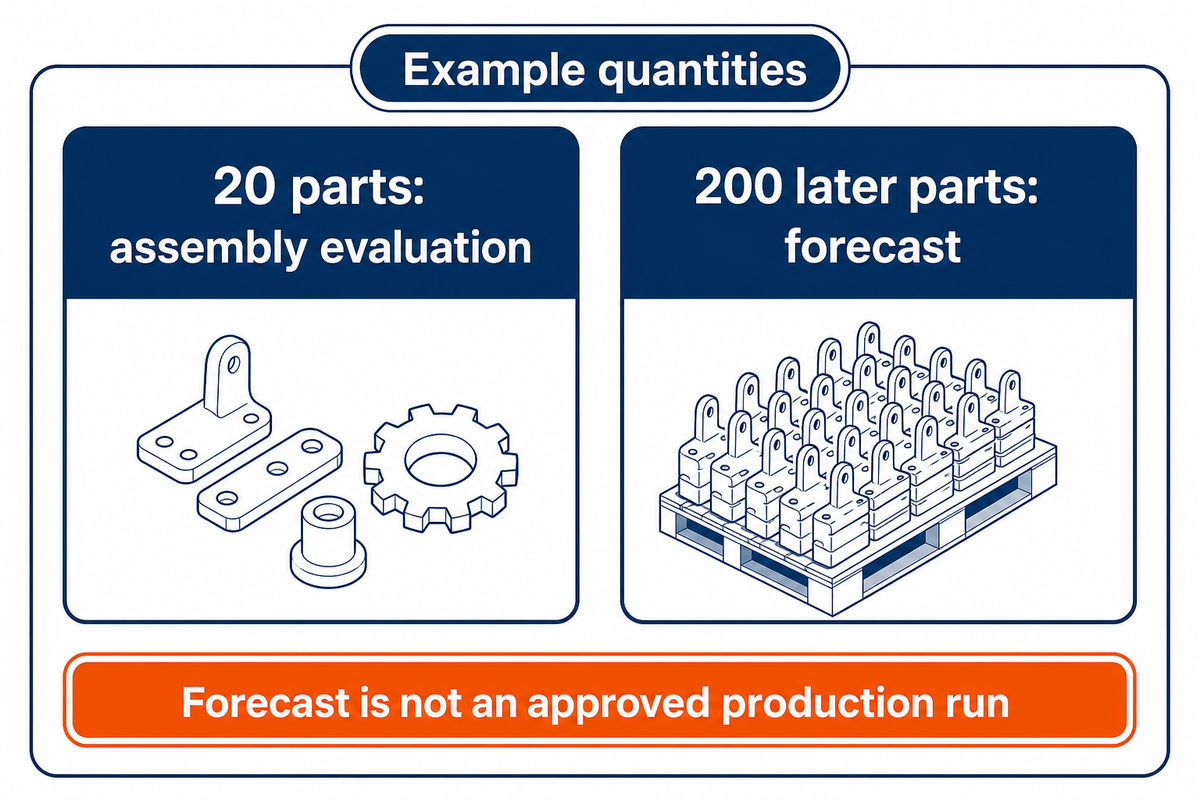
For a low volume run, mark the request “20 parts for assembly evaluation” when that is the actual need. A forecast for 200 later parts provides valuable advance planning, but it doesn’t mean the 200 parts are an approved production run. Separating the quantities helps low volume production be easier to quote and control.
Benefits and Limits of Small Batch CNC Machining
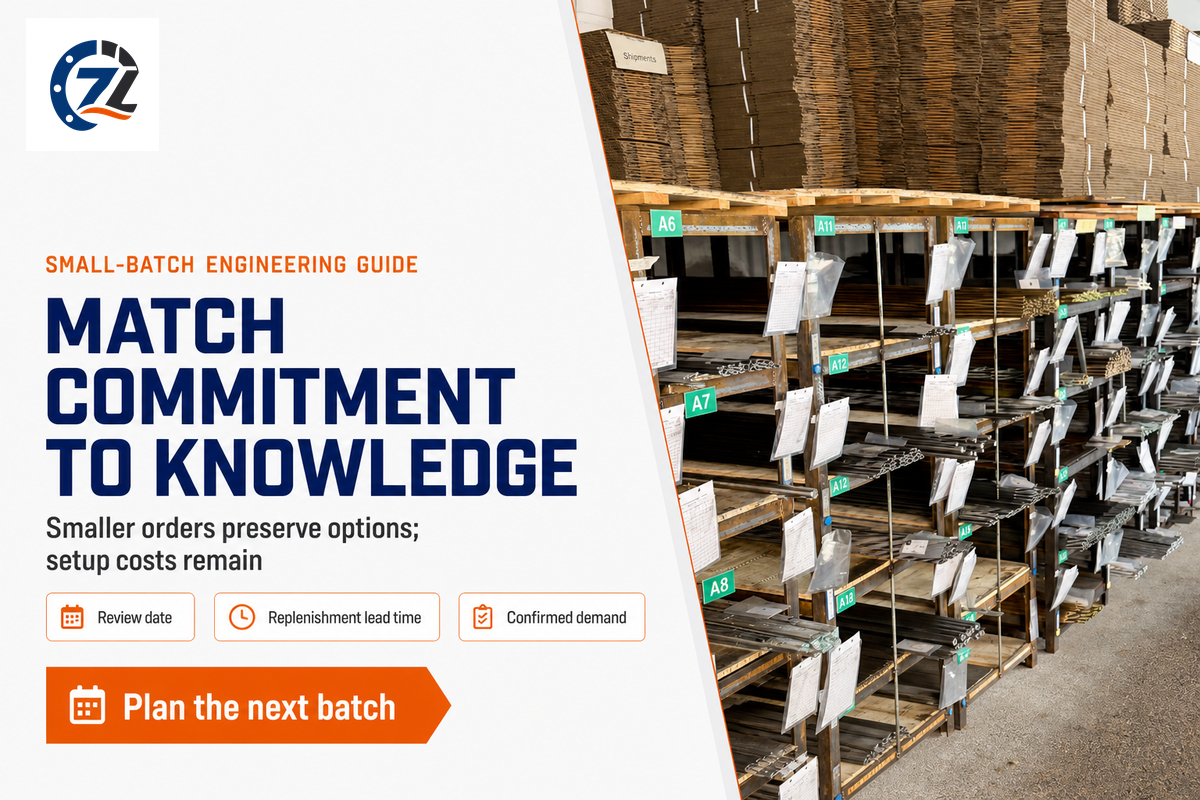
Small batch CNC machining allows a buyer to order parts before committing to a large inventory or dedicated production tooling. Flexibility in design and the use of machinable stock allow access to functional parts. A trade-off is that programming, fixtures and verification costs are spread over a limited number of finished pieces.
At low quantities, machining applications include development housings, equipment adapters, variations of custom parts and replacement parts. Bridge production fills a temporary parts supply gap while a different production process is prepared. Repeated requests for niche products allow low-volume manufacturing to remain their normal model rather than a step toward mass production.
Consider the situation of a hypothetical equipment builder who needs 20 aluminum sensor brackets for a field evaluation. While awaiting test results from the connector position, purchasing has an opportunity to buy 100 sensor brackets at an attractive price. Engineering expects one design decision after the first installation. Ordering 20 leaves flexibility to change the next design revision, while ordering 100 locks in 80 more pieces before that decision. A small order only helps if the evaluation can finish before more brackets are needed. A delayed test may force an expedited second order. The team pairs the first order with a realistic review date and a replenishment lead time, rather than assuming the smallest order is automatically best.
These are the key advantages of low volume CNC work: the buyer can match commitment to what’s known. They don’t remove setup costs, stock minimums or finishing charges. EPA’s explanation of batch-and-queue manufacturing shows why work waiting between operations ties up space and resources. That principle supports checking inventory and queues; it doesn’t prescribe one-piece flow for every machine shop.
If the design and demand are already stable, repeated low volume production runs may simply repeat avoidable setup work. Compare the future route using the high-volume CNC machining guide to determine if the additional cost is warranted.
Choose CNC Machining, 3D Printing or Tooling
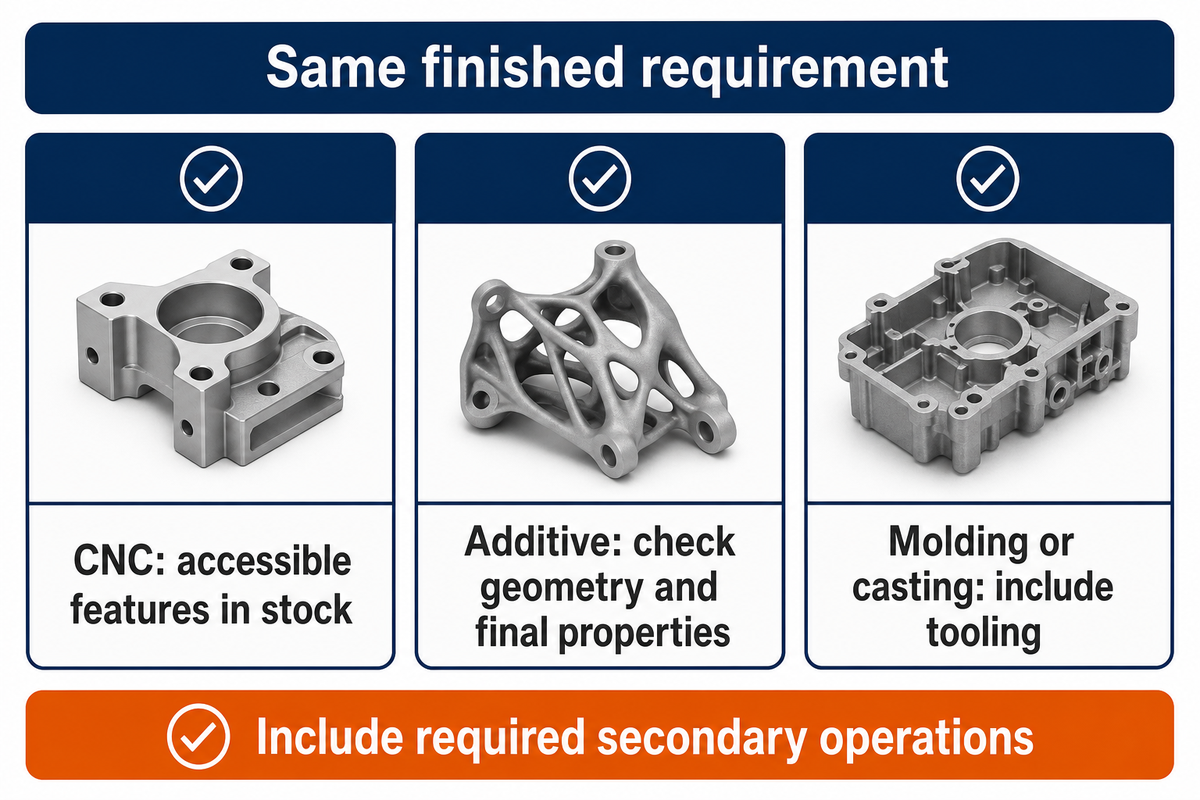
Function and geometry must be checked before price is compared. CNC machining works well for accessible features in stock material. With additive manufacturing, shapes can be produced that can’t be accessed by cutting tools. Molding or casting may become attractive when their tooling and secondary operations serve a stable design and sufficient demand.
The comparison must end at an equivalent finished requirement. A printed fit-check model isn’t equivalent to a machined end-use component merely because both follow the same CAD file. Likewise, a casting that still needs machining should be priced as a combined route. The Open University’s gear-manufacturing example illustrates the order of decisions: a low-cost zinc die-casting option was excluded because its strength was unsuitable.
| Decision | CNC route | Alternative route to examine |
|---|---|---|
| Functional material | Check grade and stock condition. | Check printed, molded or cast properties in the actual condition. |
| Tool access | Cutters must reach each machined feature. | Additive construction may allow enclosed or curved features. |
| Internal corners | Allow cutter radii or a secondary operation. | Check the alternative’s own geometry restrictions. |
| Critical fits | Plan cutting and measurement of mating features. | Include finish machining where the initial process cannot meet the fit. |
| Surface requirements | Specify important surfaces and finishing steps. | Include support removal, polishing or other secondary work. |
| Design changes | Review program, stock and fixture changes. | Price tool changes or new builds, not just the first tool. |
| Initial commitment | Programming and workholding remain real costs. | Include mold, die, pattern or build-preparation costs. |
| Repeat demand | Check what setup work can actually be reused. | Spread tooling only across demand you reasonably expect to order. |
| Delivery route | Include material, finishing, inspection and dispatch. | Include tooling preparation and every required secondary operation. |
Sometimes, specifying machine axes to a single housing with an inaccessible interior passage may not make the passage accessible. Splitting the housing, modifying the passage, or opting for another alternative may be more relevant than modifying the specified quantity. Compare this geometry in the CNC Machining vs 3D Printing Guide.
Low volume machining has no unambiguous process winner. Request a complete route for the current quantity and another for the anticipated repetitive demand. A machining partner should define what differs between them, including retained tooling, secondary processes and inspection.
CNC Machining Materials and Surface Finish
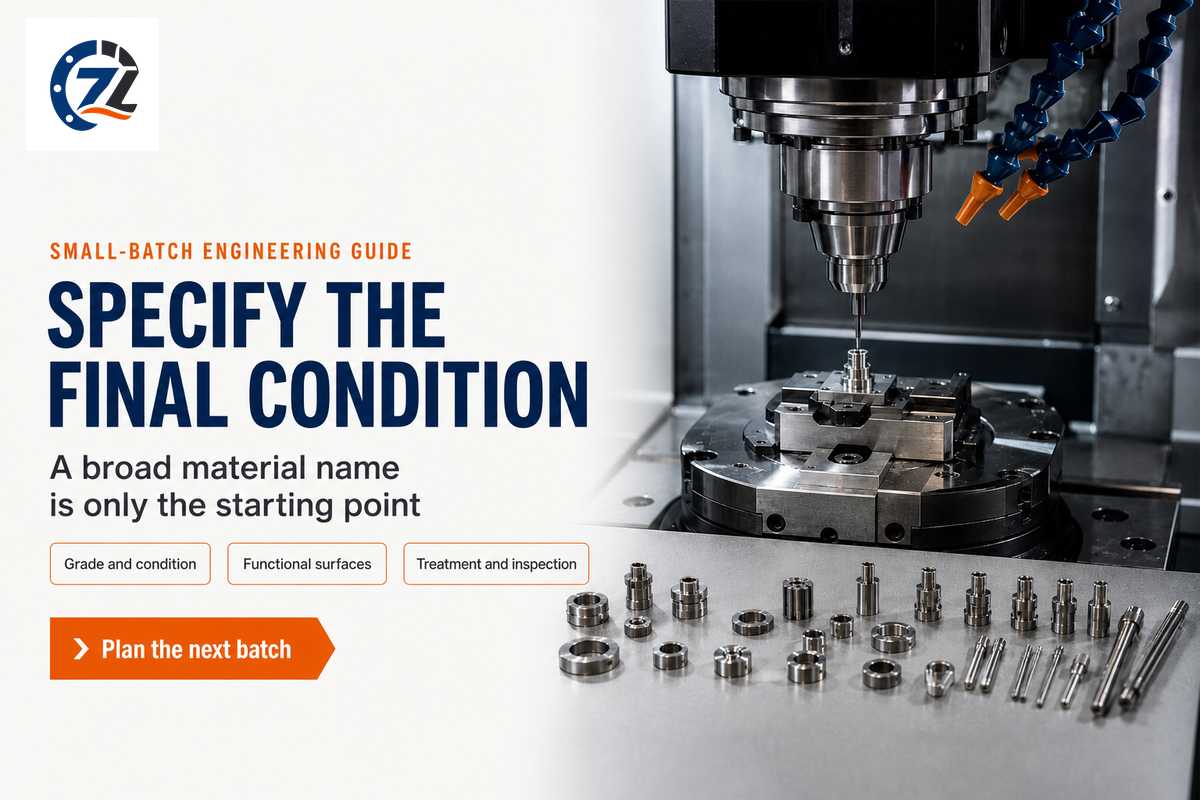
Choose CNC machining materials based on the function of the component in question, and then verify grade, condition, availability and required finish. The behavior of the material during machining and the performance in the end-use are some factors that may dictate material choice. A prototype of convenient stock shouldn’t be taken as a rule to conclude that a different production material will exhibit similar behavior.
Aluminum is a good choice for lightweight housings; stainless steel may serve for corrosion related requirements; engineering plastics may serve for insulation and/or sliding and/or weight related functions. The descriptions above are starting points for material selection for CNC machined parts. They don’t stipulate the grade, polymer, alloy, temperature or chemical limitations. The CNC Material Selection Guide will help answer these.
A drawing which states only “stainless steel” leaves the supplier to ask for the grade and condition. “Black Finish” doesn’t define the surface texture or dimension. Functional surfaces, appearance requirements and final-condition dimensions should be shown on the same revision controlled specification.
Surface finish involves more than appearance. State whether requirements pertain to texture, coating, edge condition or visual consistency. ISO 21920-2:2021 defines terms and parameters for profile surface texture; its public catalogue lists the published edition as corrected in 2022 and under revision. It does not supply one roughness value suitable for every machined part.
It’s possible that deburring or other surface treatments are pertinent to certain materials and functions. Agree to the actual process and which surfaces it affects. A coating that affects a mating dimension would require final fit to be ensured prior to machining the first lot. It’s useful to state the surface and required condition and indicate when inspection occurs instead of applying an expensive surface treatment everywhere.
Design Small Batches Around Tool Access
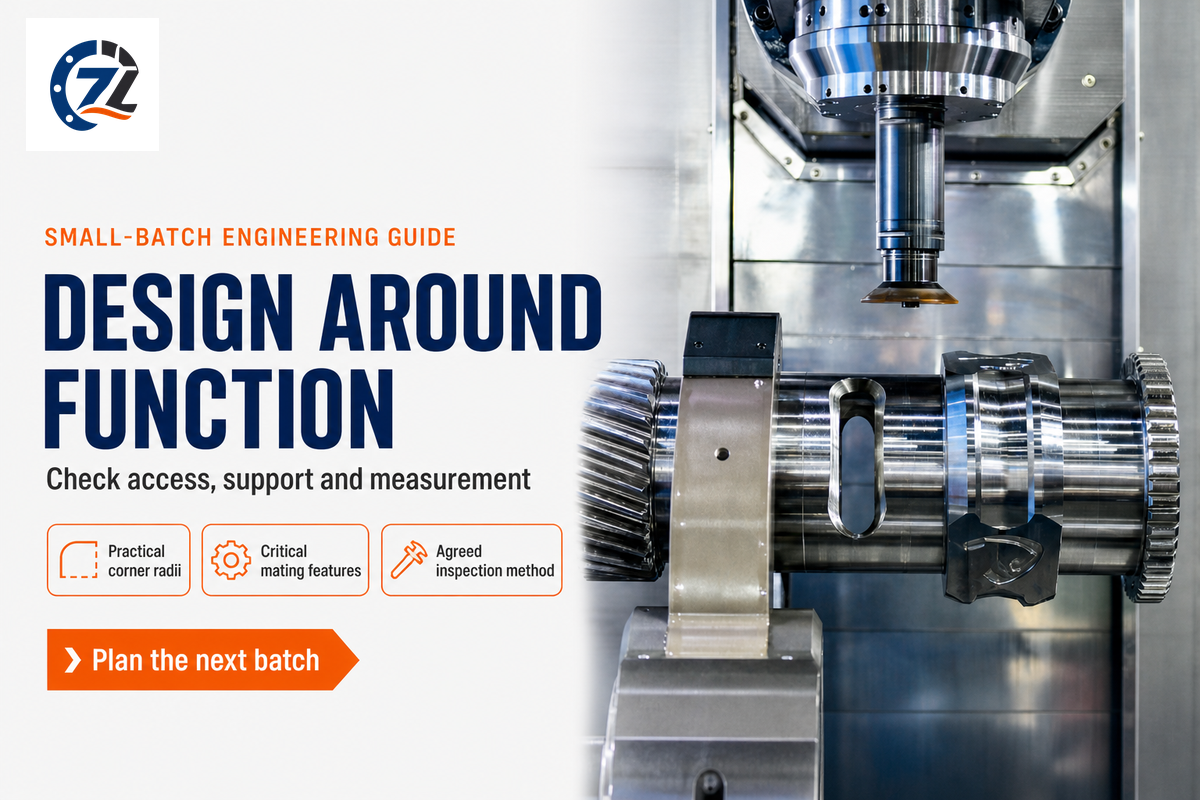
Small batches are designed with respect to the cutting tool, clamped workpiece and measurement approach. Simplifying features by including practical corner radii can reduce the difficulty of machining a part without affecting its function. Tight tolerances should adhere to assembly requirements; applying them to all surfaces creates extra work without necessarily improving the product.
MIT’s machining teaching material provides a brief description on cutting and machine basics. A buyer would be interested if the tool can access the feature, if the workpiece is fully supported and if the significant surfaces are measured post cutting.
While a 5-axis CNC machine may improve access and reduce some repositioning, the machine label doesn’t confirm the accuracy of a completed part. Multi-axis machining is still dependent on adequate tools, workholding and verification. Use CNC capabilities to solve a defined geometry problem; a simpler setup on a standard CNC machine may be sufficient for an accessible part.
“It establishes symbols, rules, definitions, requirements, defaults, and recommended practices for stating and interpreting GD&T”
ASME Y14.5-2018 was reaffirmed in 2024. The drawing language communicates requirements; it isn’t a promise that every supplier can meet them. Mark the datums and mating features that drive function, and resolve conflicting notes before programming.
Consider a hypothetical cover with a deep pocket, square corners, and two mounting faces. The designer requires clearance for a component, but the component doesn’t even touch the corners. The first quotation includes additional work to achieve the defined corners. After an assembly review, the designer accepts internal radii and specifies only the mounting faces as critical.
The supplier can now suggest a less restrictive cutting route. If a square mating component actually resides in those corners, then a change to internal radii would be wrong. The machining strategy should follow contact and clearance in the assembly, not a general instruction to relax the drawing.
For similar CNC projects, review deep features, thin walls, tool reach, burr access and datum continuity using the CNC machining DFM guide. The precision requirements for low-volume CNC parts start with measurable features, not the largest possible equipment. High-precision CNC work needs a similarly clear inspection methodology.
Compare CNC Machining Costs and Batch Commitment
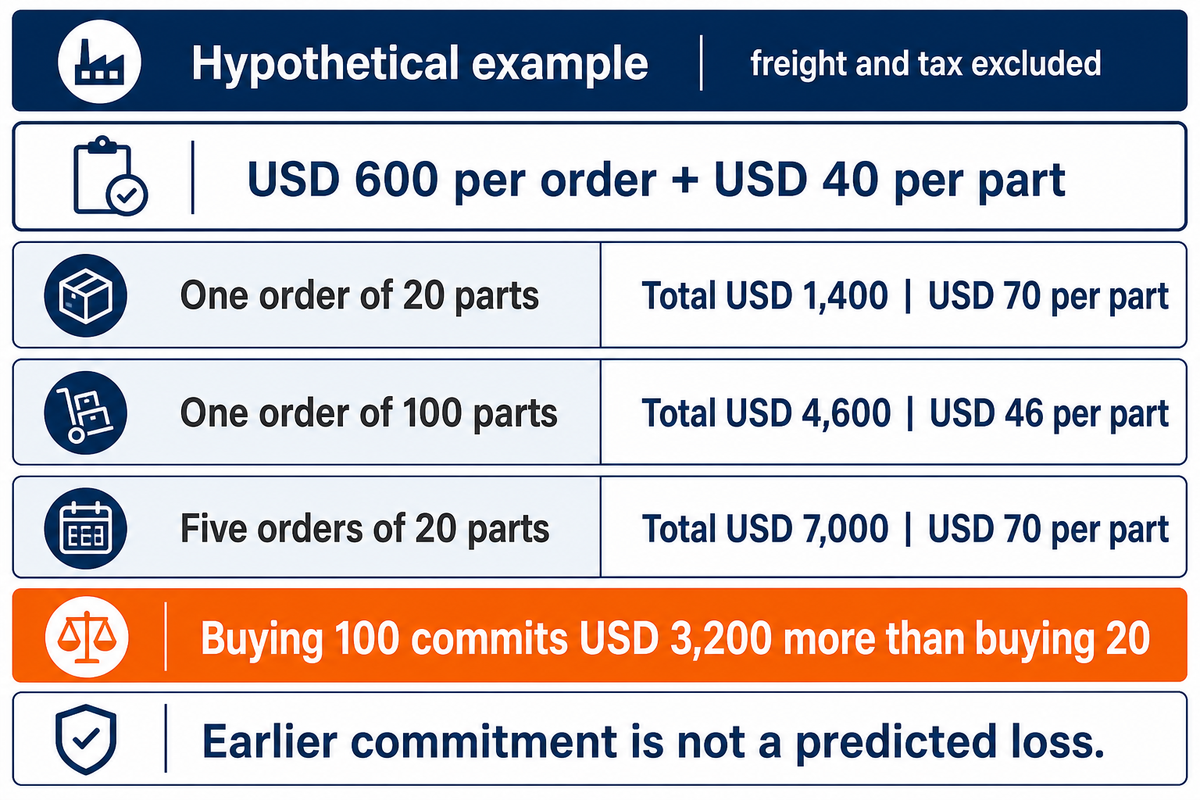
Compare the total CNC machining cost of each order with its cost per finished part. The fixed preparation cost per part is lower for a larger order, but the total batch commitment increases as well. If demand is stable, small, repetitive orders can increase total cost.
A good example is batch cost = fixed batch cost + quantity × variable cost per finished part. Put programming and job-specific fixtures and setups in the fixed cost portion only where the quote does the same. Material, cutting, finishing, and inspection should be in the variable cost portion consistently. For more details, consult the CNC machining cost guide.
Uncertain first order: compare the cash committed before the next design decision.
Stable repeat demand: compare the total cost of supplying the same required quantity across all orders.
Take a hypothetical quotation with USD 600 in fixed cost for each order and USD 40 per finished, conforming part. The USD 40 includes the assumed material, machining, finish and inspection; freight and tax are excluded. An order for 20 parts costs USD 600 + 20 × USD 40 = USD 1,400, or USD 70 per part. An order for 100 costs USD 4,600, or USD 46 per part. If only 20 parts are needed before a design decision, buying 100 commits USD 3,200 more. That’s exposure to an earlier commitment, not a predicted loss: the extra 80 parts may still be used.
| Order pattern | Total quantity | Setup charges | Total cost | Cost per part |
|---|---|---|---|---|
| One order of 20 parts | 20 parts | USD 600 | USD 1,400 | USD 70 |
| One order of 100 parts | 100 parts | USD 600 | USD 4,600 | USD 46 |
| Five orders of 20 parts | 100 parts | USD 3,000 | USD 7,000 | USD 70 |
For firm demand of 100 identical parts, five separate 20-part orders cost USD 7,000 if every order incurs the full USD 600 setup charge. One 100-part order costs USD 4,600 under the same assumptions. The difference is USD 2,400. Reused programs or fixtures could reduce later setup charges, so ask for the actual repeat-order basis rather than assuming either full repetition or free setup.
NC State’s EOQ tutorial covers the balance of ordering and holding costs, which are impacted by several assumptions, including known and uniform demand. Prototype demand is often unstable. Consider holding, change, shortage and expedite costs where applicable and relevant using your project parameters. The example given doesn’t arrive at an optimal batch size.
How Can You Reduce Low-Volume CNC Machining Costs?
Machining costs for low-volume CNC can be reduced by removing excessive operations from the complete route. Simplify accessible geometry, reserve tight tolerances for functional features and clarify the required finish. Then, evaluate setup reuse and order frequency. Increasing quantity saves money overall only when the additional parts and earlier commitment serve a real demand.
Ask CNC machining quotes to distinguish the first order from a repeat order. A reusable fixture may help later machining projects, but programming, locating the part and proving the setup still take work. Agree how fixtures and approved programs will be retained and identified. The benefits of low volume CNC disappear quickly when an unclear revision forces a second setup.
From Prototype to Repeat Production: The 3-Stage Commitment Map
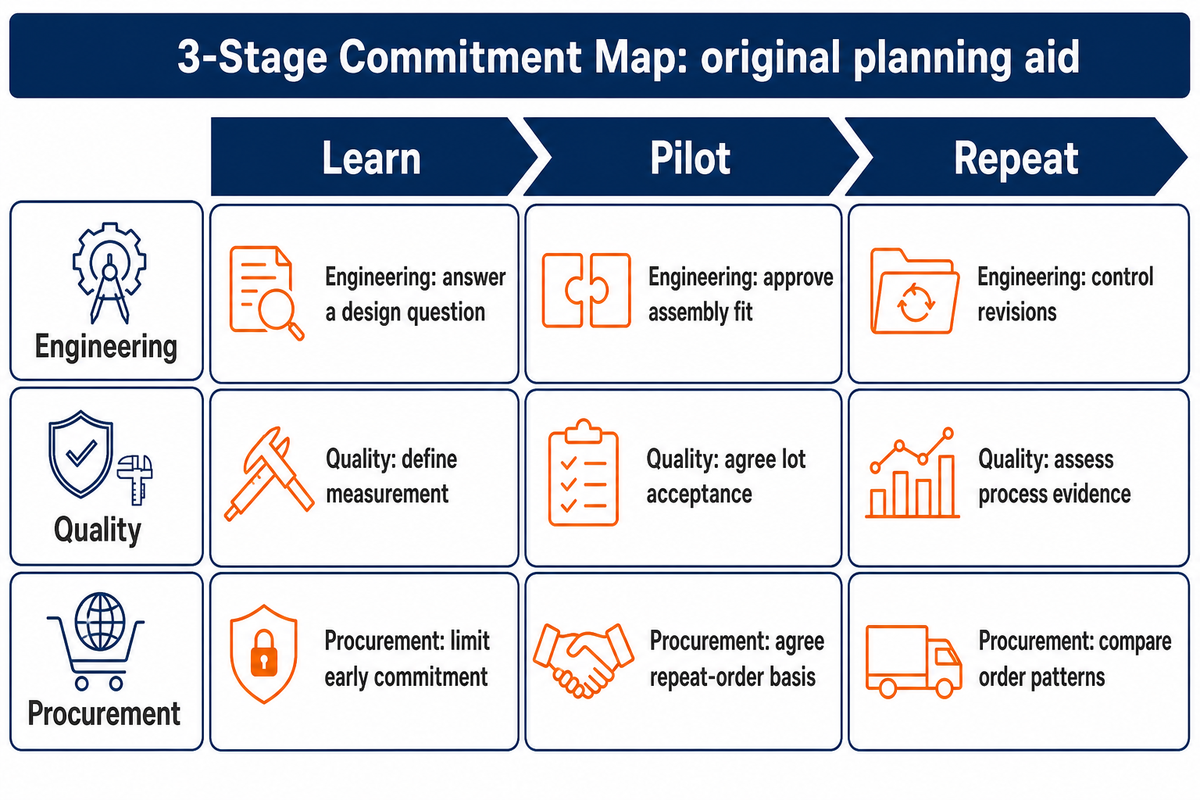
The 3-Stage Commitment Map separates learning, pilot production and repeat supply, so each order answers a clear question. Engineering, quality and procurement checks address uncertainty. Advance when the uncertainty is resolved; a larger quantity alone doesn’t transform a prototype into a controlled repeat process.
This planning framework is original. It isn’t based on a published standard. Use it to show what the current batch proves as opposed to what the next order assumes. A prototype can determine fit, but finish consistency may be left unresolved. A pilot may determine handling problems, but long-term process capability may be left unproven.
| Stage and owner | Question | Evidence to carry forward | Next commitment |
|---|---|---|---|
| Learn — Engineering | Does the part solve the intended fit or function question? | Revision-linked test observations and unresolved features | Change the design or release a pilot drawing. |
| Learn — Quality | Were critical features measured in the relevant condition? | Identified part, material condition and measurement results | Close measurement gaps before generalizing from the part. |
| Learn — Procurement | How many parts are needed before the next decision? | Immediate quantity, evaluation date and replenishment need | Separate the order from the forecast. |
| Pilot — Engineering | Can the design be made and assembled through the intended route? | Approved revision and observed assembly or finishing issues | Resolve route changes before repeat supply. |
| Pilot — Quality | What does the delivered lot satisfy? | Agreed acceptance criteria, results and disposition | Accept or resolve this lot without claiming long-term capability. |
| Pilot — Procurement | Which costs and delays recur? | Actual route, setup basis and outside-process schedule | Agree the repeat-order commercial basis. |
| Repeat — Engineering | What change requires renewed approval? | Controlled drawing, material and process change record | Review relevant changes before release. |
| Repeat — Quality | Is the process evidence adequate over time? | Comparable measurements and appropriate stability analysis | Increase reliance on repeat evidence only where justified. |
| Repeat — Procurement | Is demand firm enough for a different batch pattern? | Confirmed demand, carrying exposure and supply schedule | Compare order patterns for the same demand. |
For a hypothetical 30-part pilot, engineering may approve assembly fit, but quality still needs to verify one difficult measurement. Purchasing may not describe the pilot as fully proven, even if all 30 pieces were cut. The number doesn’t address the measurement concern. The measurement concern still governs the next step.
Can low-volume CNC production scale to mass production?
The production of low-volume CNC may repeat or transition to high volume production, but this should be reassessed as demand shifts. Greater dedication in workholding and cutting, or a different manufacturing process, may merit consideration. Hold the approved part requirements constant and look at how each alternative route satisfies the same requirement.
A CNC manufacturing supplier’s advanced machining capabilities may help with complex geometries, yet full-scale production also requires scheduling, tool control and repeatable inspection. If design variability is expected to continue, the more useful model may be small batch machining. In the case of design stability, compare volume manufacturing routes using actual forecast confidence and total expected demand.
Plan Lead Time and Repeat-Batch Quality
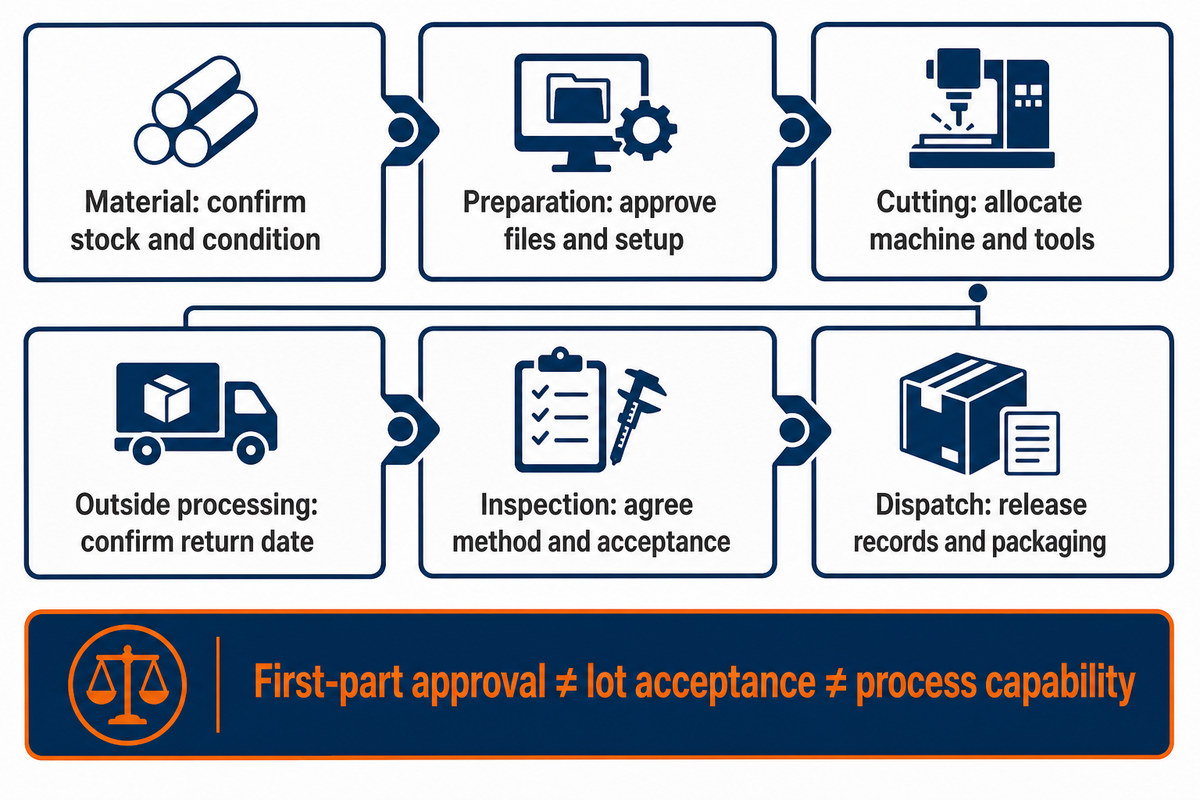
Plan lead time for the entire manufacturing process and plan quality around three separate questions: first-part approval, delivered-lot acceptance and process behavior. A short cutting cycle answers none of those questions by itself. Real world constraints dictate when usable parts become available.
The Modern Machine Shop account of The Kinetic Company explores scheduling around vacuum-furnace capacity and touches on shipping. The lesson is to look beyond machine time. A company-specific scheduling system isn’t a promise of delivery for another shop.
| Route stage | What can hold the batch | Useful scheduling evidence |
|---|---|---|
| Material | The specified grade or condition is unavailable. | Confirmed stock and incoming-material date |
| Programming and fixture | The model revision or locating method is unresolved. | Approved files and setup-readiness date |
| Cutting | The appropriate machine or tool is occupied. | Allocated production slot and tool readiness |
| Outside processing | Finishing or heat treatment waits for another batch. | Processor acceptance and return date |
| Inspection | A critical feature lacks an agreed measurement method. | Inspection method, capacity and acceptance criteria |
| Dispatch | Release records or suitable packaging are incomplete. | Release responsibility and shipment-ready date |
If 20 finished parts are waiting for measurement, shortening the next cutting cycle doesn’t release those 20 parts. Who’s best positioned to remove the constraint, and by when? Separate a machining complete date from a shipment ready date on the purchase schedule.
First-part approval checks that the initial setup and part satisfy the agreed first-part requirements. Lot acceptance addresses the delivered batch. NIST’s acceptance-sampling guidance distinguishes deciding whether a lot is acceptable from estimating lot quality or managing long-run process control. Agree the inspection extent and disposition rules for the actual features; there’s no universal sample count for every small order.
Process capability asks a different question. NIST’s capability guidance compares an in-control process with specification limits. A successful pilot alone doesn’t establish long-term capability. Preserve comparable measurement records and assess the relevant process conditions before making that claim.
A coordinate measuring machine is equipment, not a complete inspection plan. NIST’s traceability policy notes that traceability alone doesn’t guarantee fitness for purpose: uncertainty must suit the measurement need. Precision machining requires a method appropriate to the feature, tolerance and condition being checked.
Industry Outlook: Reduce Repeat Setup Work
For recurring small batches, reusable preparation is a more useful purchasing question than automation alone. Ask how a supplier retains and retrieves approved programs, tool information and workholding arrangements. Flexible automation can reduce repeated handling, but it still needs a stable description of the part and a controlled response to changes.
AMT’s August 2025 preview of workholding innovations for IMTS 2026 highlighted developments including modular, palletized and sensor-related approaches. That publication is evidence of the technologies being discussed, not proof that a particular installation delivers a stated saving. For an order being planned after the 2026 event, ask which functions are installed and relevant to your part family.
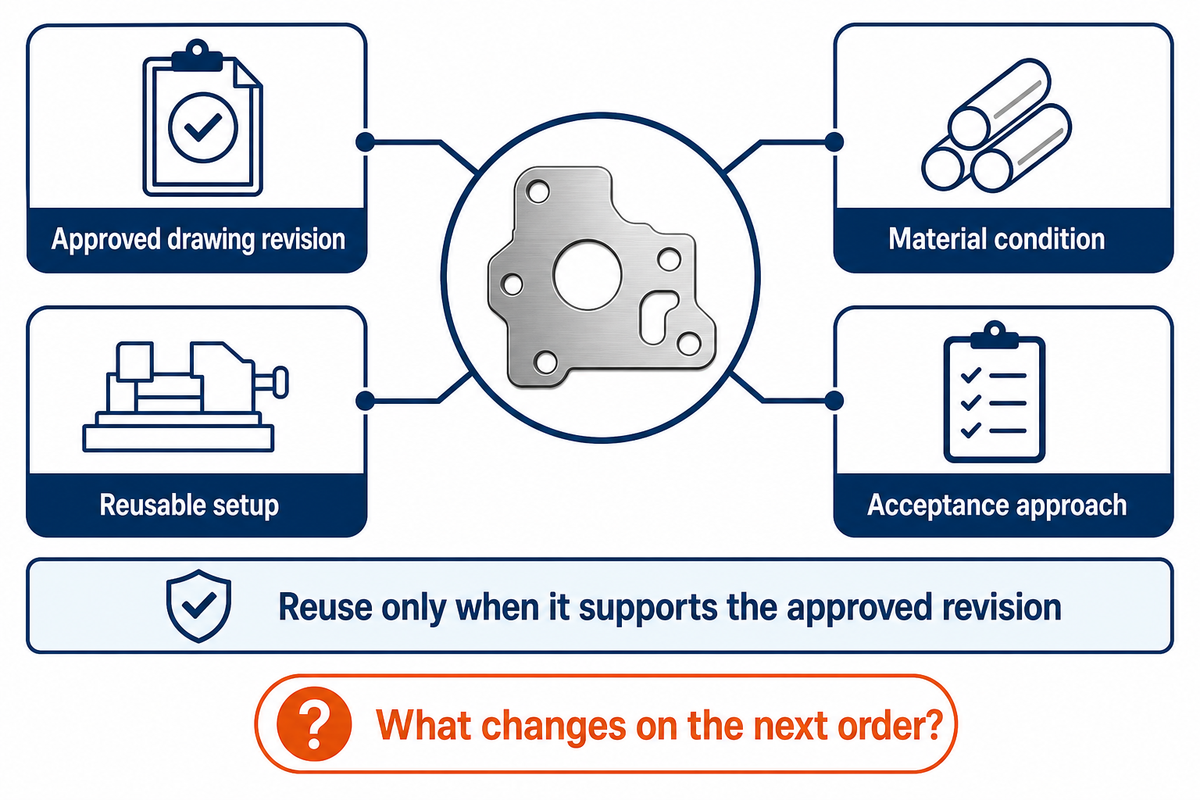
A flexible fixture can make low volume CNC work easier to repeat only when the reused workholding inserts, locating surfaces and setup data support the approved revision. Quick first parts and economical repeat runs don’t remove this responsibility. The same applies to CNC machining for prototyping: a first part may use one preparation and a repeat run may use a different preparation.
Imagine a repeat order for 20 valve body variants. If the same locating approach serves the family, reusable workholding may reduce repeated preparation. If every revision changes clamping surfaces, the claim for reusability needs to be reevaluated. The supplier should explain this in the repeat quote. The documented setup is the evidence for reusability, not the presence of a machine robot.
For buyers selecting a low volume CNC machining service, this information frames the next discussion: what preparation is retained, what triggers a change to new work, and what operations remain outside the cell? The challenges in low-volume supply often sit between operations, especially when a small order shares capacity with a large order.
Carry forward the approved process, not just the part number. Keep the drawing revision, material condition, reusable setup and acceptance approach connected to the repeat order.
When you have a defined part and quantity, Zhenling Metal’s Low-Volume CNC Machining service is the next step for discussing the manufacturing route. Bring the CAD model, drawing, quantity and required delivery condition so the conversation can focus on your component.
Low-Volume CNC Machining FAQ
How Long Does It Take to Complete a Low Volume CNC Job? The delivery schedule includes material, preparation, cutting, finishing, inspection and dispatch.
A short cutting cycle doesn’t establish a short delivery date. Ask whether the quotation starts after drawing approval and whether it includes outside processing and shipment. For repeat batches, identify which programs, fixtures and inspection methods can actually be reused before relying on the earlier schedule. Request a shipment-ready date tied to the agreed drawing revision and material condition.
What Are the Best Materials for Low Volume CNC Machining? Choose the grade and condition that meet the part’s functional requirements.
Aluminum may suit lightweight housings, while stainless steel may suit corrosion-related requirements. Engineering plastics serve different mechanical and environmental needs. Compare the exact grade, temper or heat treatment, stock availability and finish. A cheaper prototype material doesn’t establish how the final material will perform. If the material changes, review the relevant functional tests and manufacturing route.
Is low-volume CNC machining cheaper than injection molding? Machining can cost less for a limited run when dedicated mold costs outweigh its per-part savings.
Compare equivalent plastic materials, geometry, surface requirements and total expected demand. Include mold changes, machining setup, inspection and secondary operations in both quotations. If demand becomes predictable and the design stabilizes, molding may justify its upfront tooling expense. The useful comparison is the total cost of the same finished requirement, not a generic quantity threshold taken from another part.
What finishing options are available for machined components? Options include deburring, blasting, polishing and material-specific surface treatments.
Anodizing, plating or passivation may be appropriate to a particular material and function. Specify which dimensions and surfaces must comply after the treatment.
Why do some shops ignore my RFQ for low volume parts? A small order may not fit a shop’s equipment, workload or commercial model.
An incomplete request can also make the engineering effort difficult to judge. That doesn’t establish why any particular supplier failed to reply. Improve the request with the current drawing and CAD model, material condition, quantity, delivery requirement and important dimensions or surfaces. Explain whether the order is a prototype, pilot batch or repeat supply. Separate confirmed follow-on quantities from forecasts. Approach machine shops whose stated machining capabilities fit the part size and route, and ask whether your timing matches their available capacity. A clear request helps both sides decide whether further quotation work is worthwhile.
Can the supplier handle both prototypes and repeat production? Some can, but one successful prototype does not prove repeat-batch performance.
Ask how the supplier retains the approved revision, setup and measurement method. Review evidence relevant to the part and discuss how process changes and repeat-order scheduling are handled. NIST explains process capability by comparing an in-control process with specification limits.
References and Method
This guide synthesizes public technical information and educational materials. The cost figures are hypothetical worked examples, not Zhenling Metal quotations. The 3-Stage Commitment Map is an original planning aid. Published source scopes are identified beside the relevant claims; quantities and acceptance decisions must be set for the actual drawing, material and manufacturing route. No private production data is disclosed.
References & Sources
- Application of High-Speed CNC Machining to Prototype Production — National Institute of Standards and Technology
- Cellular manufacturing — U.S. Environmental Protection Agency
- Manufacturing process selection: gear example — The Open University
- ISO 21920-2:2021 public scope — International Organization for Standardization
- Machining teaching material — Massachusetts Institute of Technology
- Y14.5 Dimensioning and Tolerancing — American Society of Mechanical Engineers
- Economic order quantity tutorial — North Carolina State University
- The Keys to Combining High- and Low-Volume Production — Modern Machine Shop
- Acceptance sampling — National Institute of Standards and Technology
- Process capability — National Institute of Standards and Technology
- Metrological traceability policy — National Institute of Standards and Technology
- Workholding innovations preview — AMT — The Association For Manufacturing Technology
Written by CYH. Learn about Zhenling Metal’s machining business.