Get in touch with Zhenling Company


Anodizing Services convert the surface of aluminum into a controlled oxide coating. The question is then what this coating must do: be corrosion resistant, retain a color, be resistant to wear, or support other finishing operations. Different requirements of a coating can result in various finishes.
By CYH · Updated October 2026 · Technical guide based on published standards, association guidance, and research
Anodizing grows an oxide layer from aluminum. Type II commonly serves decorative and protective uses; Type III targets demanding wear applications. Alloy, preparation, coloring and sealing determine whether the finished part meets its intended use.
- Choose the required property before choosing a process label.
- Separate initial color approval from evidence of outdoor color retention.
- Specify the standard and its class system; the word “Class” alone is ambiguous.
- Compare quotations for the same preparation, masking, inspection and acceptance scope.
| Concept | What it tells you | What to record |
|---|---|---|
| Process type | The anodizing route | Specification, edition and type |
| Military Class 1 / Class 2 | Non-dyed / dyed | Color requirement and approved sample |
| Architectural Class I / Class II | A different architectural classification | Architectural standard and coating requirement |
What Anodizing Does to Aluminum
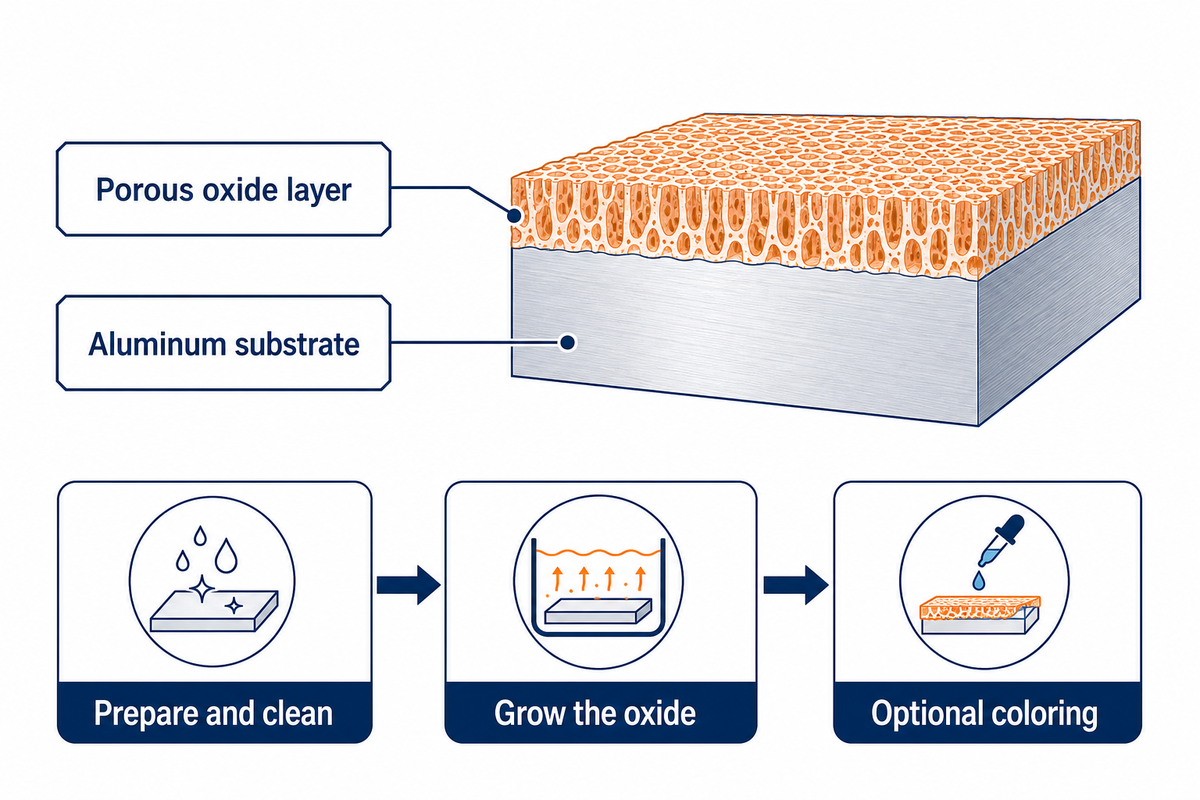
Aluminum anodizing uses an electrolytic process to generate a useful coating from the naturally occurring metal oxide. The layer grows from the substrate instead of arriving as sprayed paint. The porous structure of the coating allows subsequent treatments and may also contribute to the final properties of the finish.
What is anodizing aluminum?
Anodizing aluminum is a controlled electrochemical process that converts the surface of the metal into aluminum oxide. The part becomes the anode in an electrolytic solution. There are steps to prepare and clean the part before the anodizing process. The coating may also be colored depending on the desired finish. Anodizing changes surface behavior without turning the underlying aluminum into a different structural alloy.
The Aluminum Anodizers Council’s process overview explains why sulfuric anodizing is widely used for both decorative and protective work. Its pores can receive dyes, while electrolytic coloring uses another coloring mechanism. Clear anodizing means no added dye in ordinary purchasing language; it doesn’t promise that every aluminum alloy will look identical.
Visible effects of preparation are present in aluminum finishing. Grain and machining lines, and welds can be present in the final finish. Polished and etched parts can have the same named color, but not the same reflection. Decide if you want your surface to be bright, satin, or matte, before treating your color swatch as your completed aesthetic.
For a visible enclosure, approve color and texture together. For a hidden bracket, focus on protection and function during assembly. Readers still choosing the substrate can refer to our CNC material selection guide; a coating can’t compensate for an inadequate base material.
Types of Anodizing and Their Tradeoffs
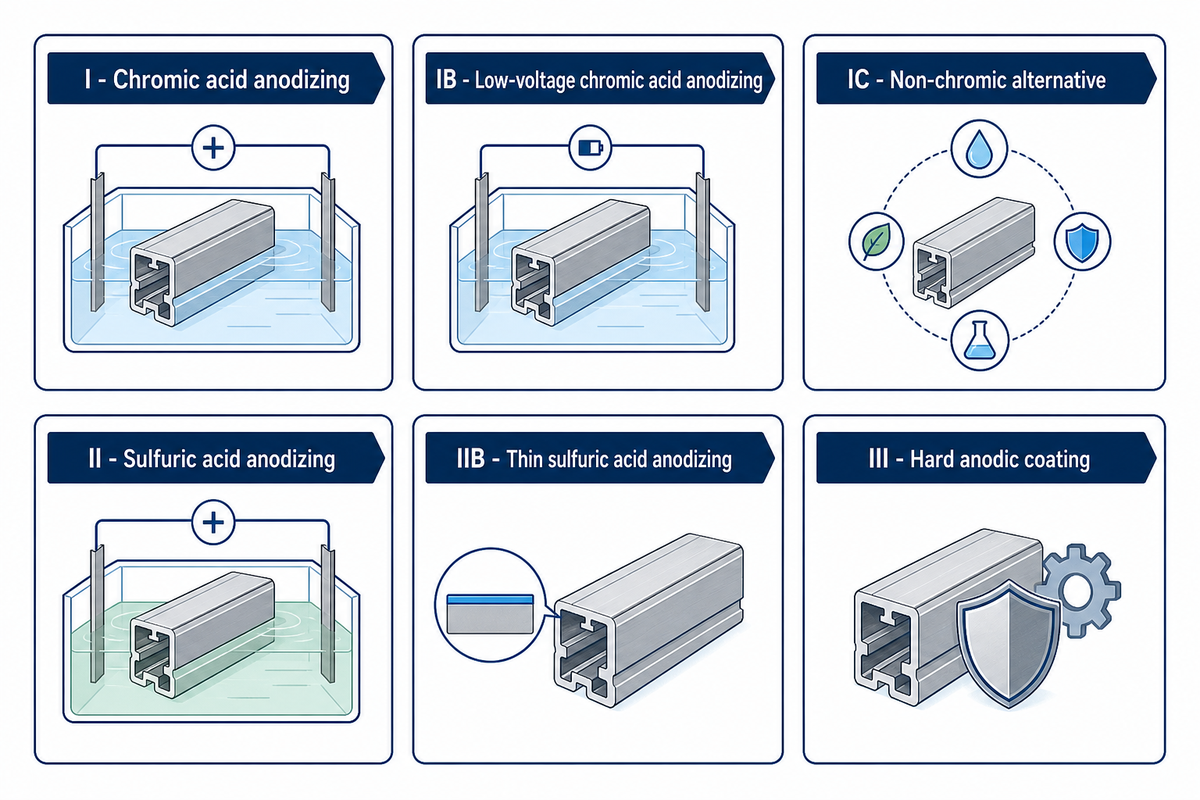
Type II anodizing suits colored aluminum parts; hardcoat anodizing should be considered when wear resistance drives the application. Neither name is a complete specification. Additional properties such as alloy type, color and seal must be indicated.
The current active DLA listing for MIL-PRF-8625 is Revision F, Amendment 2 dated November 23, 2020. A review date or new project number by itself doesn’t mean a specification has been replaced. Its six types include several alternatives beyond the standard Types II and III.
| Type | Process description | Selection point |
|---|---|---|
| I | Chromic acid anodizing | Use the specified route |
| IB | Low-voltage chromic acid anodizing | Not interchangeable merely because both use chromic acid |
| IC | Non-chromic alternative | Check the approval requirements |
| II | Sulfuric acid anodizing | Common decorative/protective route |
| IIB | Thin sulfuric acid anodizing | Alternative route with specification conditions |
| III | Hard anodic coating | Define wear, corrosion and seal priorities |
Under that military specification, Class 1 is non-dyed and Class 2 is dyed. Architectural Class I and Class II mean something different. The AAC specifying guide describes architectural Class I at 0.7 mil or greater, and Class II at 0.4–0.7 mil. These correspond to about 17.8 µm or greater and 10.2–17.8 µm. Do not transcribe an architectural class into a military class without identifying the governing document.
The published military specification, sections 3.7.2.1 and 3.8.2, sets a default Type III nominal thickness of 0.002 inch, or 50.8 µm, unless otherwise specified. It also distinguishes unsealed maximum-wear applications from sealed exterior corrosion applications that permit reduced abrasion resistance. Therefore, for some jobs, more sealing is not an improvement.
Consider function first, and then resolve the drawing. A component described as “black hard anodize” requires the specification of an applicable type, class, seal and acceptance criteria. Requirements for fit and wear need to be specified in the hard anodizing service specification, as opposed to being inferred from a dark surface.
Why Alloy and Surface Preparation Matter
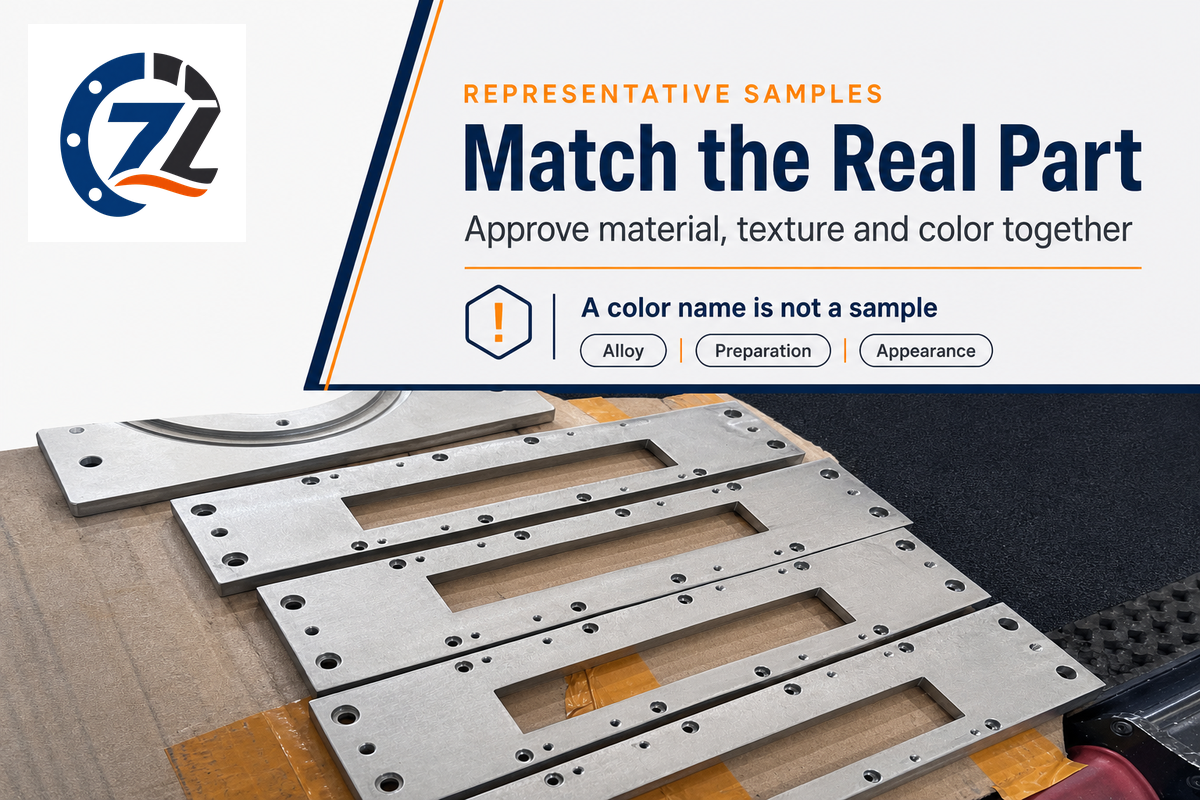
Alloy and preparation differences result in different appearances for anodized aluminum, even if the nominal color remains the same. Anodized aluminum samples made from different alloys or product forms may not represent the final result. Be sure to match samples to the part that will be supplied.
Is 5052 aluminum good for anodizing?
The Aluminum Anodizers Council notes that 5052 can develop a yellowish appearance with thicker coatings. Therefore, a clear-finish sample from another alloy isn’t a good color reference. Assess a representative 5052 part with the proposed preparation and finish prior to approving an assembly in the visible state.
AAC’s alloy and preparation guidance also distinguishes 6061 from 6063 and explains how etching produces a matte surface. While the finishing instructions may be the same, the materials are different. For example, discuss aluminum machining and weld locations and appearance together prior to sending parts to a finishing shop.
Consider an illustrative instrument housing with a 5052 sheet-metal cover and a machined 6061 frame. The designer is requesting a clear finish for both, as they’ll be next to each other. Approving a small 6061 coupon leaves the sheet metal cover untested. A better sample set includes both actual materials, the intended grain direction and the same preparation planned for production. The customer then decides what mismatch is acceptable by inspecting the assembled parts under the agreed-upon lighting conditions. If the mismatch is unacceptable, the team decides on a different approach (i.e. material, texture, or opaque coating) before releasing the batch. Repeating “clear” on the purchase order doesn’t resolve appearance decisions.
Sampling welded assemblies also deserves consideration. Filler and heat-affected regions may respond differently, while polishing or blasting changes the texture presented to the coating process. Compare polishing and bead blasting and approve the resultant anodized surface. A bare metal texture approval is part of the decision, but not the only factor.
In the case of load-bearing structures, alloy choice can impact fatigue life. A 2005 study by Rateick and colleagues reported different fatigue lives in large and small section aluminum-copper materials after anodizing. The public abstract supports checking product-form relevance; it doesn’t justify borrowing fatigue data from a different material.
Color, Sealing and Outdoor Durability
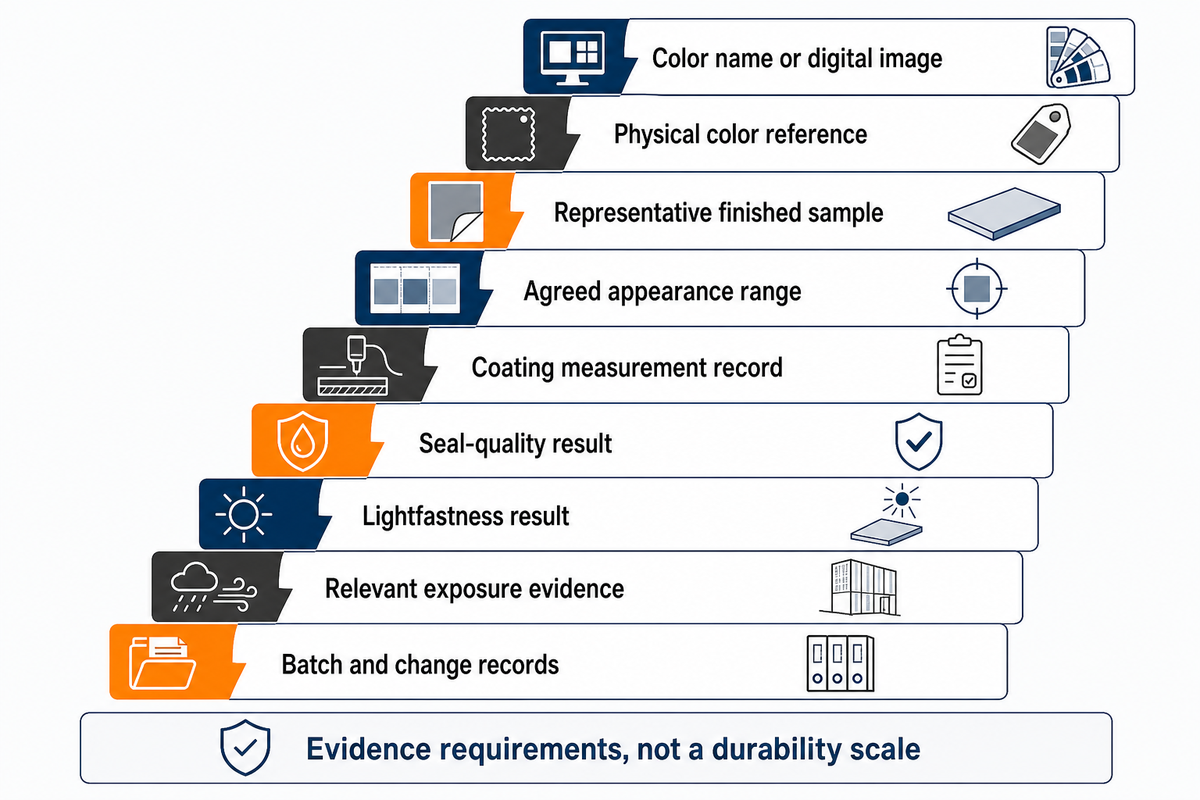
Color approval establishes an initial appearance, but to demonstrate outdoor durability we need to evaluate how that appearance changes over time in service. There are many factors from the selection of dyes to the formation of oxides to sealing and exposure. The supplier may offer a wide variety of colors, but that doesn’t ensure that there’s equal lightfastness of those colors.
In 2016, Larry Chesterfield discussed black-dye lightfastness in a technical answer and mentioned the role of sealing. The difference is relevant: a dye rating describes a test system, and not the guaranteed number of years of outdoor durability for every component.
“The quality of seal is essential to maximize the resistance to conditions of usage.”
A failed seal test also warrants an upstream investigation. In their 2019 study, George N. Oh and Nathan Sheffield mentioned the role of anodizing conditions on the final result, and how adjustments made in the final tank could miss the cause. The useful request is evidence of the finish coating system, rather than a list of chemicals.
Color-to-Service-Life Evidence Ladder
The approach to evaluate what’s actually supported by each record is outlined in this table. Each row represents a different evidence requirement and doesn’t represent a relative scale of durability. Requesting evidence is the responsibility of procurement; the conditions and acceptability limits are the responsibility of the quality and design teams.
| Evidence | Question it answers | What remains to establish |
|---|---|---|
| Color name or digital image | Which family of appearance is intended? | Physical appearance under agreed lighting |
| Physical color reference | What initial shade is acceptable? | Production alloy and texture |
| Representative finished sample | How does the actual material look? | Acceptable production variation |
| Agreed appearance range | Which variations can be accepted? | Inspection method and viewing conditions |
| Coating measurement record | Was the specified coating requirement met? | Seal and exposure performance |
| Seal-quality result | Does the seal meet the specified test? | Color retention under intended exposure |
| Lightfastness result | How did the tested finish respond to light? | Relevance to the actual environment |
| Relevant exposure evidence | How did the finish behave under those conditions? | Maintenance and service-life assumptions |
| Batch and change records | Can later deliveries be connected to the approved process? | Reapproval after a relevant change |
Imagine a procurement team picking black anodized trim for an outdoor sensor. Samples are submitted and arranged on the meeting table. One sample is accompanied by a color code. The other describes the production alloy, finish system, and includes a light exposure test. The second sample provides evidence to support its case, however the team must cross check the test conditions with the environment the sensor will be exposed to (mounting location, weather, etc.) to make a final decision. They agree to an appearance range and request a production sample before giving final approval. The supplier can’t substitute the alloy or dye without the team reviewing the case again. The team relies on evidence to support their case rather than relying on an unsupported promise of a permanent finish.
Limits, Damage and Care of Anodized Parts
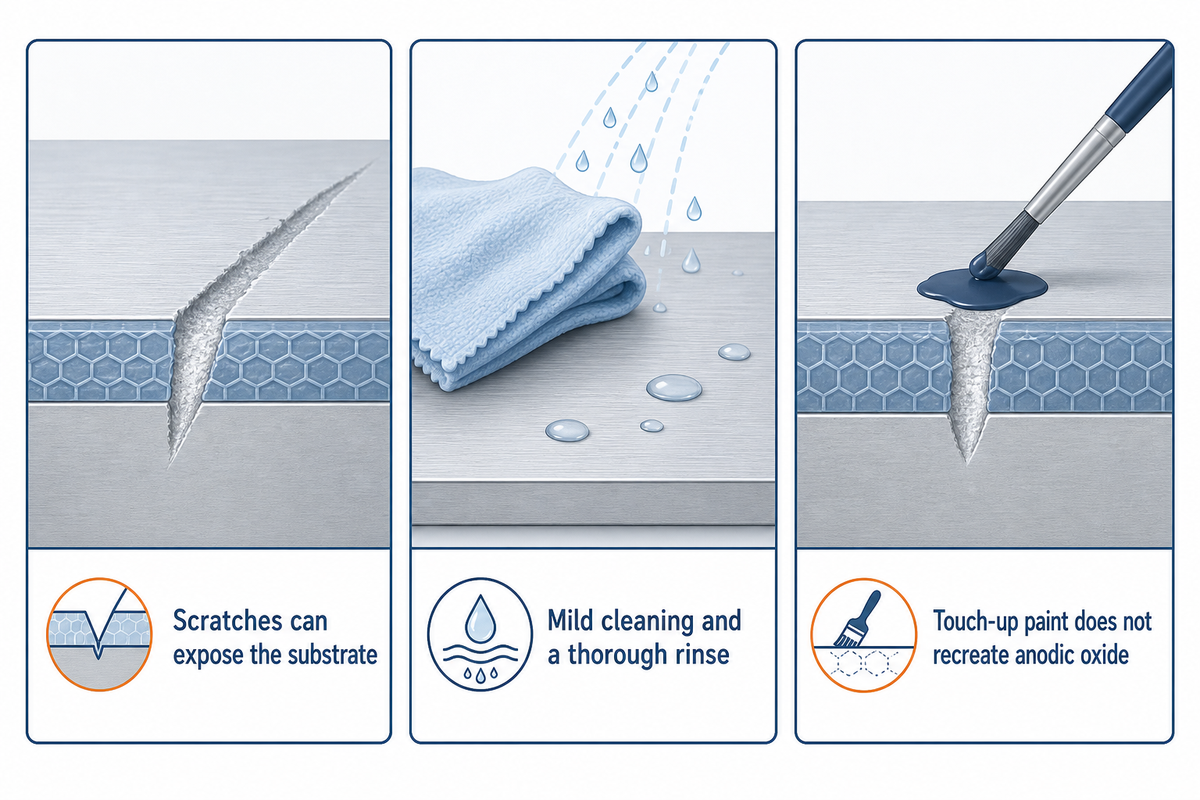
An anodized surface provides an easy way to protect a part from certain types of damage. The anodized layer can still be scratched, etched, or otherwise removed to expose the substrate. Finally, anodizing doesn’t always strengthen the part and doesn’t prove structural performance. Inspection and cleaning should consider the actual environment, including the parts’ mechanical and electrical functions.
In Su and colleagues’ 2023 AA7075-T6 study, a 30 µm hard-anodized layer was examined in rotating-bending fatigue tests at 33.3 Hz. The anodized specimens showed poorer fatigue performance than the untreated baseline under those test conditions. The study also examined micro-shot peening. Its results concern those specimens, treatments, and test conditions, and do not establish a universal fatigue reduction for all anodized aluminum parts.
For fatigue-critical aerospace and automotive components, attention to alloy, product form, geometry and processing is critical. Treating a decorative sample as structural qualification is unacceptable. The drawing should define the critical process requirements.
For routine maintenance, follow the finishing supplier’s guidance: mild cleaning with a soft cloth and a thorough rinse is a reasonable starting point for many anodized surfaces. Avoid scraping, the use of aggressive acids and alkalis. Test the compatibility of a cleaning product on a small, inconspicuous area before widespread use. Industrial cleaning requirements should be evaluated on a case by case basis. An easy-to-clean description doesn’t establish chemical resistance.
Touch-up paint may hide a scratch, but it does not recreate the original anodic oxide or establish equivalent corrosion resistance. Stripping and re-anodizing is an alternative processing option that may impact both dimensions and appearance. Obtain a disposition for damaged precision parts before authorizing rework. Inspect parts in their finished condition.
Anodizing vs Powder Coating and Conversion Coatings
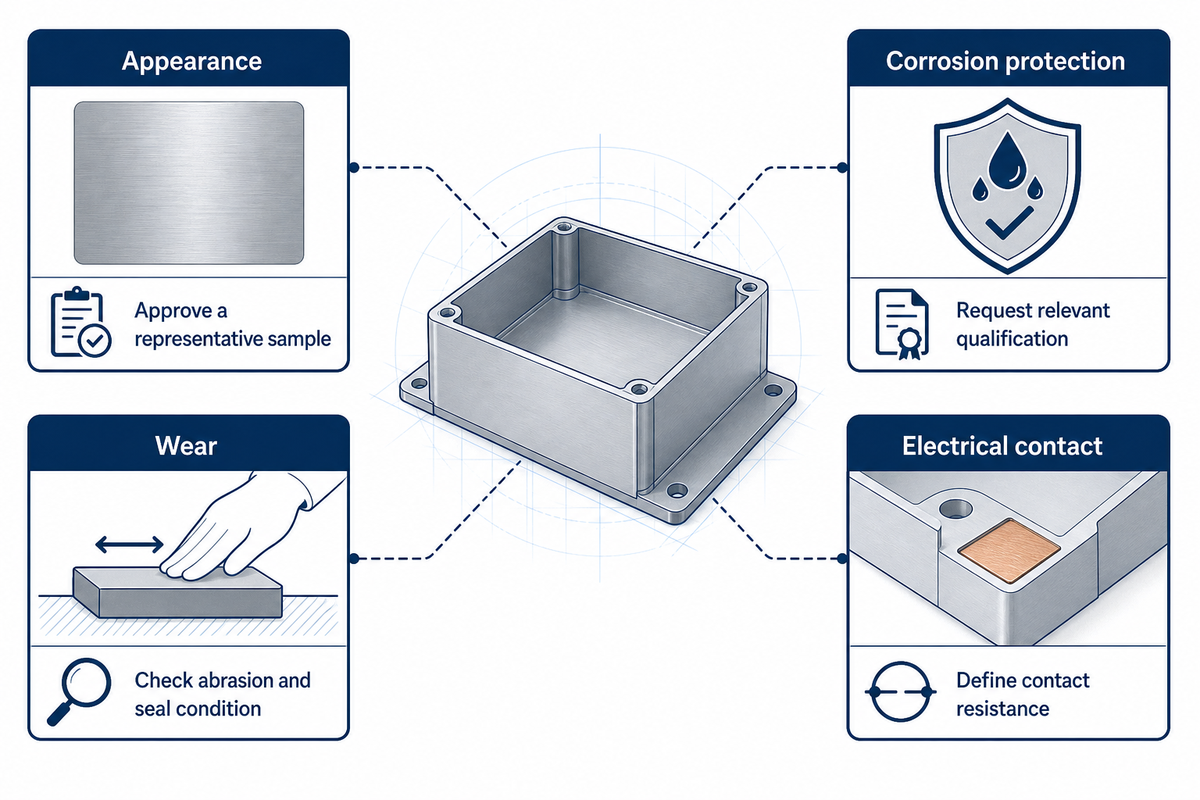
Choose between anodizing, powder coating and conversion coatings based on appearance, corrosion protection, wear and electrical contact. Each process tackles a different balance of these factors. Therefore, a coating that’s ideal for a visible cover may be completely unacceptable for a grounding interface, and a given assembly can require more than one treatment.
4-Property Finish Map
The following map provides a qualitative means of selecting among the various options. It turns the four properties into questions for design, purchasing and inspection. When requirements compete, specify different surfaces or ask the processor to suggest a qualified combination, rather than assuming one treatment will satisfy all requirements.
| Part requirement | Property driving the choice | Route to discuss | Evidence to request |
|---|---|---|---|
| Visible metallic enclosure | Appearance | Decorative anodizing | Actual alloy, texture and color sample |
| Opaque branded cover | Appearance | Powder coating | Approved color, gloss and coating system |
| Outdoor architectural trim | Corrosion and appearance | Architectural anodizing or qualified paint system | Applicable architectural specification and exposure evidence |
| Repeatedly rubbing surface | Wear | Hard anodizing | Relevant abrasion test and seal condition |
| Electrical grounding contact | Electrical contact | Specified conversion coating or controlled contact area | Contact-resistance requirement and test |
| Corrosion-exposed bracket | Corrosion | Sealed anodizing or another qualified protection system | Relevant corrosion qualification |
| Bonded or painted component | Protection and adhesion | Specified pretreatment | Compatibility with the complete coating or adhesive system |
| Mixed-alloy visible assembly | Appearance | Representative anodize samples or opaque coating | Assembly-level appearance approval |
| Insulated electrical housing | Electrical insulation | Qualified insulating coating system | Required dielectric test, including geometry and defects |
In the AAC hardcoat application guideline, testing for abrasion, corrosion and electrical breakdown is considered separately. Hardness isn’t a surrogate for wear. A high-quality coating for one property may not meet the requirements for another property.
MIL-DTL-5002F, section 3.7.2.3.2, identifies MIL-DTL-5541 Class 3 conversion coatings for low electrical contact resistance. An insulating anodic layer serves a different function from achieving low electrical contact resistance. Anodizing and chromate conversion coatings shouldn’t be interchanged merely because both are described as coatings for aluminum.
This illustrative control enclosure has a front panel and a grounding connection on the back. The designer prefers the look of an anodized metal surface, and the electrical engineer needs a reliable contact path. Not managing that contact path creates an issue. The team marks the contact area on the drawing, defines the electrical acceptance criteria and agrees on its treatment with the processor. The remaining cosmetic surface of the part receives its own appearance criteria. Quality inspects the functions individually to ensure the assembly meets the acceptance criteria, and not to accept the part on appearance. This decision is a surface allocation decision. Choosing a better grade of anodizing wouldn’t address grounding.
Where an opaque color is more useful than visible metal texture, review powder coating options. For a broader comparison of paint systems and prep, see the painting services guide.
What Drives Anodizing Costs and Supplier Choice
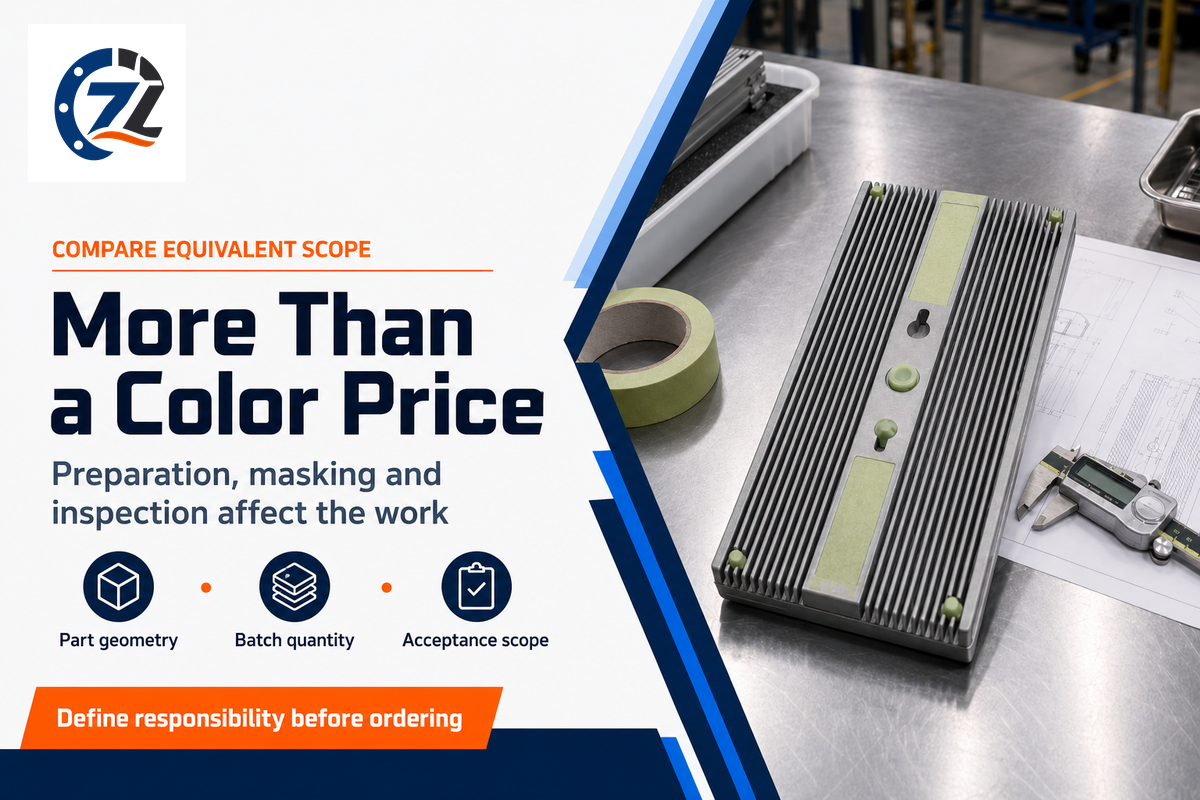
Anodizing cost reflects the metal finishing work needed to produce an accepted part, and includes preparation, handling, masking, coloring and inspection. Quantity affects how batch work is allocated, and geometry affects processing effort. Compare suppliers against the same requirement before reaching a conclusion on the best offer.
Find out whether the quote is for customer-supplied parts, or if the supplier is also doing the machining and finishing. Identify the contact surfaces and areas that require masking. Different colors may require special matching. Ask about the records and inspection that are required. A tight turn-around time is of little value if approval, inspection or sample testing time isn’t included. The CNC machining cost guide can be used for estimating costs for the manufacturing portion.
The QUALANOD monitoring program provides an example of a defined qualification system: its licensees receive 2–5 product inspections per year, with plant inspections every 2 years. The scope of this program should not be confused with a general quality claim. No QUALANOD qualification for Zhenling is claimed here.
Likewise, the scope, facility and validity of an ISO certificate or Nadcap claim should be verified when assessing a supplier. Great customer service helps clarify an order; it is not test evidence. To identify who performs the work and who resolves nonconformities, you should ask suppliers who specialize in the required process. Agree how alloy or manufacturing changes will affect the need for sample review, in line with the AAC guideline’s initial approval recommendations.
Once finish requirements are understood, contact Zhenling’s ‘Anodizing Services’ page to discuss scope of work. It states they provide or coordinate finishing, and should be contacted to finalize processing arrangements for your order. This guide explains the selection context and the service page addresses the commercial requirement.
Industry Outlook: Ask About the Process, Not the Promise
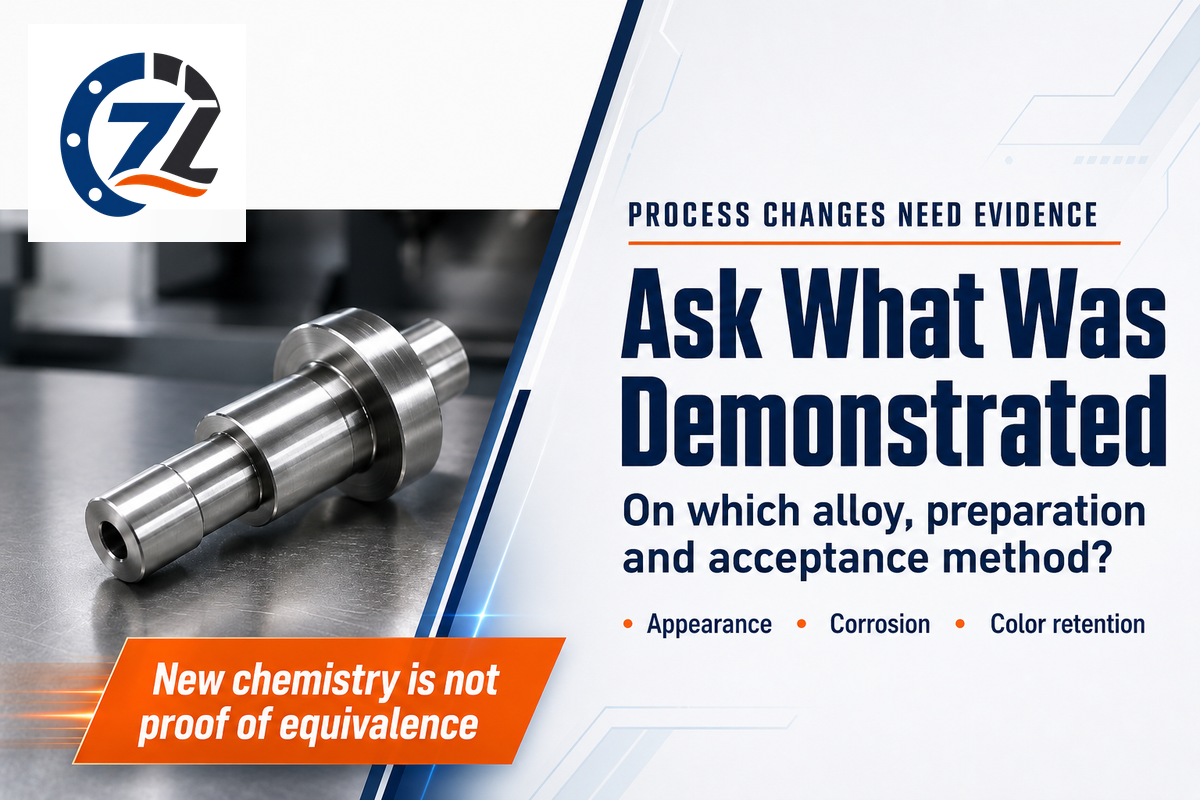
Different sealing chemistries and aluminum feedstocks mean process specific evidence is important to the buyer. A newer finish should be assessed against the same appearance and performance requirements as the finish it replaces. Claims related to the environment or efficiency should be defined to be useful in a purchase decision.
A Products Finishing article published October 15, 2025 by MacDermid Enthone’s Dr. Can Akyil and Dr. Pinar Afsin discusses nickel-free sealing, hybrid treatments and challenges of recycled aluminum. The authors work for a chemical supplier, so their discussion is useful technical context with a commercial interest. Their article doesn’t support that all nickel-free seals are equivalent or that Zhenling uses a particular chemistry.
For a proposed chemistry change, ask what property has been demonstrated, on which alloy, with what preparation and acceptance method. A demonstrated saving in energy doesn’t prove corrosion performance. Achieving corrosion performance doesn’t guarantee color retention. Keep the comparison with the complete production process, relating to the surfaces and inspections of interest to the production function.
Architectural specifications also continue to change. FGIA’s catalog now lists AAMA 611-26 for anodized architectural aluminum. This identifies the current cataloged edition; the public listing does not provide a complete overview of changes. If an architectural specification references an older edition, determine the applicable edition with the specifier and adjust the purchase order accordingly.
For a 2026 project, make changes traceable: identify the approved material and finish route, record the relevant test basis, and agree when a replacement chemistry or feedstock needs new samples. Traceability allows a purchasing team to evaluate an actual improvement. A forecast of growth in the marketplace doesn’t provide assurance that a given component will maintain its color, or provide protection as required by the specification.
Selection takeaway
Define the surface function, approve a representative finish, and request evidence for the property that matters. Added durability is useful only when it matches the application.
Frequently Asked Questions
What are the downsides of anodized aluminum?
Anodized aluminum still has limits in electrical contact, appearance matching, chemical resistance and repair.
The oxide can interfere with grounding contacts, while the substrate and preparation remain visible through many finishes. Scratches may expose metal, and touch-up paint doesn’t reproduce the original coating. Harsh cleaning products can damage the surface. For structural parts, surface hardness also says little about fatigue performance. Specify the relevant operating conditions and acceptance tests instead of treating anodizing as a general strengthening treatment.
How much does it cost to get something anodised?
A useful price requires a defined part, quantity and finish scope.
Batch preparation, handling, masking and inspection can matter as much as the visible color. Ask for quotations that include the same operations and identify any minimum charge. If one offer includes machining or sample approval and another covers finishing alone, the totals aren’t comparable. Send the drawing and acceptance requirements together so the processor can identify work that a photograph would miss.
Can I anodize my own aluminum?
Anodizing is possible outside an industrial plant, but repeatable specification work requires controlled processing and verification.
The task involves chemical handling, electrical equipment, bath control and management of spent solutions. Producing a colored sample is only one outcome; delivering consistent coating properties across a batch is another. For parts with specified appearance, corrosion, wear or electrical requirements, use a processor able to document the required results. This guide explains selection and acceptance rather than providing a home-processing recipe.
Which metal is used in the anodizing process?
This guide addresses aluminum and aluminum alloys.
Other metals, including titanium and magnesium, can receive anodic treatments, but their processes and resulting properties differ. Don’t transfer an aluminum specification directly to another metal.
Where can I find a suitable contract anodizing service?
Start with the required process and approval scope, then compare suitable facilities by location and logistics.
A dedicated metal finisher may accept customer-supplied components, while a machining company may coordinate finishing as part of a manufacturing order. Establish which arrangement is being offered and identify the facility responsible for processing. Request representative samples and the records required by your application. Local access can simplify transport or a color review, but distance alone doesn’t prove capability. For controlled work, the customer’s approved-processor list may narrow the choices before price is discussed. Keep responsibility for changes and rejected parts explicit. Clear communication and quality service matter most when they support a defined acceptance process. You can review Zhenling’s company background alongside its stated service scope before discussing an order.
Related Guides
- CNC machining design for manufacturability: address geometry before surface finishing.
- CNC milling service guide: understand upstream machining choices.
References & Sources
- Aluminum Anodizers Council: Current Anodizing Processes.
- Aluminum Anodizers Council: Specifying Anodized Aluminum.
- DLA: MIL-PRF-8625 document status; government specification text, Revision F Amendment 2.
- AAC: Hard Anodic Oxide Application Guideline. Guidance contains historical standard references.
- Rateick et al.: Microstructure and fatigue strength loss, 2005; public abstract.
- Su et al.: AA7075 hard anodizing and micro-shot-peening research, Materials, 2023.
- Chesterfield: Black-dyed parts and lightfastness, 2016.
- Oh and Sheffield: It’s Not Always the Seal Tank, 2019.
- MIL-DTL-5002F, 2022, section 3.7.2.3.2.
- QUALANOD: Performance Monitoring.
- Akyil and Afsin: Surface Treatment Breakthroughs for Recycled, New Aluminum Alloys, 2025.
- FGIA: AAMA 611-26 catalog listing.