
Get in touch with Zhenling Company

Updated August 2026
A CNC Material Selection Guide is a working method for selecting materials: it turns material requirements into screening, comparison, evidence, and approval instead of claiming one right material for CNC machining. It should show which candidates fail the part’s non-negotiable requirements, how to compare the survivors, what evidence remains missing, and who has authority to approve the final grade or a substitute.
CNC material selection starts with hard constraints, not a favorite alloy. Screen out candidates that fail function, environment, geometry, evidence, or manufacturing requirements; then rank the survivors against the project owner’s weighted priorities and test whether the ranking changes when assumptions move.
Decision brief
- Reject any candidate that misses a non-negotiable service or compliance condition.
- Compare only fully identified grades, forms, tempers, heat-treated conditions, and permitted substitutes.
- Keep unknowns visible; assign each one to engineering, procurement, quality, the supplier, or the design authority.
- Treat a technically attractive substitute as a proposal until the controlling drawing, specification, contract, and quality process permit it.
7 filtersfrom service need to approval
4 ownersengineering, procurement, quality, commercial
3 assetsscreen, cost delta ledger, approval record
The Fast Answer: Screen First, Then Rank Survivors
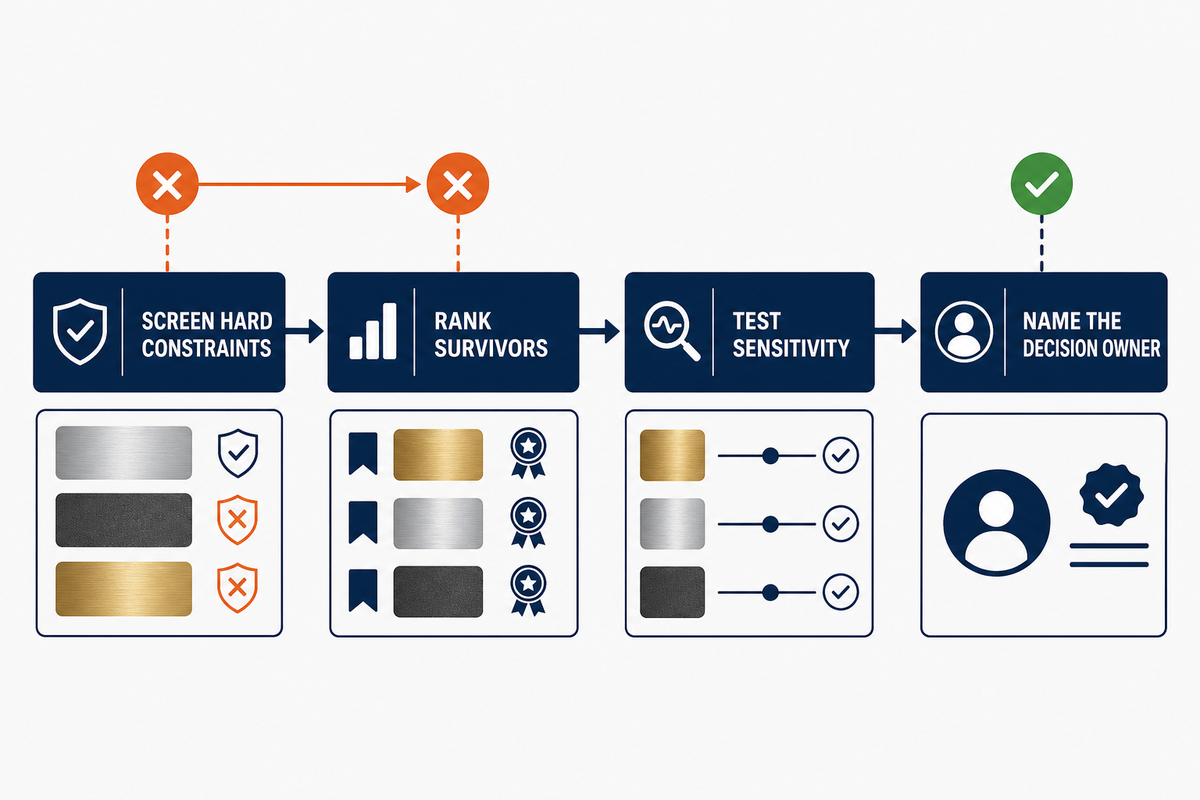
Material screening removes options that fail hard constraints; ranking resolves trade-offs among the candidates that remain. One 2026 peer-reviewed review describes the sequence as criteria definition, screening, comparison and ranking, and final selection. That distinction matters whenever cost, performance, manufacturing, availability, or environmental criteria point in different directions.
A defensible CNC material comparison therefore has two stages: reject non-starters, then expose how the priorities rank the survivors.
Every veto is non-compensatory. If the part must resist a named chemical at a stated temperature, a low price can’t cancel failed compatibility. Ranking begins only after those vetoes. Assign weights to the remaining criteria, document who chose them, and repeat the comparison with changed weights. If the winner flips easily, the decision is sensitive and shouldn’t be presented as settled.
This screen-then-rank sequence avoids two common errors: choosing the strongest material without checking the service, and choosing the easiest material to machine without checking finished-part function. The 2026 material-selection review also warns that ranking can change with weights, normalization, constraints, and the set of alternatives.
Start with Failure: Load, Temperature, and Environment
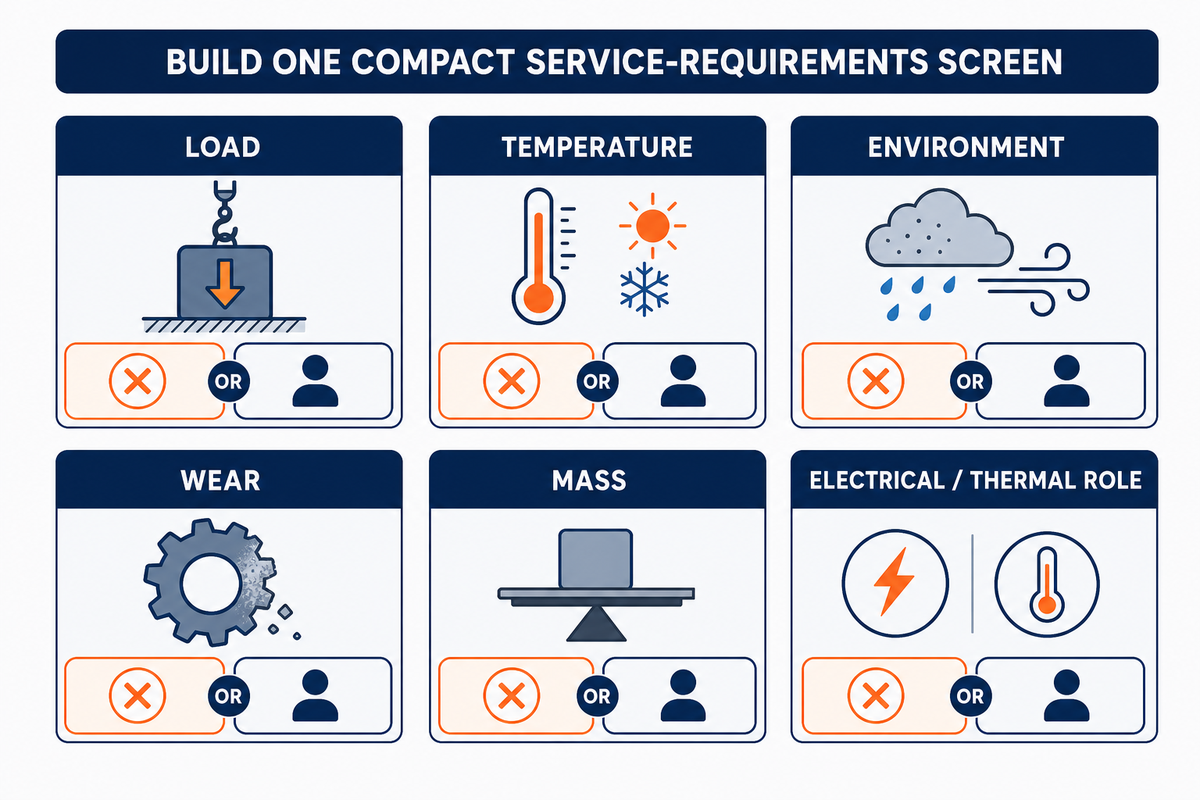
Service failure defines the first material filter. Write the load type, temperature range, chemical or corrosion exposure, wear mechanism, moisture state, electrical role, mass limit, and failure consequence before opening a material database. Each requirement needs a testable boundary, an evidence source, and an owner for any missing value.
What material properties should be defined first?
Define the property linked to the likely failure mode, not the most impressive number on a data sheet. Yield or fatigue behavior may govern a loaded bracket; creep can govern a polymer seal under sustained force; moisture and thermal expansion can govern a plastic locating feature; corrosion or chemical compatibility can govern a wetted component.
A requirement sheet can make units explicit with illustrative inputs such as a 2.0 mm minimum wall, 12 mm bore, 80 °C continuous service, 24 h cleaning exposure, 0.03 mm flatness across 100 mm, 0.8 µm Ra, and a 500 g mass ceiling. Depending on the duty, the same sheet might need a −20 °C minimum, 100 °C peak, 5 bar pressure, 50% relative humidity, 1200 rpm shaft speed, 20 Hz cycling, 15 kg load, 2 min dwell, 3 sec impact interval, 60 sec sampling window, 10 days test exposure, 2 years service, 50 µm coating, 30 mm thread length, 25 cm assembly envelope, or 2 kW heat input. Those figures are examples of controlled fields, not recommendations for another part; the design owner supplies the real limits.
| Question | Required input | Reject when | Limitation / owner |
|---|---|---|---|
| Load | Static, cyclic, impact, contact, or sustained | The candidate misses the drawing’s design basis | Design owner sets the basis |
| Temperature | Minimum, maximum, duration, and cycling | Property evidence does not cover the service state | Short excursions and continuous duty differ |
| Environment | Fluid, concentration, humidity, UV, or galvanic couple | Compatibility evidence is missing or adverse | Site chemistry belongs to the buyer |
| Wear | Sliding, abrasive, impact, fretting, or adhesive | The material or finish route lacks relevant evidence | Hardness alone does not define wear life |
| Mass | Finished-part budget and stiffness target | The assembly exceeds its mass or deflection limit | Compare specific performance, not density alone |
| Electrical / thermal role | Insulation, conductivity, heat spreading, or isolation | The property direction conflicts with function | Interfaces can dominate bulk behavior |
Safety-sensitive materials need a separate route. For example, copper-beryllium machining belongs under qualified occupational controls rather than generic copper-alloy advice. The OSHA beryllium guide addresses containment, ventilation, and contaminated metalworking fluid; it doesn’t prove exposure at any particular shop.
Turn a Material Family into a Purchasing Specification
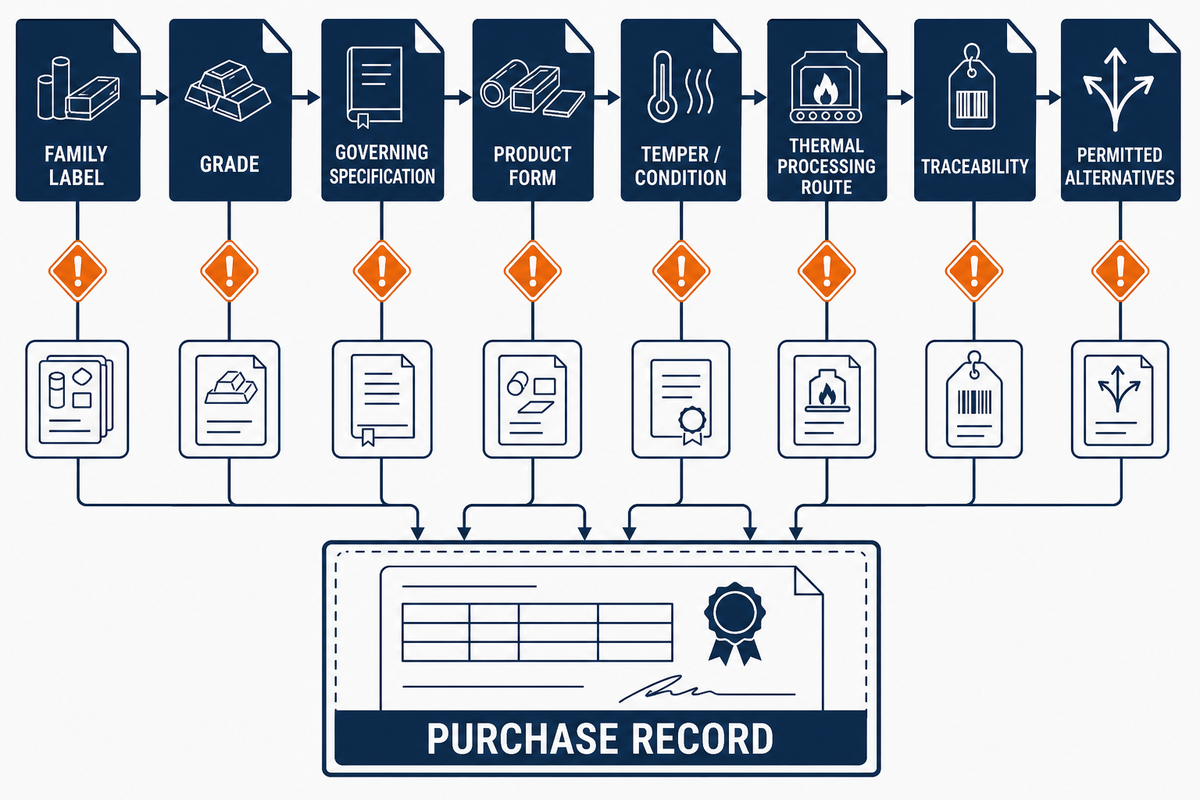
A family label isn’t a controlled purchasing input. “Aluminum,” “stainless steel,” “bronze,” or “plastic” leaves the grade, governing specification, product form, temper or condition, thermal processing route, filler, traceability, and permitted alternatives unresolved. Comparison should wait until every candidate is identified at the same level of detail.
A guide to CNC machining materials or a CNC material list can expose a range of materials for CNC machining, but neither can replace the controlled designation, condition, form, evidence scope, and substitution rule on the purchase record.
Standards also have scope. ASTM A29/A29M-23, for example, is a general-requirements specification for carbon and alloy steel bars that individual bar specifications call on; it is not a complete grade decision by itself. Record the applicable document, edition, form, and condition rather than treating a familiar standard number as a blanket approval.
“A batch of steel … turned out to be unacceptably inhomogeneous.”
That sentence comes from a specific NIST 4340 reference-specimen investigation. Reported grain sizes were 60–70 µm for unacceptable heats and 30–40 µm for acceptable heats in that program. Those values aren’t universal incoming limits for ordinary CNC stock. Its narrower lesson is that grade and nominal thermal processing didn’t remove batch variability, so incoming evidence must match the part’s risk and governing specification.
For an example of how condition and material family change the machining problem, see the tool steel CNC machining guide. The link is educational; the drawing and controlled specification still decide what can be purchased.
Use the Pass-Fail Material Funnel: a 2-Stage Decision Framework
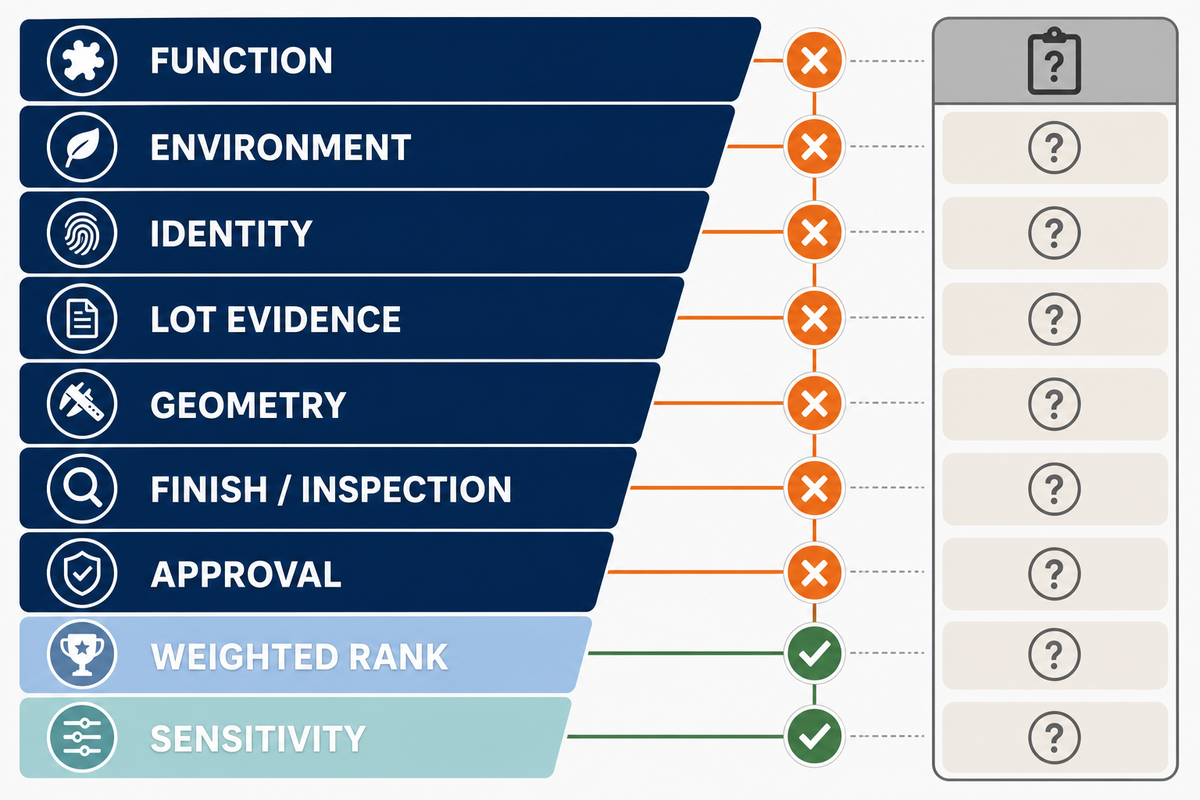
The Pass-Fail Material Funnel is a two-stage decision aid. Stage one applies non-negotiable vetoes and labels missing evidence. Stage two ranks the surviving candidates under the project owner’s stated priorities. Any candidate marked “unknown” remains pending and moves to a named owner for evidence or supplier confirmation.
How should you choose CNC material candidates?
To select the right material for a CNC machining project, use the first seven rows to screen each candidate, then use rows eight and nine to rank only the survivors. This material selection process lets the owner select the most suitable material while keeping a wrong material out of the ranking; never select a material with an unresolved veto.
| Filter | Pass evidence | If unknown | Limitations / not suitable for |
|---|---|---|---|
| 1. Function | Named load, interface, failure consequence | Engineering defines the design basis | No rank can compensate for an undefined job |
| 2. Environment | Temperature, chemical, moisture, UV, galvanic context | Buyer supplies service data | Generic corrosion labels are insufficient |
| 3. Identity | Grade, form, condition, governing specification | Procurement requests a controlled callout | Family-level comparisons stop here |
| 4. Lot evidence | Certificate, test, or incoming check matched to risk | Quality defines acceptance evidence | A grade name does not prove uniformity |
| 5. Geometry | Feature access, stiffness, stock form, workholding route | Supplier reviews the drawing | Property tables cannot prove manufacturability |
| 6. Finish / inspection | Allowance, datums, measurement state, evidence type | Quality and supplier close the gap | Roughness is not every form of surface integrity |
| 7. Approval | Named design, customer, program, or contract authority | Escalate before substitution | Technical similarity is not approval |
| 8. Weighted rank | Owner-approved criteria and weights | Record missing score inputs | Do not rank failed candidates |
| 9. Sensitivity | Winner remains stable under plausible weight changes | Return to owners for a trade-off decision | An unstable winner is not a final answer |
Consider an outdoor sensor bracket. Aluminum 6061-T6, 304 stainless steel, and POM shouldn’t receive a score until outdoor exposure, stiffness, fastening, mass, finish, and inspection needs are known. If all three survive, engineering may weight stiffness and mass, procurement may weight availability and finished-part cost, and quality may weight lot evidence and measurement stability. The final record should show those weights rather than hiding them behind one “best” label.
After the requirements are written, the public CNC material shortlist filter can help you explore candidates, but it cannot select or approve the material to use. Its output is a prompt for engineering review, not approval of a grade.
Metal vs Plastic CNC Machining: Compare Without a Universal Winner
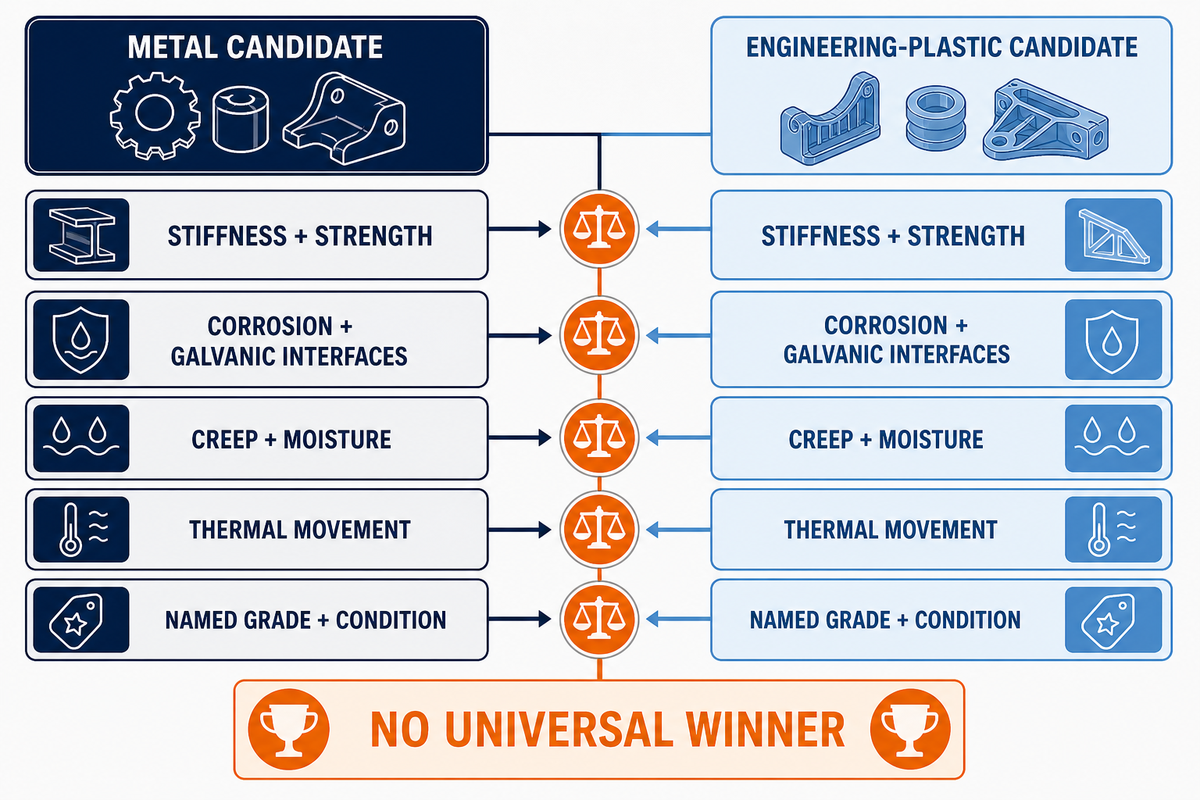
Metal and plastic selection is a trade among stiffness, mass, corrosion behavior, friction, moisture, thermal movement, creep, stock condition, finish, and evidence, not a contest with one permanent winner. Compare named grades and states under the same service conditions, geometry, batch size, and acceptance requirements.
Lists of common CNC materials can expose material options across a range of materials; they cannot select the right grade. Brass, carbon steel, aluminum alloys, and stainless grades are metal materials and common materials used in CNC supply chains, while engineering polymers form a separate family. Choosing the right material still requires a named grade and condition tied to the drawing’s failure modes, evidence, and approval path.
Where should CNC plastic machining start?
Start with the failure mode. POM may be a candidate for low-friction mechanism parts; nylon deserves a moisture-state review; PTFE deserves creep and thermal-movement review; PEEK may enter when temperature or chemical duty justifies its evidence and cost burden. None of those family names decides the filler, grade, stock condition, tolerance, or supplier route.
Metal candidate
- Check stiffness, strength, fatigue, corrosion, and galvanic interfaces.
- Bind alloy, form, temper, thermal processing, and lot documents.
- Plan coating or passivation allowance before machining.
- Review residual stress and work hardening where function makes them relevant.
Engineering-plastic candidate
- Check creep, moisture, temperature, chemical contact, and stress cracking.
- Bind polymer family, grade, filler, stock condition, and conditioning state.
- Plan thermal movement and measurement state around critical fits.
- Review surface damage and clamping sensitivity for the actual geometry.
Compare mechanical properties against the failure mode. Tensile strength alone cannot select the right candidate. A strength-to-weight ratio can matter under a mass constraint, yet the claimed strength-to-weight benefit may disappear if a thicker section, insert, coating, or joining change is required. Corrosion resistance, chemical resistance, and wear resistance also need evidence for the actual environment rather than a family-level adjective.
Under the studied turning and milling conditions, a peer-reviewed PA6G study found that humidity changed the machined surface outcome. It does not provide a universal nylon allowance; it shows why moisture state belongs in the evidence packet. For a material-specific discussion of acetal behavior, consult the POM CNC machining guide.
Let Geometry and Process Veto a Technically Good Material
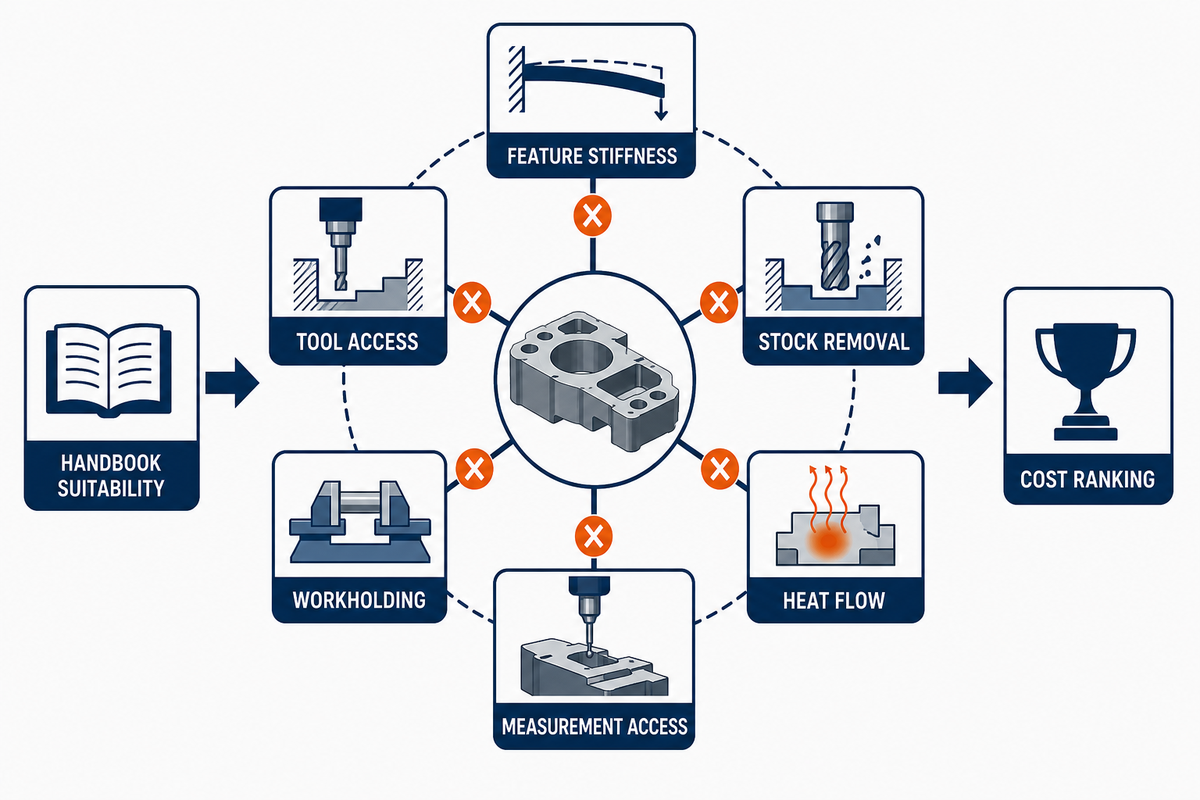
A candidate can meet handbook properties and still be a poor choice for the drawing. Thin walls, deep pockets, small threads, long reach, interrupted cuts, stock form, clamping, residual stress, and inspection access change the machining and measurement problem. Geometry can therefore veto a technically attractive material before cost ranking.
A prototype CNC machining project and an aerospace production part may share geometry but not evidence or substitution authority. Prototype status can change quantity and learning objectives; it does not erase service constraints. To choose the right route for precision CNC work, evaluate material and machining together: the CNC machining process, CNC milling access, finishing, inspection, and the wider manufacturing process. A grade described as easy to machine may still become difficult around thin walls, interrupted cuts, or a demanding finish.
What manufacturing factors drive material selection?
Review feature stiffness, tool access, cut continuity, stock removal, workholding, heat flow, burr or edge sensitivity, post-process movement, and measurement access. Published machinability ratings are relative results under defined conditions. They aren’t cutting speeds, tolerance guarantees, or proof that the same result transfers from turning to milling or drilling.
A peer-reviewed materials-selection study states that free-machining effects differ between operations and that results from one operation aren’t obviously transferable to another. A separate thin-wall experiment used 35–45 kN initial loads on a defined 7075-T6 test geometry and found that the initial stress state strongly affected distortion. Those numbers belong to that experiment; they’re evidence of mechanism, not settings for another part.
Forum discussions reach the same practical question from another angle. A machinist asking for one speeds-and-feeds table was told that tool length, part rigidity, coolant, heat, depth of cut, and feed change the usable range. That’s attributed field language, not a parameter source.
Use the Material-Driven Cost Delta Ledger, Not Stock Price Alone
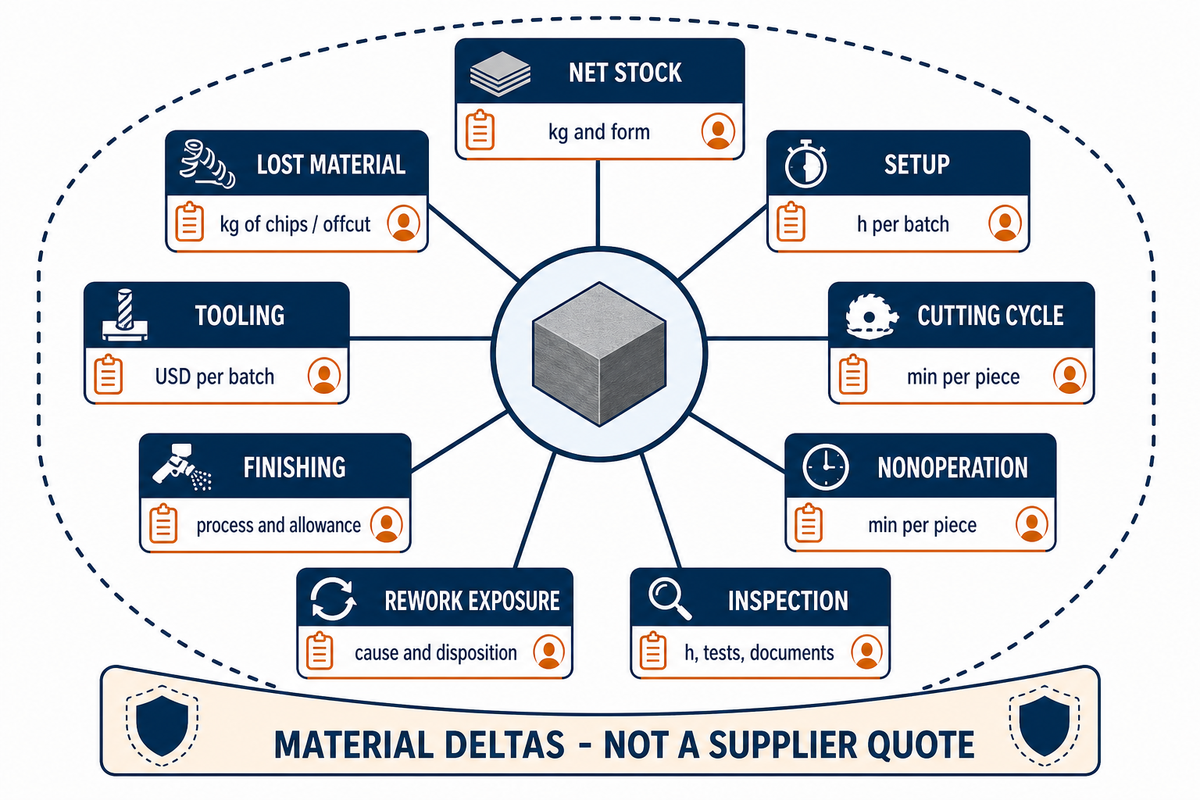
Material selection changes more than the price per kilogram of stock. The Material-Driven Cost Delta Ledger compares only the cost inputs that change when one surviving material replaces another: purchased stock and loss, setup, operation, nonoperation time, labor, tooling, finishing, inspection, and rework exposure. It does not replace a complete accepted-part cost model or a supplier quote.
Material-Driven Cost Delta Ledger
Populate the same rows for every survivor. Leave an unknown blank and assign an owner; never insert an invented multiplier.
| Cost input | Candidate A | Candidate B | Evidence / owner | Limitations |
|---|---|---|---|---|
| 1. Net stock | kg and form | kg and form | Supplier quote | Same delivered condition |
| 2. Lost material | kg of chips / offcut | kg of chips / offcut | Stock-to-part model | Scrap-value offset must be stated |
| 3. Setup | h per batch | h per batch | Process plan | Batch size changes the unit effect |
| 4. Cutting cycle | min per piece | min per piece | Supplier estimate | Same geometry and acceptance basis |
| 5. Nonoperation | min per piece | min per piece | Load, unload, probing, handling | Do not hide it inside cutting time |
| 6. Tooling | USD per batch | USD per batch | Tool plan | Allocate over stated quantity |
| 7. Finishing | Process and allowance | Process and allowance | Finish supplier | Masking and dimensional growth vary |
| 8. Inspection | h, tests, documents | h, tests, documents | Quality plan | Risk-based evidence only |
| 9. Rework exposure | Cause and disposition | Cause and disposition | Engineering + quality | Not a guessed failure rate |
Treat this as a material-delta worksheet. The NIST manufacturing-cost paper doesn’t provide current material prices, a CNC hourly rate, or Zhenling pricing. For accepted-part arithmetic and equal-scope quote comparison, use the full CNC cost and quote reconciliation guide. Ask suppliers to quote the same revision, quantity, finish, inspection, packaging, and material-document scope.
Treat Tolerance, Finish, and Inspection as Selection Inputs
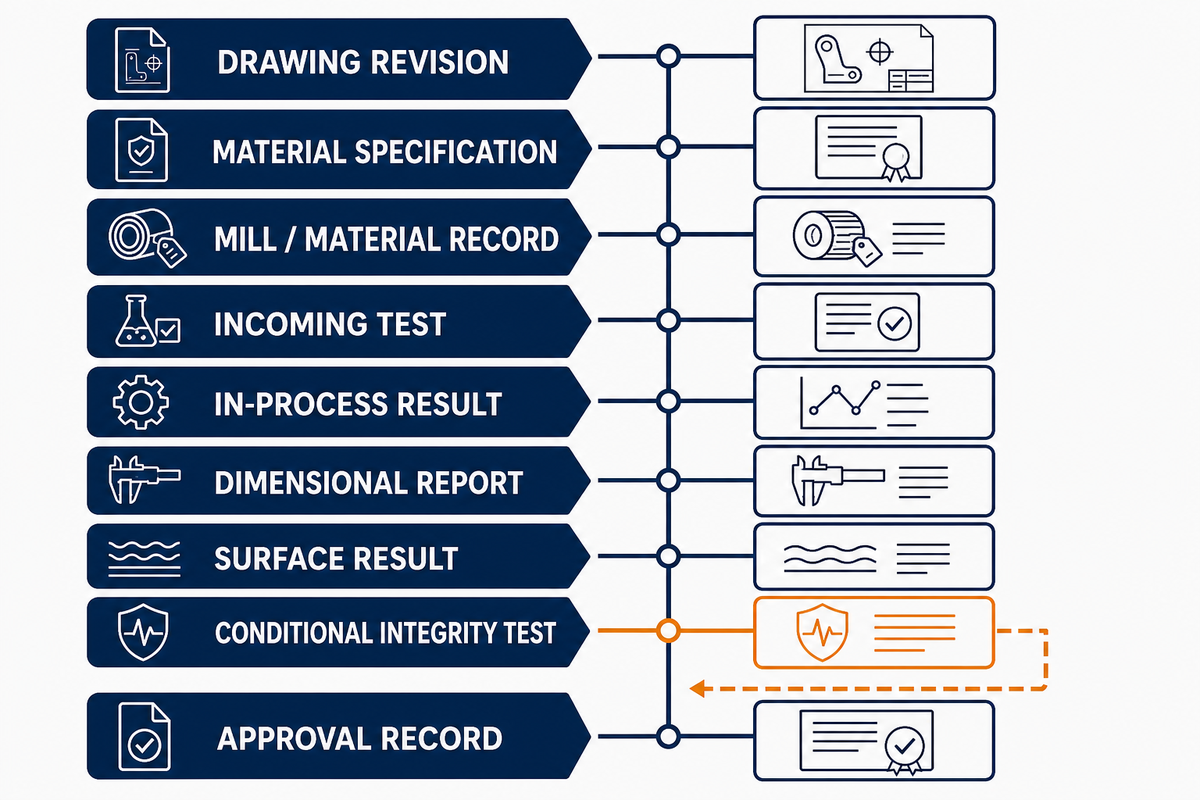
Tolerance belongs to a feature, datum system, material state, process route, temperature, and measurement method. Finish can add or remove material, alter edges, or change a sealing surface. Where fatigue, corrosion, sealing, or wear makes it relevant, surface-integrity requirements may extend beyond dimensions and roughness.
“CNC machine tolerance” is therefore an incomplete purchasing question. Part geometry, setup, stock state, process sequence, finishing, measurement uncertainty, and acceptance rules all sit between machine capability and an accepted feature.
Keep the requirement conditional. Most parts don’t need residual-stress mapping or subsurface testing. For risk-sensitive features, engineering may need to define whether residual stress, work hardening or softening, microstructural alteration, or subsurface damage matters. A peer-reviewed thin-wall study describes interacting stress, force, temperature, and stiffness effects; it doesn’t create a universal inspection plan.
Evidence Type Matrix
| Evidence type | What it controls | Owner | Limitations / not suitable for |
|---|---|---|---|
| 1. Drawing revision | Geometry, dimensions, datums, notes | Design | Does not prove stock identity |
| 2. Material specification | Grade, form, condition, tests | Design + procurement | Scope and edition must match |
| 3. Mill / material record | Supplied heat or lot evidence | Procurement + quality | Does not guarantee every functional property |
| 4. Incoming test | Risk-selected property or identity | Quality | Test method and sampling matter |
| 5. In-process result | Critical feature during manufacture | Supplier quality | Not a final release by itself |
| 6. Dimensional report | Measured features and datums | Supplier + buyer quality | Does not prove material identity |
| 7. Surface result | Defined texture or finish condition | Design + quality | Roughness alone may miss subsurface effects |
| 8. Conditional integrity test | Residual stress, hardness, microstructure, subsurface state | Design authority | Use only when function justifies it |
| 9. Approval record | Final material and any substitution | Named controlling authority | Supplier preference is not approval |
Surface-texture terminology also changes as standards evolve. The official page for ISO 21920-2:2021 identifies withdrawn predecessor documents. Name the standard and edition that control the drawing rather than copying an old roughness notation from a previous job.
Before fixing a finish route, the material and environment screen can help expose questions that still need project evidence.
Build a Material Approval Evidence Record Before the RFQ
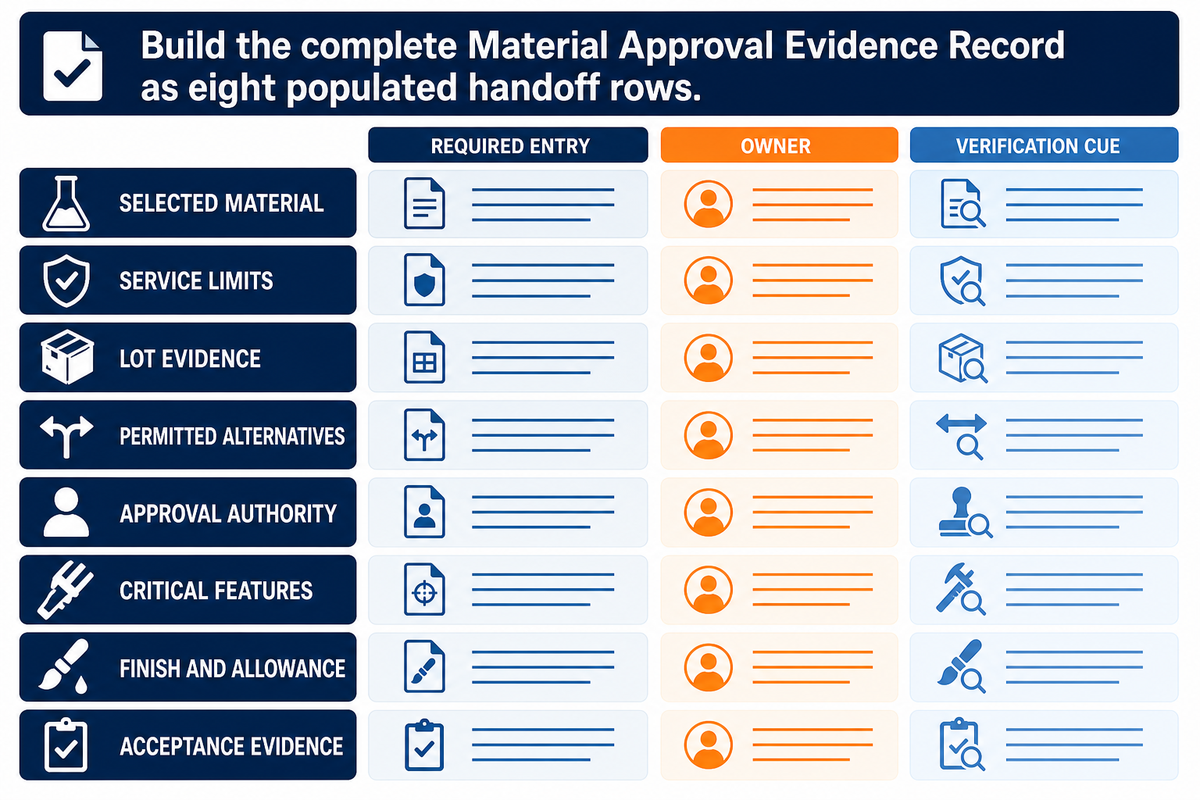
The Material Approval Evidence Record is the controlled handoff from selection to sourcing. It records the chosen grade and condition, heat or lot evidence, surviving alternatives, substitution authority, service constraints, critical features, finish, inspection, conditional surface-integrity requirements, unresolved risks, and the owner of every open item.
Material Approval Evidence Record
Copy these fields into the project record. A technically credible substitution stays pending until the controlling authority approves it.
Material approval evidence record — copy these into the controlled handoff:
| Parameter | Required entry | Why it matters | How to verify |
|---|---|---|---|
| Selected material | Grade, form, temper / condition | Prevents family-name ambiguity | Drawing and material specification |
| Service limits | Load, temperature, environment, duration | Explains the screen | Design basis and application evidence |
| Lot evidence | Certificate, test, sample plan, or none | Keeps batch uncertainty visible | Risk-based quality plan |
| Permitted alternatives | Named candidates or “none” | Stops silent substitution | Controlled approval record |
| Approval authority | Design, customer, contract, or program role | Separates advice from permission | Applicable document and signature |
| Critical features | Dimensions, datums, interfaces, surfaces | Connects material to the drawing | Inspection plan |
| Finish and allowance | Process, masked faces, pre-machining basis | Protects final size and function | Finish specification and supplier route |
| Acceptance evidence | Dimensions, material, surface, conditional integrity | Defines release evidence | Report, certificate, or test record |
NIST’s digital-thread work connects product definition to manufacturing and inspection and emphasizes trustworthy, traceable data ownership. That does not mean every supplier runs a formal digital thread. The practical lesson is smaller: engineering, procurement, quality, and commercial teams should not work from conflicting material assumptions.
Once the record is ready, use Zhenling’s CNC machining materials and grades hub or request drawing-specific review. The hub owns the material catalogue, tools, capability, and quotation path; this article intentionally doesn’t duplicate them.
CNC material suppliers can suggest grades, stock forms, or other materials for CNC machining, but each proposal remains subject to the controlling design, contract, program, or customer approval path recorded in the approval record. Search labels such as popular material, important material, select the right CNC materials, right CNC, choice for CNC, metal for CNC, and guide to CNC are discovery shorthand, not engineering approval.
Traceability Is Emerging, Not Universal: What Changes in 2026
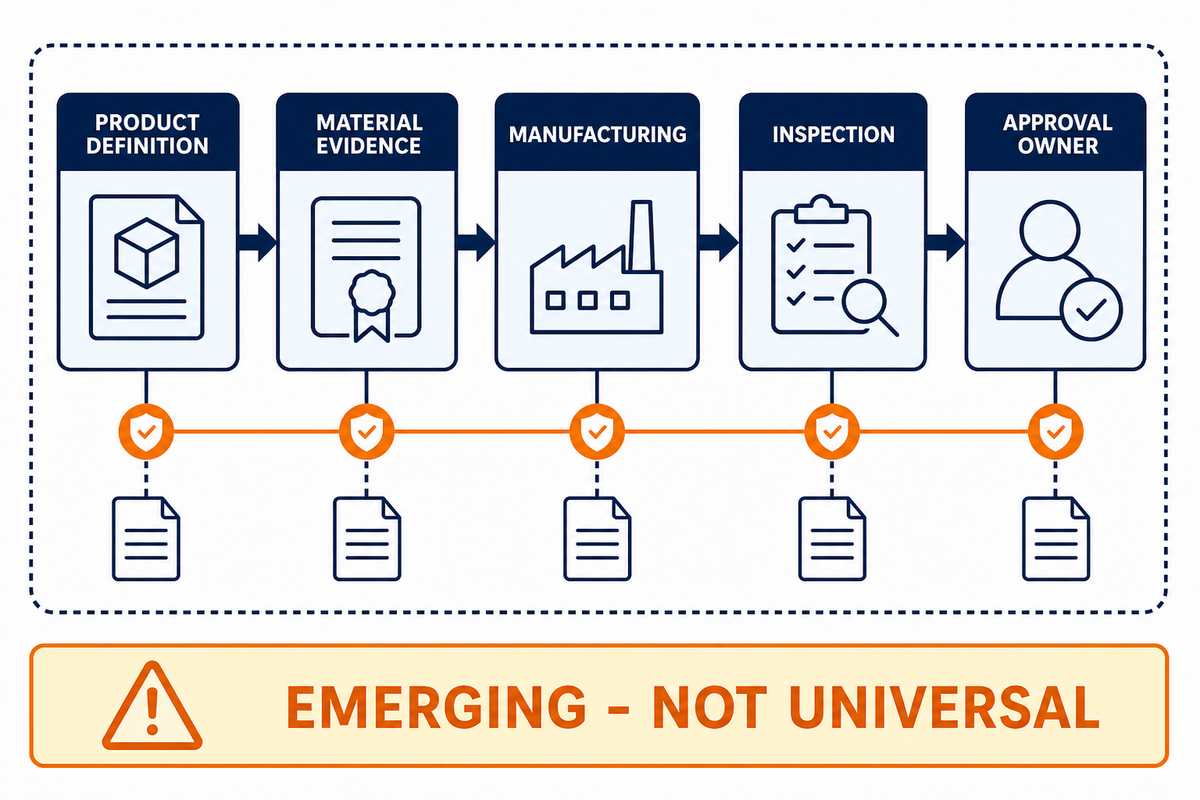
Traceable material data is a direction of travel, not a universal 2026 requirement for every CNC part. Current NIST work supports linking product definitions, material evidence, manufacturing, and inspection. Regulatory rollout remains product- and sector-specific, with different authorities, dates, and transition rules.
Prepared by the Commonwealth Center for Advanced Manufacturing, the 2024 NIST-funded contractor roadmap calls for property testing linked to service conditions and traceability to raw materials. In July 2025, NIST released a second public draft of a manufacturing traceability meta-framework. Draft status matters: these sources describe methods and infrastructure, not a blanket release requirement.
The European Commission likewise describes Digital Product Passports as progressive across selected product groups. Its indicative timeline places the registry framework in July 2026, sector-specific iron and steel work in Q4 2026, and mandatory passports for certain batteries on 18 February 2027; it also states that operators receive at least an 18-month transition after relevant delegated acts. Treat those dates as scope markers, not as a claim that every CNC component needs a passport.
Key takeaway
Screen hard failures, rank the survivors, test ranking sensitivity, and release one controlled record that names the evidence and approval owner for every open material decision.
Frequently Asked Questions
What is the best default material for CNC machined parts?
No material is a safe universal default for every CNC drawing; choosing materials begins with service constraints, measurable evidence, and a named approval owner before ranking.
Define service conditions and critical features first. Reject candidates that fail temperature, environment, load, geometry, regulatory, or document constraints. Rank only the survivors using the project owner’s priorities. Aluminum 6061 may be economical for one duty yet unsuitable for another that demands different stiffness, wear, electrical, or corrosion behavior. Record evidence gaps and the owner of each decision.
When should I use stainless steel instead of aluminum?
Stainless steel becomes a stronger candidate when corrosion, wear, stiffness, or temperature advantages justify added mass and machining burden; different materials still require grade-specific comparison.
Corrosion exposure, wear, stiffness, temperature, or a controlling material specification may outweigh aluminum’s mass and machining advantages. Compare named grades and conditions: 303, 304, 316, and precipitation-hardening stainless steels do not behave as one material. Also check joining, finish, lot evidence, inspection access, tool strategy, lead time, and permitted substitutes. For assemblies, include fastener compatibility and the actual cleaning environment. If several grades remain, request quotes against the same controlled drawing and document package so differences in finished-part cost are comparable and supplier assumptions stay visible.
What is the best engineering plastic for CNC machining?
Before you choose a material, start from the failure mode rather than family reputation; the material you choose must match moisture, creep, thermal, chemical, and dimensional requirements.
POM may suit low-friction mechanism parts; PEEK can enter higher-temperature or chemical duties; nylon needs a moisture-state review; PTFE needs creep and thermal-movement review. Grade, filler, stock condition, geometry, tolerance, surface requirements, service evidence, inspection method, and supplier capability decide whether any candidate is suitable. Confirm the actual designation instead of approving a family name alone.
How does material choice affect CNC machining cost?
Material affects the entire finished-part cost delta ledger, not only stock price; ease of machining may reduce one input, while geometry can make a candidate difficult to machine and inspect.
Each candidate changes purchased stock, chips and offcuts, setup, cutting time, handling, tool consumption, finishing, inspection, and rework exposure. Compare candidates with the same drawing revision, quantity, finish, critical dimensions, packaging, and document requirements. Ask suppliers to identify assumption changes, such as stock form or inspection method, that prevent a direct comparison. Keep uncertain inputs open for confirmation instead of inserting guessed multipliers.
Can a CNC supplier choose the material from my drawing?
A supplier can propose candidates, but selecting the appropriate material and approving any substitution remain with the controlling design, contract, program, or customer authority named on record.
Send the controlled drawing and service requirements. Similar properties do not override the specification, contract, program rules, or quality process; record each approved substitution.
How this guide was built
The evidence review uses public first-party pages, current search evidence, government sources, official standards pages, peer-reviewed research, and an automated source-scope review run through Firecrawl Agent. No private customer data, Zhenling tolerance history, certification file, material-specific project outcome, or proprietary process was supplied. Company capabilities and document options must be confirmed against the current drawing, quotation, and applicable certification scope.
Have a short list, but not a final grade?
For CNC projects, bring the service conditions, controlled drawing, critical features, finish, inspection needs, and permitted substitutes. Zhenling can review the machining route and identify the questions that still need design-owner approval before any final grade or substitution is recorded.
References & Sources
- 2026 Review of Material-Selection Decision Support: International Journal of Precision Engineering and Manufacturing-Green Technology
- Materials Design Toolkit: National Institute of Standards and Technology
- ASTM A29/A29M-23 Catalogue Scope: ASTM International
- Assessing the Quality of As-Received 4340 Steel: National Institute of Standards and Technology
- Machinability Data Applied to Materials Selection: Materials & Design
- Thin-Wall Milling: Thermal and Mechanical Interactions: Peer-reviewed full text
- Effects of Humidity on Cast PA6G During Machining: Advances in Materials Science and Engineering
- Manufacturing Cost Estimation Framework: National Institute of Standards and Technology
- ISO 21920-2:2021 Surface Texture Terms: International Organization for Standardization
- Beryllium in General Industry: Small Entity Guide: Occupational Safety and Health Administration
- Digital Thread for Manufacturing: National Institute of Standards and Technology
- 2024 Digital Thread Supply-Chain Roadmap: Commonwealth Center for Advanced Manufacturing, funded by the National Institute of Standards and Technology
- Digital Product Passport Scope and Timeline: European Commission